Connect with us

Finance

PODCAST | Adapting to change: The future of factoring and supply chain finance

Published

on

PODCAST | Adapting to change: The future of factoring and supply chain finance

Estimated reading time: 5 minutes

Listen to this podcast on Spotify, Apple Podcasts, Podbean, Podtail, ListenNotes, TuneIn

The volatility of the geopolitical and macroeconomic environment in recent years has caused some problems in the trade, treasury, and payments industries. 

However, industry actors have adapted and are working together to build resilience and make international trade even stronger.

Advertisement

To hear about developments in the factoring and supply chain finance world, Trade Finance Global (TFG) spoke with Çağatay Baydar, Chairman at FCI and Irina Tyan, Principal Banker, TFP at the European Bank for Reconstruction and Development (EBRD).

Challenges and growth in the factoring industry

The factoring industry has demonstrated impressive growth since the turn of the century despite facing significant challenges, particularly in emerging markets. 

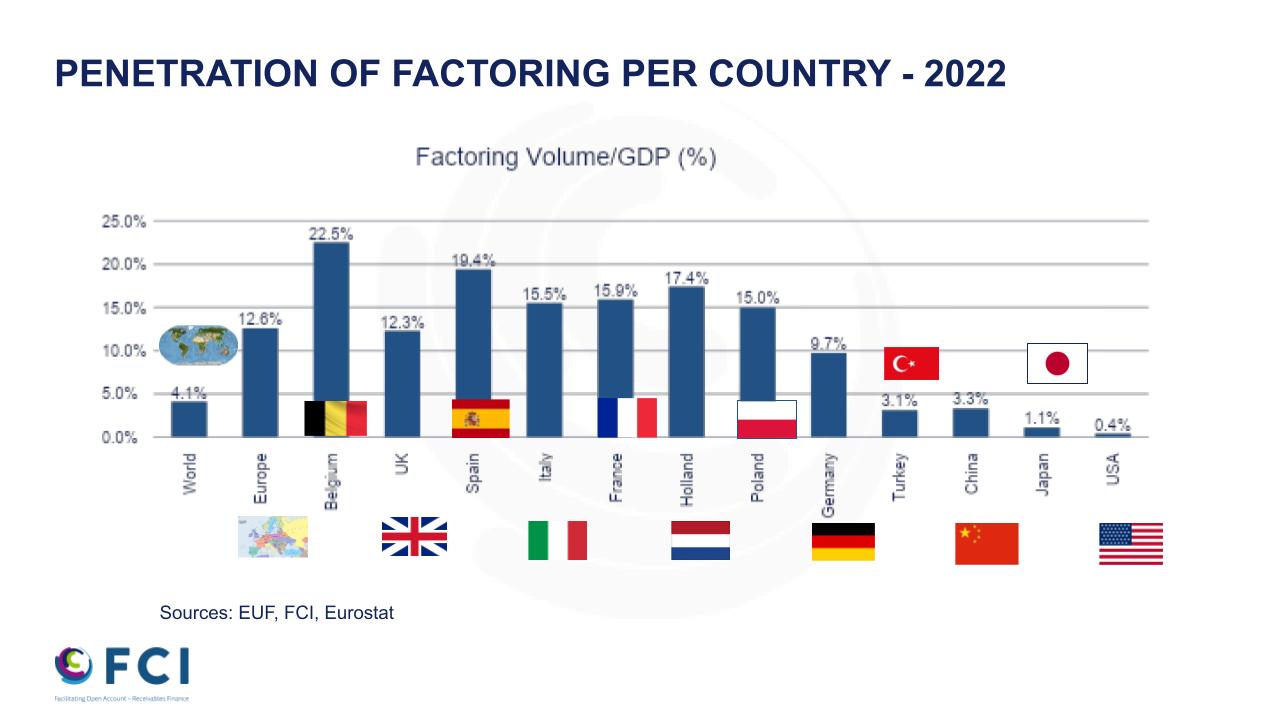
Baydar said, “The growth rate in 2023 was 3.3% globally in the volume of the world factoring and in 2022 it was 18%. Over the last 20 years, the average growth rate has been 8% which shows that factoring is becoming a mainstream financial product globally, which is very good indeed.”

The sector, which revolves around the purchase of receivables from businesses to provide them with immediate liquidity, has become an essential component of global trade finance, but it also faces challenges. One of the primary challenges is the bureaucratic and infrastructural limitations inherent in the current system. 

Factoring, being an invoice-based product, requires a significant amount of paperwork and documentation, which can be cumbersome and traditionally relies on a paper-based system that only adds to the administrative burden for businesses.

In developed regions like Europe, factoring’s penetration rate – a measure of the amount of trade volume that uses factoring – is around 15%, reflecting a more mature understanding and use of this financial product. By contrast, in emerging markets, the penetration rate is significantly lower, with countries like Turkey and Georgia showing rates as low as 3%.

Advertisement

This discrepancy highlights the knowledge gap and infrastructural deficiencies in these regions. Businesses in these markets often lack the necessary awareness and understanding of factoring, which limits their ability to leverage this financial tool to its full potential.

However, factoring usage in some emerging markets is growing.

Tyan said, “We see the progress in the countries where we started five to seven years ago, like Georgia. We recently had a workshop in Jordan, where we also see a more adapted market, more ready to look into this type of product.”

Further collaboration and efforts to promote regulatory reforms and technological advancements may be what is needed to drive factoring growth in these underutilised regions.

Regulatory reforms and technological integration

Regulatory reforms are crucial for the sustained growth and development of the factoring industry, and legal clarity is particularly important in emerging markets, where the absence of a well-defined regulatory environment can pose significant barriers to factoring’s growth.

One of the key areas that require attention is the standardisation of data exchange formats. 

Advertisement

Creating common data standards for supply chain transactions can facilitate smoother integration between different platforms and financial institutions, improving efficiency, reducing administrative burdens, and enhancing the overall effectiveness of the factoring process. 

Another important aspect of regulatory reform is cybersecurity. 

Tyan said, “As this product heavily relies on platforms, clear regulation on data security and cybersecurity is crucial to build trust among the participants.”

Ensuring the integrity and security of transactions protects sensitive financial information from potential cyber threats and is vital for the long-term sustainability and credibility of the industry.

Digitalising to draw clients and talent to factor

The factoring industry has been significantly transformed by the integration of digital technologies that have made the process faster, more efficient, and more accessible, especially for small and medium-sized enterprises (SMEs). 

Traditionally, the paperwork involved in factoring, particularly for international transactions, slowed down the process and added to its complexity but digital platforms are allowing for quicker access to funds and improving the overall client experience.

Advertisement

Baydar said, “Today, with digitalisation and the platforms, we are making our business much faster, quicker, and more effective. This really helps SMEs to touch the money very soon, very quickly. This makes our clients happier than before because they can experience a very fast, very effective, seamless transaction.”

This shift not only speeds up transactions but also minimises the risk of errors and fraud associated with manual paperwork and can help attract more young professionals to the industry. 

Baydar said, “Young people prefer to work with new technology and high-level startup businesses rather than traditional models.”

The new generation of workers is drawn to innovation and technologically advanced sectors. By embracing digital advancements, the factoring industry can position itself as a forward-thinking and dynamic field, appealing to young talent looking for exciting career opportunities. This influx of new talent is essential for sustaining the industry’s growth and development in the long term.

Organisations that fail to embrace digitalisation risk being left behind in a rapidly evolving market, meaning that investing in digital solutions is not just an option but a necessity for the future of the factoring industry.

Advertisement

Finance

A 27-year-old drew down half of her stock portfolio to buy real estate. It’s part of her plan to hit financial independence.

Published

on

A 27-year-old drew down half of her stock portfolio to buy real estate. It’s part of her plan to hit financial independence.

A few years into her accounting career, Carolyn Yu began thinking seriously about financial independence.

“I’d feel very stressed and tired,” Yu, who was working at a Big Four firm at the time, told Business Insider. “I thought, maybe someday I could have more freedom and not spend 24/7 working at a very demanding job.”

She picked up “Rich Dad, Poor Dad” and started listening to the popular real estate podcast, BiggerPockets. One takeaway stood out: focus on buying assets that can grow in value.

Yu, who’d been consistently investing in the stock market since college, felt compelled to make a move. In late 2024, she drained about half her stock portfolio in order to pay cash for a two-bedroom, two-bathroom condo in Fort Worth, Texas.

The Bay Area-based Gen Zer had been eyeing Texas in part for its tax advantages, including the absence of state income tax. She considered other Texas markets, but Fort Worth stood out for its affordability and growth potential.

Advertisement

“The population growth, the crime rate, the property value growth — they all looked good to me,” she said.

She flew to Fort Worth, toured the condo, signed a contract the next day, and closed within a month. Yu intentionally kept her first purchase under $100,000, unsure whether she had the capital or experience to take on something larger.

“Pretty much 50% of my stock portfolio was gone,” she said. But the drawdown didn’t faze her. “I knew that $80,000 transitioned into another investment.”

Advertisement

Scaling to 5 properties in 2 years by recycling capital

Yu grew her portfolio by reinvesting equity from one property into the next.

Her strategy centers on buying below market value, improving the property, allowing it to appreciate, and then tapping into the built-up equity to help finance another purchase.

As her portfolio expanded, her financing evolved. She moved from paying all cash for her first condo to using conventional loans and later DSCR (debt service coverage ratio) loans, which are designed for investors and rely heavily on a property’s cash flow.

Her second purchase was a two-bedroom, one-bath single-family home. She bought it in June 2025 for about $105,000, putting down 25%. After investing about $50,000 in renovations, she said the home appraised at $195,000 and rented for $1,500 a month.

“This property allowed me to execute the BRRRR strategy successfully,” she said, referring to buy, rehab, rent, refinance, repeat. She said she was able to pull out about 70% of the appraised value to help fund her next purchases.

Advertisement

Within about two years of buying her first condo, Yu had a five-property portfolio. Her first three are cash-flowing, while her fourth is currently listed for rent, and her fifth is being prepared for tenants. Business Insider reviewed mortgage documents to confirm ownership and lease agreements to verify rental rates.


carolyn yu

Yu resides in the Bay Area, but invests in real estate in Fort Worth.

Courtesy of Carolyn Yu


One of the challenges she’s faced since buying property has been vacancy.

She purchased her first condo in late 2024 — “probably the worst time to rent because of winter vacancy,” she said — and it sat empty for six months. She eventually lowered the asking rent by about $100 a month before securing a tenant.

Advertisement

The vacancy was stressful, but manageable because she had paid cash and didn’t carry a mortgage. Still, she owed about $600 a month in HOA dues.

Her advice to other investors: keep at least six months of reserves, know your numbers inside and out, and expect vacancies and repairs.

Why she prefers real estate to stocks

Yu still invests in stocks, but said she prefers real estate because it feels more controllable and scalable. In addition to generating a few thousand dollars a month in rental income, she’s also building equity in her properties.

“Real estate gave me more control, more tangible assets, more tax efficiency,” she said, pointing to depreciation, mortgage interest deductions, and the ability to refinance without selling. She also enjoys negotiating deals.

She funnels most of her rental income back into her stock portfolio. Her end goal is financial independence and work flexibility.

Advertisement

Yu wants to own at least eight properties by 2027 and have her portfolio appraised at roughly $2 million. By then, she hopes rental income will cover her expenses and provide enough cushion to leave her W-2 job, so she can focus solely on her real estate business.

She’s also changed how she thinks about spending. Early in her career, she said she coped with work stress by traveling frequently. Now, she prioritizes investing over lifestyle upgrades.

“I would rather put my money into investments right now in exchange for vacations in the future,” she said. “I think it’s totally worth it because I think in two years, I could be financially free.”

Advertisement
Continue Reading

Finance

When making travel plans, timing and financing are major considerations

Published

on

When making travel plans, timing and financing are major considerations

For the true travel fan, there’s often a built-in conflict on how best to plan for your next adventure.

On the one hand, the world awaits. Spin the globe, cover your eyes and point. Or, throw a dart at the map! Then it’s time to dig in and research your next dream destination.

On the other hand, getting the best bargain can be a last-minute proposition. There may be a fare sale today, but not tomorrow. How does that mash up with your bicycle tour in Italy? Or your friend’s wedding in Hawaii?

Spreading out all the options on the table can be daunting. It’s a bit like taking a sip from the fire hose. And we all have varying degrees of tolerance for changing prices, tiny seats and geopolitical uncertainty.

So let’s take a snapshot of what’s happening now, knowing you won’t likely drink from the same river, or fire hose, twice.

Advertisement

Since most of today’s snapshots are on the phone, there are some handy settings: You can zoom in for a closer look at that fruit and cheese platter, frame it up nicely for a good shot of your seatmate, or look out the window and get a nice view from 30,000 feet.

Fares we love. There are just a few fares to zoom in on right now.

Anchorage-Chicago. Three airlines will offer nonstop flights this summer: Alaska, United and American. Alaska and United fly the route year-round. There are just a couple of months where travelers have to stop in Denver or Seattle on the way. Right now, the Basic price is $349 round-trip. United has the least-expensive Main price of $429 round-trip. Alaska charges more: $449-$469 round-trip.

The rate to Chicago is steady throughout the summer, as long as you’re open to flying on other airlines, including Delta and now Southwest, starting May 15.

Anchorage-Dallas. Choose from four airlines with competitive prices. United and Delta offer great rates starting on March 30, for travel all summer and into the fall for $331 round-trip in basic economy. Remember: Basic economy means you’ll be sitting in the middle seat back by the potty. There are few, if any, advance seat assignments permitted and you’re the last to board. Don’t expect to accrue many frequent flyer points. Alaska will give you 30%. Delta and American offer none. United is axing MileagePlus points for basic travelers soon.

Advertisement

Delta and United offer the chance to pay $100 more for pre-reserved seats and mileage credit. Of course, they may charge you more for a nicer seat on the plane. But that’s another story.

American Airlines charges a little bit more, about $20 more for a round-trip, to fly nonstop. It’s a nice flight.

Anchorage-Albuquerque. Delta is targeting this route with a nice rate: $281 round-trip in Basic or $381 in Main. But it’s just between May 23 and June 29. Why? Well, it lines up nicely with Southwest’s launch on May 15. Who knows why airlines cut their fares during a traditionally busy season? It’s just a hunch.

Looking at airfares more broadly, there are a few more bargain rates out there, but most only go through May 20. Airlines are hoping for a robust summer — so prices go up after that.

For example, between March 29 and May 20, Alaska Air offers a nonstop from Anchorage to Los Angeles for $257 round-trip in basic. For pre-assigned seats and full mileage credit, the main price is $337 round-trip. Prices go up to $437 round-trip in the summer.

Advertisement

The view from 30,000 feet is pretty clear, although past performance is no guarantee of future results. Several carriers, including American, Delta, United, Southwest and Alaska are adding flights for the summer. There will be robust competition, which means lower fares. Just last week, Alaska Air dropped the price from Anchorage to Seattle to $210 round-trip. That rate is gone, but others will come along.

Charge it. Banks own the airlines by virtue of their popular credit cards. Do they own you, too?

Sifting through the various credit card offers and bonus points emails, it’s easy to forget that banks, not travelers, are the airlines’ biggest customers. At a Bank of America conference last year, Alaska Airlines reported it receives about 15% of its total revenue from its loyalty plan. That adds up to more than 1.7 billion in 2024. Delta has a similar deal with American Express, which paid the airline about $8.2 billion last year.

Think about that the next time the flight attendants are handing out credit card applications in the aisle.

Zooming in, if you’re going to play the Atmos loyalty game on Alaska Airlines, you have to have an Alaska Airlines credit card from Bank of America.

Advertisement

I carry the plain-old Alaska Air card. I used to have two of them, primarily for the $99 companion fare. That’s still a compelling offer. But to get that benefit, you have to charge it on an Alaska Airlines Visa card.

So the question is: Is it worth it to pay $395 per year for the new Summit Visa card from Bank of America?

If you use your credit card for your business or if you regularly charge thousands of dollars every month, the Summit card may be the card for you.

One of the foundational benefits is for every $2 you charge, you earn one status point toward your next elite tier, such as titanium. It’s possible to charge your way to the top tier of the frequent flyer ladder without ever stepping on a plane. If that’s your level of charge-card use, then the Summit is for you. For the lesser Ascent card like mine, you earn one status point for every $3 spent.

For a little wider view, consider that your other travel costs, including accommodations, can hit your budget a lot harder than an airline ticket. It’s one reason I carry a flexible spend credit card in addition to my Alaska Airlines card. Here’s a snapshot of some popular options:

Advertisement

1. Bilt Rewards. I finally signed up for a Bilt account, although I haven’t yet received my card. There are two big benefits with Bilt: You can charge your rent and transfer points to Alaska Airlines. There also is a scheme to charge your mortgage, but it’s more convoluted. But the charge-your-rent option is a stand-alone gold star for the Bilt program, even if you don’t fly Alaska Airlines.

In addition to the link with Alaska Airlines, Bilt points transfer to other oneworld carriers like British, Japan Airlines and Qatar Air. Hotel partners include Hyatt, my favorite, and Hilton. A big bonus comes with the “Obsidian” card, $95 per year: three points for every dollar spent on groceries.

But there’s also a Bilt card with no annual fee. And there are no extra fees incurred when you charge your rent.

2. American Express. If you fly on Delta, the American Express card is a natural choice.

The two companies really are joined at the hip. The last American Express card I had was a Delta “Gold” card, which included a 70,000-point signup bonus. Cardholders get a free checked bag, although Delta offers two free checked bags for SkyMiles members who live in Alaska, and 15% off award tickets.

Advertisement

The Delta card is free for the first year, then $150 per year thereafter.

There is a dizzying array of American Express cards available, including some with no annual fee. But with Delta there is a narrowed-down selection, including one that’s more than $800 per year. That includes lounge access and some other benefits, including a companion pass.

American Express cardholders also can transfer their points to Hilton and Bonvoy as well as to 15 other airlines.

Capital One offers the Venture X card, which offers cardholders 75,000 points plus a $300 travel credit at their in-house travel service. The cost is $395 per year. Get the slimmed-down Venture card for just $95 per year. You still can earn the 75,000 bonus points after spending $4,000 in the first three months. Plus, there’s a $250 credit with Capital One Travel.

Airline partners include EMirates, Singapore Air, Japan Air and EVA Air, from Taiwan. Hotel partners include Hilton and Marriott.

Advertisement

I’ve carried several Chase cards for years. Right now I have the Chase Sapphire Preferred card, for which I received 80,000 bonus points. But that was several years ago. More recently, I got the Chase-affiliated Ink Business Cash card to harvest a 90,000 point bonus. Previously, I carried the Chase Sapphire Reserve. I got a 100,000 point bonus for that. But I dropped that card when the fee went up to $795 per year.

Stacking the cards like that — getting more than one — has helped me to get more bonus points, both for American Express and for Chase.

The best value for Chase points that I’ve found is for Hyatt Hotels. Right now, it’s the best redemption ration, but that can change. Chase also allows for transfers to Emirates, United, Singapore Air and Southwest, among others. The Chase travel portal is managed by Expedia, so you can redeem points for other hotels at a lower redemption rate.

The long view: All airline mileage plans are now credit card loyalty plans. Terms and conditions change, along with signup bonuses and other features of the cards. Last year, Chase dropped its airport restaurant feature, which offered $29 per person at select restaurants in Los Angeles, Seattle and Portland. A couple of years ago, the Priority Pass affiliated with Chase dropped the Alaska Airlines lounges as a partner.

It takes some time and effort to keep up with the programs and get the best value. But airline credit card plans are here to stay, even if the frequent-flyer programs are watered down year after year.

Advertisement

Continue Reading

Finance

Lawmakers target ‘free money’ home equity finance model

Published

on

Lawmakers target ‘free money’ home equity finance model

Key points:

  • Pennsylvania lawmakers are considering a bill that would classify home equity investments (HEIs) and shared equity contracts as residential mortgages.
  • Industry leaders have mobilized through a newly formed trade group to influence how HEIs are regulated.
  • The outcome could reshape underwriting standards, return structures and capital markets strategy for HEI providers.

A fast-growing home equity financing model that promises homeowners cash without monthly payments is facing mounting scrutiny from state lawmakers — and the industry behind it is mobilizing to shape the outcome.

In Pennsylvania, House Bill 2120 would classify shared equity contracts — often marketed as home equity investments (HEIs), shared appreciation agreements or home equity agreements — as residential mortgages under state law.

While the proposal is still in committee, the debate unfolding in Harrisburg reflects a broader national effort to determine whether these products are truly a new category of equity-based investment — or if they function as mortgages and belong under existing consumer lending laws.

A classification fight over home equity capture

HB 2120 would amend Pennsylvania’s Loan Interest and Protection Law by explicitly including shared appreciation agreements in the residential mortgage definition. If passed, shared equity contracts would be subject to the same interest caps, licensing standards and consumer protections that apply to traditional mortgage lending.

The legislation was introduced by Rep. Arvind Venkat after constituent Wendy Gilch — a fellow with the consumer watchdog Consumer Policy Center — brought concerns to his office. Gilch has since worked with Venkat as a partner in shaping the proposal.

Gilch initially began examining the products after seeing advertisements describe them as offering cash with “no debt,” “no interest” and “no monthly payments.”

Advertisement

“It sounds like free money,” she said. “But in many cases, you’re giving up a growing share of your home’s equity over time.”

Breaking down the debate

Shared equity providers (SEPs) argue that their products are not loans. Instead of charging interest or requiring monthly payments, companies provide homeowners with a lump sum in exchange for a share of the home’s future appreciation, which is typically repaid when the home is sold or refinanced.

The Coalition for Home Equity Partnership (CHEP) — an industry-led group founded in 2025 by Hometap, Point and Unlock — emphasizes that shared equity products have zero monthly payments or interest, no minimum income requirements and no personal liability if a home’s value declines.

Venkat, however, argues that the mechanics look familiar and argues that “transactions secured by homes should include transparency and consumer protections” — especially since, for many many Americans, their home is their most valuable asset. 

“These agreements involve appraisals, liens, closing costs and defined repayment triggers,” he said. “If it looks like a mortgage and functions like a mortgage, it should be treated like one.”

Advertisement

The bill sits within Pennsylvania’s anti-usury framework, which caps returns on home-secured lending in the mid-single digits. Venkat said he’s been told by industry representatives that they require returns approaching 18-20% to make the model viable — particularly if contracts are later resold to outside investors. According to CHEP, its members provide scenario-based disclosures showing potential outcomes under varying assumptions, with the final cost depending on future home values and term length.

In a statement shared with Real Estate News, CHEP President Cliff Andrews said the group supports comprehensive regulation of shared equity products but argues that automatically classifying them as mortgages applies a framework “that was never designed for, and cannot meaningfully be applied to, equity-based financing instruments.”

As currently drafted, HB 2120 would function as a “de facto ban” on shared equity products in Pennsylvania, Andrews added.

Real Estate News also reached out to Unison, a major vendor in the space, for comment on HB 2120. Hometap and Unlock deferred to CHEP when reached for comment. 

A growing regulatory patchwork

Pennsylvania is not alone in seeking to legislate regulations around HEIs. Maryland, Illinois and Connecticut have also taken steps to clarify that certain home equity option agreements fall under mortgage lending statutes and licensing requirements.

Advertisement

In Washington state, litigation over whether a shared equity contract qualified as a reverse mortgage reached the Ninth Circuit before the case was settled and the opinion vacated. Maine and Oregon have considered similar proposals, while Massachusetts has pursued enforcement action against at least one provider in connection with home equity investment practices.

Taken together, these developments suggest a state-by-state regulatory patchwork could emerge in the absence of a uniform federal framework.

The push for homeowner protections

The debate over HEIs arrives amid elevated interest rates and reduced refinancing activity — conditions that have increased demand for alternative equity-access products. 

But regulators appear increasingly focused on classification — specifically whether the absence of monthly payments and traditional interest charges changes the legal character of a contract secured by a lien on a home.

Gilch argues that classification is central to consumer clarity. “If it’s secured by your home and you have to settle up when you sell or refinance, homeowners should have the same protections they expect with any other home-based transaction,” she said.

Advertisement

Lessons from prior home equity controversies

For industry leaders, the regulatory scrutiny may feel familiar. In recent years, unconventional home equity models have drawn enforcement actions and litigation once questions surfaced around contract structure, title encumbrances or consumer understanding.

MV Realty, which offered upfront payments in exchange for long-term listing agreements, faced regulatory action in multiple states over how those agreements were recorded and disclosed. EasyKnock, which structured sale-leaseback transactions aimed at unlocking home equity, abruptly shuttered operations in late 2024 following litigation and mounting regulatory pressure.

Shared equity investment contracts differ structurally from both models, but those episodes underscore a broader pattern: novel housing finance products can scale quickly in tight credit cycles. Just as quickly, these home equity models encounter regulatory intervention once policymakers begin examining how they fit within existing law — and the formation of CHEP signals that SEPs recognize the stakes.

For real estate executives and housing finance leaders, the outcome of the classification fight may prove consequential. If shared equity contracts are treated as mortgages in more states, underwriting standards, return structures and secondary market economics could shift.

If lawmakers instead carve out a distinct regulatory category, the model may retain more flexibility — but face ongoing state-by-state negotiation.

Advertisement
Continue Reading

Trending