Midwest
On this day in history, May 29, 1851, Sojourner Truth delivers famed 'Ain’t I a Woman' speech

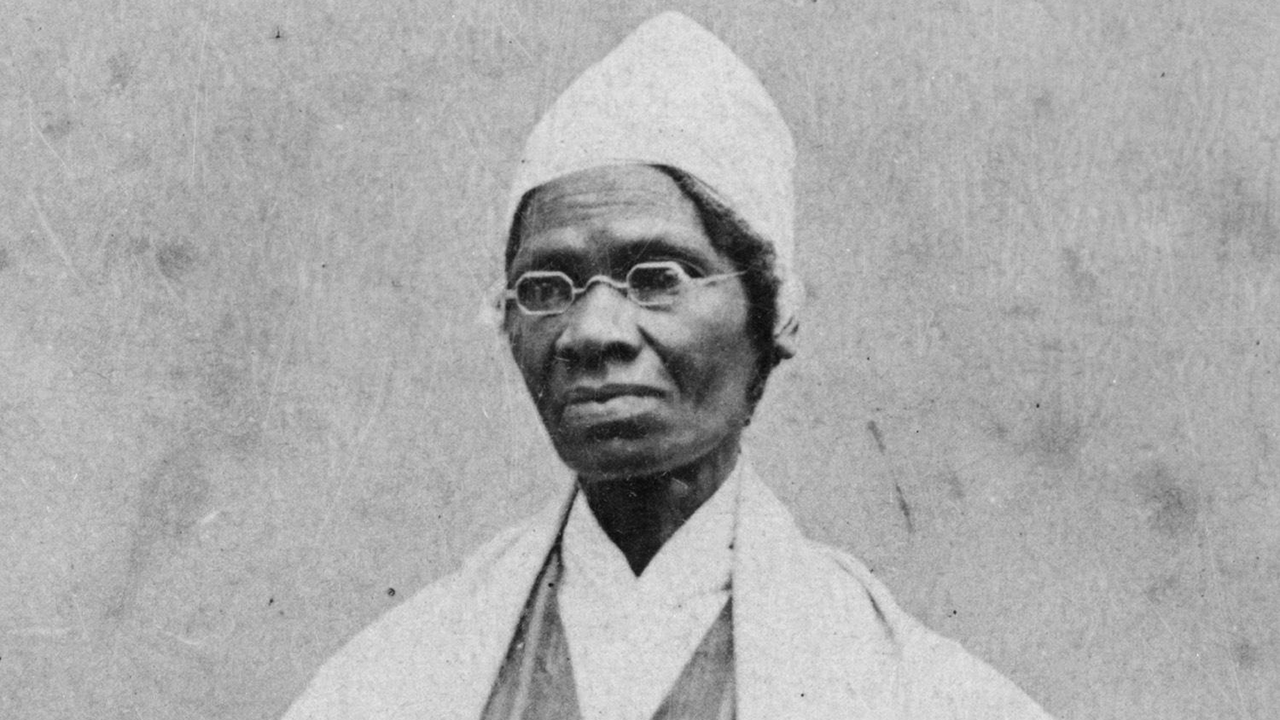
Sojourner Truth, the African American abolitionist, women’s rights advocate and social activist revered to this day for her presentation on racial inequalities, delivered her famous “Ain’t I a Woman?” speech on this day in history, May 29, 1851, at the Ohio Women’s Rights Convention in Akron, Ohio.
The powerful performance is still used today as a call for equal treatment of women, according to many sources.
Truth’s words are recognized as one of the most abolitionist and pro-women’s rights speeches in American history, the U.S. Capitol Visitor Center notes.
ON THIS DAY IN HISTORY, MAY 28, 1888, JIM THORPE, ‘GREATEST ATHLETE IN THE WORLD,’ IS BORN
“She suggested that the women’s rights movement had marginalized African American women and stated, ‘You need not be afraid to give us our rights for fear we will take too much, for we can’t take more than our pint’ll hold,’” the site indicates.
Truth was born into slavery in 1797 as Isabella Baumfree — and subsequently changed her name to Sojourner Truth.
Sojourner Truth headshot from 1864. Truth’s speech “Ain’t I a Woman?” is recognized as one of the most abolitionist and pro-women’s rights speeches in American history, the U.S. Capitol Visitor Center notes. (Associated Press)
She would come to be considered one of the most powerful advocates for human rights in the 19th century, says the National Park Service of the U.S. Department of the Interior.
She spent her early childhood on a New York estate owned by Col. Johannes Hardenbergh.
Like other slaves, she experienced the challenges of being sold and mistreated, says the same site.
“I did not run away, I walked away by daylight.”
In 1827, after her master did not honor his promise to free her or to uphold the New York Anti-Slavery Law of 1827, she fled.
She reportedly told her master, per the same site, “I did not run away, I walked away by daylight.”
ON THIS DAY IN HISTORY, SEPT. 22, 1862, ABRAHAM LINCOLN PROCLAIMS SLAVES WILL SOON BE ‘FOREVER FREE’
After choosing to convert her religion, in 1843 she changed her name to Sojourner Truth, the site noted.
Truth continued her commitment to the expanding antislavery movement, and by the 1850s she was involved in the women’s rights movement.
Truth continued her commitment to the emerging and expanding antislavery movement, and by the 1850s she was involved in the women’s rights movement.
At the 1851 Women’s Rights Convention held in Akron, Ohio, Truth delivered her noteworthy and famous abolitionist and women’s rights speech.
She continued to advocate for African Americans and women’s rights during and after the Civil War, says the National Park Service.
This excerpt from Truth’s famous speech has been distributed on many sites.
“That man over there says that women need to be helped into carriages, and lifted over ditches, and to have the best place everywhere,” she supposedly said.
“Nobody ever helps me into carriages, or over mud puddles, or gives me any best place! And ain’t I a woman? Look at me! Look at my arm! I have ploughed and planted, and gathered into barns, and no man could head me! And ain’t I a woman? I could work as much and eat as much as a man — when I could get it — and bear the lash as well! And ain’t I a woman?”
She went on, “I have borne 13 children, and seen most all sold off to slavery, and when I cried out with my mother’s grief, none but Jesus heard me! And ain’t I a woman?”
There are two conflicting versions of Truth’s famous speech — neither of which was transcribed at the time Truth actually gave it, says History.com.
An account reported in the Anti-Slavery Bugle, the first to be published, reportedly did not actually include the namesake phrase, “Ain’t I a Woman?” the same site recounts.
There are two conflicting versions of Truth’s famous speech.
On May 2, 1863, Frances Gage, a White abolitionist, published an account of Truth’s words in the National Anti-Slavery Standard.
In this account, Gage wrote that Truth used the rhetorical question, “Ar’n’t I a Woman?” to point out the discrimination that Truth experienced as a Black woman, says History.com.
ON THIS DAY IN HISTORY, JULY 28, THE 14TH AMENDMENT WAS CERTIFIED, ASSURING EQUALITY FOR ALL AMERICANS
Various details in Gage’s account, however, including that Truth said she had 13 children (she had five) — and that she spoke in dialect — have since cast doubt on its accuracy, the same site chronicled.
“There is little doubt that Truth’s speech — and many others she gave throughout her adult life — moved audiences.”
Some years later, the slogan was further distorted to “Ain’t I a Woman?” — which the same site says reflected the false belief that as a formerly enslaved woman, Truth would have had a Southern accent.
“Truth was, in fact, a New Yorker,” notes History.com. “Regardless, there is little doubt that Truth’s speech — and many others she gave throughout her adult life — moved audiences,” the same site says.
In the 1850s, Sojourner Truth settled in Battle Creek, Michigan, says Brittanica.com
Truth’s words continue to impact American society as a beacon of hope and equality, even though there are discussions about the actual messaging of her 1851 speech.
When the Civil War began, Truth was dedicated to recruiting soldiers for the Union Army, says the New York Historical Society Museum and Library.
“Although she was a pacifist, she believed that the war was a fair punishment from God for the crime of slavery.”
“Although she was a pacifist, she believed that the war was a fair punishment from God for the crime of slavery. She also knew the Union needed fighters to win,” reports the same source.
MEET THE AMERICAN WHO WROTE ‘THE BATTLE HYMN OF THE REPUBLIC’
In 1864, Truth went to Washington, D.C., where SHE worked for the National Freedman’s Relief Association, striving to improve the lives and prospects of free Black people, the same site indicated.
That fall, she was invited to meet President Abraham Lincoln, the site also says.
President Abraham Lincoln with General George B. McClellan at his headquarters at Antietam, October 3, 1862. In the fall of 1864, Sojourner Truth was invited to meet with President Lincoln. (Getty Images)
After the war, Truth lobbied the U.S. government to grant land to newly free Black men and women, says the New York Historical Society Museum and Library.
“She understood that Black people could never be truly free until they achieved economic prosperity, and she knew that owning land was an important first step. She also continued to travel throughout the United States, giving speeches about women’s rights, prison reform, and desegregation,” the same site recounted.
“She fought for her son’s freedom after he had been illegally sold.”
Truth was the first African American woman to win a lawsuit in the United States, says the Library of Congress. “This was when she fought for her son’s freedom after he had been illegally sold,” the source said.
Truth passed away at age 84 in Michigan — with thousands of mourners in attendance.
ON THIS DAY IN HISTORY, FEB 3, 1870, 15TH AMENDMENT IS RATIFIED, GRANTING BLACK MALES THE RIGHT TO VOTE
In Dec. 1883, just after her death, The New York Globe published an obituary, which read, in part: “Sojourner Truth stands preeminently as the only colored woman who gained a national reputation on the lecture platform in the days before the [Civil] War,” according to the Library of Congress.
Unveiled in the U.S. Capitol’s Emancipation Hall on April 28, 2009, a bronze bust of Sojourner Truth was the first sculpture honoring an African American woman in the U.S. Capitol, says the U.S. Capitol Visitor Center.
It was donated by the National Congress of Black Women and Congress authorized its placement in the Capitol (Public Law 109-427). President George W. Bush signed the bill into law on Dec. 6, 2006, says the same site.
“California-based sculptor Artis Lane, who designed the Rosa Parks Congressional Medal of Honor, was commissioned to create the bust. Lane depicted Truth with a smile to show Truth’s confidence and determination.”
For more Lifestyle articles, visit www.foxnews.com/lifestyle.
Read the full article from Here


Taylor police are investigating after a man was found dead with stab wounds outside of a vehicle early Thursday morning.
Police responded to the 11000 block of Elm Street around 4:15 a.m. Thursday for a report of an unresponsive man lying on the ground next to a vehicle. Medics pronounced the man dead at the scene.
Detectives identified a former girlfriend of the victim, and an investigation led police to the area of Telegraph and McNichols roads in Detroit, where authorities say they found her vehicle.
When detectives attempted to make contact with the woman, they say she fled in her car.
The woman’s vehicle was later found abandoned in a field in the 15000 block of Salem Street.
With help from Detroit police and the Michigan State Police K-9 Unit, authorities tracked down the woman hiding behind a bush and took her into custody without incident.
Taylor police have not identified the victim or the suspect.
An investigation is ongoing.

MILWAUKEE — As Venezuela continues to recover from devastating earthquakes, support from Milwaukee’s “United for Venezuela Emergency Relief Campaign” is soon heading to the disaster-stricken country.
The basement of Blessed Sacrament Catholic Church is filled to the brim with donations ticketed for Venezuela, the culmunation of a week of community generosity.
From food to clothing and toys, the outpouring has been remarkable said Father Norberto Sandoval, who is from Venezuela and serves as associate pastor of Blessed Sacrament.
“This [has been] overwhelming,” said Sandoval. “I mean, if you can see [the basement], you were able to get in on Monday. Now we [are not] able to walk.”
(Spectrum News 1/Blake Dietz)
Aura Escobar, who is also from Venezuela, has been doing whatever she can to help her home country, including packing donations. She described the support from friends, coworkers, and strangers as something special to witness.
“In my Venmo, I had three thousand dollars in less than 24 hours,” Escobar said. “And I was able to buy stuff to donate. It’s been amazing. It’s very heartwarming to have so many people that care about Venezuela.”
Due to limited storage capacity and the logistical planning required to transport the supplies to those who need them most, organizers have decided to stop accepting donations after Friday afternoon.
“We have more than a thousand boxes right now. We are expecting two semi-trucks either to move [Friday] in the afternoon or tomorrow,” Sandoval said.

(Spectrum News 1/Blake Dietz)
He acknowledged that corruption in times of trauma is a long-standing concern in Venezuela. For that reason, the trucks will take the local donations to Miami, where a Venezuelan organization he fully trusts will handle the final distribution.
“We have already the person and it’s going to be [done] free. It’s going to be directly to a group of religious groups in Venezuela. So, in that way people will get the donations,” he said.
Sandoval and other organizers are putting out one final plea for volunteers to help load the semi-trucks on Friday and Saturday.

What does it look like to carry your culture with you? When Minneapolis architect and photographer Patricia Mutebi posted a casting call on TikTok in December, she was looking for a way to map how immigrants and diaspora communities in Minnesota keep their heritage close.
She initially planned to photograph Twin Cities residents in their homes, but Operation Metro Surge, the federal immigration enforcement crackdown in Minnesota, forced her to reconsider the safety of her subjects.
“I didn’t think that people would feel comfortable letting a stranger into their home, trying to take pictures of them,” Mutebi said. “From January all through April, I photographed those who were comfortable coming into the downtown [Minneapolis] area.”
The result is “Threads of Us,” a portrait exhibit featuring 20 Hmong, Thai, Indian, African, Pakistani and Indigenous people who have built a life in the Twin Cities.
After seeing the exhibit, spend the rest of the weekend at the annual Taste of Minnesota, revisit soul music of the 1990s at the Dakota or watch Saturday’s World Cup matches at a street fair in Minneapolis.
Finding home in Minnesota
In “Threads of Us,” Mutebi asked each person she photographed the same question: What does home look like after you’ve left it behind?
“Each person I photographed taught me something new about perseverance and resilience,” Mutebi said. “They’ve come into a new place that doesn’t necessarily welcome them openly, but they’re choosing to show up as their authentic self regardless. Nothing could honestly beat that.”
Mutebi understands the feeling. She was born in Uganda, studied architecture in Kenya, and moved to Minnesota in 2019.
“I have friends here who have families that know how to cook Kenyan food, and whenever I go visit them, there’s a smell that just hits me, and I’m taken back to a time when I was an undergrad,” she said. “In the first house that I bought, I have this gallery wall that shows the journey I’ve traveled. It has art from Kenya, from Uganda, and pictures of friends and family. That’s the most treasured thing I have.”
She also draws inspiration from architects like Burkinabé-German designer Diébédo Francis Kéré, whose work centers on Indigenous materials and community-led design across Africa.
He “didn’t try to bring the Western world with him,” Mutebi said. “He was designing for the culture — where it sat, and using the materials they have to help people understand that we have these resources already.”
For “Threads of Us,” participants arrived in traditional clothing — from Hmong vests and Ethiopian habesha dresses to Ghanaian kente cloth and Pakistani shalwar kameez. They brought meaningful objects, including wedding garments, family heirlooms, Oromo beadwork, Somali incense burners and Ethiopian coffee ceremony sets. Each item served as a tangible bridge to their families and homelands.
“I found people who have photographed cultures in the most beautiful way and have captured joy without trying to modernize the culture,” Mutebi said. “I want to photograph people where they’re at and how they move through life without trying to change them one way or another.”
Threads of Us, now on view at The Residency by Modern Day Me in Minneapolis, is Mutebi’s first exhibit — but she’s already thinking about what comes next. She was recently selected for the cohort of the Little Africa residency program, where she will partner with local African-descent business owners to tell their stories through photography.
“Unless you’re Indigenous, you came from somewhere,” Mutebi said. “I want people to take the time to think about what it means to them and how they can show up in the places they are now.”
Date: Friday, July 3 through Friday, July 17.
Time: 10 a.m. to 5 p.m. Monday through Friday
Location: The Residency by Modern Day Me, 401 N. 1st Ave., Minneapolis
Cost: Free
For more information: Visit patriciamutebi.studio/portfolio/threadsofus

Taste of Minnesota
Spend your Fourth of July weekend at the Taste of Minnesota, where 18 local musicians and more than 100 food vendors will take over downtown Minneapolis for the annual two-day festival.
The main stage will feature grunge-pop band Gully Boys, hip-hop artist Nur-D, singer-songwriter Dessa, and DJ Sophia Eris. The North Star Stage will spotlight emerging acts, including Frankie Torres, Adam David Bohanan, and Solana and the Sunsets.
Date: Friday, July 3 and Saturday, July 4
Time: 4 to 10 p.m. on Friday. Noon to 10 p.m. on Saturday
Location: At the intersection of Nicollet Mall and Washington Avenue
Cost: Free. RSVP here.
For more information: Visit tasteofmn.com
A night of ’90s soul
If music from the 1995 film “Waiting to Exhale” still has a place on your playlist, head to the Dakota this Friday for the Ladies of Soul tribute show.
Local singers Solorah, Ashley Commodore and Monique Blakey will perform the soundtrack from start to finish, revisiting songs by Whitney Houston, Toni Braxton, Mary J. Blige, Brandy and Aretha Franklin.

World Cup watch party
Catch the knockout rounds between Canada and Morocco and Paraguay and France at the World Cup Street Fair in Minneapolis this Saturday.
Utepils Brewing will show both games on large indoor and outdoor screens, while the street fair will feature food trucks, art vendors, mini soccer games and DJ sets between kickoffs.
-

 Health13 minutes ago
Is Skipping Breakfast Bad? The Weight-Loss Truth May Surprise You
-
 Lifestyle28 minutes ago
Nearly half of Americans surveyed don’t know what America 250 commemorates
-

 Technology38 minutes ago
Amazon updated 2023’s Fire HD 10 tablet with 4GB of RAM
-

 World43 minutes ago
Interpol issues red notice for Ukrainian woman wanted for Monaco apartment bombing targeting oligarch
-

 Politics50 minutes ago
Mamdani blasts ICE agents, Elon Musk and ‘supremacy’ in America 250 speech ahead of July 4 weekend
-

 Health53 minutes ago
What killed Americans in 1776? The answer is dramatically different from today
-

 Sports58 minutes ago
Knicks champion says he hopes ‘truth comes out’ after leaving team for Eastern Conference rival
-

 Technology1 hour ago
Cheap streaming box could hijack your home internet

