West
Disabled veteran who survived attack by grizzly bear recalls when instincts kicked in

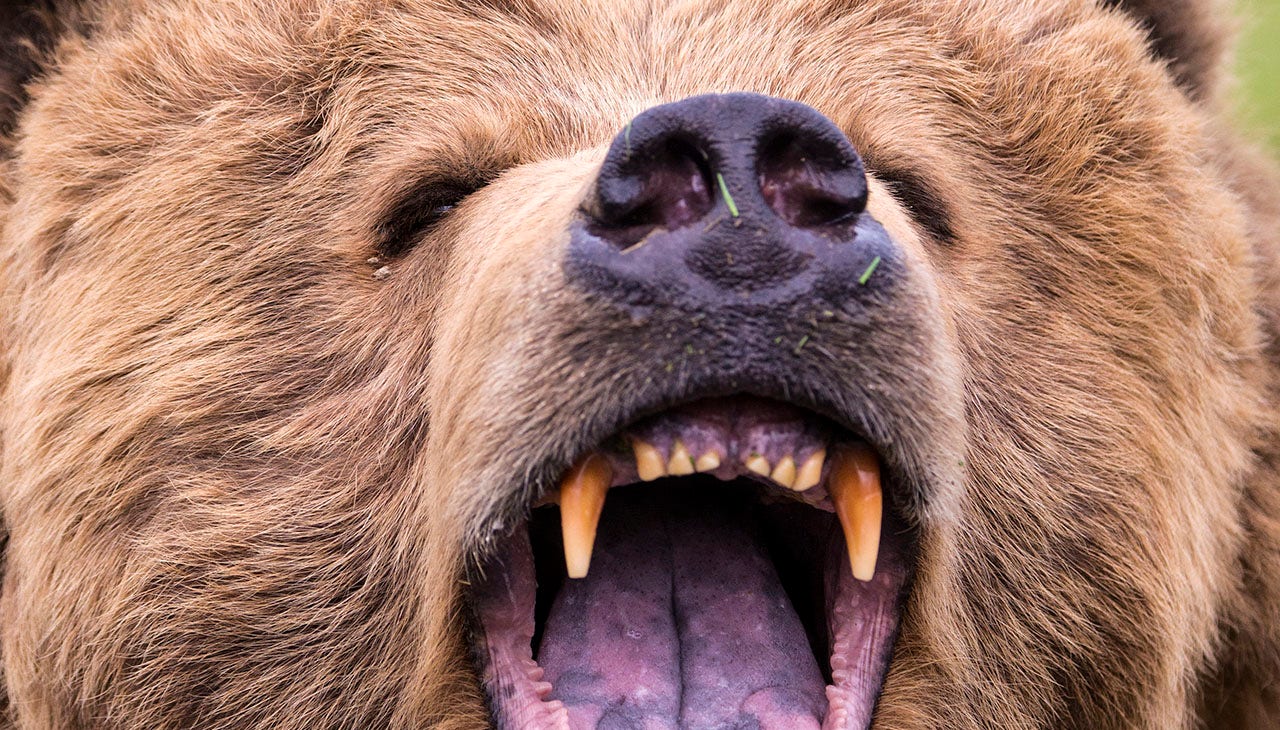
A disabled veteran Army reservist this week described a harrowing grizzly bear attack he survived by playing dead and holding onto his can of bear spray.
Shayne Patrick Burke, 35, called the attack by the mama grizzly last Sunday the “most violent thing I have ever experienced.”
He added in an Instagram post: “I’ve experienced being shot at, mortared and IED explosions.”
Burke said he was walking through the woods at Grand Teton National Park’s Signal Mountain in western Wyoming in an effort to photograph a Great Grey Owl last weekend.
SURPRISE GRIZZLY ATTACK PROMPTS CLOSURE OF A MOUNTAIN IN GRAND TETON
A disabled veteran Army reservist was attacked by a grizzly bear last weekend. (Prisma Bildagentur/Universal Images Group via Getty Images)
His wife was waiting for him at the parking lot and he was trying to hurry back when he had a “really uncomfortable feeling. I was breaking branches, singing and talking to myself aloud. These are some things that can help prevent a ‘surprise encounter’ with a brown bear.’”
Then he noticed a bear cub in front of him. “I knew this wasn’t good,” he wrote, adding “I unholstered my bear spray and saw the mother bear charging. I stood my ground, shouted and attempted to deploy the bear spray but as I did she already closed the gap.”
With little time to think, he decided to lie on the ground on his stomach so the grizzly would attack his back instead of his front and interlocked his hands behind his neck to “protect my vitals.”
MONTANA GRANDPA WHOSE JAW WAS RIPPED OFF BY GRIZZLY BEAR ATTACKS RECOVERY: ‘HE’S GOING TO BE LIKE RAMBO’
He said the bear bit him on the shoulder, legs, buttocks, slammed him to the ground and stood on his back before going for his neck for a “kill bite.”
“I still had my hands interlocked and my arms protecting my carotid arteries,” he wrote. “I never let go of the bear spray can. As she bit my hands in the back of my neck she simultaneously bit the bear spray can and it exploded in her mouth. This is what saved my life from the initial attack. I heard her run away, I looked up and instantly ran in the opposite direction up a hill.”
When hurrying back to his wife, he texted her “attacked” and applied improvised tourniquets to his legs.
The man was attacked while hiking Signal Mountain at Grand Teton National Park in Wyoming.
While they waited for help to arrive, he filmed a video saying goodbye to his loved ones in case the worst happened. But soon a helicopter and ambulance arrived and he was taken to a hospital.
“The No. 1 thing that kept me alive during the attack was reading and understanding what to do in the event of a bear attack and being prepared with the bear spray,” he wrote. “Though I am not sure if I got to spray any at the bear, having it on me and keeping it in my hands while protecting my vitals 100% is the only reason I am telling my story now.”
He also thanked the “Jenny Lake Rangers who saved my life.”
He also has no ill will toward the bear, telling the rangers the attack was just “wrong place, wrong time” and the mama bear was simply defending her cub. Park officials have confirmed the bear won’t be captured or killed, which Burke himself urged.
The man called said the attack was just a case of “wrong place, wrong time” because the grizzly was simply trying to defend her cub. (Huseyin Demirci/Anadolu via Getty Images)
“In fact, the second thing I said to the park rangers was please don’t kill the bear, she was defending her cub,” he wrote, adding, “I love and respect wildlife.”
“What happened up on Signal Mountain was a case of wrong place wrong time,” he wrote.
Burke is expected to make a full recovery.
Read the full article from Here


SALT LAKE CITY (KUTV) — In the middle of Utah’s drought, an environmental group is calling out what it labeled “hysteria” over water supplies for Wasatch Front cities.
“We’ve heard for 50 years that Utah is about to run out of water for its cities,” said Zach Frankel, director of the Utah Rivers Council. “And it’s a myth.”
Frankel, a frequent presence on Utah’s Capitol Hill, said cities — including the people who live in them — account for only a sliver of Utah’s total water use.
MORE | Utah Drought
He said that water rates are so low we have “the most wasteful water users in the country” and that outdoor watering could be dramatically curtailed with little to no impact.
Claims of running out of water, Frankel said, are aimed at pushing pricey, publicly funded water construction projects.
Ogden is embarking on a $100 million replacement of a 100-year-old pipeline through Ogden Canyon aimed at “improving reliability, reducing water loss, and supporting long-term water security.”
The Weber Basin Waster Conservancy District is not driving or financing the construction, but is involved with it, and the general manager called the Utah Rivers Council position “hogwash.”
“We’re not doing projects … just to spend hundreds of millions of dollars,” said GM Scott Paxman. “We are running out of water.”
Paxman said 20,000 more homes are already approved and/or permitted within the district boundaries, and even more permits are likely in Ogden Valley, Summit and Morgan Counties.
Laura Briefer, director of the Salt Lake City Department of Public Utilities, said the city rates have gone up, and are “encouraging conservation.”
Frankel said conservation efforts can go further, even as more and more water is diverted in northern Utah from agriculture to growing communities — water that will not end up in a near-record-low Great Salt Lake.
“If you went to the gas station and saw someone pouring gasoline on the sidewalk while simultaneously simply telling us, ‘We’re running out of gas,’ it would be, ‘What are you talking about?’” Frankel said. “Put the nozzle back.”
_____

NAVASOTA, Texas (KBTX) – For many Texans, the Fourth of July is about fireworks and family cookouts. At Washington-on-the-Brazos State Historic Site, it’s also about standing where Texas’ own independence story began, and marking a milestone in how the Lone Star State became part of the nation it celebrates.
The Texas historic site, set on 293 acres of parkland along the Brazos River, is known as “Where Texas Became Texas.” It is the place where 59 delegates met and signed the Texas Declaration of Independence from Mexico on March 2, 1836, launching what would become the Republic of Texas.
From 1836 to 1846, Texas existed as a separate nation, before the question of annexation came to the forefront. Site staff say Washington-on-the-Brazos offers a “bookended” look at the Republic’s decade-long history because discussions about joining the United States also took place there and were ultimately voted on in the property.
This year’s July 4 programming is designed to connect those chapters of Texas history with the national holiday, including a commemoration tied directly to the Lone Star being added to the American flag.
“This is also the 180th anniversary of when Texas was added to the American flag,” said Chandler Wahrmund, assistant site manager for the Fanthorp Inn State Historic Site, which is part of the broader Republic of Texas Complex.
A historic site with multiple stops
Washington-on-the-Brazos includes several major attractions:
- Visitor Center: The recommended starting point for guests. It features interactive exhibits presenting a timeline of the Texas Revolution and includes the Museum Store, with snacks and Texas-themed items. The Visitor Center is free and is where visitors can gather information and purchase entry tickets for the site’s paid attractions.
- Independence Hall: A replica building that sits on the spot where the Texas Declaration of Independence was signed, allowing visitors to visualize where that pivotal moment unfolded.
- Star of the Republic Museum: A central museum on the grounds focused on the Republic era.
- Barrington Living History Farm: A living-history area that interprets life in the Republic of Texas period through demonstrations and activities.
The historic site is also the core of the Republic of Texas Complex, which includes Fanthorp Inn, a preserved 19th-century stagecoach inn in nearby Anderson.
July 4 events across the grounds
Staff say this year’s July 4 celebration will include activities happening throughout the site, with scheduled programs at key times.
According to site staff, the day includes:
- Flag raising ceremony at 11 a.m.
- Readings of the American Declaration of Independence at 1 p.m. and 3 p.m.
- Star of the Republic Museum cockade-making, creating patriotic lapel decorations
- Barrington Living History Farm games, including trap ball, a precursor to baseball
- Townsite activities at Hatfield’s Exchange, a recreated high-class bar from the period, with lemonade and other period-inspired nonalcoholic drinks for visitors
Wahrmund said the day is a chance to revisit the country’s founding words, and understand why they still matter.
“I love to read the words of Thomas Jefferson on the day, July 4th, to really understand why we exist as a nation,” he said.
Hours and admission
Washington-on-the-Brazos State Historic Site will be open 10 a.m. to 4:30 p.m. on July 4, and admission is free all day.
Copyright 2026 KBTX. All rights reserved.

Media outlets gasped last week at the socialist movement’s success in the New York congressional Democratic primary elections.
That success headed west Tuesday, to Wyoming’s southern neighbor of Colorado.
Democratic socialist Melat Kiros, 29, defeated 15-term incumbent U.S. House Rep. Diana DeGette in Tuesday evening’s primary election.
Colorado Public Radio called the ouster “a stunning blow to the Democratic establishment in Denver and continuing a run of leftist victories in major cities.”
Former Wyoming Gov. Mike Sullivan, a Dvemocrat, told Cowboy State Daily on Tuesday that he wasn’t surprised at the move by Denver voters, but he doubted the proximity of a House socialist – if Kiros wins the general election – will affect Wyoming much.
“We have our own issues, and we’re certainly more sensitive to certain issues than others,” Sullivan said. “And it doesn’t necessarily divide us or make us closer to anybody else.”
Could Deepen ‘Don’t Colorado My Wyoming’ Sentiment
Liz Brimmer, longtime Wyoming politico, agreed in general, but said having a socialist congressional neighbor could galvanize Wyoming even harder into a tendency it already has: spurning anything that looks like Colorado governance.
“I think Wyoming uniformly and strongly feels, you know, ‘Don’t Colorado my Wyoming’,” Brimmer said. “And I think if anything, it deepens that sentiment.”
Brimmer said the ouster speaks of “these times, where there’s no doubt an anti-incumbent strain.” But no one will know all the reasons, nor should presume too much, until the voter data return, she said.
The Republicans saw the anti-incumbent strain surface differently, with newcomers ousting President Donald Trump’s foes in GOP primary elections.
State Rep. Landon Brown, R-Cheyenne, who is finishing off his final legislative term, voiced fascination with the election outcome.
Brown, a self-described political junkie, lives about 14 miles from the Colorado border.
He said the ouster shows Denver is increasingly dictating the rest of Colorado’s fate, and that the state is growing more polarized.
On the Republican gubernatorial primary side, The Associated Press was showing a half-point lead for Victor Marx as of Wednesday.
“He’s just as crazy as a democratic socialist on the left,” said Brown.
As for DeGette’s defeat, it’s not as symptomatic as one would think, he added.
“She was running a ‘Hey, I’m the incumbent and I’ve been here 30 years’ (campaign),” he said.
That hurt her. As did a growing divide on the left over Israel’s approach to its many foes — and Congress’ funding of Israeli war and defense efforts, said Brown.
Israel was also a fulcrum in the May primary loss of libertarian-leaning incumbent Rep. Thomas Massie, of Kentucky. But the Republican voters took the inverse approach on that one, nominating the candidate who supports funding Israeli war efforts.
Jack Speight, the GOP strategist who helped Wyoming Gov. Stan Hathaway to victory in 1966, told Cowboy State Daily Kiros’ win is alarming.
Speight was a Democrat when he graduated from the University of Wyoming law school. But the allure of capitalism and the prevailing logic of his good friends pulled him to the Republican side, he said in another interview last month.
The socialist victories of 2026 are “sad for this country. It may well affect the results of this fall, and nationwide,” he said. He called it a shift of California transplants into the Rockies, and a symptom of a growing entitlement.
Look North
Colorado isn’t the only Wyoming neighbor with socialist momentum.
Sam Forstag, a smoke jumper endorsed by Sen. Bernie Sanders, I-Vermont, and Rep. Alexandria Ocasio Cortez, D-New York, won his primary bid for Montana’s U.S. House District 1 on June 2.
Forstag may be less favored than Kiros going into the general election: No Democrat has won that Montana House district this century.
The New York Times called Forstag’s candidacy a “test for left-leaning politicians” who have been arguing for a populist surge in the blue party.
Clair McFarland can be reached at clair@cowboystatedaily.com.
-

 Pennsylvania2 minutes ago
Pennsylvania State Police trooper killed in crash along Interstate 81
-

 Rhode Island7 minutes ago
‘Real Housewives of Rhode Island’ star Liz McGraw exits show after one season
-

 South-Carolina14 minutes ago
South Carolina Lottery Powerball, Pick 3 results for July 1, 2026
-

 South Dakota17 minutes ago
Families celebrate 250th in South Dakota
-

 Tennessee22 minutes ago
Parasite-induced ‘explosive’ diarrhea cases rise in Tennessee. Here’s what to know
-

 Texas29 minutes ago
New date set for opening of Six Flags Over Texas’ Tormenta Rampaging Run coaster after delay
-

 Utah32 minutes ago
Wasatch Front cities running out of water called a ‘myth’
-
Vermont37 minutes ago
VT Lottery Powerball, Gimme 5 results for July 1, 2026

