Lifestyle
‘It is time to break up Live Nation-Ticketmaster’: Justice Department sues concert ticket behemoth

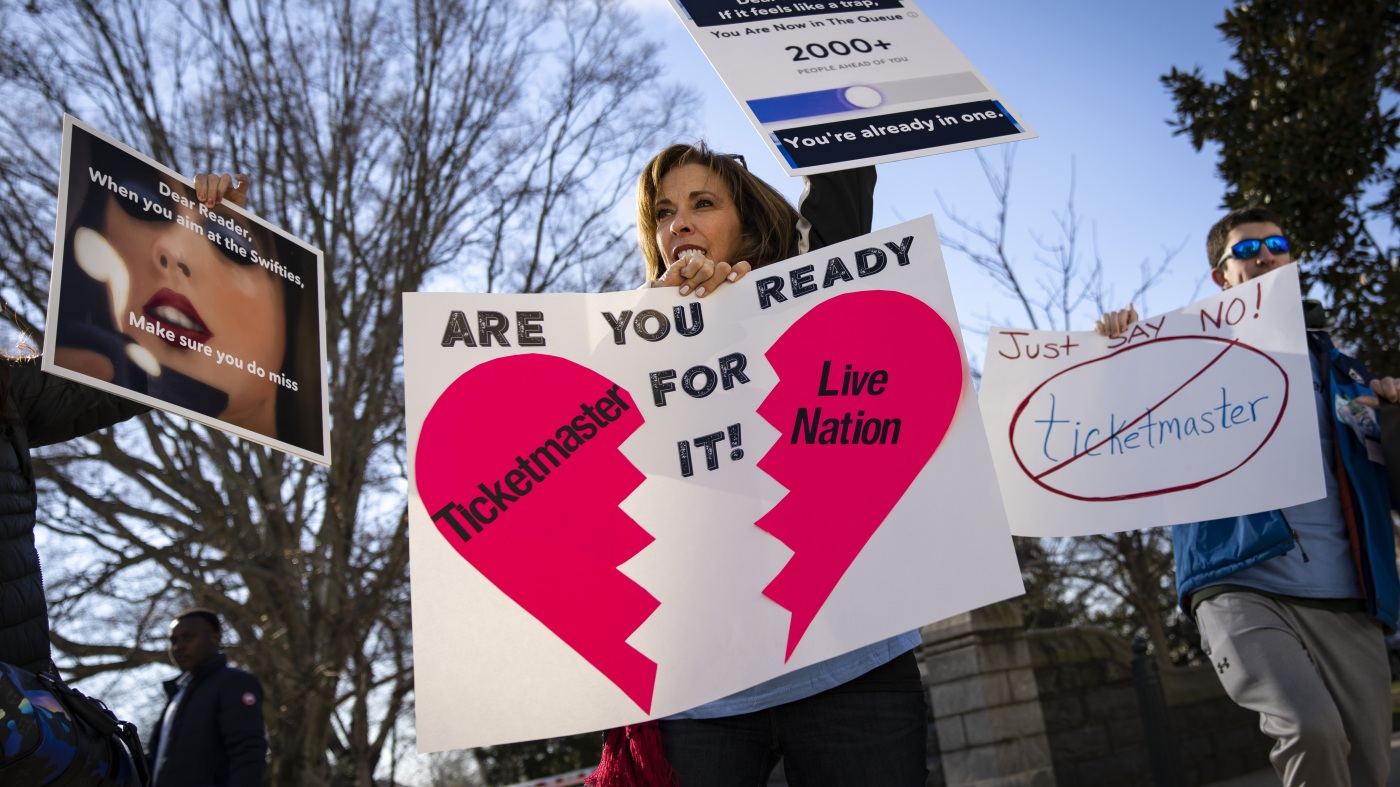
Penny Harrison and her son Parker Harrison rally against the live entertainment ticket industry outside the U.S. Capitol last year.
Drew Angerer/Getty Images/Getty Images North America
hide caption
toggle caption
Drew Angerer/Getty Images/Getty Images North America
The Department of Justice and 30 state and district attorneys general across the country filed a federal lawsuit Thursday against Live Nation Entertainment and its wholly owned subsidiary Ticketmaster. The suit alleges that Live Nation has created a monopoly on live event ticket prices across the United States. The civil antitrust suit was filed in the Southern District of New York.
This fight has been long in coming: Music fans and other consumers, performers, independent venues and even members of Congress have argued that Ticketmaster, which merged with Live Nation in 2010, had artificially pushed ticket prices sky-high. Live Nation has long been a dominant player in the live event marketplace, with substantial holdings in venues, concert promotions, music festivals, ticketing, sponsorship, advertising and artist management – holding so much power across so many aspects of the business, the Justice Department alleges, that it is effectively able to limit its competition.
If successful, this suit could reshape the live event landscape – and the prices fans pay to see their favorite performers – across the country.
The state and district attorneys general joining the suit include several states that are home to major live event venues, including those of New York, California, Colorado, Florida and Texas.
In a lengthy statement provided to NPR on Thursday, Live Nation wrote in part: “The DOJ’s lawsuit won’t solve the issues fans care about relating to ticket prices, service fees, and access to in-demand shows. Calling Ticketmaster a monopoly may be a PR win for the DOJ in the short term, but it will lose in court because it ignores the basic economics of live entertainment, such as the fact that the bulk of service fees got to venues, and that competition has steadily eroded Ticketmaster’s market share and profit margin.”
Within the suit, the Department of Justice and the states allege that Live Nation and Ticketmaster engaged in several forms of anticompetitive conduct, including retaliating against other promotion companies and venues that worked with its rivals; locking out competitors with long-term, exclusive ticketing contracts; restricting musicians’ access to live event venues; and strategically acquiring smaller, independent companies that Live Nation allegedly perceived as threats to its dominance.
Earlier this month, in a bid to increase transparency for consumers, the House of Representatives passed the TICKET Act, which would force Live Nation and other ticket sellers to list all the costs and fees within a live event ticket price. The bill, which was introduced in the Senate by Ted Cruz of Texas, has been supported by hundreds of prominent musicians, including Billie Eilish, Dave Matthews and Nile Rodgers, who wrote in a joint statement: “We are joining together to say that the current system is broken: predatory resellers and secondary platforms engage in deceptive ticketing practices to inflate ticket prices and deprive fans of the chance to see their favorite artists at a fair price.”
According to Thursday’s filing, Live Nation Entertainment currently owns or controls over 250 concert venues across North America, and controls around 60 percent of concert promotions at major concert venues across the U.S. The company also directly manages more than 400 musical acts.
In the suit, the Department of Justice and the states asserted: “With this vast scope of power comes influence. Live Nation and its wholly owned subsidiary, Ticketmaster, have used that power and influence to insert themselves at the center and the edges of virtually every aspect of the live music ecosystem.”
“It is time to break up Live Nation-Ticketmaster,” said Attorney General Merrick Garland in a statement.
In the past, and again in its statement to NPR on Thursday, Live Nation argued that musicians — not its own company — are the ones to ultimately set their own ticket prices. Live Nation executive vice president of corporate and regulatory affairs Dan Wall said that the suit “ignores everything that is actually responsible for higher ticket prices, from increasing production costs to artist popularity, to 24/7 online ticket scalping that reveals the public’s willingness to pay far more than [what] primary tickets cost.”
“It is not surprising that Live Nation has pointed its finger at artists,” a senior Justice official said on background on Thursday morning. “In an industry in which artists have historically been squeezed for compensation for their creative work, it’s important that artists are properly compensated.”
“To us, that’s a little bit of a red herring,” the official continued, referring to Live Nation’s previous argument. “How is the system set up? How is Live Nation’s control at all levels of the system allowing for a process that’s distorted in part by Live Nation’s power?”
The DOJ is pressing for “structural relief” – that is, it is asking the federal court to break up the Live Nation-Ticketmaster combined company, which the DOJ itself had approved in the 2010 merger. Justice Department officials are now arguing that since the merger, Live Nation has created a stranglehold on the live event industry.
Thursday’s case is the latest lawsuit by the Biden administration against major corporations that it has accused of abusing monopoly power. The Justice Department and the Federal Trade Commission have sued Apple, Google and Amazon. They’ve successfully stopped the mergers of publishers Penguin Random House and Simon & Schuster and of JetBlue Airways with Spirit Airlines. They’ve also unraveled a partnership between JetBlue and American Airlines.
Last year, however, federal officials lost their bids to block the merger of Microsoft and videogame giant Activision Blizzard; of Facebook parent Meta with virtual-reality company Within Unlimited; and of insurer UnitedHealth Group with tech firm Change Healthcare.
“While we do not comment on specific enforcement matters, President Biden strongly supports fair and robust enforcement of the antitrust laws,” said White House Press Secretary Karine Jean-Pierre in a statement Thursday. “The President launched the Strike Force on Unfair and Illegal Pricing because no American should pay higher prices or lose choices because companies break the law and engage in anti-competitive practices. His Administration has taken action to fight corporate greed by banning hidden junk fees—including event tickets—that unfairly increase prices for hardworking families trying to make ends meet. As the President has said, the American people are tired of being played for suckers.”
The announcement of the federal antitrust suit against Live Nation is just a first step in what will almost certainly be a long court process, so music fans likely won’t encounter lower ticket prices any time soon.
With additional reporting by Alina Selyukh.


The Late Show with Stephen Colbert on Monday May 18, 2026.
Scott Kowalchyk/CBS Broadcasting Inc.
hide caption
toggle caption
Scott Kowalchyk/CBS Broadcasting Inc.
The Late Show With Stephen Colbert comes to an end this week amid a lot of changes in the business and the country. Some of the sources of tension include the economics of late night, the approaching merger of Paramount and Warner Brothers, and President Donald Trump’s constant criticism of late-night hosts. But for Colbert’s fans, it’s the end of a friendly, funny, candid show. So we’re talking about the legacy of Stephen Colbert in late night.


Kars4Kids advertisements, like this TV commercial on a hot-pink set, feature children turning the charity’s phone number into a catchy jingle. But they do not disclose that most of the proceeds go to a Jewish nonprofit that supports programming for young adults.
Kars4Kids/Screenshot by NPR
hide caption
toggle caption
Kars4Kids/Screenshot by NPR
The “Kars4Kids” jingle — with its chipper melody and high-pitched, pre-tween singers — has been wedged firmly in many Americans’ heads for two decades. But it may soon go off the air in California after a judge banned it for being “deceptive.”

Judge Gassia Apkarian of the Orange County Superior Court ruled earlier this month that the ad violates California’s laws against unfair competition and false advertising because it does not disclose Kars4Kids’ religious affiliation.
The case has put the jingle — and the charity behind it — in the headlines. And it inspired us to check in on some other nostalgic favorites (more on that below).
The Kars4Kids case, explained
Kars4Kids says it gives most of its proceeds from used-car donations to Oorah, an Orthodox Jewish nonprofit based in New Jersey that provides opportunities like summer camps, adult matchmaking services and trips to Israel.
Kars4Kids makes the connection to its “sister nonprofit” clear on its website, though not in its infamous jingle: “1-877-Kars4Kids / K-A-R-S Kars for Kids / 1-877-Kars4Kids / Donate your car today.”
That omission prompted California resident Bruce Puterbaugh to sue Oorah in 2021.
According to the judge’s order, Puterbaugh testified that he donated a 2001 Volvo station wagon after hearing the Kars4Kids advertisement “over and over,” believing the money would benefit California kids in need. Puterbaugh, a self-described “not a computer person” in his 70s, said he never visited the charity’s website and only learned the truth from a casual conversation with his Lake County neighbor after the car was picked up.
“He testified that he felt ‘taken advantage of’ upon discovering — only after the donation — that the funds did not stay in California but supported a specific religious mission in the Northeast,” Apkarian wrote.
The neighbor, Neal Roberts, is a lawyer who went on to represent him in the case. Roberts told NPR that the ad — which has aired on the radio since the turn of the millennium and on TV since 2014 — is ubiquitous in California. But he said Apkarian, the judge in the case, doesn’t watch TV and hadn’t heard the jingle until it was played at the four-day trial in November.
“She heard it the first time, and then she heard it the second time, and then the rule in the court was, ‘Do not play that jingle again,’” he said with a laugh. “So I thought that gave us some idea that we might have a chance.”
According to the judge’s order, Kars4Kids’ Chief Operating Officer Esti Landau confirmed at trial that the charity’s primary function is not helping economically disadvantaged children but “Jewish kids and families throughout their lives.” She said the charity has “no functional programs in California beyond a ‘backpack giveaway’ characterized as a branding exercise,” the judge wrote.
Landau confirmed on the stand that in 2022 — among other expenditures — Oorah transferred $16,500,000 to North Africa and the Middle East, and spent $16.5 million to purchase a building in Israel. She testified that while the Kars4Kids ad features kids ages 8 to 10, the programs Oorah funds “often target young adults (17-18) and matchmaking as well as Jewish families.” And she conceded that a donor would “have to go to the website” for that information.
Neither Kars4Kids nor Oorah responded to NPR’s requests for comment. But in a lengthy statement on its website, Kars4Kids said the judge mischaracterized its work and its testimony at trial.
“Kars4Kids’ ads have one purpose: to remind listeners that Kars4Kids offers a quick and easy way to dispose of an unused vehicle,” it wrote. “The ads are targeted to vehicle owners, not specifically to people considering donating to charity.”
The charity said “helping children often means engaging parents and families as well,” and stressed that its mission and religious affiliation are prominently stated on its website.
But the judge ultimately sided with Puterbaugh, writing that “a reasonable consumer is not required to be ‘computer savvy.’” She gave the charity 30 days to stop airing the ad in California unless it is updated to include an “audible disclosure of its religious affiliation and the geographic location of its primary beneficiaries and the age of the beneficiaries.”
The judge also ordered the charity to pay Puterbaugh $250, the value of the car he donated, though acknowledged that “money cannot ‘un-donate’ a car or restore the donor’s belief that they were helping a local, needy child.”
Kars4Kids says on its website that it plans to appeal the ruling, which it said is “deeply flawed, ignores and misrepresents the facts that were presented at trial, and misapplies the law.”
The charity also called the case as “a lawyer-driven attempt to siphon off charitable funds for their own gain.” Roberts dismissed that accusation, saying the only money his client stands to gain is the $250 for the car and lawyers’ fees. The bigger win, he said, is putting Kar4Kids — and potentially other charities nationwide — on notice about the consequences of false advertising.
“I think anyone who knows the facts would think that there was wool being pulled over people’s eyes,” Roberts said.
Where are they now?
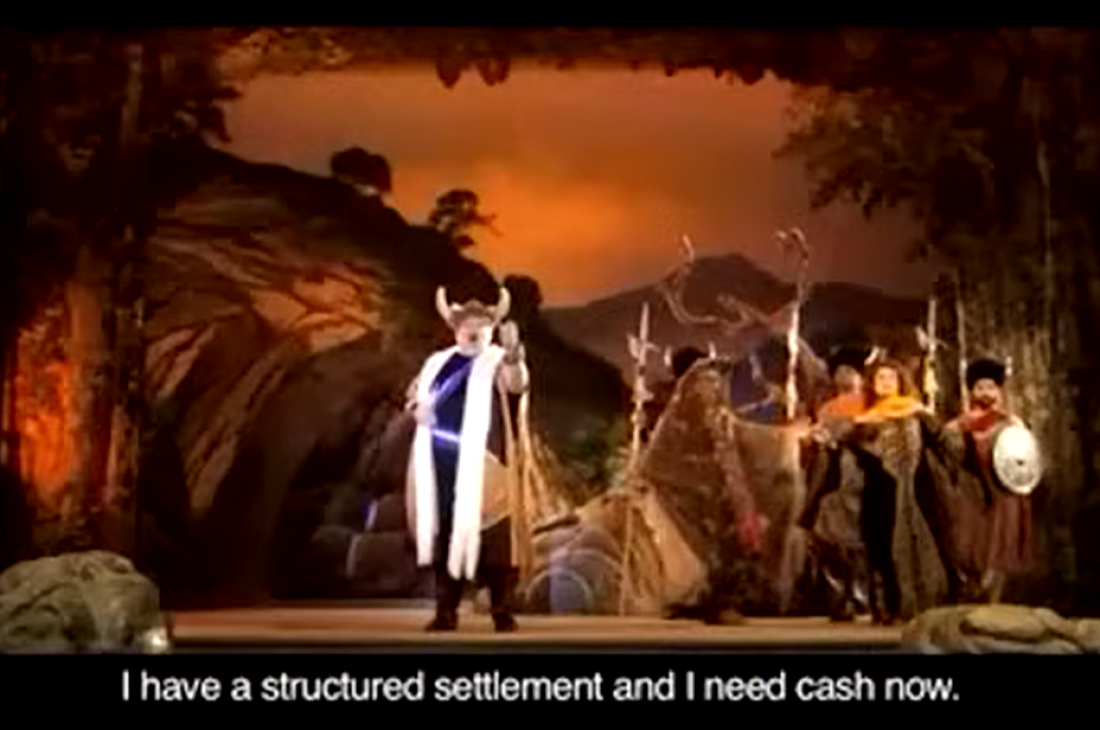
J.G. Wentworth’s catchy “Viking Opera” commercial, featuring elaborately costumed, structured settlement-winning opera singers in need of cash, has been airing on and off since 2008.
J.G. Wentworth/Screenshot by NPR
hide caption
toggle caption
J.G. Wentworth/Screenshot by NPR
This story sent us down a head-bopping rabbit hole of nostalgic jingles, confirming they never truly leave the depths of your brain. And it turns out, some of them are — in a sense — new again.
Remember Zoo Pals, the early-aughts, dipping sauce-friendly paper plates shaped like animals (pig, bee, frog, duck) that, per their peppy theme song, “make eating fun!”? Hefty discontinued the onetime birthday-party staple in 2014, but brought the plates back in 2023 — and has also introduced disposable cups and plastic bags in the years since. No word yet on whether the commercial might make a comeback too.
Folgers, the coffee brand, has had people humming “The best part of wakin’ up / is Folgers in your cup” since the cozy jingle first aired in 1984. Its various iterations have managed to hold viewers’ attention in the years since (the 2009 sibling version inspired a slew of parodies and fan fiction). In 2021, public performance royalties for the song — which is actually titled “Real Snowy Morning” — were auctioned off online. The winning bidder, identified as “Josh C.,” paid $90,500.
And earlier this year, the brand released remixed versions of the ad, fusing the original jingle with several popular wake-up songs spanning genres and generations (including the Everly Brothers’ “Wake Up Little Susie” and “Bring Me to Life” by Evanescence).
Just this week, comedian John Oliver parodied JG Wentworth’s Viking opera (“877-cash-now”) jingle for an episode examining the structured settlement factoring industry. Oliver’s version, warning people to be skeptical of such companies, features stars like singer Megan Hilty, actor Victor Garber and Larry David, in a nod to the original earworm’s prominent cameo in the final season of Curb Your Enthusiasm.
Sometimes a jingle outlives the very thing it’s advertising. Consider: “I’m a Toys R Us Kid,” the toy store ditty belted enthusiastically by generations of trike-riding kiddos since the 1980s. The franchise shuttered due to bankruptcy in 2018, though it has since been partially revived through a partnership with Macy’s. The jingle has staying power — much to the delight of prolific thriller author James Patterson, who helped write the lyrics in his early career in advertising.
“That’s a big moment in my life,” Patterson said when asked about it in a 2024 appearance on Live with Kelly and Mark. “That’s a fun one, and kids obviously loved it. And we do remember it, which is great.”
-

 Florida4 minutes ago
Man who stabbed woman, her daughter to death in Coral Springs to be executed
-

 Georgia10 minutes ago
What channel is Tennessee softball vs Georgia on today? Time, TV schedule to watch Knoxville Super Regional Game 1
-

 Hawaii16 minutes ago
General plan bill advances in County Council – West Hawaii Today
-

 Idaho22 minutes ago
Montana Tech, Idaho National Laboratory sign partnership agreement
-

 Illinois28 minutes ago
1 dead, 3 injured after interstate crash in Morton, State Police say
-

 Indiana34 minutes ago
These former Indiana high school softball players are in NCAA Super Regionals
-

 Iowa40 minutes ago
Crews respond to fire near Eastern Iowa Airport
-

 Kansas46 minutes ago
Damp at times into the holiday weekend

