Lifestyle
The magical California state park that doesn't allow visitors

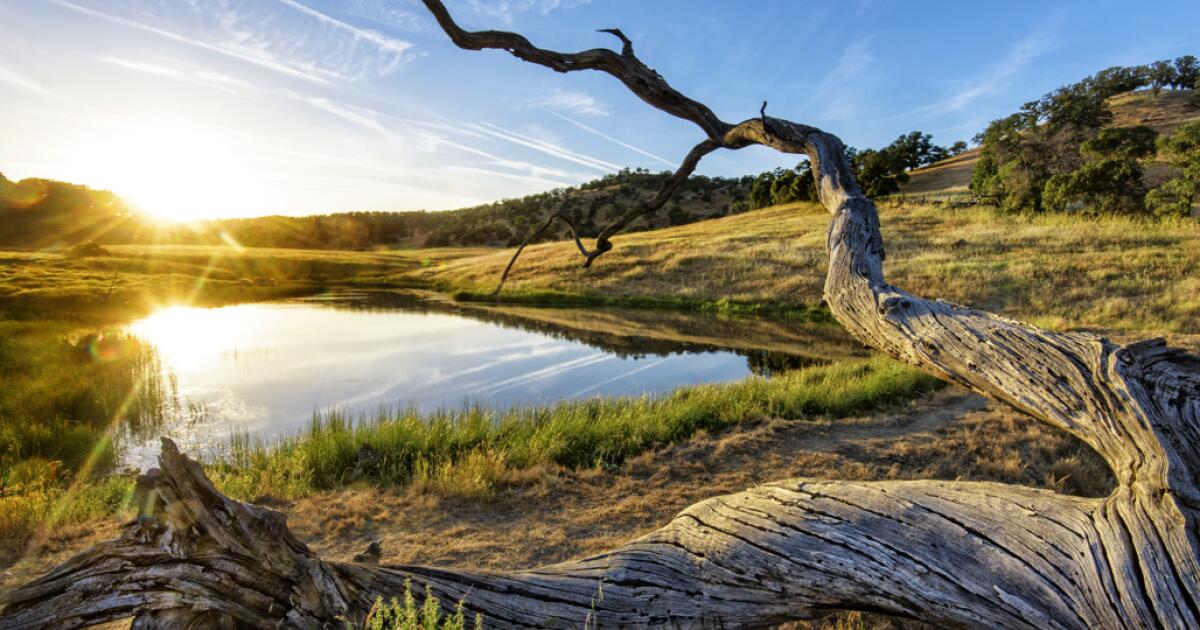
About 60 miles north of Sacramento, the Sutter Buttes rise starkly from the floor of the Central Valley, the remnants of a volcano active more than 1.4 million years ago. Their cathedral-like spires twist upward, some reaching more than 2,000 feet into the sky — an imposing circular formation, 10 miles in diameter, that’s been called “the smallest mountain range in the world.”
Sheltered within these lava domes is an oasis of rolling hills, rich with wildflowers and Native American artifacts, and watched over by hawks and countless other species of birds.
Bitter debates over the lack of public access to the Sutter Buttes have roiled for years. But most everyone on both sides agrees on this: They encompass some of the most magical and otherworldly terrain in California. Long sacred to Native American tribes, the formation is now home mainly to cattle that chomp grass behind stone walls built by Chinese laborers more than a century ago, oblivious to the fact that some people want to throw open the gates and some want to keep them locked forever.
For the last two decades, the Sutter Buttes have also been home to a California state park that almost no one is allowed to visit.
For the record:
7:30 a.m. May 20, 2024An earlier version of this article misspelled the last name of the famed landscape architect who helped establish the National Park Service as Frederick Law Olmstead Jr. His last name is spelled Olmsted.
In 2003, the state of California spent about $3 million to buy 1,800 acres on the north side of the buttes, including an idyllic stretch of emerald called “Peace Valley.” The government has eyed a park in this ruggedly beautiful landscape since the inception of the state parks system in the 1920s. Frederick Law Olmsted Jr., the famed landscape architect who helped establish the National Park Service and also surveyed potential parkland for California in those early years, put it on a state park wish list, along with such gems as Point Lobos on the Monterey County coast and Donner Lake in Northern California.
In 2005, the state finally achieved its goal — sort of. The State Park and Recreation Commission officially declared its 1,785 acres a park. The property has its own state-sponsored webpage and a budget for conservation and maintenance.
What it does not have is any way for the public to get in.
“Please note: There is currently no public access point to enter this park,” reads a notice in big red letters at the top of the webpage.
Beneath that are breathtaking photos: sunlight glinting off a placid lake; a dirt road leading up a verdant hill; a haunting photo of the buttes at sunset — from a distance.
That last image — the one from a distance — is the only way most people can view the park.
Most of the land in the Sutter Buttes is held by a handful of families, some with holdings dating to the 19th century, who use the fields to graze cattle and sheep.
(Brian Baer / California State Parks)
The issue, according to current and former parks officials, is that all the roads leading into the Sutter Buttes are privately owned. And none of the landowners — some of whom have had title to the land since before California entered the union — will give the state permission to use those roads for park visitors. Nor has the state found anyone willing to sell them property near a public road that could be used to access the park.
With the impasse in its 20th year, state officials instead allow a few people into the park on occasion for carefully guided visits.
State parks officials were not available for an interview to discuss the situation, but said in a statement that the department “continues to look for opportunities to either secure land or easements to provide access.” So far, nothing has come up.
Many locals say the current status — an empty state park — suits them just fine. The Sutter Buttes are a precious ecosystem, they say, filled with delicate tribal artifacts and threatened species. It isn’t the same, they argue, as a state park in the immense Sierra Nevada or vast inland deserts or along the glittering coast.
“This little blob in the middle of the Sacramento Valley is so sensitive to encroachment,” said Marty Steidlmayer, 59, whose family has owned land in the Sutter Buttes since the 1930s. A state park, he said, would “let people in, free and unattended,” which could lead to vandalism, fires and degradation. “It’s not a good idea,” he said.
Sutter County Supervisor Mat Conant agreed. “It is more important to protect those land rights,” he said, noting that “some families have held that land for close to 200 years.”
Francis Coats is one of the few local landowners who think the state needs to find a way to let in the public.
“It’s absolutely beyond me why it’s not open,” said Coats, whose family has been in the area since the 19th century. Coats said he owns a small interest in 160 acres on the north side of South Butte, and so strong is the antipathy toward access that he faced death threats when he first tried to visit his own parcel.
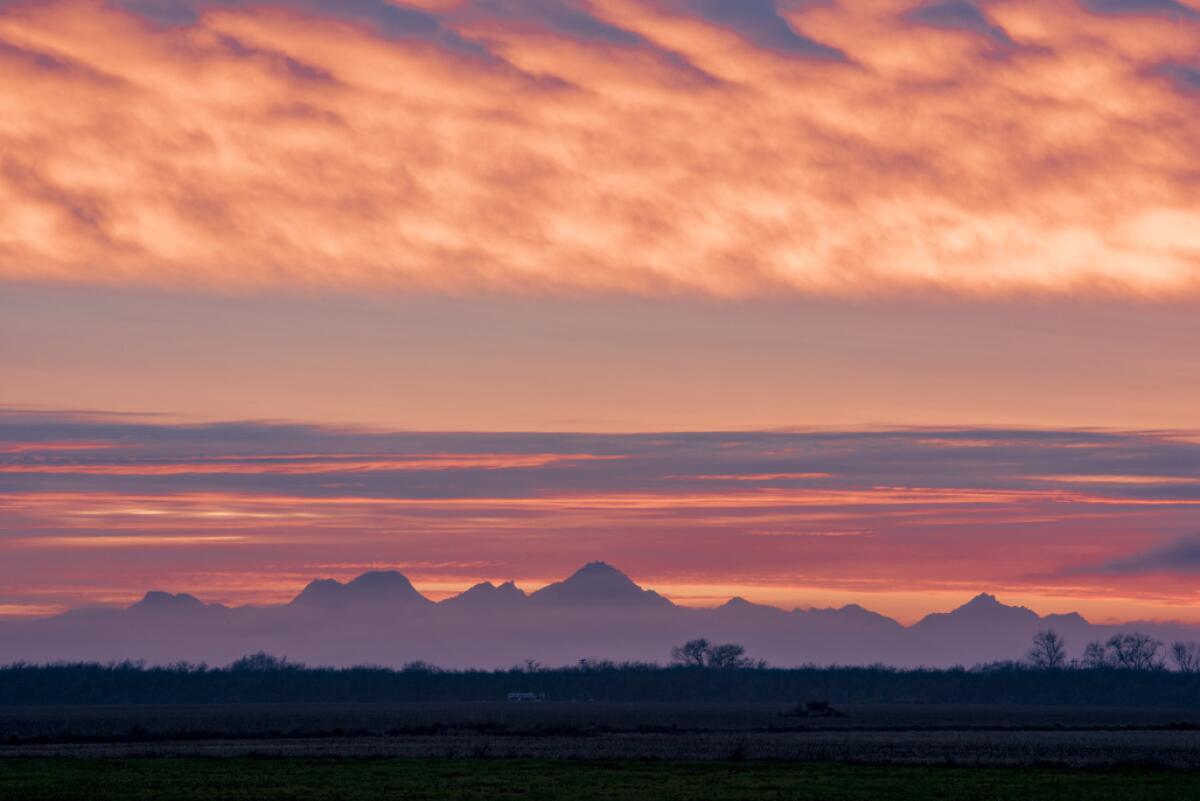
Debates over the lack of public access to the Sutter Buttes have roiled for years. But both sides agree the buttes encompass some of the most magical terrain in California.
(Brian Baer / California State Parks)
The Sutter Buttes, though little heralded in modern-day California, have played an outsize role in the state’s history.
The Maidu people took refuge there for thousands of years during periods when the Sacramento Valley flooded. They believed it was a resting point for spirits on their journey to the afterlife.
In the 1840s, Kit Carson and Gen. John C. Fremont, fresh from their savage massacres of Native Americans in the north state, hid out in the buttes and plotted to seize California from Mexico. Then they headed to Sonoma County to lend support to the Bear Flag Revolt of 1846. Their Republic of California was short-lived, but helped stoke the Mexican-American War, which paved the way for California to join the United States.
When state officials first proposed a park in the Sutter Buttes in the 1920s, local newspapers took the opportunity to celebrate this history.
“These rugged hills hold a prized place in the hearts of Californians,” the Sacramento Union wrote in 1931. “They are indelibly linked with the romance of the state’s secession from Mexican rule.”
The park didn’t come to fruition then, and the Depression and World War II created other priorities.
The state tried again in the 1970s, putting money in a parks bond to fund the purchase of tens of thousands of acres in the Sutter Buttes. Local landowners were horrified, and the county Board of Supervisors voted in opposition. “We’ll fight them, right down the line,” Supervisor J.A. Bagley told the local newspaper.
The state backed down. But within the parks department, some never dropped the dream.
The department’s chief of land acquisition, Warren Westrup, knew how to play a long game. Westrup, who worked for the state for 37 years, figured out how to put together parcels of land, piece by piece, until a vision came to fruition.
He did it in the Santa Monica Mountains, where state officials devised ways to purchase land for a trail that connects communities from Los Angeles to Malibu; and in Chino Hills, buying one canyon after another until eventually a whole park came to fruition.
In 2003, Westrup heard through an intermediary that someone with land in the buttes was looking to sell. He arranged for its purchase, even though he was aware the property was surrounded by private land blocked by private gates and accessible only via a private road.
Parks officials moved forward to establish the park with the notion that they eventually could persuade someone else to sell them land adjacent to a public road, where they could build a parking lot, bathrooms and maybe a few tents for people to camp.
The problem: No one would sell.
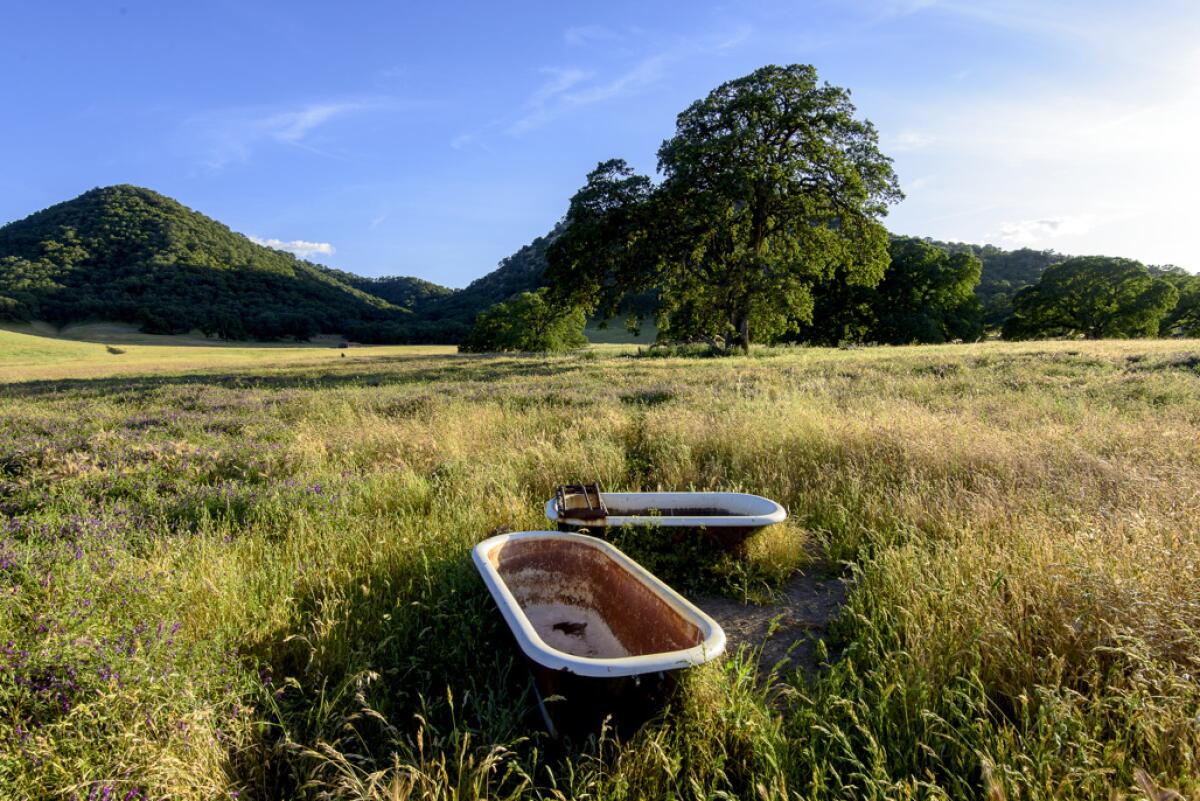
Government officials have pursued a park in the Sutter Buttes since the inception of the state parks system in the 1920s.
(Brian Baer / California State Parks)
Most of the land in the buttes is held by a small number of legacy families who primarily use the fields for grazing cattle and sheep. No one lives in the interior, although there are a few homes on the outside.
After the state pushed for a park in the 1970s, some landowners feared the government might take their property. To stave that off, they began providing guided tours that granted limited access to the public and also to researchers. Local schoolchildren were also invited in.
They hired a manager, who moved into a cabin for the job, along with his wife, their golden retriever and their cat. They fell in love with the quiet grandeur of the area — all except for the cat, who was snatched by an eagle and never seen again.
“Some places just attract us more powerfully than others,” Walt Anderson, the manager, explained in a 2006 oral history. “I mean, everybody loves the profile of the buttes when they pass it, but once they get inside, I mean, they’re hooked.”
Steidlmayer, who owns land adjacent to the state park, said officials have told him “that the state will buy anything that we would be willing to sell. But that is the last thing my family would ever do.”
Even some outdoor enthusiasts have reservations about opening the park.
Lisa Lindman, executive director of the Sutter Buttes Regional Land Trust, said she has come to view the issue as “really complicated.”
She wants the public to be able to appreciate the peace and beauty of the buttes, but echoed landowners’ concerns about the delicate ecosystem and centuries-old Native American artifacts that remain largely untouched.
In lieu of full public access, Middle Mountain Interpretive Hikes, a sister organization to Lindman’s land trust, leads private tours for small groups of people who pay about $35 apiece for a carefully supervised hike. Reservations can be hard to come by. The Middle Mountain hikes do not enter the state parkland. Instead, they traverse private land near the park under a long-standing agreement with landowners that grew out of those early tours from the 1970s.
On a recent spring day, a tour group wound up dirt roads and through locked gates in a small caravan of cars, before parking near the center of the range. Volcanic domes rose above a green meadow. Wind rustled through the grass. A flock of snow geese passed overhead, their silver wings gleaming against a blue sky.
From atop the lava domes, it was possible to see Mt. Lassen and Mt. Shasta. The snow-capped Sierra stood to the east. After a precarious scramble down, group members traversed the grassy base of the domes and came to the edge of the state park at Peace Valley. A guide warned the tour group they did not have permission to enter.
Ruth Coleman, who was head of the Department of Parks and Recreation when the site was designated a state park, said she hopes California will keep pushing to find a way to change that, while putting measures in place to preserve the land.
“It’s classified as a state park. And a state park has access,” Coleman said, adding: “I’ve been there. … It’s magic.”


The Kennedy Center, the facade of which remains covered with a tarp, is seen in Washington, DC, on June 28, 2026. A US federal judge asked on June 24 for an explanation for why a tarpaulin continues to cover the facade of the Kennedy Center where President Donald Trump’s name was recently removed. District Judge Christopher Cooper gave the board of trustees of the performing arts venue until the end of July to explain “the purpose for and status of the tarp and scaffolding that Defendants have erected on the front portico of the Center.”
ALEX WROBLEWSKI/AFP via Getty Images
hide caption
toggle caption
ALEX WROBLEWSKI/AFP via Getty Images
More than two weeks ago, President Trump’s name was removed from the Kennedy Center facade though it is still covered by a tarp and the legal battle continues.
On Monday, a U.S. Department of Justice filing on behalf of the Kennedy Center included some surprises. The document was submitted in response to issues raised by lawyers for ex-officio board member Rep. Joyce Beatty of Ohio who is suing to remove President Trump’s name from the center and stop its closure for renovations.
Among the revelations, the Kennedy Center admitted that, during a board meeting on December 18, 2025, Beatty had been “muted and prevented from speaking.” It was at that meeting that the board voted to add President Trump’s name to the center. The filing later acknowledges the congresswoman was “prevented from voicing her opposition.”
The John F. Kennedy Center for the Performing Arts is a living memorial to its namesake. The guidelines for how the theatre complex spends federal dollars are very specific. Among other rules, it states that “no additional memorials or plaques shall be designated or installed.” Beatty argues adding Trump’s name runs afoul of those rules and that any change requires approval from Congress.
According to one of Beatty’s filings, “There was no advance notice in the agenda that the Board would be considering a name change,” a statement the Kennedy Center now does not deny. The center admits that, prior to voting, there was “no discussion about potential risks or downsides of the vote to adopt a secondary name for the Center.” Nor was there a board discussion “about any potential conflict of interest that might result from the vote.”
The center’s lawyers previously contended that if Trump’s name were to be removed, it would “lose money from donors who support” him and “impede the Center’s fundraising efforts.”
Closing for renovations
Earlier this year, Trump announced on social media that the Kennedy Center would close for two years for renovations. He wrote that he made the decision after “a one year review” with “Contractors, Musical Experts, Art Institutions, and other Advisors and Consultants.”
But, according to the center’s lawyers, Trump’s announcement “was made without presenting any plans, analyses, timelines, or funding information to his cotrustees and without any Board vote.”
The Kennedy Center has long denied reporting by The Washington Post that ticket sales plummeted after President Trump became the Center’s board chair. In Monday’s legal filing, the Center admits that, by October 2025, “nearly half of the Center’s tickets were going unsold.”


Paul Tremblay has made a career of pushing the horror genre – and the novel format – in strange and exciting new directions.
In his latest, Dead but Dreaming of Electric Sheep, the author offers an amalgamation of genre elements that can be best described as psychological-dystopian-science-fiction horror. It’s a mouthful, but the narrative does all of that and more in a way that defies categorization.
Julia Flang is a former semiprofessional gamer working two mediocre jobs she dislikes and living in a modest ranch house in a San Fernando Valley suburb with her retired uncle, whom she calls Uncle Fun. Julia likes movies and gaming but there’s little else going on in her life, so when her estranged mother, the CFO of a large tech company, contacts her with a possible job offer – a “once-in-a-lifetime thing” that pays handsomely just for doing the interview – she hesitantly agrees.

The job is relatively simple and perfect for someone with gaming skills: using a controller built into a phone to get a man, who is stuck in a vegetative state, from California to the East Coast. It will require her to learn how to control his body – walking, moving, sitting, standing, using his arms – so she can maneuver him out of the facility where he is located and into cars and planes and through crowded airports. A fan of movies, Julia decides to call the man Bernie – after the movie Weekend at Bernie’s. When the ethics of the job start to bother her, Julia realizes it’s too late and she must go through with it. However, she’s soon contacted by people interested in sabotaging the whole thing, people who, like her, don’t align with the shady interests of conglomerates and those set to make “gobs of money” from this new, somewhat inhuman technology.

As with every Tremblay novel, any synopsis barely scratches the surface. The novel’s chapters alternate between Julia and you (yes, you). Julia’s chapters are “normal” in the sense that they obey a chronological order and have action, basic descriptions of movement and places, and dialogue. The chapters in second person are like fever dreams from a shadow world; the desperate experiences of a man trapped inside his own body with no control of it, no clue what’s happening to him, and only a few fragmented memories of his life. Also, Tremblay uses a similarly fragmented style of storytelling (including words and sentences trapped in boxes and/or “moving” on the page) to keep things interesting but also confusing and creepy.
This novel operates on several different levels and – planes of existence? Bernie has a head full of AI that controls his body, but his consciousness is still there and struggling to regain control, struggling to remember things. There are monsters, leeches, mysterious rabbits, and eerie shadows in his world, but the true horror comes from the lack of control, from being moved around against his will and having no clue what comes next. Bernie is the embodiment of losing control to AI, and when taken together with the commentary of creativity and AI and the meta interludes in which the author takes a wrecking ball to the fourth wall and addresses readers, this is the best anti-Generative AI story horror has produced so far.
Despite the horror of it, this is a very funny novel. Julia is sarcastic and struggles to keep her comebacks in line, but the conversations she has and messages she writes are always entertaining. However, the humor is far from the crown jewel here. That title belongs to a plethora of big ideas Tremblay juggles. The nature of life, death, and consciousness, the evils of conglomerates, inhuman practices in the name of capitalism, and AI, and even what it means to be human are all explored here: “Is Bernie alive? Is he feeling pain? Is he experiencing everything as a prisoner looking through the bars of his body? Has his consciousness been winnowed to a metaphysical keyhole? Where does consciousness begin or end?” There are no definite answers here, but the way Tremblay infuses humanity, love, the importance of relationships, and humor throughout the narrative provides the kind of answers that can’t and don’t need to be spelled out.
A genre-bender full of big ideas that constantly switches between a world full of real or uncomfortably plausible nightmares and a bizarre hellscape in which loss of self, memory, and autonomy are only the tip of the proverbial iceberg, Dead but Dreaming of Electric Sheep is a horrific and terrifyingly disorienting novel that invites readers to consider a future that already started. Tremblay has always been an innovator, but this beautifully written collection of real and imagined grotesqueries cements him not only as one of the most original and exciting voices in horror but also as one of the smartest, most engaging authors in contemporary fiction.
Gabino Iglesias is an author, book reviewer and professor living in Austin, Texas. Find him on X, formerly Twitter, at @Gabino_Iglesias.

-

 Arizona5 minutes ago
Proposed data centers, ICE facility create mixed emotions in rural Arizona town
-

 Arkansas8 minutes ago
Central Arkansas bike trail breaks ground in Cabot – The Arkansas Leader
-

 California13 minutes ago
California bill to block registered sex offenders from local office rejected by Senate committee
-

 Colorado20 minutes ago
Where to watch Miami Marlins vs Colorado Rockies: TV channel, start time, streaming for July 1
-

 Connecticut23 minutes ago
Lamont signs law in Norwich to stop pay to contractors violating wages
-

 Delaware28 minutes ago
Delaware has gotten these 15 verbal commitments from football recruits
-
 Florida35 minutes ago
Kids with autism are prone to drowning. Florida is trying to prevent that
-

 Georgia38 minutes ago
Bradenton man wanted for murder is found hiding in Georgia

