Science
Column: Democrats show that they're no better than Trump in allowing politics to interfere with science

Anyone who cares about the importance of science in the making of government policy had to be deeply dispirited by the hearing into the origins of COVID-19 staged by a Republican-led House subcommittee on May 1.
The sole witness at the hearing, and its target, was Peter Daszak, the head of EcoHealth Alliance, a nongovernmental organization tasked with overseeing international virus research funded by federal agencies.
It wasn’t just that the GOP majority used the occasion to promote the ignorant, imbecilic and 100% evidence-free notion that SARS-CoV-2, the virus that caused the COVID pandemic, originated in a Chinese laboratory, through work funded by the U.S. government, and overseen by EcoHealth.
Science is a myth-buster…Because of this, science has become a nuisance, even an enemy to some industries and many of the most powerful actors in the new attention economy.
— Science blogger Philipp Markolin
It was that the Democratic minority showed itself to be complicit with the GOP attack on EcoHealth.
As I wrote at the time, the Democrats threw Daszak and by extension science itself under the bus: “Perhaps they hoped that by allowing Daszak to be drawn and quartered, they might persuade the Republicans to climb down from their evidence-free claims about government complicity in the pandemic’s origins.”
The Democrats’ craven and shameful performance hinted that EcoHealth’s government funding, which had been blocked by the Trump administration and restored, though delayed, under Biden, was pretty much doomed.
On Wednesday, the bell tolled. EcoHealth received a notice from the Department of Health and Human Services, the parent agency of the NIH, that it was immediately suspending all funding to the organization and moving to “debar” it from federal funding going forward.
It’s impossible to overstate what a serious blow this is for EcoHealth and research into the origins of pathogens that could cause illness and death on a global scale — the central purpose of EcoHealth’s work.
The organization, which has operated with a budget of about $16 million, cannot receive a contract from any federal agency or even serve as a subcontractor of another awardee. All organizations with federal contracts that have affiliated with EcoHealth will be “carefully examined.”
EcoHealth says it will appeal the proposed debarment, as is its right. But that process could take years. In the meantime, the organization will be effectively out of money, and very likely out of business. The HHS action effectively turns one of the leading organizations in the quest to protect humankind from the next pandemic into a pariah, completely unjustifiably.
The debarment threat “will mean the demise of EcoHealth, one of the most scientifically productive and internationally respected groups conducting field surveillance for potential pandemic viruses,” says Gerald T. Keusch, a former associate director of international research at the NIH. “And that means our national security will be compromised.”
Let’s be clear about what has happened here. EcoHealth has been made a scapegoat for the pandemic for partisan reasons. The process started with President Trump. At a news conference on April 17, 2020, a reporter from a right-wing organization mentioned that the NIH had given a $3.7-million grant to the Wuhan Institute of Virology. (Actually, the WIV grant, which was channeled from a larger EcoHealth grant, was only $600,000.)
Trump, sensing an opportunity to show a strong hand against China and advance his effort to blame the Chinese for the pandemic, responded: “We will end that grant very quickly.” The NIH terminated the grant one week later, prompting a backlash from the scientific community, including an open letter signed by 77 Nobel laureates who saw the action as a flagrantly partisan interference in government funding of scientific research.
The HHS inspector general found the termination to be “improper.” The NIH reinstated the grant, but immediately suspended it until EcoHealth met several conditions that were manifestly beyond its capability, as they involved its demanding information from the Chinese government that it had no right to receive. The grant was reinstated last year under Biden, but NIH bureaucrats, perhaps worried about their careers in a new Trump administration, continued to put administrative obstacles in the way of EcoHealth’s work.
The attacks on Daszak and his organization are simply instruments of the GOP project to pin blame for the pandemic on Anthony Fauci, one of the world’s most respected public health figures.
The context is a battle for the minds of uninformed and misinformed Americans over the origin of COVID-19. The hypothesis favored by most qualified virologists and epidemiologists is that the virus reached humans the way most viruses do — as spillovers from wildlife. The alternative hypothesis, for which absolutely not a speck of evidence has ever been presented, is that the virus emerged from a laboratory—specifically the Wuhan Institute of Virology in China, whether deliberately or through sloppy lab practices.
The latter hypothesis was initially promoted by an anti-China cabal in the Trump-era State Department. Although they never produced any grounds for the conspiracy theory, it remains favored by anti-vaccine agitators and in the Republican anti-science camp. It has a certain appeal for uninformed people susceptible to sinister explanations of complicated, troubling events; but it’s not science.
Daszak calls the government actions “fundamentally unfair” and “based on a set of false assumptions about COVID-19 origins and on persistent mischaracterizations and misunderstandings of our research…Our work has been at the forefront of understanding pandemic risk for over two decades, and it’s a very cruel irony that because we knew that China was a potential hotspot for the next coronavirus pandemic, we’re now being targeted in a political backlash caused by exactly the type of pandemic we were concerned about preventing.”
An outgrowth of the lab-leak fantasy is the asinine claim that as head of the National Institute of Allergy and Infectious Diseases, Fauci funded research in China that created the pandemic virus and let it loose on the world, and then concealed his complicity. This is a favorite meme among lab-leak fanatics. Among the research bodies that received NIAID funding to conduct field work in China was EcoHealth. (Fauci retired last year as director of NIAID, which is part of the National Institutes of Health.)
On May 1, the GOP-led Select Subcommittee on the Coronavirus Pandemic brought things to a head with its grilling of Daszak. It was a circus featuring posturing politicians intent on smearing Daszak and EcoHealth on the pretext of getting to the bottom of the pandemic’s cause. The committee Democrats participated fully, hammering Daszak as a “poor steward of the taxpayers’ dollars,” based on transparent trivialities.
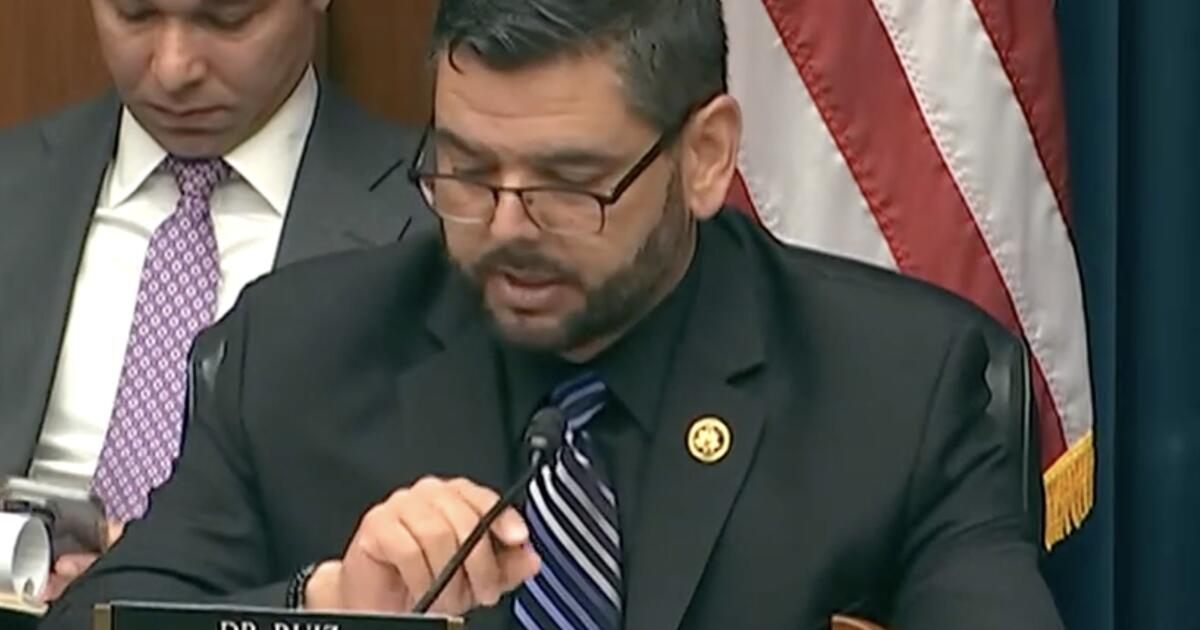
During a follow-up subcommittee hearing Thursday, ranking member Raul Ruiz (D-Indio) alluded to the dishonestly of the GOP attack on Fauci. But, perhaps inadvertently, he also exposed the dishonesty of his caucus’ attack on Daszak.
The committee Republicans, Ruiz said, “still have not succeeded in substantiating their allegations that NIH and NIAID through a grant to EcoHealth Alliance created SARS-CoV-2 and conspired to cover it up. … No evidence demonstrates that work performed under the EcoHealth grants, including at the Wuhan Institute of Virology, led to the creation of SARS-CoV-2.”
Does Ruiz ever listen to the words coming out of his mouth? The very goal of the GOP’s dragging Daszak and EcoHealth into this controversy was to fabricate a link in the chain between Fauci and COVID-19; by rejecting the GOP position, Ruiz demolished the case against EcoHealth.
Yet Ruiz didn’t walk the last mile. “EcoHealth has defied its obligations to be a transparent steward of taxpayer dollars,” he said, repeated the lame case against the organization that he first aired, in connivance with the Republicans, during the public interrogation of Daszak on May 1.
Legitimate scientists, such as virology experts uninfected by the conspiratorial fantasy that the virus originated in the lab, are aghast at the suspension of EcoHealth’s funding and the organization’s likely debarment, as well as the Democrats’ supine behavior.
The Democrats, as Stuart Neil, a professor of virology at Kings College London, wrote on X, “have made some shoddy back room deal to allow them to look tough to the conspiracy theorists.” Neil is right. There is no rational explanation for the Democrats’ behavior than some sort of deal with the Republican majority to give them cover to challenge the lab leak theory.
Put it all together, and it looks like HHS started with a politically driven impulse to cut off EcoHealth’s funding, followed by an effort to assemble every justification for doing so, no matter how trivial. The absurdity of its action drips from the closing words of the notice issued by H. Katrina Brisbon, an HHS “suspension and debarment official.” She wrote that “the immediate suspension of EHA is necessary to protect the public interest and due to a cause of so serious or compelling a nature that it affects EHA’s present responsibility.”
The notice was accompanied by an 11-page bill of particulars, but they all boil down to two key purported offenses — that EcoHealth had missed a 2019 deadline for an annual report of its activities to NIH, and that work EcoHealth had funded in China had produced a recombinant version of a virus that grew fast enough to trigger a safety halt in the work.
The first was tantamount to a traffic violation. EcoHealth maintained that it hadn’t been able to file the report on time because it had been locked out of NIH’s onlline reporting portal, which NIH denies. On the second, there were legitimate disagreements over whether the subject virus’ growth actually did trigger the halt requirement; in any case, the virus wasn’t a threat to human health. The work at issue took place in 2018.
HHS cited several other supposed offenses, including EcoHealth’s failure to submit lab notebooks from the Wuhan institute that NIH has requested in November 2021. But since NIH had ordered EcoHealth to stop funding the institute as of April 2020, those notebooks were plainly out of its reach.
Daszak says EcoHealth will respond to the HHS and the subcommittee “with documentary evidence…refuting every single allegation that’s been levied against us.”
The roots of anti-science slant of Trump and others on the far right isn’t hard to discern. It’s aimed at protecting the economic establishment from new ideas and realities such as global warming, while providing financial and personal opportunities for grifters and charlatans.
Swiss scientist and science blogger Philipp Markolin has put his finger on this phenomenon.
“Science is a myth-buster,” he writes. “Its debunking activity reduces the value of information products that too many media manipulators rely on for their business. Because of this, science has become a nuisance, even an enemy to some industries and many of the most powerful actors in the new attention economy.”
Why did the Democrats agree to participate in this charade? In joining the Daszak smear, they have shredded their credibility as of scientific truth, at the very moment when science is most in need of their protection.
The time has come to ask this question of Ruiz, his Democratic colleagues on the coronavirus subcommittee — Debbie Dingell of Michigan, Kwesi Mfume of Maryland, Deborah Ross of North Carolina, Robert Garcia of Long Beach, Ami Bera of Sacramento and Jill Tokuda of Hawaii — along with Health and Human Services Secretary Xavier Becerra: How can you live with yourselves?


new video loaded: NASA Announces Artemis III Crew
transcript
transcript
NASA Announces Artemis III Crew
NASA announced the crew of Artemis III mission, which will fly to low-Earth orbit to test rendezvous and docking maneuvers with one or two lunar landers.
-
“I am excited to welcome you as the next crew in the Artemis journey to successfully return to the moon — this time to stay.” “I’m honored by the role that I’ve been given. I’m also very humbled by the task in front of us. But first and foremost, I’m grateful.” “So with that, the Artemis II crew, comrade, hands you the baton. You got the controls.” “As you know, we had a significant anomaly at our Launch Complex 36A on May 28. We’ve redoubled our efforts and are moving forward.”
By Alisa Shodiyev Kaff
June 9, 2026
Science
Santa Monica Mountains’ last steelhead trout survived the Palisades fire — and even had babies

Scientists feared the Santa Monica Mountains’ last remaining steelhead trout were dead, smothered by debris flows unleashed by the Palisades fire.
But the endangered fish surprised them: A team of biologists recently spotted 30 of the rare trout — and 21 babies — in Topanga Creek.
“There was a lot of happy dancing in the creek,” said Rosi Dagit, principal conservation biologist for the Resource Conservation District of the Santa Monica Mountains, which works with public and private landowners to conserve natural resources.
That’s because the steelhead here are endangered, at both the state and federal levels. Once, they swam in most streams of the Santa Monicas, but their numbers plummeted amid overfishing and coastal development. Increasingly frequent wildfire has further stressed their habitat. Topanga Creek, a biodiversity hot spot, is home to their last known population in the mountains that stretch from the Hollywood Hills to Point Mugu in Ventura County.
The trout that were spotted, including this one, are part of a distinct Southern California population that’s listed as endangered at the state and federal levels.
(RCDSMM Stream Team)
The California Department of Fish and Wildlife spearheaded a complex mission to rescue trout threatened by the Palisades fire that sparked in January 2025.
Time was of the essence. The fire hadn’t yet been fully contained. But rain was on the way, which would sweep massive amounts of sediment from the denuded hillsides into the water. Fish are often killed this way.
Crews stunned the fish with electricity, scooped them up in buckets, trucked them to a hatchery and ultimately moved them to Arroyo Hondo Creek in Santa Barbara County.
Within days, Topanga Creek was choked with mud. Some assumed the fish left behind were goners.
But in March, the conservation district’s team found four. The following month, when water conditions were clearer, they saw more.
“These fish continue to amaze me,” said Kyle Evans, environmental program manager for the state Department of Fish and Wildlife, who had seen the damage to the creek. “I had seen populations get wiped out in similar situations. So when I heard, I was thrilled.”
Evans surmises the fish that survived were in an area of the creek where less charred material and sediment were swept in.
“These fish likely hunkered down, were hiding under some rocks or places to try to get away from the main concentration of flow,” he said. “And luckily they weren’t buried.”
The ones that were spotted were fairly small, around 6 to 14 inches. Rainbow trout and steelhead trout are the same species, but with different lifestyles. If the fish remain in freshwater, they’ll be considered rainbows. However, they can migrate to the ocean and become steelhead, where they typically grow larger before returning to their natal waters to spawn.
Topanga Creek hasn’t fully recovered from the damage it sustained, but scientists say it’s looking better. Surveys last year were “so depressing,” Dagit said, with very few animals, and stretches that were essentially transformed into flat roads from all the sediment buildup. Some of the riparian canopy burned right down to the creek.
Then came 32 inches of rain over the last nine months, scouring out and moving sediment, creating deeper pools. Dagit said they recently found newt egg masses for the first time in years, as well as a few adult newts and many frogs. Plants that provide cover are starting to recover.
She provided photos comparing certain pools last year and this year, some dramatically transformed. In September 2025, the Shrine Pool could have been an overgrown hiking trail. This April, it was filled with shallow water.

The Shrine Pool in September 2025, left, and the same location in April 2026, right, with RCDSMM’s Isaac Yelchin donning a wetsuit.
(RCDSMM Stream Team)
Topanga Creek is home to another endangered fish, the small but hardy northern tidewater goby, often described as cute. Not long before the trout operation, Dagit led a rescue of hundreds of these fish too. Many were repatriated to the lagoon at the mouth of the creek in a moving ceremony last June.
There’s still the matter of what to do with the trout that were moved to Santa Barbara County last year. Evans would like to bring them home to the Santa Monicas at some point, but isn’t sure if it will happen. On one hand, they could bolster the small, genetically isolated surviving population. On the other, they might inadvertently bring in a disease or bacteria. There is some time to decide. Evans estimates the creek still needs to recover for two to three more years.
For now, the fish are functioning fine in their adopted creek. Experts worried the trauma wrought by the move would disrupt their spawning process, but they had babies that spring. This year, they spawned again.

The Pacifica Municipal Pier was shut down and taped off Thursday after city workers noticed cracks running through the landmark structure and concrete chunks falling into the ocean.
It’s just one of many coastal California structures that have recently crumbled under pressure from a rising and relentless ocean.
Officials from the small, beach city south of San Francisco said the pier was closed due to “cracking, separation, and displacement of the concrete walkway and structural elements.”
It will stay closed while structural engineers asses its safety.
Photos taken by city employees show a wide crack that runs from top to bottom and across the structure as well. Other photos show a large horizontal crack under the foundation of a small restaurant on the pier, the Chit Chat Cafe.
The cafe was also shut down.
This is not the first time the 53-year-old pier has shown signs of stress. In 2021, part of it was shut down after handrails along the edge collapsed. And in 2023, after a series of storms pummeled the Central California coast, damaging parts of the pier, the structure was partially closed for more than year.
Those same storms caused extensive damage in Aptos and Capitola, 70 miles south, where piers and waterfront infrastructure were swept away or damaged.
In 2024, a 150- to 180- foot section of the Santa Cruz wharf was ripped off by powerful waves.
At least 10 of the state’s dozens of coastal public piers were closed for part or all of 2024 due to structural damage sustained in winter storms since 2022. At least five others have longer-term upgrades planned to address structural issues.
“These things are costly to maintain,” said Zach Plopper, senior environmental director at Surfrider. “They are a part of our California coastal culture in many ways, but we’re going to need to reckon with, one, the state that they’re in, and two, the continuous and worsening threats they’re going to experience,”
He said most of the piers were constructed in the early 1900s, and they weren’t built to withstand decades of rough seas, storms and rising sea level.
“With this incoming El Niño, which is forecasted to be significant, and this marine heat wave we’re in the midst of, we’re kind of in uncharted waters as far as what this winter could bring in terms of storms and swells to the California coast, and we’re likely going to see a lot more damage,” he said. “Not just piers, but roads and other coastal infrastructure up and down the state.”
There was no storm in Pacifica earlier this week, so no single event could be blamed for the destruction.
However, a 2025 report from an outside engineering firm, GHD, found that several sections of the pier were in “poor” or “serious” condition, and they recommended closure before anticipated storms or events that could “subject the piles to high winds, swells and large waves.”
The firm found several areas of the pier where concrete was missing and rebar was exposed and corroding.
“The pier has continued to experience high winds and large waves in a harsh marine environment,” the engineers wrote in the report, noting that continuous exposure to seawater or marine spray was “detrimental” to the structure.
A 2023 city report estimated it would cost $19 million to repair.
That same year, a state law was enacted to require local governments along the California coast to plan for sea level rise in the coming decades.
Sea level has risen some 8 inches, on average, along the coast in the past 150 years, Plopper said, and researchers anticipate another foot in the next 25 years.
“We’re going to see profound shifts on our coastline, none that we have ever experienced before, and building static structures on the coast just doesn’t work all that well,” he said. “We’re going to have to make some really hard decisions.”
-
 Business27 seconds ago
Primm is a spooky shell of its former self. But the gambling oasis may have found a savior
-
 Entertainment5 minutes ago
Hiker who died in Runyon Canyon ID’d as Hollywood screenwriter, pal of Caitlyn Jenner
-
 Politics15 minutes ago
Supporters of L.A. County healthcare sales tax declare victory
-
 Sports27 minutes ago
USC freshman linebacker Talanoa Ili joins lawsuit seeking to upend new NIL system
-

 World35 minutes ago
Who has the most and fewest judges in the EU?
-
 News55 minutes ago
In Nevada, Trump’s policies are making things tough for Republican Gov. Joe Lombardo
-

 New York2 hours ago
This Parking Spot Is Free. Should It Be?
-

 Los Angeles, Ca2 hours ago
O.C. Uber customer says driver asleep in Tesla on 405 Freeway

