West
Pete McCloskey, GOP congressman who once challenged Nixon, dies at 96

Pete McCloskey — a pro-environment, anti-war California Republican who co-wrote the Endangered Species Act and co-founded Earth Day — has died. He was 96.
A fourth-generation Republican “in the mold of Teddy Roosevelt,” he often said, McCloskey represented the 12th Congressional District for 15 years, running for president against the incumbent Richard Nixon in 1972. He battled party leaders while serving seven terms in Congress and went on to publicly disavow the GOP in his later years.
ON THIS DAY IN HISTORY, AUGUST 8, 1974, PRESIDENT NIXON ANNOUNCES HIS RESIGNATION
He died at home Wednesday, according to Lee Houskeeper, a family friend.
Years after leaving Washington, McCloskey made one last bid for elective office in 2006 when he challenged Richard Pombo of Northern California’s 11th District in a primary race that McCloskey described as “a battle for the soul of the Republican Party.” After losing to Pombo, who had spent most of his tenure in Washington attempting to undo the Endangered Species Act, he threw his support behind Democrat Jerry McNerney, the eventual winner.
“It was foolish to run against him (Pombo), but we didn’t have anybody else to do it, and I could not stand what a—— they’d become,” the frank-talking former Marine colonel said of the modern GOP in a 2008 interview with The Associated Press.
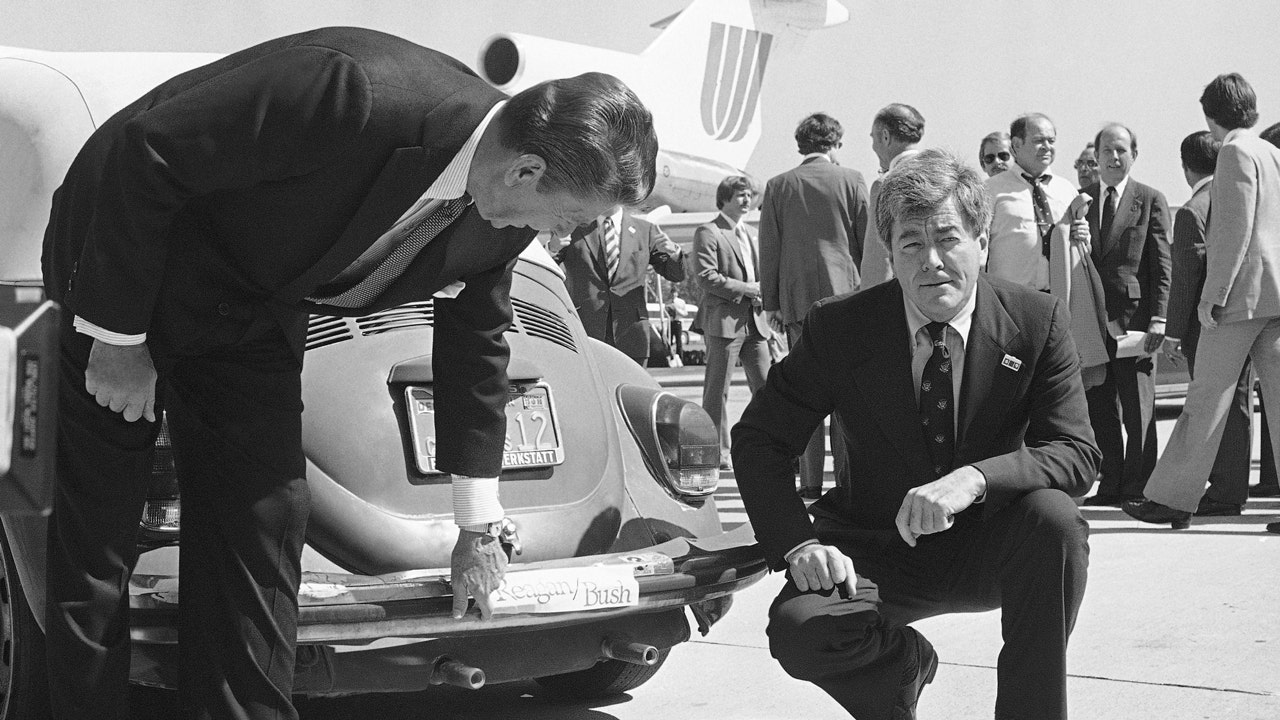
Republican presidential candidate Ronald Reagan, left, admires the bumper sticker on the car of Congressman Pete McCloskey as the congressman looks on, right, in San Jose, Calif., Sept. 25, 1980. Reagan was in the area on a campaign trip prior to leaving for more campaigning in Washington and Oregon. Former California Congressman McCloskey, who ran as a Republican challenging President Richard Nixon in 1972, died on Wednesday, May 8, 2024, at age 96. (AP Photo/Harrity)
McCloskey cited disillusionment from influence peddling and ethics scandals under the George W. Bush administration as reasons why he switched parties in 2007 at the age of 79. “A pox on them and their values,” he wrote in an open letter explaining the switch to his supporters.
“McCloskey was a rarity in American politics — his actions were guided by his sense of justice, not by political ideology,” Joe Cotchett, his law partner since 2004, said in a statement. “He hated inequity and did not hesitate to take on members of his own political party.”
Born in Loma Linda, California, on Sept. 29, 1927, as Paul Norton McCloskey Jr., he graduated from South Pasadena High School, where the second baseman made the school’s baseball hall of fame, although he self-deprecatingly called himself “perhaps the worst player on the baseball team.”
McCloskey joined the Marine Corps as an officer and led a rifle platoon during some of the most intense fighting of the Korean War. He was awarded the Navy Cross for extraordinary heroism, the nation’s second-highest honor, a Silver Star for bravery in combat and two Purple Hearts.
He earned a law degree from Stanford University and founded an environmental law firm in Palo Alto before making the move to public office. In 1967, he defeated fellow Republican Shirley Temple Black and Democrat Roy Archibald in a special election for the San Mateo County congressional seat.
The left-leaning McCloskey had a thundering presence in Washington, attempting to get onto the floor of the 1972 Republican National Convention during his bid to unseat then-President Nixon on an anti-Vietnam War platform. He ultimately was blocked by a rule written by his friend and law school debate partner, John Ehrlichman, that said a candidate could not get to the floor with fewer than 25 delegates. McCloskey had one.
Still, McCloskey loved to say he finished second.
He would later visit Ehrlichman in prison, where Nixon’s former counsel served 1.5 years for conspiracy, perjury and obstruction of justice in the Watergate break-in that led to the president’s resignation.
While in office, McCloskey also was known for befriending Palestinian leader Yasser Arafat and criticized Israeli influence on American politics. The congressman was the first to demand Nixon’s impeachment, and the first to demand a repeal of the Gulf of Tonkin resolution that allowed the Vietnam War.
But his enduring legacy is the Endangered Species Act, which protects species designated as endangered or threatened and conserves the ecosystems on which they depend. McCloskey co-wrote the legislation in 1973, after a campaign by young people empowered by Earth Day activities successfully unseated seven of 12 Congress members known as “The Dirty Dozen” for their anti-environment votes.
“On that day, the world changed,” McCloskey recalled in 2008. “Suddenly, everybody was an environmentalist. My Republican colleagues started asking me for copies of old speeches I had given on water and air quality.”
“A powerful champion of endangered species, Pete, ironically, became one,” said Denis Hayes, co-organizer of the Earth Day, about the rarity of a “green, anti-war Republican.”
After 15 years in the House, he lost his run for a Senate seat to Republican Pete Wilson, who went on to be California’s governor. He moved back to rural Yolo County, relishing the life of a farmer and part-time attorney.
“You know, if people call you ‘congressman’ all the time, you’ll end up thinking you’re smarter than you are,” he said.
McCloskey, however, couldn’t stay quiet forever.
In 2006, after his unsuccessful race against Pombo, he helped form the Revolt of the Elders Coalition, a group of retired Republican congressmen who pushed to get soldiers more money for college, undo measures that made it tougher to investigate ethics violations and rallied against those who had received funding from disgraced lobbyist Jack Abramoff, including Pombo.
“If you can do something at age 80 that positively affects our country, you should be proud of it. Otherwise there’s no redeeming value in getting older,” he said.
McCloskey is survived by his wife, Helen — his longtime press secretary whom he married in 1978 — and four children by his first wife: Nancy, Peter, John and Kathleen.
Read the full article from Here


LAS VEGAS (FOX5) — Real roads come with real consequences. This summer, the Nevada Department of Public Safety and FOX5 want everyone to Arrive Alive, and that starts with smart choices behind the wheel. Safe driving habits are the best way to prevent crashes. With more teens and first-time drivers hitting the road, the Nevada Department of Public Safety is advising everyone to slow down, stay focused, and look out for each other.
- Stay distraction-free. Distraction plays a role in nearly 6 out of 10 crashes involving teens. The biggest distraction is often other teens in the car, followed by phones and in-car screens. Put the phone away, keep your eyes up, and save the playlist changes for later. Passengers can help too; keep the driver focused, not stressed.
- Don’t speed. Nearly 30% of fatal teen crashes involve speeding, and driving too fast cuts down your reaction time, increases stopping distance, and makes any crash more serious. Stick to the speed limit, slow down when roads or weather change, and leave plenty of space between you and the car ahead.
- Never drive impaired. Impaired driving is still a major problem in Nevada, making up 51% of traffic deaths from 2018 to 2022. If you’ve been drinking or using drugs, don’t drive. Call a trusted adult, use a designated driver, or take a rideshare.
- Buckle up! Every trip. Every seat. Seatbelts greatly reduce the risk of serious injury or death. Everyone in the vehicle, front seat and back, needs to wear one. Put it on every time. It takes seconds and can save your life.
We’re in the middle of the 100 deadliest days of summer please share the road, as even one traffic death is too many. Arrive Alive. That’s the plan. Learn more at ZeroFatalitiesNV.com
Copyright 2026 KVVU. All rights reserved.


SALEM, Ore. (KATU) — The U.S. Supreme Court on Tuesday upheld state laws in Idaho and West Virginia that bar transgender girls and women from competing on girls’ and women’s school sports teams.
The decision could influence future policy debates in Oregon, but does not immediately change the state’s rules.
Oregon continues to allow students to participate in school sports, physical education, and other school activities in accordance with their gender identity.
The Oregon School Activities Association, which oversees high school sports statewide, said it is reviewing the ruling with legal counsel.
“The Oregon School Activities Association is reviewing today’s Supreme Court ruling with our legal counsel. The association will work with the Oregon Department of Education on the ruling’s impacts on state law and OSAA policy in order to provide updated guidance to member schools as needed. The OSAA remains committed to ensuring interscholastic activities remain a safe and welcoming environment for all student-athletes,” a spokesperson said in a statement.
While Tuesday’s ruling leaves Oregon’s current policy in place, political scientists say it could reshape the legal landscape surrounding future proposals.
“This particular decision, coupled with a federal push, may end up altering the landscape of opportunities in states that affirm trans athletic participation,” said Allison Gash, chair of the Department of Political Science at the University of Oregon.
SEE ALSO | Supreme Court ruling preserves Oregon law protecting late-arriving mail ballots
Gash said the Supreme Court’s decision itself does not require Oregon to change its policies.
Instead, she said the more immediate question is how the Trump administration chooses to respond.
“Where we could see some required movement on the part of Oregon or where it may impact Oregon directly is how the federal government determines what it wants to do in light of today’s ruling,” said Gash.
According to Gash, the administration has argued that schools should separate sports teams based on biological sex under its interpretation of Title IX.
“One of the several efforts that the federal government is taking to ensure that all states bar trans female athletes in particular from participating in women’s sports is to tie the provision of federal funding to essentially a ban,” she said.
She added that the Supreme Court’s ruling could make the administration “more muscular in those efforts because now the court has essentially upheld that interpretation.”
Oregon leaders respond
House Republicans unsuccessfully pushed legislation during the 2025 legislative session that would have required school sports teams to be separated based on biological sex, but the bill failed in the Democratic-controlled House.
The bill was sponsored by then state representative Christine Drazan, the 2026 Republican candidate for Governor.
In a news release Tuesday, Drazan welcomed the ruling, calling it “a victory for fairness, for common sense, and for progress.”
“Girls and young women across Oregon are still competing on an unfair and unsafe playing field. I have always supported women’s right to compete, and as Governor, I will do everything in my power to make sure that women’s sports are protected and girls across our state get their shot to compete and win,” said Drazan.
KATU asked Governor Tina Kotek whether she supports legislative or executive action to maintain Oregon’s current policy following the ruling.
The governor’s office had not responded by publication.
Meanwhile, Oregon Senate Democrats said in a news release that the decision does not change students’ rights in Oregon, and they vowed to continue to protect the policy in effect today.
“Nobody wins when states deny children the right to play sports. Sports have the power to unify, but today’s SCOTUS decision will lead to dangerous gender harassment of athletic girls. States banning access to sports are feeding the same regime that is trying to divide and control,” said State Senator Courtney Neron-Misslin.
She continued, “Oregonians must keep our eye on the ball. We must stay focused on addressing actual problems, protecting rights, addressing affordability, and investing in education. Today’s decision erodes LGBTQ+ rights and the rights of women across our country. Here in Oregon, we will continue to stand up to injustices and defend our most vulnerable from Trump-style attacks.”
-

 Nevada2 minutes ago
‘Arrive Alive’ initiative with Nevada Department of Public Safety, FOX5
-

 New Hampshire7 minutes ago
This NH Short Film Festival Returns in July, and Every Film Clocks in at 15 Minutes or Less
-

 New Jersey14 minutes ago
New Jersey’s $60.7 billion budget signed into law by Gov. Mikie Sherrill • The Jersey Vindicator
-

 New Mexico17 minutes ago
Community Champions: New Mexico’s Flo Valdez inducted into NFHS
-

 North Carolina22 minutes ago
North Carolina mail carrier kidnapped and killed while on her route, authorities say
-

 North Dakota29 minutes ago
June ND severe weather recap: 5 tornadoes, damaging winds impact numerous towns
-

 Ohio32 minutes ago
‘Pure evil’: Adults arrested after 16 children found in deplorable conditions in Ohio home
-

 Oklahoma37 minutes ago
Oklahoma Lottery Mega Millions, Pick 3 results for June 30, 2026

