News
The Major Supreme Court Cases of 2024


No Supreme Court term in recent memory has featured so many cases with the potential to transform American society.
The consequential cases, with decisions arriving by late June or early July, include three affecting former President Donald J. Trump, two on abortion, two on guns, three on the First Amendment rights of social media companies and three on the administrative state.
In recent years, some of the court’s biggest decisions have been out of step with public opinion. Researchers at Harvard, Stanford and the University of Texas conducted a survey in March to help explore whether that gap persists.
Trump’s Ballot Eligibility
Conservative bloc
Roberts

Kavanaugh
Barrett
Gorsuch
Alito
Thomas
Is there a major precedent involved?
Are there recent rulings on the subject?
A decision that Mr. Trump was ineligible to hold office would have been a political earthquake altering the course of American history.
Where does the public stand?
| Think Trump is eligible to run in 2024 | Think Trump is not eligible |
Immunity for Former Presidents
Is there a major precedent involved?
But in 1982, in Nixon v. Fitzgerald, a closely divided court ruled that Nixon, by then out of office, was absolutely immune from civil lawsuits “for acts within the ‘outer perimeter’ of his official responsibility.”
Are there recent rulings on the subject?
The court’s decision will determine whether and when Mr. Trump will face trial for his attempts to overturn his 2020 loss at the polls.
Where does the public stand?
| Think former presidents are not immune from criminal prosecution for actions they took while president | Think former presidents are immune |
Obstruction Charges for Jan. 6 Assault
Is there a major precedent involved?
In a series of decisions, the court has narrowed the reach of federal criminal laws aimed at public corruption and white-collar crime.
Are there recent rulings on the subject?
The case has the potential to knock out half of the federal charges against former President Donald J. Trump for plotting to subvert the 2020 election and could complicate hundreds of Jan. 6 prosecutions.
Where does the public stand?
| Think the events at the U.S. Capitol on Jan. 6, 2021, were criminal | Think the events were not criminal |
Abortion Pills
Food and Drug Administration v. Alliance for Hippocratic Medicine
Is there a major precedent involved?
Are there recent rulings on the subject?
The case will determine whether access to the drug, which is used in the majority of abortions in the United States, will be sharply curtailed.
Where does the public stand?
| Think the F.D.A.’s approval of mifepristone should not be revoked | Think the approval should be revoked |
Emergency Abortion Care
The Supreme Court will decide whether a federal law that requires emergency rooms to provide stabilizing care to all patients overrides a state law, in Idaho, that imposes a near-total ban on abortion.
Is there a major precedent involved?
Are there recent rulings on the subject?
It is the first time the Supreme Court is considering a state law criminalizing abortion since it overturned Roe v. Wade. The decision may affect more than a dozen states that have passed near-total bans on abortion.
Where does the public stand?
| Think Idaho hospitals must provide abortions in medical emergencies | Think they are not allowed |
Second Amendment Rights of Domestic Abusers
Is there a major precedent involved?
Are there recent rulings on the subject?
Lower courts have struck down federal laws prohibiting people who have been convicted of felonies or who use drugs from owning guns.
The court may start to clear up the confusion it created in the Bruen decision, in the first major test of its expansion of gun rights. The standard it announced has left lower courts in turmoil as they struggle to hunt down references to obscure or since-forgotten regulations.
Where does the public stand?
| Think barring domestic abusers from possessing firearms does not violate their Second Amendment rights | Think it violates their rights |
Restrictions on the Homeless
City of Grants Pass v. Johnson
The Supreme Court will decide whether ordinances in Oregon aimed at preventing homeless people from sleeping and camping outside violate the Eighth Amendment’s prohibition on cruel and unusual punishment.
Is there a major precedent involved?
Are there recent rulings on the subject?
The case could have major ramifications on how far cities across the country can go to clear homeless people from streets and other public spaces.
Where does the public stand?
| Think banning homeless people from camping outside even when local shelters are full violates the Constitution | Think it does not violate the Constitution |
Social Media Platforms’ First Amendment Rights
Moody v. NetChoice; NetChoice v. Paxton
The laws’ supporters argue that the measures are needed to combat perceived censorship of conservative views on issues like the coronavirus pandemic and claims of election fraud. Critics of the laws say the First Amendment prevents the government from telling private companies whether and how to disseminate speech.
Is there a major precedent involved?
In 1980, in Pruneyard Shopping Center v. Robins, the court said a state constitutional provision that required private shopping centers to allow expressive activities on their property did not violate the centers’ First Amendment rights.
Are there recent rulings on the subject?
The cases arrive garbed in politics, as they concern laws aimed at protecting conservative speech. But the larger question the cases present transcends ideology. It is whether tech platforms have free speech rights to make editorial judgments.
Where does the public stand?
| Think states cannot prevent social media companies from censoring speech | Think states should be able to prevent censoring |
Disinformation on Social Media
Is there a major precedent involved?
Are there recent rulings on the subject?
The Supreme Court is also considering a case that raises similar issues, National Rifle Association v. Vullo, about whether a state official in New York violated the First Amendment by encouraging companies to stop doing business with the National Rifle Association.
The case is a major test of the role of the First Amendment in the internet era, requiring the court to consider when government efforts to limit the spread of misinformation amount to censorship of constitutionally protected speech.
Where does the public stand?
| Think federal officials urging private companies to block or remove users violates the First Amendment | Think it does not violate the First Amendment |
N.R.A. and the First Amendment
National Rifle Association of America v. Vullo
The Supreme Court will decide whether a New York State official violated the First Amendment by trying to persuade companies not to do business with the National Rifle Association after the school shooting in Parkland, Fla.
Is there a major precedent involved?
Are there recent rulings on the subject?
The case is one of two that will determine when government advocacy edges into violating free speech rights. The other, Murthy v. Missouri, concerns the Biden administration’s dealings with social media companies.
The case centers on when persuasion by government officials crosses into coercion.
Where does the public stand?
| Think the state regulator’s behavior violates the N.R.A.’s First Amendment rights | Think it does not violate the N.R.A.’s rights |
Opioids Settlement
Harrington v. Purdue Pharma
Is there a major precedent involved?
The case is the first time the Supreme Court will address whether a bankruptcy plan can be structured to give civil legal immunity to a third party, without the consent of all potential claimholders. The legal maneuver under scrutiny has become increasingly popular in bankruptcy settlements.
Are there recent rulings on the subject?
Approving the deal would funnel money toward states and others who have waited for years for some kind of settlement. Yet the Sacklers would be largely absolved from future opioid-related claims. More broadly, the case may have implications for similar agreements insulating a third party from liability.
Where does the public stand?
| Think the Sackler family should not keep immunity from future lawsuits | Think family should keep immunity |
Racial Gerrymandering
Alexander v. South Carolina State Conference of the N.A.A.C.P.
Is there a major precedent involved?
Yes. A series of Supreme Court decisions say that making race the predominant factor in drawing voting districts violates the Constitution.
Are there recent rulings on the subject?
The Alabama case was governed by the Voting Rights Act, the landmark civil rights statute, and the one from South Carolina by the Constitution’s equal protection clause.
The case concerns a constitutional puzzle: how to distinguish the roles of race and partisanship in drawing voting maps when Black voters overwhelmingly favor Democrats. The difference matters because the Supreme Court has said that only racial gerrymandering may be challenged in federal court under the Constitution.
Where does the public stand?
| Think these changes to the districts are unconstitutional | Think they are constitutional |
Power of Federal Agencies
Loper Bright Enterprises v. Raimondo; Relentless v. Department of Commerce
Is there a major precedent involved?
Yes. Chevron is one of the most cited cases in American law.
Are there recent rulings on the subject?
“The question is less whether this court should overrule Chevron,” Paul D. Clement, one of the lawyers for the challengers, told the justices, “and more whether it should let lower courts and citizens in on the news.”
Overturning the decision could threaten regulations on the environment, health care, consumer safety, nuclear energy, government benefit programs and guns. It would also shift power from agencies to Congress and to judges.
Where does the public stand?
| Courts should defer to administrative agencies when laws are unclear | Courts should not defer to agencies |
Agency Funding
Consumer Financial Protection Bureau v. Community Financial Services Association of America
Is there a major precedent involved?
There is no precedent squarely on point.
Are there recent rulings on the subject?
A ruling against the bureau, created as part of the 2010 Dodd-Frank Act after the financial crisis, could cast doubt on every regulation and enforcement action it took in the dozen years of its existence. That includes agency rules — and punishments against companies that flout them — involving mortgages, credit cards, consumer loans and banking.
Where does the public stand?
| Think this agency funding structure is unconstitutional | Think it is constitutional |
Administrative Courts
Securities and Exchange Commission v. Jarkesy
Is there a major precedent involved?
Are there recent rulings on the subject?
A ruling against the S.E.C. would not only require it to file cases in federal court but could also imperil administrative tribunals at many other agencies, including the Federal Trade Commission, the Internal Revenue Service, the Environmental Protection Agency, the Social Security Administration and the National Labor Relations Board.
Where does the public stand?
| Think federal agencies bringing actions in administrative proceedings rather than in federal courts is not constitutional | Think it is constitutional |
Cross-State Air Pollution
Ohio v. Environmental Protection Agency
Is there a major precedent involved?
Are there recent rulings on the subject?
Prevailing winds carry emissions of nitrogen oxide toward Eastern states with fewer industrial sites. The pollutant causes smog and is linked to asthma, lung disease and premature death.
Bump Stocks for Guns
Is there a major precedent involved?
Are there recent rulings on the subject?
The case involves how to interpret a federal law that banned machine guns, the National Firearms Act of 1934. The definition was broadened by the Gun Control Act of 1968 to include parts that can be used to convert a weapon into a machine gun. At issue is whether bump stocks fall within those definitions. Federal appeals courts have split on the issue.
A decision could do away with one of the few efforts at gun control that gained political traction after the Las Vegas massacre in 2017. More broadly, a ruling could help clarify the scope of the power of federal agencies.

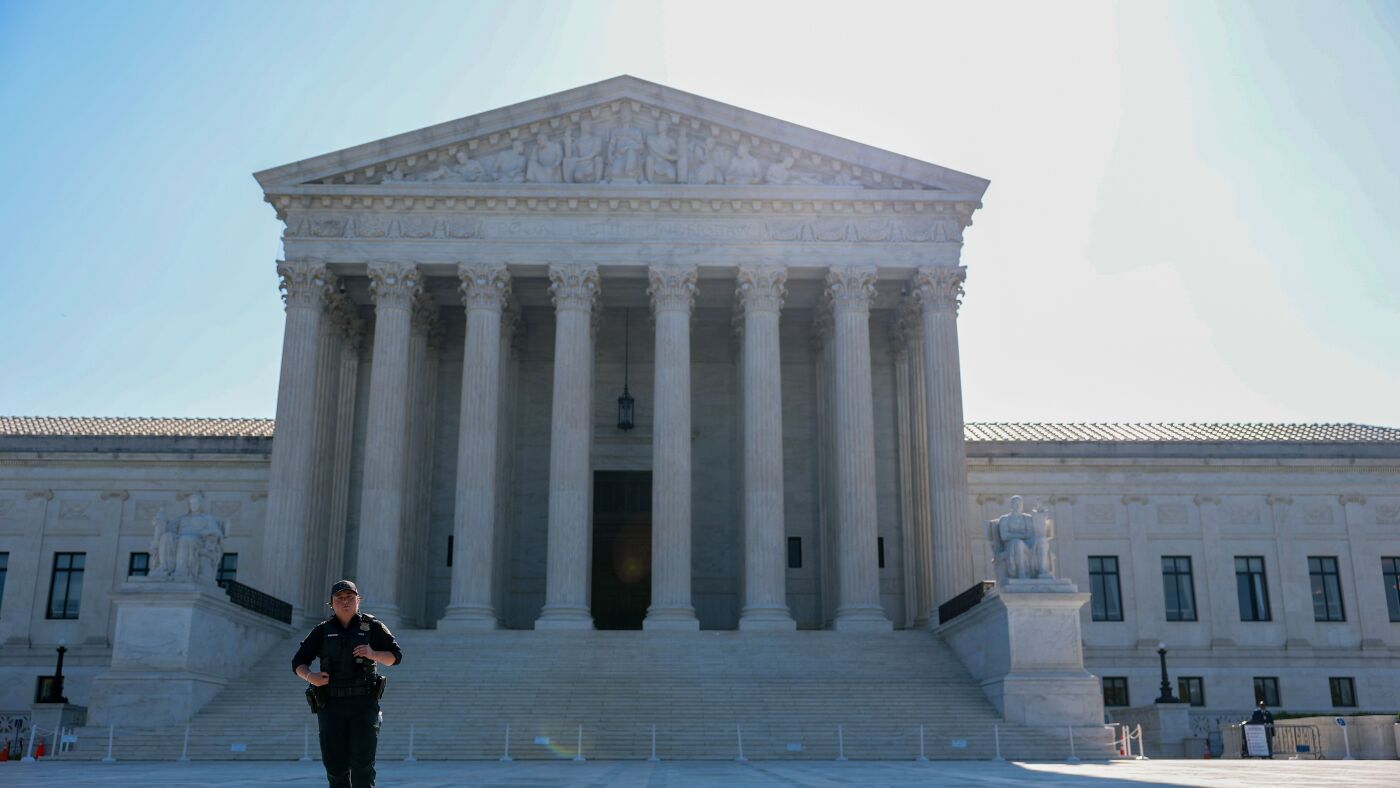
The U.S. Supreme Court
Tasos Katopodis/Getty Images
hide caption
toggle caption
Tasos Katopodis/Getty Images
The Supreme Court Tuesday upheld the long-established right of children born on U.S. soil to automatic American citizenship, regardless of their parents’ immigration status. In so doing, the court rejected President Trump’s most aggressive attempt to limit immigration in the United States.
Writing for the court majority, Chief Justice John Roberts traced birthright citizenship back to the founding of the nation. Just as the colonists demanded “the rights of Englishmen” more than 250 years ago, he said, Congress, after the Civil War, amended the Constitution to specify automatic citizenship for any child born on U.S. soil.
“Citizenship then and now was the right to have rights”—and the framers of the 14th amendment extended that promise to every free born person in this land. He concluded: “We keep that promise today.”
The vote was 6-to-3, depending on how you count it. Altogether, five justices signed on to the Roberts’ majority opinion. A sixth, Justice Brett Kavanaugh, agreed only that federal legislation enacted in the 1950s grants automatic citizenship for children born in the U.S.
Justice Clarence Thomas wrote the lead dissent, a 91-page opus that agreed with Trump’s assertion that the 14th amendment only applied to former slaves and their descendants. The Thomas dissent added ominously that he “was not sure that “today’s opinion will stand the test of time.” The dissent was joined by Justice Neil Gorsuch, with Justice Samuel Alito writing a separate dissent.
Justice Ketanji Brown Jackson, who, like Thomas is African American, responded to some of the themes in the Thomas dissent.
“Despite his longstanding endorsement of a colorblind society,” she wrote, “Justice Thomas now surprisingly suggests that the citizenship clause was a race-conscious remedial measure relating only to freed slaves.”
Cecillia Wang, legal director of the ACLU, who successfully argued the case at the Supreme Court, said President’s Trump failed attempt to limit birthright citizenship was transparent.
“A majority of the court saw through what the president was trying to do in spinning birthright citizenship as something that can flex and retract and expand depending on what the administration in power thinks about immigration policy,” she said.
Wang sees birthright citizenship as “much more fundamental than that.”
“It is part of how our country rejected caste distinctions and championed freedom and equality,” she said.
Yale law professor Akhil Amar called the court’s opinion a classic example of the court sticking to the original meaning of the Constitution. The text of the 14th Amendment, he said, “is about the child. It doesn’t say anything about parents.”
University of Virginia law professor Amanda Frost, however, was surprised and saddened that the court was so closely divided.
“The very length of the opinion,” she told NPR, plus “the fact that you had four justices say the Constitution does not require near universal birthright citizenship, which had been the understanding, that suggests that this is a fringe argument that the Trump administration has succeeded in moving into the mainstream, even though it has not succeeded in the end of the result.”
The issues in the birthright case focused in large part on the longstanding, and as of Tuesday, still standing, meaning of the 14th Amendment, which was enacted after the Civil War. It guarantees birthright citizenship to almost all persons born or naturalized in the United States. Chief Justice Roberts pointedly said the only exceptions written into the amendment were for certain Indian tribes, which were not subject to the laws of the United States at the time, and the children of foreign diplomats. That understanding was so well accepted that even in World War II, when Japanese citizens were confined to internment camps, their children, born in those camps, were automatically deemed to be American Citizens.
The Supreme Court’s decision Tuesday was the second time the justices have upheld birthright citizenship. The court’s previous decision came in 1898 in the case of Wong Kim Ark, born in the U.S. to Chinese parents. His great grandson, Norman Wong, issued a statement today saying, “My great grandfather, Wong Kim Ark, never set out to become a symbol. He was one man, only a cook, and yet he stood up for what was right, and I believe that it has made a difference. As a result, he stood up for the rights of all of us Americans – it just so happens that I am related to him. Today’s ruling shows that his victory remains as important now as it was in 1898.”
The high court also issued opinions in two other cases on Tuesday. In a 6-to-3, ideologically divided vote, the court upheld state laws that prevent transgender athletes from playing on women’s sports teams. Writing for the conservative majority, Justice Brett Kavanaugh said that the laws violate neither federal statutes nor the 14th Amendment. States, he said, have a legitimate interest in protecting the safety of sports, which he suggested could be compromised if transgender girls or women are allowed to play on female teams. Similarly, he said transgender athletes could also compromise fairness in athletic competition.
Sitting in the court chambers Tuesday when Kavanaugh summarized his opinion were not only his wife and mother, but his two daughters, whose athletic teams their father has long coached.
Justice Sonia Sotomayor, joined by her liberal colleagues, issued a partial dissent. She agreed with the majority that the benefits of sports are “immense,” but she wrote that these laws unconstitutionally deny transgender athletes the opportunity to play with their peers.
In a third ideologically divided case Tuesday, the Court struck down decades-long limits on the amount of money political parties can spend on candidates. The limits were challenged by the Republican National Committee. The decision may well increase by millions of dollars the amount of money that will pour into campaigns.

Rep. Thomas Kean Jr., R-N.J., arrives at the U.S. Capitol with his wife Rhonda Kean on June 30.
Anna Moneymaker/Getty Images
hide caption
toggle caption
Anna Moneymaker/Getty Images
New Jersey Republican Thomas Kean Jr. said it was struggles with depression that kept him away from Congress for nearly four months with no explanation to his constituents.
Kean last voted on March 5th, missing numerous votes and other appearances on Capitol Hill since. In April, House Speaker Mike Johnson told reporters he had spoken to Kean and that he was dealing with an undisclosed medical issue. Kean was not spotted until recently at his New Jersey home.
Speaking from the House floor on Tuesday, the second term lawmaker said he had checked into a hospital for testing several months ago after health concerns, and was subsequently diagnosed with depression.
“Talking about myself has never come naturally,” Kean said. “But I believe that I owe an explanation to the people of New Jersey’s seventh district, to my colleagues in this chamber and to the American people for my absence.”
Kean said he originally did not think his diagnosis would result in a long-term absence. Doctors recommended he remain in the hospital to address the illness, and it was his fastest route to recovery, he said.
“It is physical. It is emotional,” he said. “And until you experience it yourself, it is difficult to fully understand how powerful this illness could be.”
Kean said he miscalculated how long he would be away, estimating it would be a matter of weeks. However, he said like the roughly 48 million Americans who have battled the illness, he learned there is no timeline for recovery.
“I am grateful that I accepted help,” Kean said. “Today I stand before you healthier, stronger and excited to return to the work that I love.”
Kean’s absence proved a struggle for House Republicans, who contend with a razor thin majority to pass party priorities. For weeks, Kean and his office declined to share additional details on why he was away, feeding rumors and speculation and raising interest in a member known for his privacy.
Despite his absence, Kean won the GOP primary earlier this month to defend his seat in Congress in this fall’s midterm elections. He will face Democrat Rebecca Bennett, a former U.S. Navy helicopter pilot and healthcare executive.
Bennett has targeted Kean’s absence in her campaign. Democrats have said Kean’s 7th congressional district is a top target to flip in their pursuit of taking back the majority.
“Tom Kean Junior, wherever you are, you have failed this district,” Bennett told supporters at an event last week.
In a statement after Kean’s remarks on Tuesday, Bennett said she was relieved he was well and wished him good health.
“But let’s be clear: I got into this race because Tom Kean Jr. was failing our community long before this absence,” she said.
Kean is not the first member of Congress in recent years to speak publicly about their struggles with depression. Sen. John Fetterman, D-Pa., took leave from the Capitol in 2023 after he was diagnosed with the illness. In Fetterman’s case, his office announced the news within days of his starting treatment.
Kean was elected to Congress for his first term beginning in 2023, flipping a district that was represented by former Democratic Congressman Tom Malinowski.
He comes from a long line of politicians: His father, former New Jersey Gov. Thomas Kean Sr., was appointed by former President George W. Bush as a chair of the 9/11 Commission. Kean’s grandfather and great grandfather also served in Congress.

Members of the National Guard stand in front of a large image of U.S. President Donald Trump that hangs from the the Robert F. Kennedy Department of Justice Building on May 18, 2026 in Washington, D.C.
Andrew Harnik/Getty Images North America
hide caption
toggle caption
Andrew Harnik/Getty Images North America
WASHINGTON, D.C. — In a strongly worded letter to the head of Michigan’s National Guard, Gov. Gretchen Whitmer reiterated troops from her state are only to be used for operations surrounding America 250 celebrations in Washington, D.C., and not for President Trump’s long-running — and controversial — joint task force to fight crime. She said that she would pull her troops from the city if that is not the case, in the letter obtained by NPR.
“Please take all necessary measures to ensure the Michigan National Guard is only supporting the narrow and limited America 250 Mission and is in no way supporting the D.C. Safe and Beautiful Mission,” wrote Gov. Whitmer, referencing the official name for the federal task force.
Trump deployed hundreds of troops to Washington, D.C., in August of 2025, in what experts said was a stunning departure from governing norms. He said he did so to address rampant crime, despite declining crime rates at the time. The number of troops in the city has increased over time to more than 4,800 from Washington, D.C. and almost two dozen states, which until recently were exclusively Republican-led.
Michigan — which has 161 guard members currently in the city — is one of four Democratic-led states that sent members of their National Guard to D.C. in recent weeks, ahead of an influx of tourists for America 250 celebrations. North Carolina and Kentucky each sent one member of their guard, while Minnesota sent more than a hundred last week.
Kentucky confirmed to NPR Monday that it had recalled its one guard member over the weekend, after that member was “diverted to the task force by the federal government without the knowledge or consent of Gov. Beshear of the Kentucky Guard,” Scottie Ellis, a spokesperson for Gov. Beshear, wrote to NPR in an email.
When contacted by NPR, spokespeople for each respective Democratic governor’s office made it clear that their guard members were sent to help specifically with America 250, not for law enforcement purposes as part of the larger ongoing federal joint task force operation. All four states have been clear about their opposition to the Trump administration’s ongoing deployment of National Guard troops to D.C., filing an amicus brief in support of litigation challenging it as recently as May.
But in recent days, a video of troops identifying themselves as Michigan National Guard members patrolling the Georgetown waterfront — an upscale neighborhood more than a mile away from any official America 250 celebrations — began circulating on social media. NPR has authenticated the video. Whitmer’s office did not immediately respond to NPR’s request to verify that the troops were Michigan members.
All state guard members are currently in D.C. under Title 32 status, which essentially means that the federal government pays for the deployment, but the state governors maintain control and command of their troops. But former National Guard officials say it’s impractical for states to play a role in day-to-day activities in a complex national mission like what’s happening in D.C.
“If the National Guard has defined the America 250 Mission to extend beyond direct support for events celebrating the nation’s 250th anniversary, please let me know so we can ensure the Michigan National Guard’s efforts are carefully limited,” Gov. Whitmer’s letter reads.
It goes on to say that if that can’t be ensured, then Gov. Whitmer will “end Michigan’s support for the America 250 mission.”
Legal experts, like those at the Brennan Center for Justice who have closely been watching Trump’s ongoing deployment to D.C., worry that drawing a distinction between the America 250 celebration and the general mission of the joint task force in the city will prove difficult. The joint task force is largely carrying out high visibility presence patrols in residential neighborhoods, public parks and metro stations.
Troops from all four Democratic-led states are listed as part of the official federal joint task force numbers released to the public. Gov. Whitmer said the Michigan troops should not be included in that count.
The offices for other Democratic governors NPR reached out to about that list also said their guard members shouldn’t be included.
When asked about the confusion, a spokesperson for the joint task force told NPR that it is overseeing all guard members in D.C. for organizational purposes, but being on the list “does not change their specific mission.” The joint task force did not immediately respond to NPR’s request for comment as to why Michigan guard members were apparently in Georgetown, and if that was part of the America 250 operations.
-

 Lifestyle3 minutes ago
ICICLE: Capturing Interest in Chinese Brands
-
 Politics10 minutes ago
Newsom signs off on 100% California tax for money from Trump’s $1.8-billion ‘slush fund’
-
 Science12 minutes ago
After bold pledge, EPA shelves microplastics testing in U.S. drinking water
-
 Sports18 minutes ago
Walter Alston, Dave Roberts and everyone in between: The 10 managers in L.A. Dodgers history
-

 World28 minutes ago
World’s oceans experience hottest June ever, scientists say more heat ahead
-
News55 minutes ago
What the Supreme Court did on the final day of its term
-

 Los Angeles, Ca2 hours ago
Los Angeles County man convicted of sex trafficking, abusing woman he was dating
-

 Detroit, MI3 hours ago
Detroit Tigers tee off on New York Yankees with 5 homers in win

