Lifestyle
This Storybook cottage's native plant wonderland shows how gorgeous no grass can be

Water-hungry lawns are symbols of Los Angeles’ past. In this series, we spotlight yards with alternative, low-water landscaping built for the future.
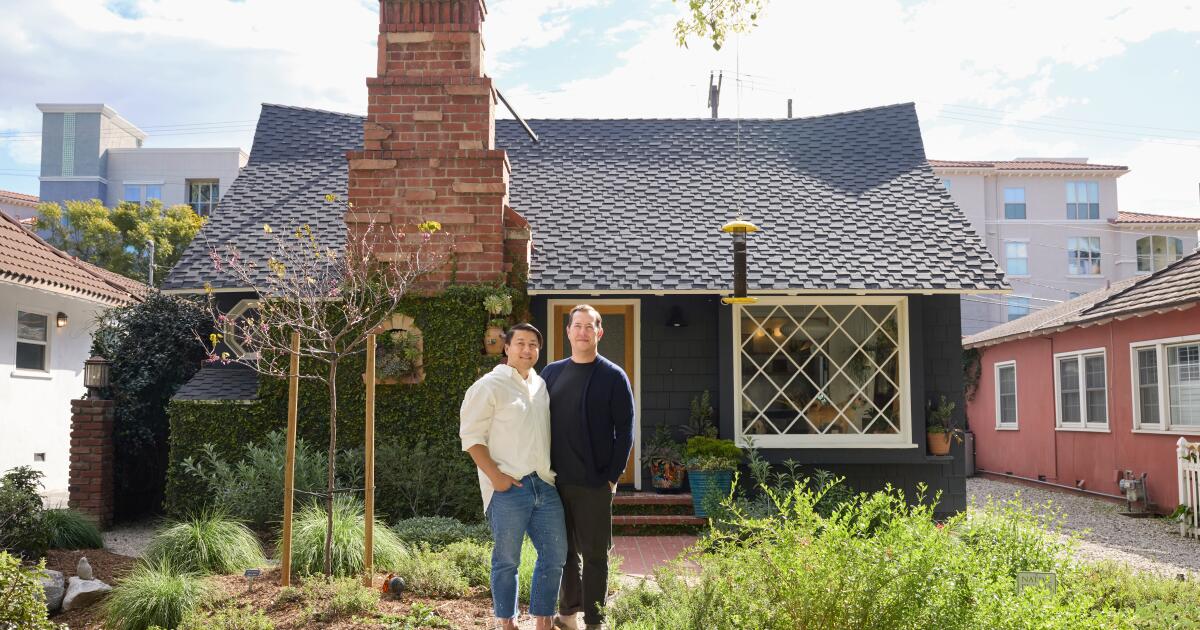
Once upon a time, under Universal Studios’ watchful Minion eye, there was a Storybook house in Studio City with a steep, sagging roof, a towering, tottering chimney and a yard so boring and prone to flooding that its charm was pretty much negated.
The front yard was mostly dead grass; the driveway was cracked and broken from runoff whenever it rained; and the funnel-shaped backyard was overwhelmed by a rotting wood pergola.
Succulents in the front yard grow in an alcove built into the chimney.
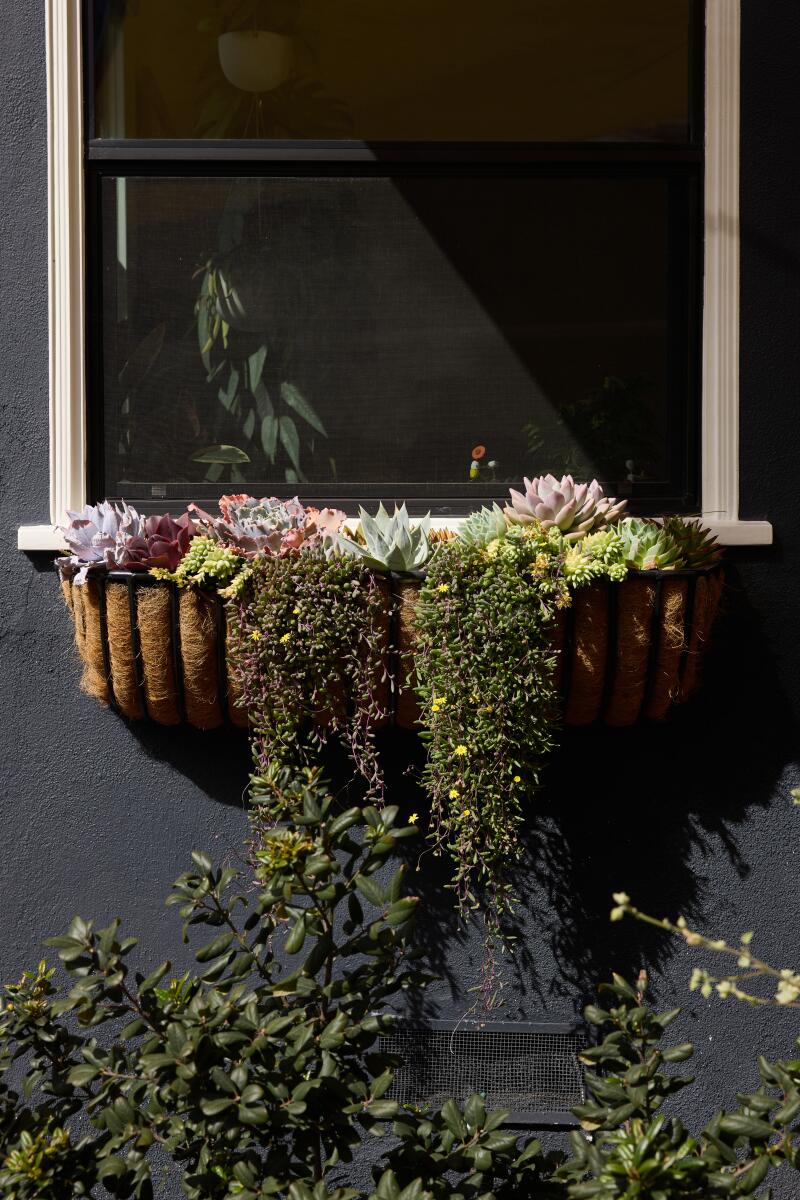
A planter spills over with succulents in Michael Solberg and Khoi Pham’s home garden.
No longer. Today, the yard of Khoi Pham and his fiancé, Michael Solberg, is a wonderland of native plants, water-conserving bioswales, a patio mosaic made from recycled concrete and permeable gravel paths with a delightful crunch. And throughout the garden are little riots of succulents spilling from pots, baskets and even the fanciful nook built into their chimney, dotting the garden with jolts of color like fancy embellishments on a cake.
There are lots of little signs identifying the plants too, to feed Solberg’s vision of educating passersby about the beauty, practicality and sustainability of native plant landscapes. The signs “make you feel like you should stop and pay attention,” said Solberg.
But they’re also helpful because this yard, designed and built by landscape designer Isara Ongwiseth of FormLA Landscaping, is one of three featured gardens during the Garden Conservancy’s San Fernando Valley Open Days Garden Tour on April 28, and the only one featuring a landscape devoted to California native plants. (Tickets are $10 per garden.)
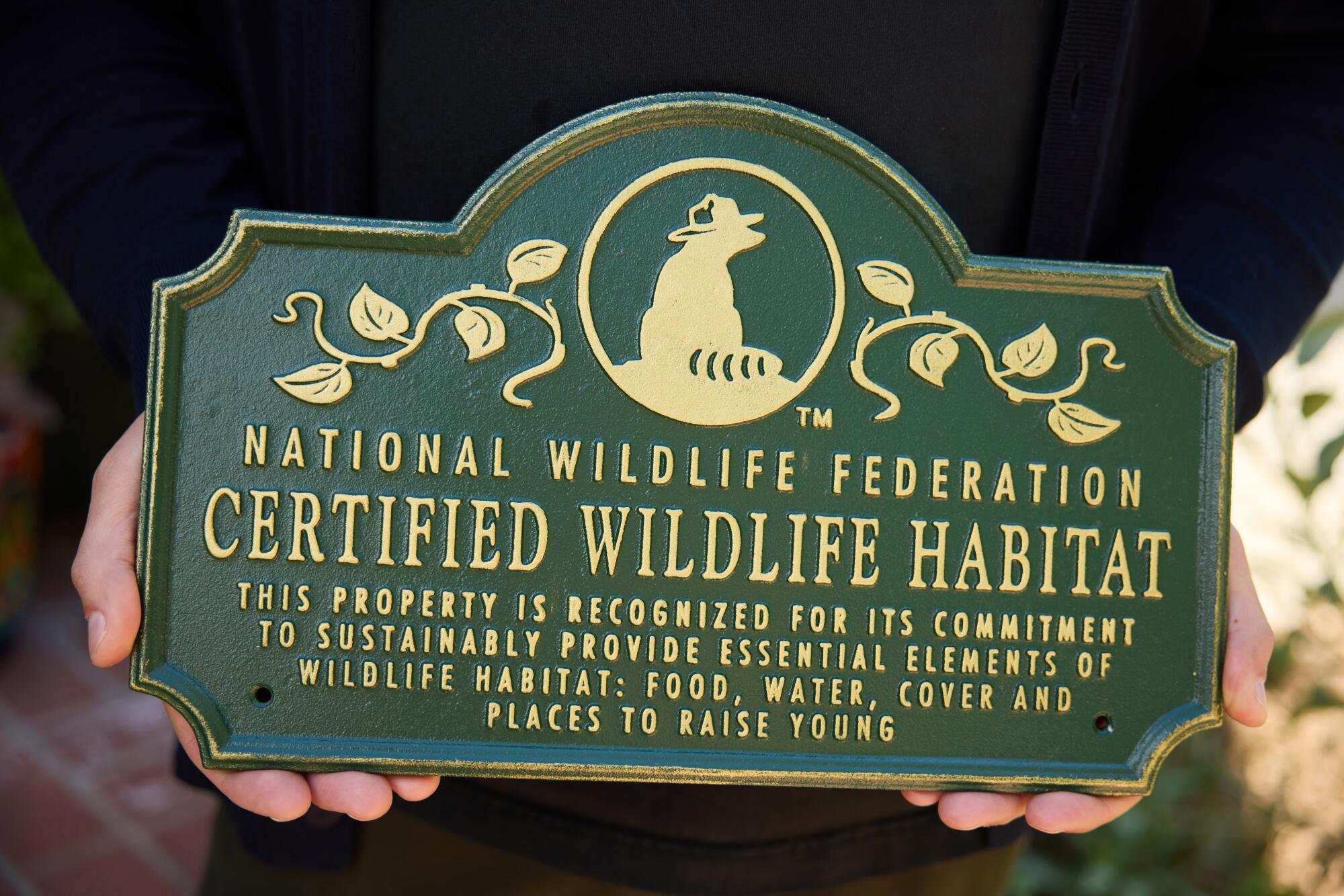
FormLA Landscaping provided this plaque for Michael Solberg and Khoi Pham’s native plant landscape.
(Yuri Hasegawa / For The Times)
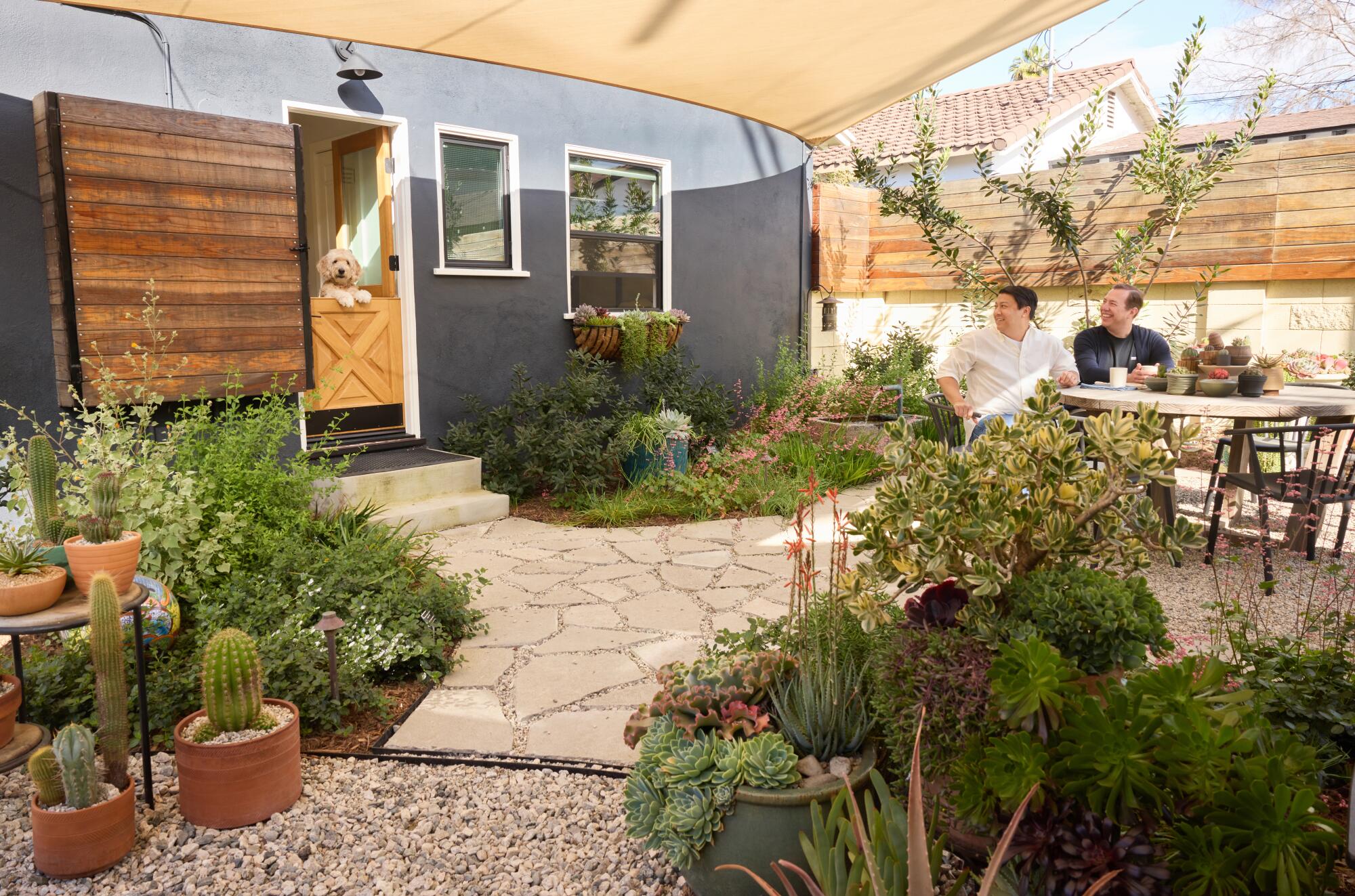
Native shrubs and flowers fill the shaded backyard’s planting areas, which are edged by pots and baskets brimming over with succulents and cactus, but all Lucy the goldendoodle wants is to join her owners outside.
(Yuri Hasegawa / For The Times)
The landscape is lush for one so young — it was installed in February 2022 — and features multiple plantings of a few varieties of native plants, such as the red-berried toyon, which Solberg is trying to espalier along one wall of his garage, dark-green ceanothus shrubs mingling with the silvery leaves of white sage (Salvia apiana), rings of Douglas iris (Iris douglasiana), earth-bound wisps of blushing coral bells, a.k.a. Wendy alumroot (Heuchera ‘Wendy’) and two Western redbud trees (Cercis occidentalis) — one in front, one in back — that bloom in deep violet clouds each spring.
For the record:
9:24 a.m. April 15, 2024An earlier version of this article incorrectly stated that the landscape was installed in February 2021. It was installed in February 2022. A photo caption incorrectly said the house is in North Hollywood. It is located in Studio City.
Out front are islands of fragrance that bloom in varying shades of purple — coyote mint (Monardella villosa), Cleveland sage (Salvia clevelandii) and bee’s bliss sage (Salvia ‘Bee’s Bliss’), along with clumps of deer grass (Muhlenbergia rigens), Oregon grape (Mahonia aquifolium) and the deep-throated flowers of Margarita BOP penstemon (Penstemon heterophyllus ‘Margarita BOP’).
Basically, Solberg said, except for the creeping fig lacing the chimney and the giant camphor tree on the parkway in front, any plants in the ground of their new landscape are California native plants; others, like his succulents and dwarf lemon, are planted in pots. And he hopes their plantings encourage more of the same.
I wanted to get the word out that native plants are a great way to have a sustainable garden that doesn’t require too much water, is good for wildlife and insects, is easy to care for and looks great too.
— Michael Solberg
“You just don’t see a bunch of California native gardens in our neighborhoods. What you see is lawn and standard shrubs, or fake turf or people who just paved everything over,” Solberg said. “I wanted something unique and different for our landscape, but also responsible with water and nature, and education was a really big part of that. I wanted to get the word out that native plants are a great way to have a sustainable garden that doesn’t require too much water, is good for wildlife and insects, is easy to care for and looks great too.”
This was Solberg and Pham’s second foray into creating a native plant landscape. Before they bought their Storybook home in late 2019, they’d taken out the lawn in front of their former home in Sherman Oaks and, inspired by gardens they’d seen on the Theodore Payne Foundation’s Native Plant Garden Tours, decided on a water-conscious landscape that relied on native plants instead of cactus and drought-tolerant plants from other countries with Mediterranean climates.
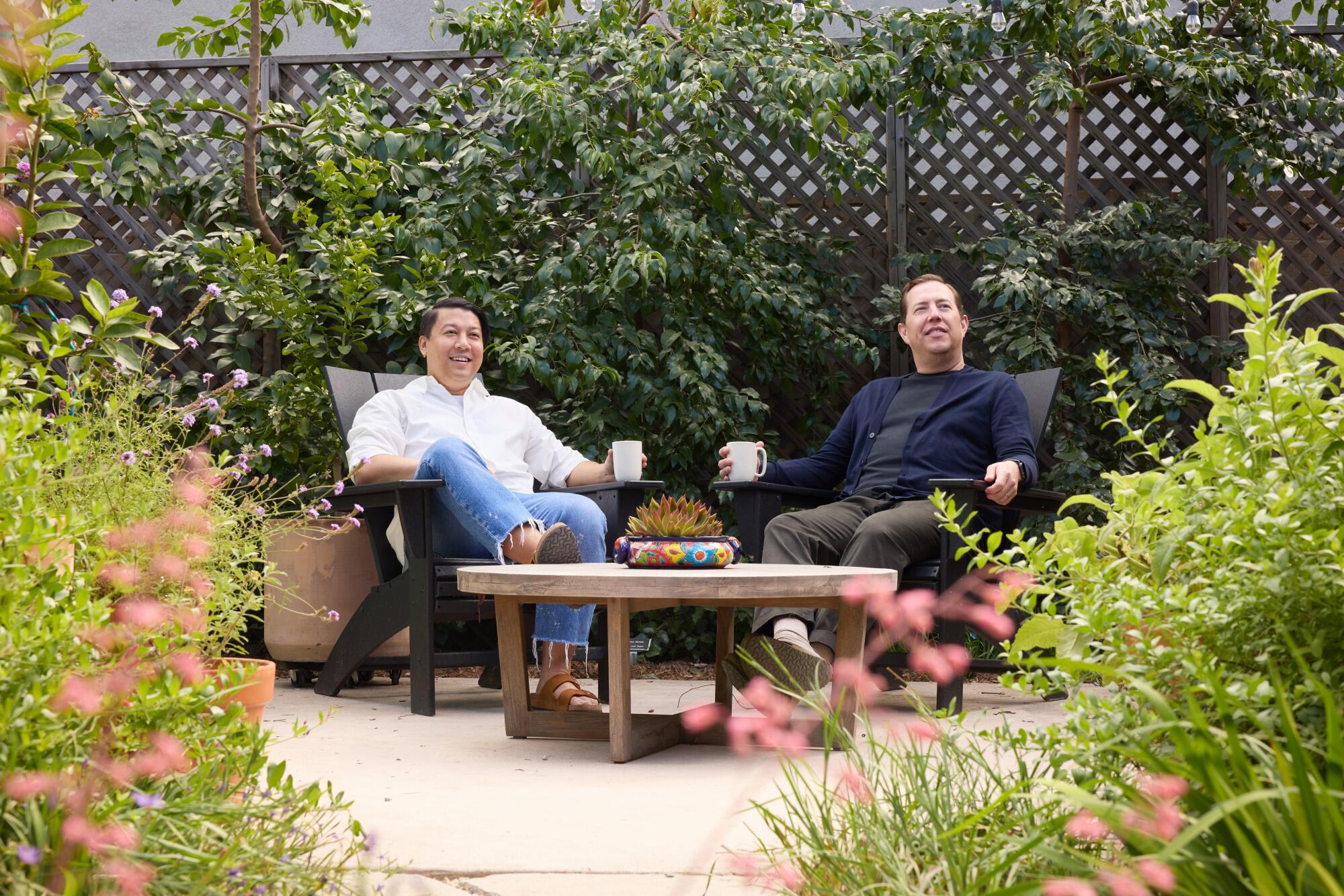
Khoi Pham, left and Michael Solberg enjoy sitting in their backyard garden most mornings, sipping coffee and admiring the leafy view.
Solberg — the gardener of the family — said he learned a lot in that DIY project: what native plants grow quickly and slowly, which he liked the best and which ones he should have placed somewhere else (such as a Matilija poppy that rapidly outgrew its location).
When it came time to finally landscape their new home in Studio City, Solberg said he wanted to continue the same theme, but he was concerned about dealing with the property’s special problems — a small, weirdly shaped backyard dominated by an aging pergola and water that ran off their Hansel-and-Gretel roof in sheets, creating runoff and flooding.
So in addition to an all-native-plant landscape, Solberg wanted permeable surfaces that would trap water in the soil instead of sending it out into the street — but he didn’t want any gutters to ruin their roof’s unusual lines. He wanted gravel walkways and drives that wouldn’t require constant maintenance. He wanted year-round color and interest, shade and privacy from the tall apartment building behind their house and plants that would attract birds and other pollinators.
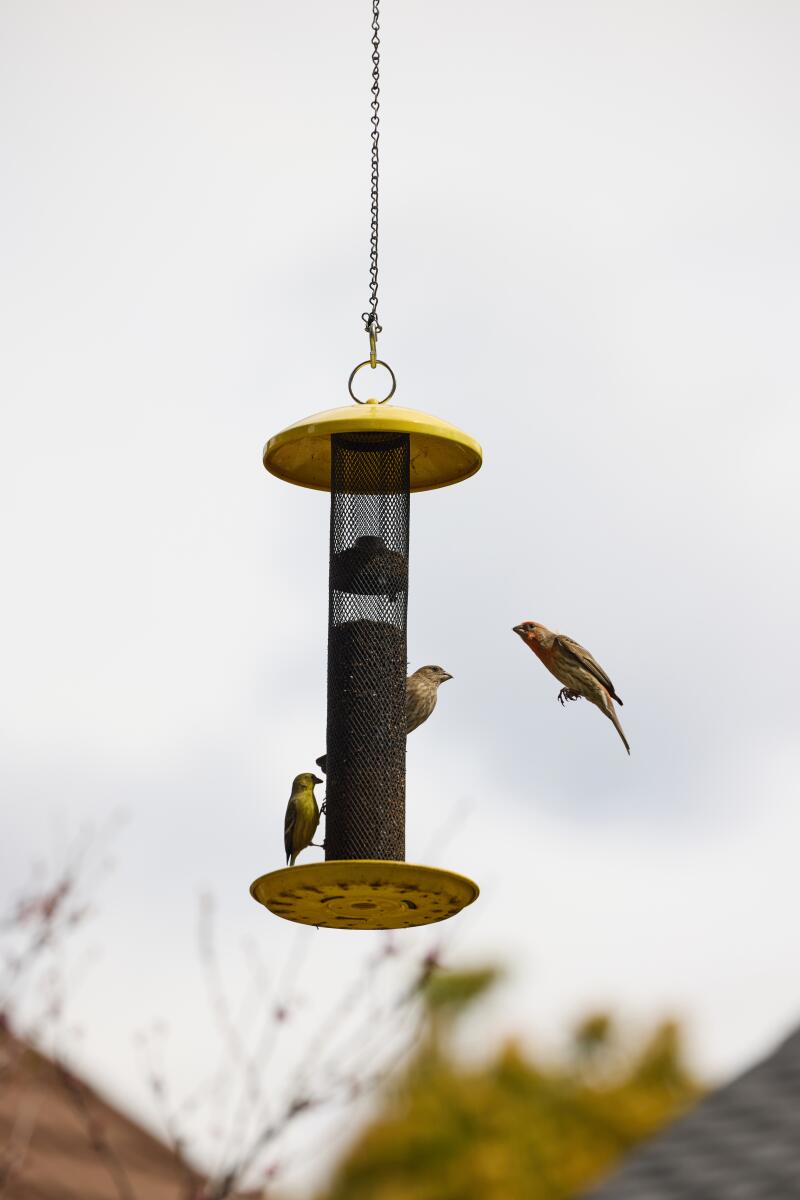
Birds fly around a feeder in Michael Solberg and Khoi Pham’s front yard.
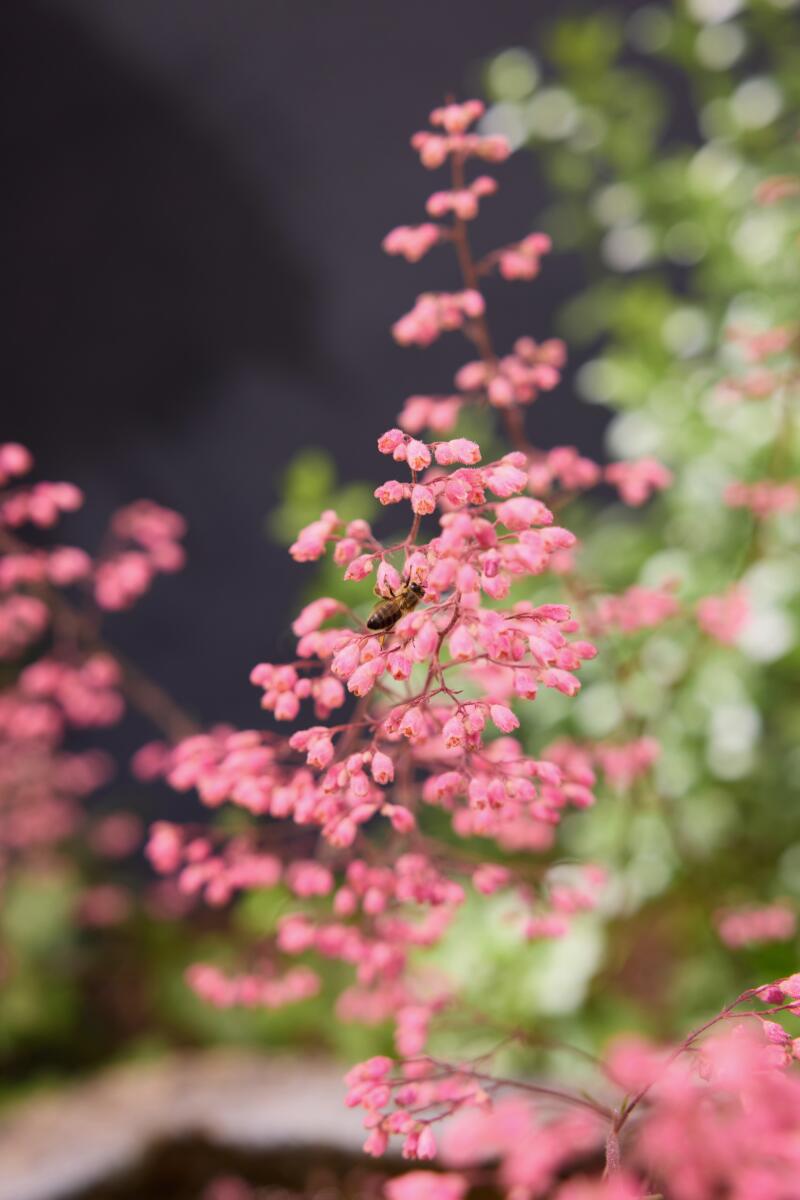
A bee noses among the pink blooms of a spray of coral bells.
They also had lifestyle considerations: Both men work from home — Solberg full-time overseeing corporate retail operations for a chain of tool stores and Pham at least two days a week as a research and development scientist for medical devices such as hospital sterilization equipment — so creating a serene and cheerful work environment was crucial inside and out.
And then there were Pham’s concerns. He was happy to leave the plant decisions to Solberg, the green thumb of the family. “I do the budget, but when it comes to gardening, I’m more of a cheerleader,” Pham said. “I was thinking more about the parties I’m going to throw in the backyard, and how they have to flow a certain way.”
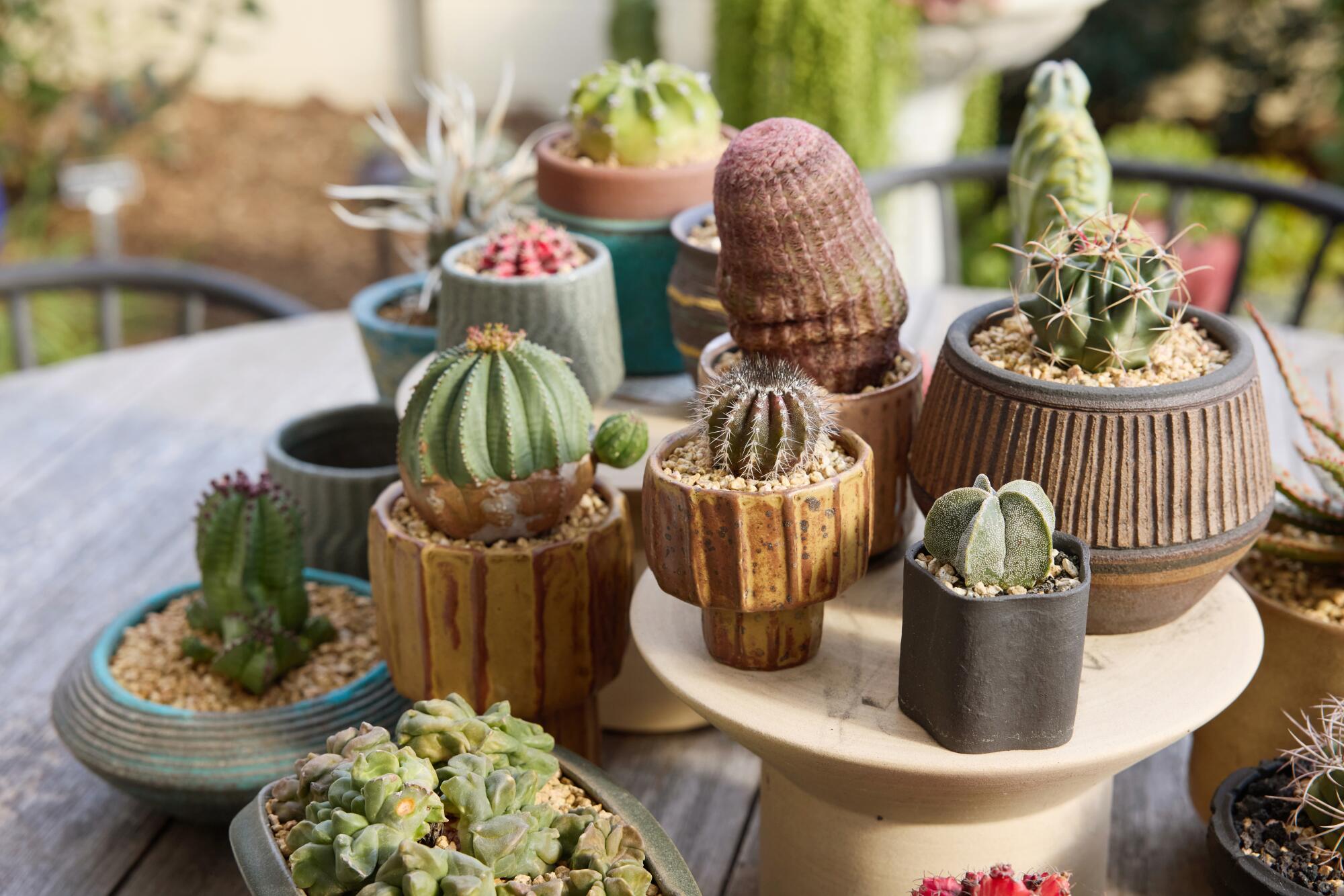
Part of Michael Solberg’s artful cactus collection sits clustered on a circular table in the home garden.
Solberg grew up around plants and gardening, but Pham said they were never a part of his life until the two met in San Diego in 2011. “When we first met, he had a beautiful succulent garden on his tiny patio that was really impressive — I had plastic succulents I bought from Crate & Barrel,” Pham said, laughing. “I just dusted them every once in a while.”
So there were lots of things to consider in creating their new landscape, Solberg said, plus he already knew how much work it was to take out a lawn and create a new landscape. So in the end, they called FormLA Landscaping, because they had admired the firm’s native landscapes in the past, and began laying out their wish list to Ongwiseth, the lead designer.
It took a few tweaks and persuasion — and $60,000 — but in the end, Solberg and Pham said Ongwiseth made their vision better than they had dreamed.
But there were a few bumps along the way.
One of the first decisions was removing the raised wooden deck in the backyard, Ongwiseth said. Pham and Solberg were reluctant not to rebuild, until they saw how much space the removal created. “It put everything at ground level, so you feel like you’re part of the garden instead of above it,” Solberg said.
Solberg was adamant about not wanting gutters to clutter up the roof line. Ongwiseth used French drains around the house perimeter — basically a trench filled with gravel and a perforated pipe to capture the runoff and direct it to the bioswales in the front yard. Ongwiseth finally convinced Solberg to add a small section of gutters on the south side of the house, along the driveway, where they were nearly invisible.
The two bioswales in the front are like planted indentations in the ground that fill with water after a heavy rain and hold it long enough that it sinks in. The gutters help direct rainfall into pipes that drain into the swales. Once they removed the broken concrete driveway and replaced it with ¾-inch crushed angular gravel, they found the rocks helped trap water coming off the roof as well, so that it sunk into the ground instead of pooling and flooding in spots like the old driveway. They also installed a subterranean drip irrigation system, which automatically waters two days a week for 10 minutes. The system uses sensors to skip watering days if it’s raining.
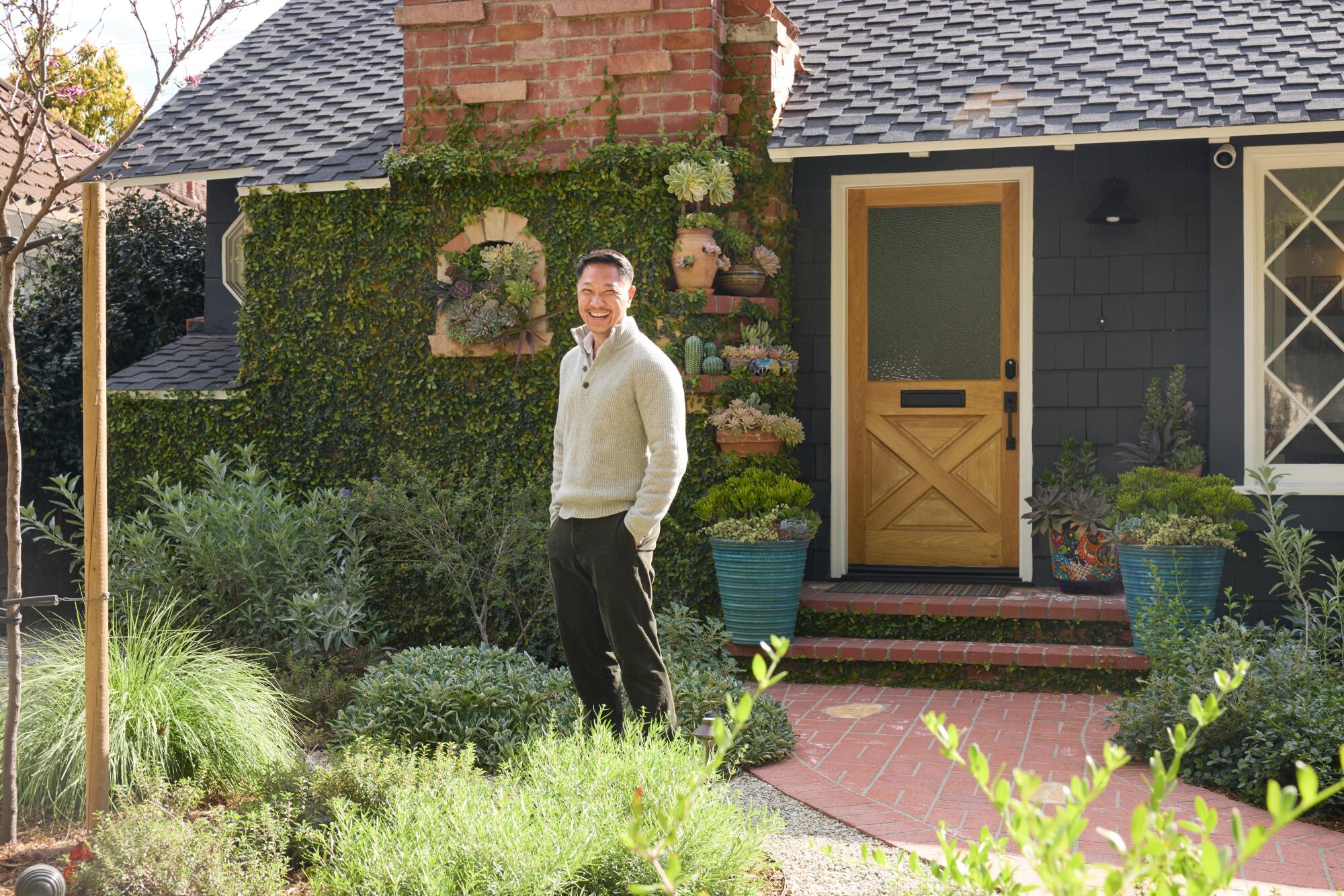
FormLA Landscaping lead designer Isara Ongwiseth in the front yard he designed.
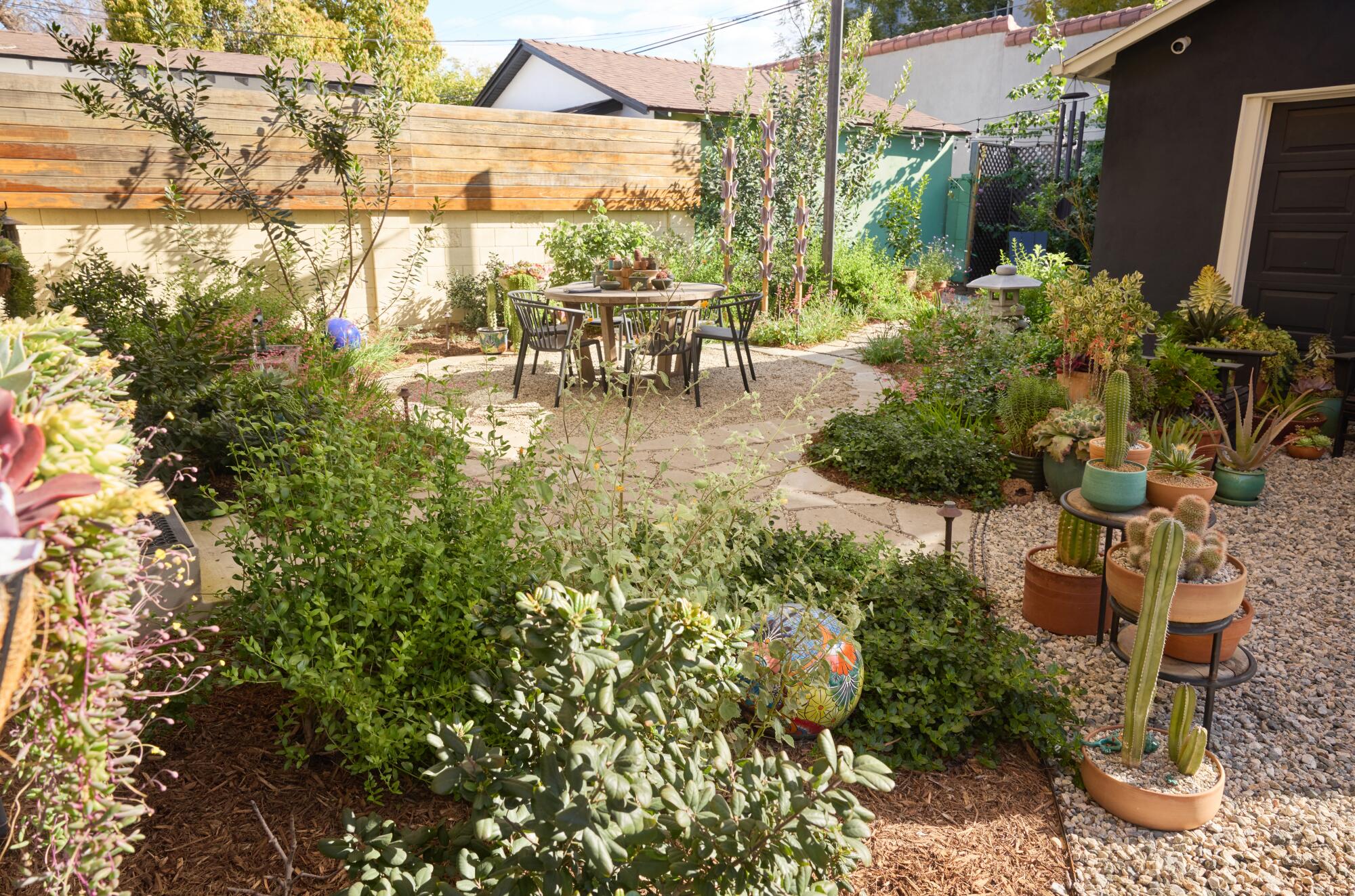
The backyard includes a circular gravel patio and meandering paths, edged in broken concrete.
The swales are edged with meandering paths of smaller, 3/8-inch angular gravel, and mostly hidden by the plants. Gravel was high on Solberg’s wish list, partly for sentimental reasons. His grandmother had gravel paths, he said, and he always loved the way they crunched when he walked on them. There’s a security aspect too, Ongwiseth said: “You’ll always know if somebody has wandered into your garden.”
But creating permeable paths and drives is more challenging than you’d think, Ongwiseth said. “Gravel and decomposed granite sounds good, but then you start tracking granite into the house and scratch the floor, so what do you do with that?” And round smooth gravel may look nice from afar, but your feet sink into those rocks when you walk on them, and they tend to scatter everywhere when children or dogs scramble by. (Pham and Solberg have two rambunctious dogs — Lucy, a goldendoodle, and Teddy, a terrier mix.) Because the kind of gravel Ongwiseth chose locks together, the small rocks stay in place when you walk on them, and your feet feel supported instead of sinking.

Lucy, Michael Solberg and Khoi Pham’s goldendoodle, laps at a rustic fountain next to a pink spray of coral bells.
Preparation was important too. After they tore out the old driveway and created the paths, they removed any weeds, added another drain at the end of the driveway and laid down a geo-textile fabric that suppresses weed growth while allowing water to soak through, before topping off the areas with two inches of gravel.
“Choosing the right type of weed barrier is very important, because so many will start to degrade over time,” Ongwiseth said. “The geo-textile fabrics don’t do that. I have many gardens I’ve installed in the last 15 years where the weed barrier is still holding up.”
Another point of concern was Ongwiseth’s plan to frame the gravel seating area outside the back door with a mosaic of broken concrete. “Broken concrete doesn’t sound very nice,” Pham said, “It felt a little too DIY, but once it was installed, I was like, ‘Oh, where else can we install it?’”
In fact, Pham said, you can still see a portion of rebar in one of his favorite pieces of concrete, “because it shows that it was reused. It truly is an art; they had to chip away at pieces of concrete to put the puzzle together to make it fit into the space.”
The finished design does look artistic, but it was all part of Ongwiseth’s practical considerations about transitioning between yard and home. He wanted a design that basically cleans your shoes of any dust or debris before you step inside. He grew up in a traditional Asian family where everyone takes off their shoes before they enter a home, “but not everyone practices that, so creating a landing or space even with concrete provides that transition.”
He also wanted to honor Solberg’s vision of having permeable surfaces throughout the garden, so instead of big concrete slabs there are spaces between all the small pieces of concrete to allow water to sink into the ground. Those spaces can create uneven places for chairs and tables, he said, so he made the main seating areas all gravel rimmed by the decorative pieces of concrete.
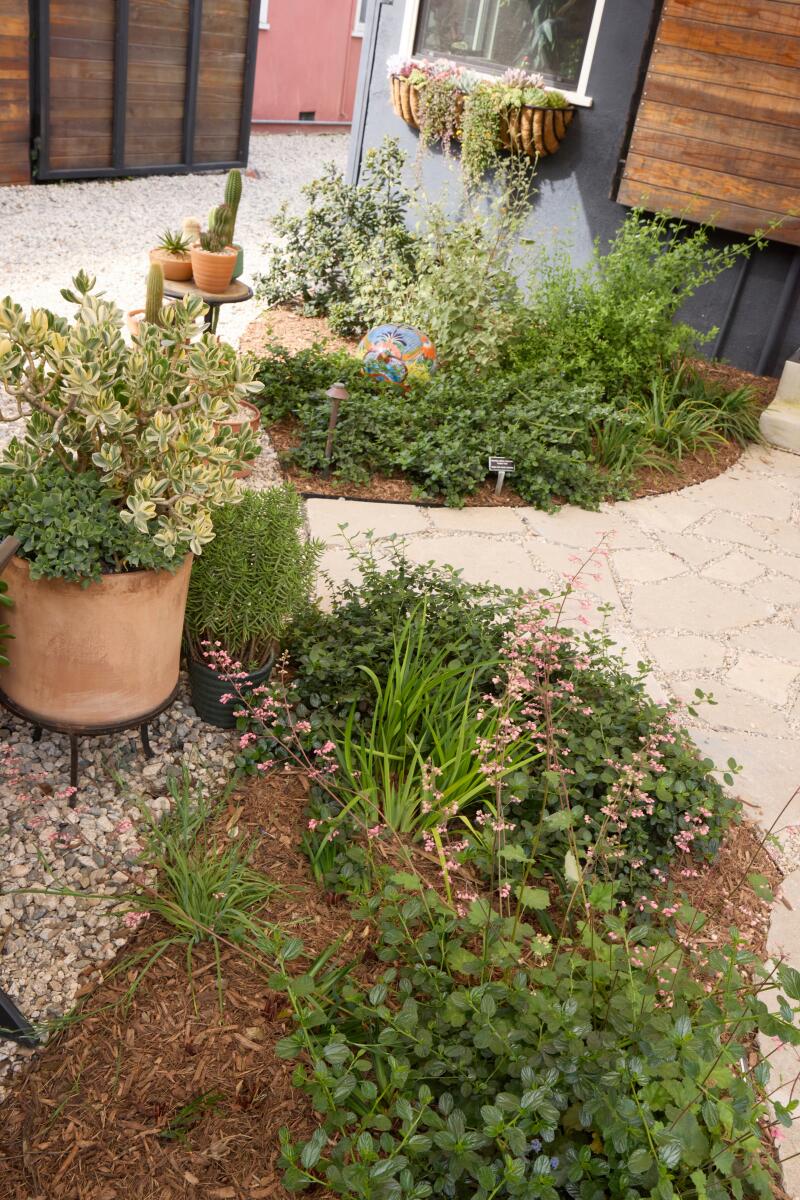
Broken concrete and gravel creates a walkway between planting areas and pots of succulents.
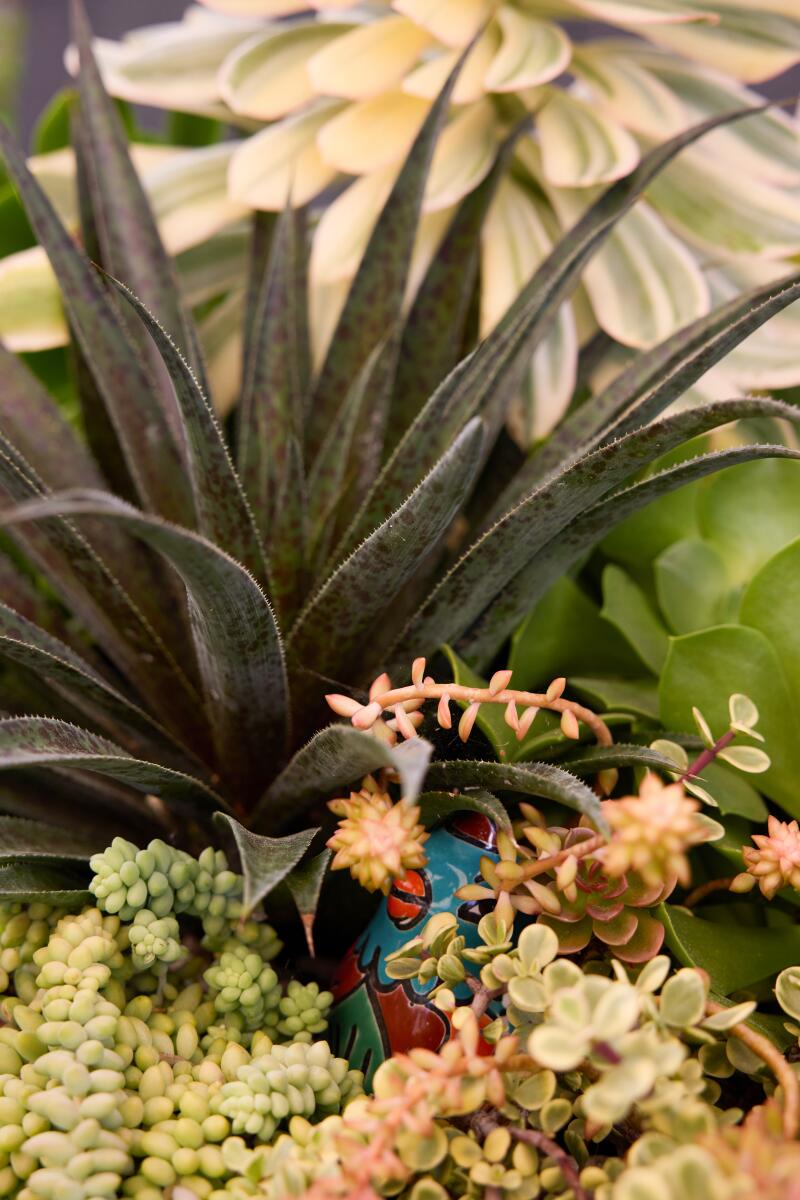
Michael Solberg’s pots of succulents add jolts of color around the home’s native plant landscape.
Ongwiseth also considered the fantastic Storybook design of the house in creating his design. As visitors will see, there is a sense of mystery and exploration as you walk from the front to the back.
“I wanted to create a meandering garden experience, where the whole garden is not revealed right away,” he said. “When we first arrived, we noticed the awkwardness of the shape of the backyard, and that old shade structure [the pergola] just emphasized that awkwardness. Once we removed all that we came up with a design that was more fluid, something that makes you want to explore the richness of the foliage, and the sense of many destinations throughout.”
There was a final and unexpected challenge, when Pham and Solberg were forced to remove a large camphor tree that provided privacy and filtered shade in their backyard. The tree had grown into their neighbor’s garage so it had to be removed, exposing their yard to the multistory apartment building behind them.
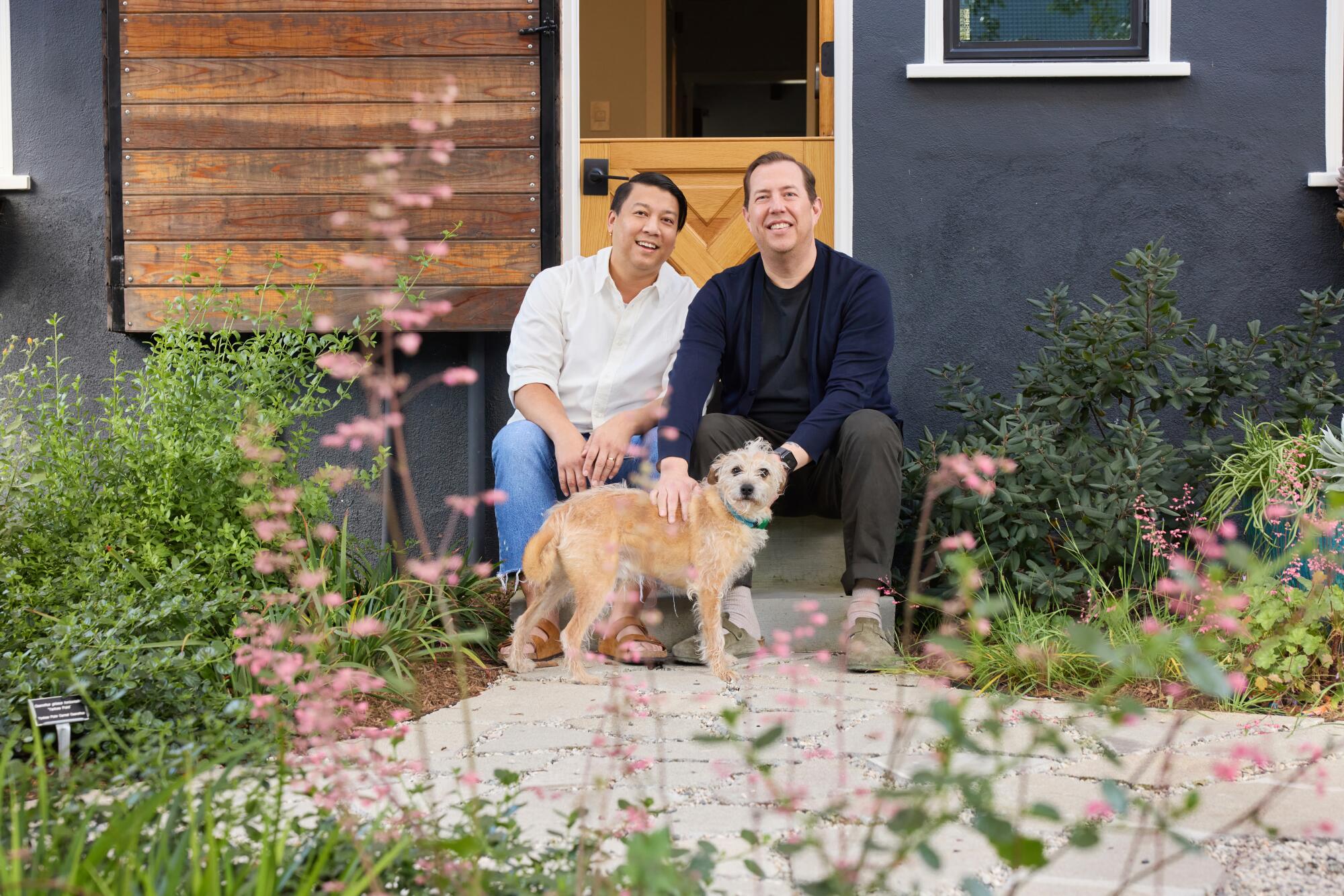
Khoi Pham, left, and Michael Solberg with their terrier mix, Teddy, one of their two dogs.
Ongwiseth softened the privacy issue by installing a large sail-shaped cover stretching from the house to the detached garage, which provides welcome shade during the summer but allows enough sunlight to filter through to keep the plants happy. They planted another redbud tree in the space where the camphor once stood — freeing up some additional space for their barbecue as well — and a bank of hollyleaf cherry (Prunus ilicifolia) at the very back that are already tall enough to block out a large swath of the apartments.
All in all, Pham and Solberg are still pinching themselves about how well it all came together. “There’s a healthy water table under our house now,” Solberg said, laughing. “And maintenance-wise, there’s not a lot we have to do. I have a blower to get rid of excess leaves once in a while, and sometimes, when it gets a little overgrown, I have to get out my clippers, but for the most part it tends to itself.”
These days, they can work outside at a large round table, with its small pots of colorful succulents, or drink coffee in the seating area nearby. Those places are separated by only a few steps, but they feel like a journey, admiring the tall abstract Dustin Gimbel sculptures of salvia whirls, next to real salvias blooming nearby, or the pots of blooming De La Mina verbena (Verbena lilacina ‘De La Mina’) and fragrant pitcher sage (Lepechinia fragrans).
This lovely space is where they’ll host their wedding reception in July, for about 50 people, the wide driveway functioning as a seating area as well as a way to drive in and out of their garage. Pham has his party flow, and Solberg has his vision of a landscape both beautiful and sustainable, visited by pollinators and birds.
“My advice is, just trust the process,” Solberg said. “Normally I would want more control, but I gave up creative license and learned a lot, like the Palmer’s Indian mallow (Abutilon palmeri) — I never would have chosen that for our garden because I didn’t know about it. So I learned, if you trust in the process, you can end up with something incredible, better than if you had done it on your own.”


The Kennedy Center, the facade of which remains covered with a tarp, is seen in Washington, DC, on June 28, 2026. A US federal judge asked on June 24 for an explanation for why a tarpaulin continues to cover the facade of the Kennedy Center where President Donald Trump’s name was recently removed. District Judge Christopher Cooper gave the board of trustees of the performing arts venue until the end of July to explain “the purpose for and status of the tarp and scaffolding that Defendants have erected on the front portico of the Center.”
ALEX WROBLEWSKI/AFP via Getty Images
hide caption
toggle caption
ALEX WROBLEWSKI/AFP via Getty Images
More than two weeks ago, President Trump’s name was removed from the Kennedy Center facade though it is still covered by a tarp and the legal battle continues.
On Monday, a U.S. Department of Justice filing on behalf of the Kennedy Center included some surprises. The document was submitted in response to issues raised by lawyers for ex-officio board member Rep. Joyce Beatty of Ohio who is suing to remove President Trump’s name from the center and stop its closure for renovations.
Among the revelations, the Kennedy Center admitted that, during a board meeting on December 18, 2025, Beatty had been “muted and prevented from speaking.” It was at that meeting that the board voted to add President Trump’s name to the center. The filing later acknowledges the congresswoman was “prevented from voicing her opposition.”
The John F. Kennedy Center for the Performing Arts is a living memorial to its namesake. The guidelines for how the theatre complex spends federal dollars are very specific. Among other rules, it states that “no additional memorials or plaques shall be designated or installed.” Beatty argues adding Trump’s name runs afoul of those rules and that any change requires approval from Congress.
According to one of Beatty’s filings, “There was no advance notice in the agenda that the Board would be considering a name change,” a statement the Kennedy Center now does not deny. The center admits that, prior to voting, there was “no discussion about potential risks or downsides of the vote to adopt a secondary name for the Center.” Nor was there a board discussion “about any potential conflict of interest that might result from the vote.”
The center’s lawyers previously contended that if Trump’s name were to be removed, it would “lose money from donors who support” him and “impede the Center’s fundraising efforts.”
Closing for renovations
Earlier this year, Trump announced on social media that the Kennedy Center would close for two years for renovations. He wrote that he made the decision after “a one year review” with “Contractors, Musical Experts, Art Institutions, and other Advisors and Consultants.”
But, according to the center’s lawyers, Trump’s announcement “was made without presenting any plans, analyses, timelines, or funding information to his cotrustees and without any Board vote.”
The Kennedy Center has long denied reporting by The Washington Post that ticket sales plummeted after President Trump became the Center’s board chair. In Monday’s legal filing, the Center admits that, by October 2025, “nearly half of the Center’s tickets were going unsold.”


Paul Tremblay has made a career of pushing the horror genre – and the novel format – in strange and exciting new directions.
In his latest, Dead but Dreaming of Electric Sheep, the author offers an amalgamation of genre elements that can be best described as psychological-dystopian-science-fiction horror. It’s a mouthful, but the narrative does all of that and more in a way that defies categorization.
Julia Flang is a former semiprofessional gamer working two mediocre jobs she dislikes and living in a modest ranch house in a San Fernando Valley suburb with her retired uncle, whom she calls Uncle Fun. Julia likes movies and gaming but there’s little else going on in her life, so when her estranged mother, the CFO of a large tech company, contacts her with a possible job offer – a “once-in-a-lifetime thing” that pays handsomely just for doing the interview – she hesitantly agrees.

The job is relatively simple and perfect for someone with gaming skills: using a controller built into a phone to get a man, who is stuck in a vegetative state, from California to the East Coast. It will require her to learn how to control his body – walking, moving, sitting, standing, using his arms – so she can maneuver him out of the facility where he is located and into cars and planes and through crowded airports. A fan of movies, Julia decides to call the man Bernie – after the movie Weekend at Bernie’s. When the ethics of the job start to bother her, Julia realizes it’s too late and she must go through with it. However, she’s soon contacted by people interested in sabotaging the whole thing, people who, like her, don’t align with the shady interests of conglomerates and those set to make “gobs of money” from this new, somewhat inhuman technology.

As with every Tremblay novel, any synopsis barely scratches the surface. The novel’s chapters alternate between Julia and you (yes, you). Julia’s chapters are “normal” in the sense that they obey a chronological order and have action, basic descriptions of movement and places, and dialogue. The chapters in second person are like fever dreams from a shadow world; the desperate experiences of a man trapped inside his own body with no control of it, no clue what’s happening to him, and only a few fragmented memories of his life. Also, Tremblay uses a similarly fragmented style of storytelling (including words and sentences trapped in boxes and/or “moving” on the page) to keep things interesting but also confusing and creepy.
This novel operates on several different levels and – planes of existence? Bernie has a head full of AI that controls his body, but his consciousness is still there and struggling to regain control, struggling to remember things. There are monsters, leeches, mysterious rabbits, and eerie shadows in his world, but the true horror comes from the lack of control, from being moved around against his will and having no clue what comes next. Bernie is the embodiment of losing control to AI, and when taken together with the commentary of creativity and AI and the meta interludes in which the author takes a wrecking ball to the fourth wall and addresses readers, this is the best anti-Generative AI story horror has produced so far.
Despite the horror of it, this is a very funny novel. Julia is sarcastic and struggles to keep her comebacks in line, but the conversations she has and messages she writes are always entertaining. However, the humor is far from the crown jewel here. That title belongs to a plethora of big ideas Tremblay juggles. The nature of life, death, and consciousness, the evils of conglomerates, inhuman practices in the name of capitalism, and AI, and even what it means to be human are all explored here: “Is Bernie alive? Is he feeling pain? Is he experiencing everything as a prisoner looking through the bars of his body? Has his consciousness been winnowed to a metaphysical keyhole? Where does consciousness begin or end?” There are no definite answers here, but the way Tremblay infuses humanity, love, the importance of relationships, and humor throughout the narrative provides the kind of answers that can’t and don’t need to be spelled out.
A genre-bender full of big ideas that constantly switches between a world full of real or uncomfortably plausible nightmares and a bizarre hellscape in which loss of self, memory, and autonomy are only the tip of the proverbial iceberg, Dead but Dreaming of Electric Sheep is a horrific and terrifyingly disorienting novel that invites readers to consider a future that already started. Tremblay has always been an innovator, but this beautifully written collection of real and imagined grotesqueries cements him not only as one of the most original and exciting voices in horror but also as one of the smartest, most engaging authors in contemporary fiction.
Gabino Iglesias is an author, book reviewer and professor living in Austin, Texas. Find him on X, formerly Twitter, at @Gabino_Iglesias.

-
 Florida3 minutes ago
Kids with autism are prone to drowning. Florida is trying to prevent that
-

 Georgia6 minutes ago
Bradenton man wanted for murder is found hiding in Georgia
-

 Hawaii11 minutes ago
Few state bills this year face potential veto – West Hawaii Today
-

 Illinois21 minutes ago
West Suburban hospital sends permanent layoff notices to about 500 furloughed employees
-

 Indiana26 minutes ago
Extreme heat peaks before holiday weekend storms | July 1, 2026
-

 Iowa33 minutes ago
New York Times/Siena Polls in Alaska, Iowa, North Carolina, and Ohio – Siena Research Institute
-

 Kansas36 minutes ago
Kansas State Fair announces Rock Fest with three-band lineup
-

 Kentucky36 minutes ago
Looking for the best hot dog in Louisville? Try these 15 spots

