Lifestyle
The benefits of dressing up to stay in — and why they outweigh dressing up to go out


I only sleep in silk. It’s a bit of a dirty secret.
This isn’t the type of thing you want to admit to a friend, much less a stranger. It’s undemocratic. Polyester isn’t good enough for you? Rayon, viscose, all the leaps and bounds made in synthetics — don’t you believe in science?
Fine silk runs through the fingers like soft water. It drapes without hiding your lines or curves — but can, if woven with enough heft, still deliver on structure. In the right color, it is impervious to sweat. With a little Woolite — and the stomach to ignore the tsk-tsk of “dry clean only” — it’ll survive a hundred washings. Silk comforts and cocoons, so light it practically hovers. I sleep in silk. I cook in silk. I clean in silk. I live in silk — it’s all I wear when I’m at home. (And, often, an apron.) Why dress up to go out when you can dress to stay in?
Pamela wears Versace briefs and robe , Justine Clenquet earrings and necklace.
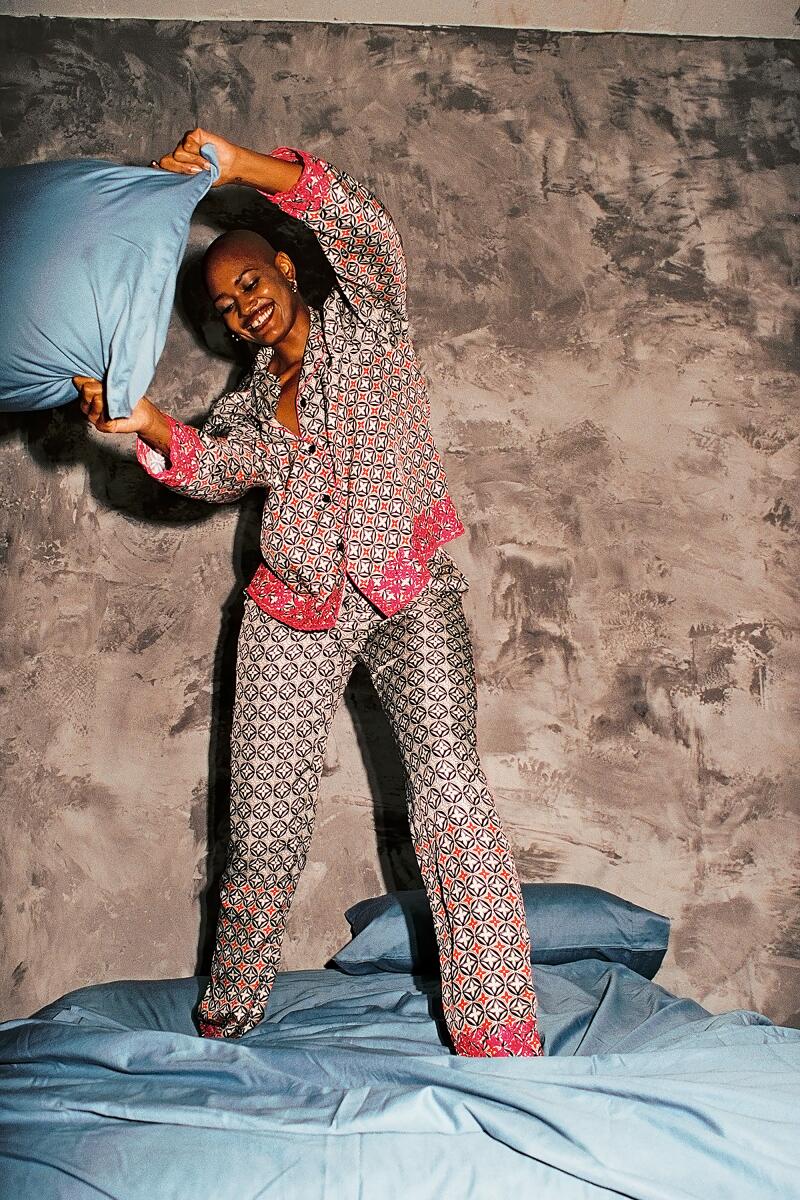
Louis Vuitton pajamas, Justine Clenquet earrings.
Like many immigrant families, the one I grew up in drew a hard line between inside clothes and outside clothes. (Or maybe it’s not about hyphens but just having some manners; as Phoebe Robinson says, “Please Don’t Sit on My Bed in Your Outside Clothes.”) Outside, the world is covered in dog s—. Plus a good deal of pollen that will have me up all night hacking. Inside, my bare feet walk on the qilim my mother “lent” me 15 years ago, and the air’s laced with cardamom from my decaf-black virgin nightcap. Inside, there’s a candle burning and a ban on overhead lighting. Inside, one rule reigns: respect the sanctity of Inside.
Pajamas, you see, aren’t just for sleeping. They’re inside clothes. This is a lesson the pandemic brought home to everyone, but for some of us it’s always been so.
The word “pajama” stems from Persian/Farsi, as I learned in my medieval Persian seminar in college after a life of speaking Farsi at home but somehow never registering the echo of this particular cognate. A compound of “pay,” or leg, and “jāma,” cloth (as in, clothes), the term first traveled to India via the Mughals, who spoke Persian at court. We’re talking the 1500s. A few centuries later — as a Dolce & Gabbana blog post on “the pyjama” also so kindly explains — the word, and corresponding style of loose pants coupled with a matching top, then went West via the Raj: colonial Brits stole the breezy unisex look from their subjects. In short, as an Iranian, I come from a long uninterrupted line of pajamas. Though probably in cotton.
When I was a kid, I also had a few nightgowns. My favorite my mother had sewn for me. Puff sleeves, peach and brown stripes. Memorialized, these days, in a snapshot of me and my childhood best friend on her family’s pullout couch, Nick at Nite on the TV.
Historically, nightgowns, opposite from pajamas, traveled from West to East. And they didn’t start out femme — in medieval Europe, men and women alike retired for the night in long, loose shirts. Today nightgowns are pretty much dead. But there was a time when Dior could dress you so good in lace and pastels it’d make you want to wear makeup to bed. Now few luxury brands bother, including Dior. (Albeit the occasional exception, like this truly wild floor-length, rhinestone-encrusted sheer getup by Dolce & Gabbana.) Probably for the same reason, I no longer have any nightgowns. First Wave feminism-slash-medieval Muslim culture has finally crashed on the shores of fashion, and women wear pants. Dresses can be restrictive. I like to lounge with one leg up.
Since those childhood days of puffs sleeves past, I’ve accrued a small collection of adult pajama sets. Window-shopping for my next set, I come back across the garment’s colonial lineage. A matching set by Dior — clearly I’m dreaming — features a generic jungle scene as the house’s take on Toile de Jouy (i.e., fussy French pastoral). Prints of “exotic” flora and fauna have become such a mainstay of luxury pajamas (see: Olivia von Halle) that we don’t even notice the history behind them. I’m not calling for a boycott, but every now and then, I like to see how the sausage gets made.
Inside you are your main audience. The joy lies in the freedom. Be extra. Go bold.
Me, I like it simple. But always in silk.
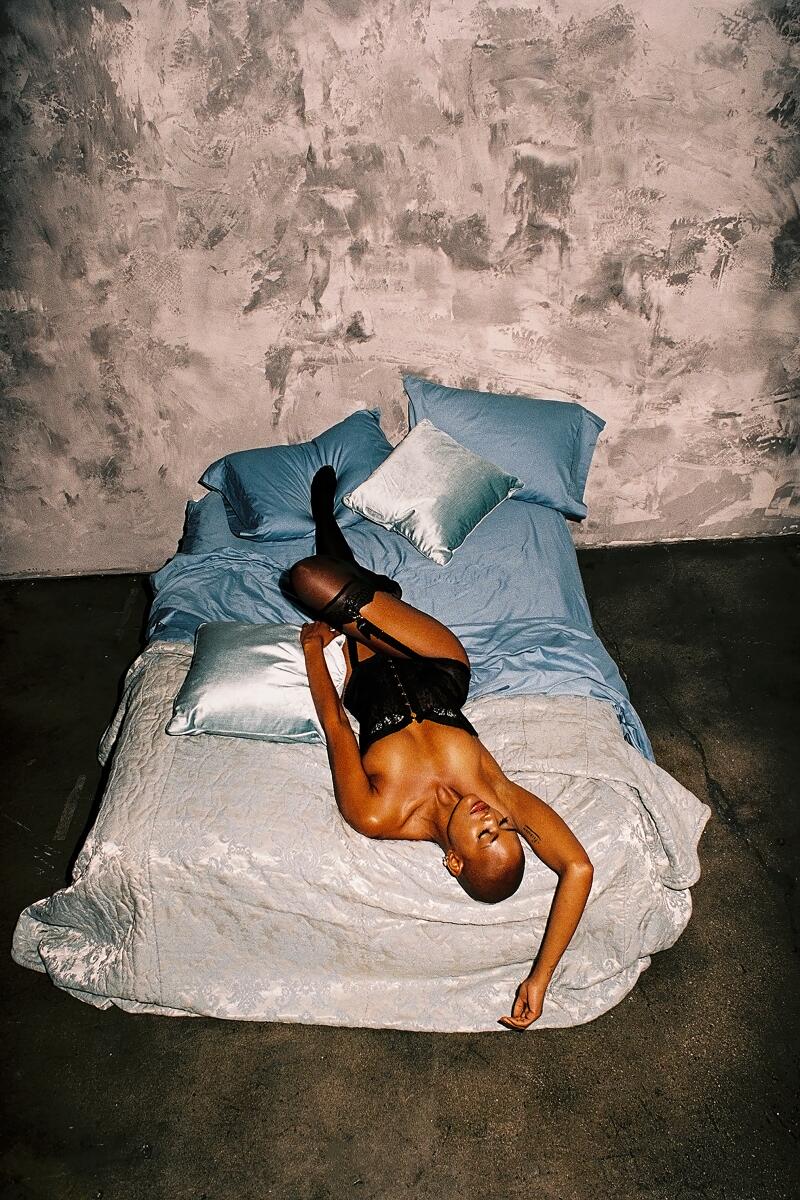
Pamela wears Agent Provocateur lingerie, Wolford stockings.

Vivienne Westwood phone purse.
My first set of silk pajamas came relatively late in life. Christmas in Fort Greene, my mid-20s. It was snowing. The kind of snow that feels like the first snow even when it isn’t, those light bright flakes that hang in the air so mournfully and beautifully you’d think you were on set for the holiday special except you can feel them melting on your chapped lips. There were so many firsts that year. My first apartment shared by an “us” that wasn’t simply financial, wasn’t me and a roommate. My first — in the form of our first — Christmas tree. (I didn’t grow up celebrating.) And, surely just as momentous, my first foray into pure silk.
Black silk with black piping. Fat black buttons, curved lapels. Long sleeves, long pants. Men’s. We’d gone Christmas shopping in the snow at the Brooklyn flea. When the scrawny guy draped over a folding chair across the stall saw me thumbing the package, he assured me that all his “girlfriends” wore them in an S, as if I needed an excuse to shop menswear and women only came in one size. He quoted 50 dollars for the set, a price that seemed at once fair and substantial. Back in the apartment that night, too lazy to iron out folds creased by time, I let more time and the wet heat of my body shake out the fabric.
Going silk is like what I imagine it felt like to step into the ’70s and burn (i.e., toss) your bras — there’s no way back. Now I have silk for every season — just a piece or two. Princesse tam tam cami and shorts in cherry red — not the skin but the flesh, which is redder. Another Princesse tam tam cami (black, bustle button detail) whose matching bottom I spent hours searching for in vain (such are sales). Thrifted and gifted to my beau before I took it back, a silk men’s tee by Cos big enough to serve as a micro-dress. Actually gifted to myself for a pandemic birthday, a classic Sleeper set in high-shine satin, the color an indulgence in itself: cream, as in farm-fresh and organic. And, I must say, way too high-maintenance. Like after I’ve done my own mani — for hours, I can hardly lift a finger without fear of effing something up.
True luxury lies in ease. As in donning that old black pajama set, day after gray rainy day, this past L.A. winter. Silk lasts. After over a decade of sitting cross-legged on the sofa in these silk pajama pants, reading or watching something; after over a decade of tossing and turning in them as I made and remade myself in cities and careers that were miles and miles apart; after over a decade of washing them, not by hand like my other silks, but by throwing them in the monstrous machine at the laundromat with regular detergent, and yes, sometimes, even machine-drying them (come out soft as a caterpillar) — after over a decade of use and abuse, I only just recently had to have a couple seams resewn. This stuff is ox-strong. Twelve years of sweat and soap, and now when the fabric ripples, black fades to gray, thick with light. You can’t buy patina like this.
Clothes are our closest homes, our first layers of shelter. I guess most folks think they’re only worth investing in when there are strangers to impress. But I want to say that being inside, being alone, is important. Maybe you’re no raja or rani, but your skin might like the touch of silk.

Pamela wears Vivienne Westwood corset, vintage purple briefs, Justine Clenquet choker.
Production: Mere Studios
Model: Pamela Holmes
Prop stylist: Gina Caravan
Makeup: Carla Perez
Photo assistant: Nicholas Mora
Prop assistant: Jessica Ayala
Mariam Rahmani is a writer and translator. Her first novel, “Liquid, A Love Story,” comes out in March from Algonquin. It takes place between L.A. and Tehran.


The Kennedy Center, the facade of which remains covered with a tarp, is seen in Washington, DC, on June 28, 2026. A US federal judge asked on June 24 for an explanation for why a tarpaulin continues to cover the facade of the Kennedy Center where President Donald Trump’s name was recently removed. District Judge Christopher Cooper gave the board of trustees of the performing arts venue until the end of July to explain “the purpose for and status of the tarp and scaffolding that Defendants have erected on the front portico of the Center.”
ALEX WROBLEWSKI/AFP via Getty Images
hide caption
toggle caption
ALEX WROBLEWSKI/AFP via Getty Images
More than two weeks ago, President Trump’s name was removed from the Kennedy Center facade though it is still covered by a tarp and the legal battle continues.
On Monday, a U.S. Department of Justice filing on behalf of the Kennedy Center included some surprises. The document was submitted in response to issues raised by lawyers for ex-officio board member Rep. Joyce Beatty of Ohio who is suing to remove President Trump’s name from the center and stop its closure for renovations.
Among the revelations, the Kennedy Center admitted that, during a board meeting on December 18, 2025, Beatty had been “muted and prevented from speaking.” It was at that meeting that the board voted to add President Trump’s name to the center. The filing later acknowledges the congresswoman was “prevented from voicing her opposition.”
The John F. Kennedy Center for the Performing Arts is a living memorial to its namesake. The guidelines for how the theatre complex spends federal dollars are very specific. Among other rules, it states that “no additional memorials or plaques shall be designated or installed.” Beatty argues adding Trump’s name runs afoul of those rules and that any change requires approval from Congress.
According to one of Beatty’s filings, “There was no advance notice in the agenda that the Board would be considering a name change,” a statement the Kennedy Center now does not deny. The center admits that, prior to voting, there was “no discussion about potential risks or downsides of the vote to adopt a secondary name for the Center.” Nor was there a board discussion “about any potential conflict of interest that might result from the vote.”
The center’s lawyers previously contended that if Trump’s name were to be removed, it would “lose money from donors who support” him and “impede the Center’s fundraising efforts.”
Closing for renovations
Earlier this year, Trump announced on social media that the Kennedy Center would close for two years for renovations. He wrote that he made the decision after “a one year review” with “Contractors, Musical Experts, Art Institutions, and other Advisors and Consultants.”
But, according to the center’s lawyers, Trump’s announcement “was made without presenting any plans, analyses, timelines, or funding information to his cotrustees and without any Board vote.”
The Kennedy Center has long denied reporting by The Washington Post that ticket sales plummeted after President Trump became the Center’s board chair. In Monday’s legal filing, the Center admits that, by October 2025, “nearly half of the Center’s tickets were going unsold.”


Paul Tremblay has made a career of pushing the horror genre – and the novel format – in strange and exciting new directions.
In his latest, Dead but Dreaming of Electric Sheep, the author offers an amalgamation of genre elements that can be best described as psychological-dystopian-science-fiction horror. It’s a mouthful, but the narrative does all of that and more in a way that defies categorization.
Julia Flang is a former semiprofessional gamer working two mediocre jobs she dislikes and living in a modest ranch house in a San Fernando Valley suburb with her retired uncle, whom she calls Uncle Fun. Julia likes movies and gaming but there’s little else going on in her life, so when her estranged mother, the CFO of a large tech company, contacts her with a possible job offer – a “once-in-a-lifetime thing” that pays handsomely just for doing the interview – she hesitantly agrees.

The job is relatively simple and perfect for someone with gaming skills: using a controller built into a phone to get a man, who is stuck in a vegetative state, from California to the East Coast. It will require her to learn how to control his body – walking, moving, sitting, standing, using his arms – so she can maneuver him out of the facility where he is located and into cars and planes and through crowded airports. A fan of movies, Julia decides to call the man Bernie – after the movie Weekend at Bernie’s. When the ethics of the job start to bother her, Julia realizes it’s too late and she must go through with it. However, she’s soon contacted by people interested in sabotaging the whole thing, people who, like her, don’t align with the shady interests of conglomerates and those set to make “gobs of money” from this new, somewhat inhuman technology.

As with every Tremblay novel, any synopsis barely scratches the surface. The novel’s chapters alternate between Julia and you (yes, you). Julia’s chapters are “normal” in the sense that they obey a chronological order and have action, basic descriptions of movement and places, and dialogue. The chapters in second person are like fever dreams from a shadow world; the desperate experiences of a man trapped inside his own body with no control of it, no clue what’s happening to him, and only a few fragmented memories of his life. Also, Tremblay uses a similarly fragmented style of storytelling (including words and sentences trapped in boxes and/or “moving” on the page) to keep things interesting but also confusing and creepy.
This novel operates on several different levels and – planes of existence? Bernie has a head full of AI that controls his body, but his consciousness is still there and struggling to regain control, struggling to remember things. There are monsters, leeches, mysterious rabbits, and eerie shadows in his world, but the true horror comes from the lack of control, from being moved around against his will and having no clue what comes next. Bernie is the embodiment of losing control to AI, and when taken together with the commentary of creativity and AI and the meta interludes in which the author takes a wrecking ball to the fourth wall and addresses readers, this is the best anti-Generative AI story horror has produced so far.
Despite the horror of it, this is a very funny novel. Julia is sarcastic and struggles to keep her comebacks in line, but the conversations she has and messages she writes are always entertaining. However, the humor is far from the crown jewel here. That title belongs to a plethora of big ideas Tremblay juggles. The nature of life, death, and consciousness, the evils of conglomerates, inhuman practices in the name of capitalism, and AI, and even what it means to be human are all explored here: “Is Bernie alive? Is he feeling pain? Is he experiencing everything as a prisoner looking through the bars of his body? Has his consciousness been winnowed to a metaphysical keyhole? Where does consciousness begin or end?” There are no definite answers here, but the way Tremblay infuses humanity, love, the importance of relationships, and humor throughout the narrative provides the kind of answers that can’t and don’t need to be spelled out.
A genre-bender full of big ideas that constantly switches between a world full of real or uncomfortably plausible nightmares and a bizarre hellscape in which loss of self, memory, and autonomy are only the tip of the proverbial iceberg, Dead but Dreaming of Electric Sheep is a horrific and terrifyingly disorienting novel that invites readers to consider a future that already started. Tremblay has always been an innovator, but this beautifully written collection of real and imagined grotesqueries cements him not only as one of the most original and exciting voices in horror but also as one of the smartest, most engaging authors in contemporary fiction.
Gabino Iglesias is an author, book reviewer and professor living in Austin, Texas. Find him on X, formerly Twitter, at @Gabino_Iglesias.

-

 South-Carolina4 minutes ago
South Carolina Lottery Mega Millions, Pick 3 results for June 30, 2026
-

 South Dakota7 minutes ago
Vermillion’s Reuvers commits to South Dakota
-

 Tennessee12 minutes ago
Tennessee’s heat wave flirting with records
-

 Texas19 minutes ago
Phoenix Merchant Partners and Texas Capital Alternative Asset Management Form Strategic Relationship
-

 Utah22 minutes ago
Therapy dogs offer a welcome break for firefighters battling Utah’s Iron, Cherry fires
-

 Vermont27 minutes ago
She moved from Paris to Vermont and found her ‘dream job’ opening a bakery – The Boston Globe
-

 Virginia34 minutes ago
Reopening date set for Virginia Creeper Trail after months of work
-

 Washington37 minutes ago
Colorado Democrats punish Washington ties in primaries

