Business
Column: Calling the police on campus protests show that college presidents haven't learned a thing since the 1960s


Students are massed peacefully on campus, making politically charged demands on university presidents. The police are summoned, leading to mass arrests and even to violence — and to the collapse of confidence in the administration.
You may see the punchline coming: This picture isn’t drawn from USC and Columbia University of the present day, but Berkeley in 1964.
The lessons should be obvious. Bringing police onto a college campus on the pretext of preserving or restoring “order” invariably makes things worse. It’s almost always inspired not by conditions on campus, but by partisan pressure on university administrators to act. Often it results in the ouster of the university presidents who condoned the police incursions, and sometimes even in the departure of the politicians whose fingerprints were on the orders.
Arresting peaceful protestors is also likely to escalate, not calm, the tensions on campus — as events of the past week have made abundantly clear.
— ACLU
In other words, nobody wins.
Perhaps in recognition of the astonishing ignorance of college administrators of their own responsibilities, the American Civil Liberties Union last week issued a succinct guide on how to fulfill their “legal obligations to combat discrimination and … maintain order” without sacrificing the “principles of academic freedom and free speech that are core to the educational mission.”
The ACLU advises that administrators “must not single out particular viewpoints — however offensive they may be to some members of the community — for censorship, discipline, or disproportionate punishment.”
It’s one thing for protesters or anyone else to direct harassment “at individuals because of their race, ethnicity, or religion,” the ACLU observed. But “general calls for a Palestinian state ‘from the river to the sea,’ or defenses of Israel’s assault on Gaza, even if many listeners find these messages deeply offensive, cannot be prohibited or punished by a university that respects free speech principles.”
The statement further advised that “speech that is not targeted at an individual or individuals because of their ethnicity or national origin but merely expresses impassioned views about Israel or Palestine is not discrimination and should be protected.” (Emphasis in the original.)
The ACLU cautions that “inviting armed police into a campus protest environment, even a volatile one, can create unacceptable risks for all students and staff.” Its statement points to the history of excessive force wielded by law enforcement units against “communities of color, including Black, Brown, and immigrant students…. Arresting peaceful protestors is also likely to escalate, not calm, the tensions on campus — as events of the past week have made abundantly clear.”
Finally, the statement urges administrators to “resist the pressures placed on them by politicians seeking to exploit campus tensions to advance their own notoriety or partisan agendas…. Universities must stand up to such intimidation, and defend the principles of academic freedom so essential to their integrity and mission.”
The history of campus protests suggests that they generally appear more threatening and disruptive on the spot than they prove to be over time. Strong, ‘decisive’ responses almost always backfire.
Any university administrator contemplating bringing police onto campus must reckon with what happened at Columbia in 1968, when 1,000 New York police summoned to clear student protesters out of the administration building made 700 arrests amid a melee that resulted in injuries of students and police officers alike.
Then there’s Kent State, where Ohio National Guard troops fired on a crowd in 1970, killing four students and wounding nine others, producing images of the confrontation that remain indelible today.
That brings us back to Berkeley. The free speech movement that originated at Berkeley in 1964 culminated in the student takeover of Sproul Hall on Dec. 2, following a speech by student leader Mario Savio in which he said, “There is a time when the operation of the machine becomes so odious, makes you so sick at heart, that you can’t take part.”
When UC President Clark Kerr failed to take action, Gov. Edmund G. “Pat” Brown stepped in, ordering police to clear the building. This resulted in 773 arrests, the largest mass arrest in California history.
Brown plainly was reacting to pressure from conservatives, who would come to include Ronald Reagan, who based his 1966 campaign for governor on sniping about “the mess at Berkeley.” Reagan beat Brown in a landslide, and subsequently orchestrated Kerr’s firing.
The wisdom of avoiding confrontations between law enforcement and campus protesters was lost on Linda Katehi, then-chancellor of UC Davis, who in 2011 allowed campus police to clear an encampment linked to the Occupy movement, which protested economic inequality.
A video of a campus officer casually pepper-spraying students seated on the Davis quad went viral; Katehi never fully regained her standing on campus and lost her chancellorship in 2016.
Judging from the responses to the Gaza-related protests on its campuses, UC itself seems to have absorbed the lessons of the past. Pro-Palestinian protests at UCLA, UC Berkeley and UC Santa Barbara have been tolerated by their administrations, as my colleague Teresa Watanabe has reported, and to date haven’t resulted in confrontations with law enforcement.
That may be the product of the 2011 episode, which yielded a systemwide review and report outlining best practices for dealing with campus protests. The report called for “a substantial shift away from a mindset that has been focused primarily on the maintenance of order and adherence to rules and regulations to a more open and communicative attitude,” with police force used as the very last resort.
That’s not the case at Columbia, USC or some other universities where police have been deployed almost as the first resort. At USC, police in riot gear made 93 arrests April 24 in clearing a protest encampment.
The university has failed to get its arms around the protests; its missteps began with its cancellation of a commencement speech by its valedictorian, Asna Tabassum, a Muslim, over unidentified “threats.” Since then, the university has doubled down by canceling its main commencement ceremony. Numerous speakers tapped for keynote speeches at other academic commencements have canceled their appearances.
Some university leaders may be trying to demonstrate a strong hand in managing their campuses, but the message they communicate is the opposite. “They look weak, they look mostly like they are appeasing hostile outsiders who have no intention of being appeased,” Timothy Burke, a professor of history at Swarthmore College, has written.
Texas Gov. Greg Abbott, for example, bragged in 2019 of signing “a law protecting free speech on college campuses.” But he responded to an encampment at the University of Texas by saying the demonstrators “belong in jail” and “should be expelled,” an indication that his devotion to free speech is selective. State and local police raided the encampment, arresting 57.
If the history of appeasement doesn’t sufficiently teach that appeasement never works, the actions of today’s cynical goons such as Abbott, Rep. Elise Stefanik (R-N.Y.) and House Speaker Mike Johnson (R-La.) demonstrate that they aren’t in this game to be appeased.
They don’t care a hoot about the “safety” of students, or about the rise of antisemitism nationally, or about hurtful rhetoric emanating from the tent colonies on campus, which they claim to be their concerns. Instead, they’re trying to exploit what appears to be a violent situation to pursue their larger campaign to demonize higher education — in fact, education generally — by softening it up for the imposition of right-wing, reactionary ideologies.
One would hope that this message hit Columbia President Minouche Shafik squarely after she staged a show of forcefulness April 18 by calling on the New York Police Department to clear an encampment on that campus’ central lawn; officers in riot gear arrested 100 individuals. That came the day after Shafik faced a lengthy grilling by Stefanik and other Republicans on a House committee about reported antisemitic incidents on and around the Manhattan campus. (Disclosure: I hold a Columbia graduate degree.)
Shafik’s appeasement was unavailing. Three days after the police incursion, Stefanik called on Shafik to “immediately resign” for having “lost control” of the campus. Speaker Johnson followed up three days later by visiting Columbia and also calling on Shafik to resign “if she cannot immediately bring order to this chaos.”
Shafik is still trying to show a strong hand. Columbia’s efforts to clear the encampment occupying a corner of its campus lawn has been excessively punitive: Students who have been suspended in connection with the encampment have been barred from campus facilities, including its libraries, classrooms and the common spaces of their dorm rooms.
Monday, participants in the protest were given until 2 p.m. to clear out and identify themselves to campus police, on pain of suspension that would prevent them from taking final exams or graduating, if they were scheduled to do so this year.
The politicians issued their calls for action after fostering the impression that the campus protests are violent. In the case of Columbia and USC, this is largely a fiction. The Columbia encampment was “fairly calm” and reports that Jewish students feared for their safety “ridiculous,” Milène Klein, a Columbia senior and member of the opinion page board of the Daily Spectator, the campus newspaper, told Slate.com on April 22.
The police presence was what created the tension, Klein said. “We have prison buses around campus, and an egregious amount of police officers off and on campus,” she said. “The presence has been very overwhelming.”
As my colleague Lorraine Ali points out, media coverage of the campus demonstrations and the official responses has tended to erase the goal of the protesters, which is to focus attention on the carnage in Gaza.
But that’s only one casualty of the misdirected coverage. Another is the conflation of anti-Israel sentiment with antisemitism. These are not the same thing. To many people appalled by the situation in Gaza — including many American Jews and even Israelis — the issue isn’t Israel as such or Jewishness but the behavior of the Israeli government, or more specifically the Netanyahu regime.
The participants in the tent protests on campus include many Jewish students who see the issues a lot more clearly than the politicians or the media. That won’t change as long as university administrators forget why their institution’s exist — to defend academic freedom and free speech. The effort may not always be easy, but it’s most important when it’s hard.


An aging downtown office complex will be converted into apartments as part of an ambitious plan by local real estate companies to create 4,000 affordable housing units in Los Angeles.
The first project will be a $200-million makeover of the L.A. World Trade Center, a sprawling white elephant of an office complex on Figueroa Street built in the 1970s that will be turned into 512 apartments in one of the largest affordable housing conversions to date downtown.
Future projects being planned in the central city for delivery over the next five years will include other office-to-apartment conversions and new housing built from the ground up.
The 10-story World Trade Center, right, at Figueroa and Fourth streets in downtown Los Angeles, was built in the mid-1970s.
(Myung J. Chun / Los Angeles Times)
Behind the building campaign unveiled Monday are two of the region’s largest real estate companies, Jamison and Kennedy Wilson. Jamison is the city’s most prolific converter of offices to market-rate apartments and currently has a major makeover of a downtown office skyscraper underway for tenants who can pay top rents.
Kennedy Wilson, a real estate investment company based in Beverly Hills, owns Vintage Housing, which builds and operates affordable housing using tax credits and other state and federal financing to help fund it.
Vintage Housing and Jamison’s new affordable housing division, Arden Residential, will take on the campaign to build the housing where qualified tenants will pay rents below market rates.
Rents in the World Trade Center — which will be renamed Sky Castle when it opens in early 2028 — are expected to start at $937 for a one-bedroom unit. Some two- and three-bedroom units would rent for $1,100 and $1,300 per month, respectively, developers said.
Sky Castle will have shared amenities found in more expensive modern apartments, the developers said, such as a fitness center, resident lounge and co-working space. It already has six tennis courts on the roof, which may be converted to pickleball courts, Jamison Chief Executive Garrett Lee said.
The goal is to build higher quality affordable housing by using efficient construction methods Jamison has learned through building more than 8,000 market-rate apartments in the past, Lee said. The makeover of the World Trade Center will mark Jamison’s 15th conversion of an office building to housing.
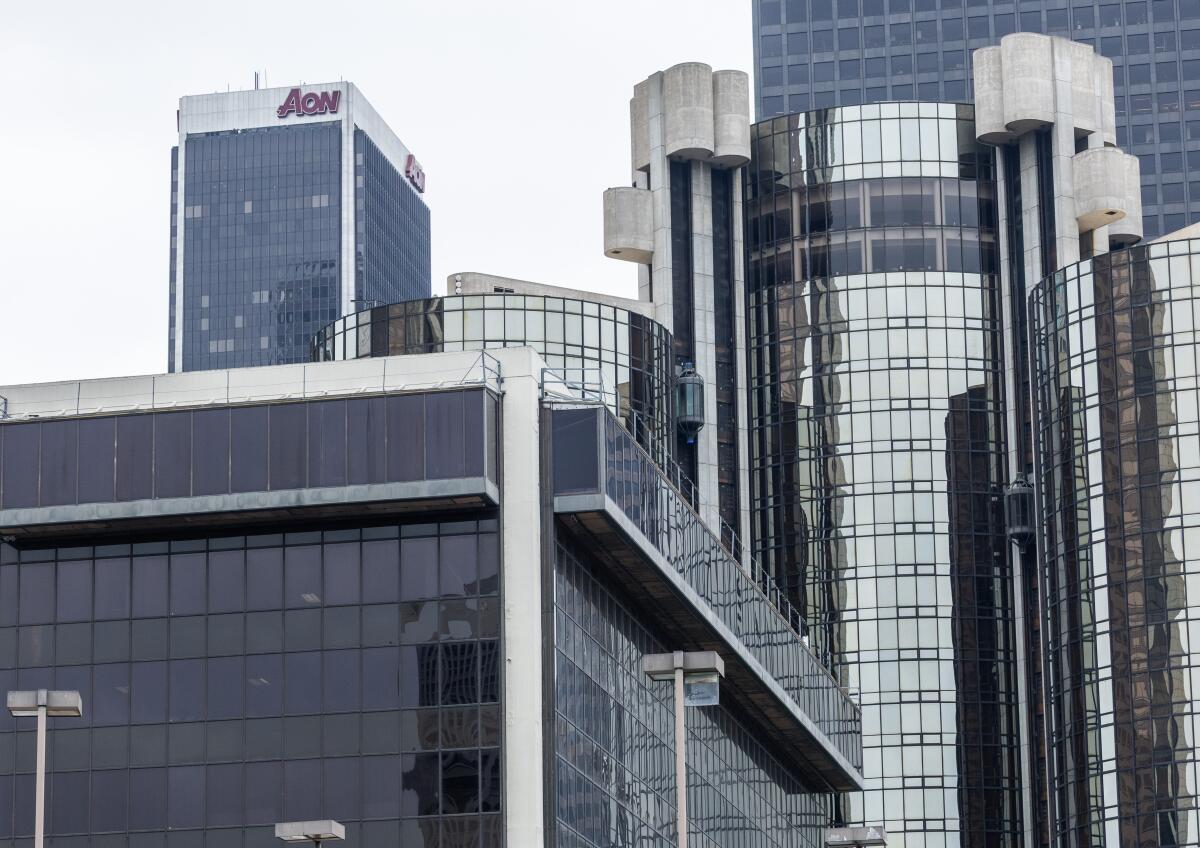
The plan to redevelop the L.A. World Trade Center, bottom left, is one of the largest affordable housing conversions to date downtown.
(Myung J. Chun / Los Angeles Times)
The 10-story World Trade Center was built in the mid-1970s to fanfare saying it would be home to international companies. In 1976, The Times described the center as a place to prepare for an overseas trip where visitors could get passports and visas, as well as exchange dollars for francs, marks, rubles and other currency. There was a language school and branches of U.S., Swiss and Japanese banks.
By the mid-1980s, the 400,000-square-foot office complex covering a city block at Figueroa and Fourth streets had lost its international flavor and was falling out of favor with corporate tenants who were moving into glossy new skyscrapers on Bunker Hill and in other locations.
The building has been cleared of remaining office tenants to allow work to begin in August, Lee said.
Kennedy Wilson is a nationwide operator of market-rate apartments that has also moved into building affordable housing in the last decade, said Nicholas Bridges, global head of capital markets at the company.
Building affordable, workforce housing “in almost all cases requires public subsidies,” Bridges said, and Kennedy Wilson has developed expertise in assembling “a cocktail of public financing sources” that includes low-income housing tax credits and tax-exempt bonds.
In the past, many housing developers have shied away from building affordable housing because assembling the subsidies needed to make construction profitable is challenging.

An artist’s rendering shows what the L.A. World Trade Center could look like after being redeveloped into affordable housing. The new complex is to be called Sky Castle.
(Ian Camarillo)
“It’s complicated,” Bridges said, “and not for the faint of heart.”
Eligible tenants must earn between 30% and 80% of the median income in the area where the housing is built.
Jamison and Kennedy Wilson will develop about 15 affordable housing projects between downtown and the 405 Freeway, Bridges said, many of them in aging office buildings such as the World Trade Center that are already owned by Jamison and are close to public transit.
Substantial potential for affordable housing lies in L.A.’s underused office buildings, he said.
“In this post-COVID world, the way people are utilizing office buildings, particularly older office buildings, has just fundamentally changed,” he said.
It makes sense for developers of conventional multifamily housing to move to building affordable housing, Lee said, because the government supports it through subsidies, zoning reform and the fast-tracking of construction permits. The city of Los Angeles also recently streamlined its adaptive reuse rules to make it easier to convert office buildings to housing.
“There are a lot of incentives pushing us in this direction,” Lee said.

Comcast is spinning off its NBCUniversal entertainment and news media businesses into a separate publicly traded company, a move that would unwind an audacious play the cable giant made for the storied Hollywood assets 15 years ago.
The plan would put broadcast networks NBC and Telemundo, NBC News, cable network Bravo, streaming service Peacock, the Los Angeles-based Universal film and television studios, Universal theme parks and British TV service Sky in a new stand-alone company.
Philadelphia-based Comcast would remain in its core business of distributing pay-TV channels, broadband internet and wireless services.
The spinoff would be the second such move by Comcast in two years. Late last year, the Brian L. Roberts-controlled company cast off most of its cable portfolio, including CNBC, USA Network, MS NOW and Golf Channel to form a new entity called Versant.
But the maneuver failed to budge Comcast’s listless stock, which has languished for years as its primary business lost thousands of broadband customers.
Comcast executives needed to make a bolder move to mollify frustrated investors.
Comcast stock peaked at nearly $26 per share Monday before closing at $24.22, up roughly 4.5% from Friday. Still, the stock remains below its 52-week high of $34.34.
The plan announced Monday would unravel Comcast’s bold decision to acquire NBCUniversal from General Electric Co. in 2011. At the time, Comcast saw tremendous value in marrying NBC’s entertainment operations, including its then-lucrative cable channels, with its cable TV distribution service that Roberts’ late father, Ralph, launched in Tupelo, Miss., in 1963.
“They were two distinct businesses,” longtime cable analyst Craig Moffett wrote in a Monday note to investors. “Having them under the same roof didn’t make either better.”
Consumers shifted to streaming, and Comcast’s attempt to build a top-tier digital service, Peacock, has fallen well short of its goal. Peacock lags behind rivals despite billions of dollars in investment from Comcast.
The concept of unwinding its NBCUniversal operation began in earnest in the fall, when Comcast joined the bidding for Warner Bros. Discovery. Comcast executives knew they could ill afford to spend billions to buy a rival; Wall Street would have pummeled the company.
So Comcast offered to spin off NBCUniversal and pair it with Warner Bros., turning two original Hollywood studios into a new media colossus.
But 43-year-old billionaire David Ellison prevailed in the bidding, agreeing to pay $111 billion to capture Warner Bros. Discovery. Losing the auction forced Comcast to find a different path forward.
On a call with investors, Roberts said the separation would bolster the two firms as they navigate increasing competitive challenges while technology companies continue to transform entertainment.
“We asked ourselves three basic questions,” Roberts said. “One, can these businesses stand alone and have the heft to stand alone in separate companies? Two, do they have a clear, viable capital allocation path to invest? And three, is now the right time? And the answer we came back with was yes to all counts.”
A free-standing NBCUniversal, home of the “Minions” and “Jurassic Park” franchises, probably would be an acquisition target, as media companies have been consolidating in an effort to get more content and mass distribution for their streaming services. Ellison’s Paramount is on track to close its Warner Bros. purchase, which would combine such media assets as HBO Max, CBS, CNN, Paramount Pictures and Warner Bros. studios.
With its Sky business, NBCUniversal has a toehold in Britain and Europe at a time when Amazon and Netflix are flexing their global distribution muscles.
Comcast would be positioned to combine with another cable and internet provider, such as Connecticut-based Charter, which owns the Spectrum television service. Charter is in the process of buying the smaller Cox cable service, which also has operations in Southern California.
Comcast is expected to complete the spinoff next year and will retain an 19% stake in the new entity.
The timetable could put NBCUniversal up for grabs by 2028 — when the company is set to broadcast the Summer Olympics, which will be held in Los Angeles.
Comcast acquired NBCUniversal in 2011. The industry-reshaping deal combined the largest distributor of TV channels with a provider of top-rated TV channels and a movie studio. But the streaming revolution has decimated the cable television business. Traditional TV viewing has been in a steady decline over the last decade. NBC has relied heavily on NFL broadcasts, and more recently, NBA and Major League Baseball games to remain relevant.
NBCUniversal has invested heavily in its streaming service, Peacock, but has been unable to reach the scale necessary for profitability. Comcast‘s stock price has struggled as a result.
Roberts, chairman and chief executive of Comcast, will continue to be involved in the leadership of Comcast and NBCUniversal, working in partnership with the CEOs of both companies.
Mike Cavanagh will remain as CEO of NBCUniversal, and Comcast’s former chief financial officer, Michael Angelakis, will return to run Comcast after the spinoff.
“Perhaps the best part of today’s welcome announcement … is that Mike Angelakis is coming back,” Moffett, the analyst, wrote. “He will now helm the cable business, [which] is unequivocally good news. With Mike Angelakis’s return, Comcast has come full circle.”
Moffett added that, despite Monday’s announcement, the 2011 combination was not a complete bust.
“The deal to acquire NBCU from GE was financially brilliant,” he said. “It was structured so that Comcast paid for just half of the acquisition and then let NBCU’s own cash flow pay for the rest.”
Over the years, Comcast has raked in billions in profit from its media holdings.
Comcast executives on the analyst call played down the notion that the two companies were being positioned for another deal.
“Absolutely not,” Roberts said. “This is the right move to put each company in the strongest position to create value, fully monetize its assets and aggressively pursue its own organic growth strategies.”
Cavanaugh, who has been running the combined company for three years, sounded more like a buyer than a seller.
“Our plan for NBCUniversal and Sky is to build and invest for growth,” he said. “We have the freedom now to explore adjacent businesses where we have the right to play, and that’s thanks to the stability of our company and management team.”
The spinoff announcement comes a week after Fox Corp. announced its deal to purchase the streaming platform Roku for $22 billion. The deal is aimed at ensuring that Fox has a means to get its portfolio of sports, news and entertainment channels into viewers’ homes as the traditional pay-TV business continues to erode.

Rocket Lab took a big step Monday to better compete with rivals SpaceX and Amazon, announcing an $8-billion acquisition of satellite communications company Iridium.
The Long Beach rocket-and-satellite maker is buying a company that provides critical communications services to pilots, mariners and others, while giving Rocket Lab a foothold in the emerging satellite-based mobile phone market.
“We are going to absorb it, optimize it and scale it into something that is really truly fantastic,” said Rocket Lab Chief Executive Peter Beck in a YouTube presentation of the deal.
Rocket Lab is paying $54 a share for McLean, Va.-based Iridium — $27 in cash and the rest in shares. Deutsche Bank and Wells Fargo are providing $3.6 billion in financing in the deal, which is expected to close next year.
Iridium’s 66 low-Earth-orbit satellites provide voice, data, navigation and other services to remote regions and across the globe to 2.55 million government, defense, aviation, maritime and commercial subscribers.
Iridium reported net income of $114 million in 2025, up 2% from the previous year. Revenue climbed 5% to $872 million.
The market for mobile cellular and other satellite-based communications is growing rapidly.
Elon Musk’s SpaceX spent $17 billion last year to acquire spectrum from EchoStar and then followed it up with a $2.6-billion purchase. The spectrum will allow its Starlink broadband satellite network to provide mobile phone service worldwide.
In April, Amazon agreed to acquire satellite operator Globalstar in a roughly $11.6-billion deal that would expand the services of its satellite system and the so-called direct-to-device smartphone market.
The competition has raised concerns about Iridium’s ability to compete.
SpaceX went public this month in the largest initial public offering ever, raising $86 billion, with the company now valued at more than $2 trillion.
In February, Iridium Chief Executive Matthew Desch said the company has shown it’s not “in decline,” dismissing concerns that it couldn’t compete with Starlink, according to Morningstar.
Founded in 2006 in New Zealand, Rocket Lab moved to the U.S. a decade ago and opened its Long Beach headquarters in 2020. It has manufacturing and mission operations in Virginia, New Mexico, Colorado, Maryland, Toronto and New Zealand.
The company manufactures a small rocket called Electron that has launched 262 satellites into space, making it the second-busiest U.S. launch provider behind SpaceX. Rocket Lab is developing a larger rocket called Neutron, and it also makes satellites, subsystems and space components.
Beck said the acquisition of Iridium will propel Rocket Lab into the satellite communications business. That would otherwise be a slow process, requiring the acquisition of spectrum, satellite development and establishment of a customer base.
“We think we’ve found a little bit of a shortcut here,” Beck said, noting the combined company will be vertically integrated, able to design, build, launch and operate its own satellites.
The deal is “very strategic” for Rocket Lab, William Blair analyst Louie DiPalma said in a note to clients, according to Morningstar.
Rocket Lab has announced multiple contracts this year.
Last week, the company said it would launch Electron rockets for three NASA missions from its New Zealand site.
In May, Rocket Lab announced a $30-million contract with Costa Mesa defense contractor Anduril for multiple hypersonic test flights in Virginia using Rocket Lab’s HASTE launch vehicle.
The company is among scores of businesses that have revitalized Southern California’s aerospace and defense industries since SpaceX was founded in 2002. SpaceX, now headquartered in Texas maintains operations in Hawthorne.
Secretary of Defense Pete Hegseth visited Rocket Lab’s headquarters in January during a stop on his tour of defense contractors in Southern California and across the country.
“This company, you right here, are front and center, as part of ensuring that we build an arsenal of freedom that America needs,” Hegseth told several hundred cheering workers. “The future of the battlefield starts right here with dominance of space.”
Iridium investors cheered the news. Its shares gained 25% to close Monday at $54.59. Rocket Lab shares jumped 16% to close at $97.95.
-

 Los Angeles, Ca59 minutes ago
Los Angeles County man convicted of sex trafficking, abusing woman he was dating
-

 Detroit, MI1 hour ago
Detroit Tigers tee off on New York Yankees with 5 homers in win
-

 San Francisco, CA1 hour ago
Popular brewery shutters San Francisco location amid industry woes
-

 Dallas, TX2 hours ago
Eight arrested after repeated attempts to enter World Cup matches without tickets
-

 Miami, FL2 hours ago
Reports: Heat add potent bench scorer in Tim Hardaway Jr.
-

 Boston, MA2 hours ago
Boston Pops gearing up for major July 4th celebration: ‘You only turn 250 once’ – Boston News, Weather, Sports | WHDH 7News
-

 Denver, CO2 hours ago
Colorado wildfires destroy more than 100 structures, force more evacuations
-

 Seattle, WA2 hours ago
Will Katie Wilson’s endorsements help or hurt Seattle’s position in Olympia?

