
Connect with us

Fitness

People Are Doing 'Two-A-Day' Workouts for Better Results: 'Let's Get Right for Summer'

Published

on

People Are Doing 'Two-A-Day' Workouts for Better Results: 'Let's Get Right for Summer'

Exercise enthusiasts, listen up! If you’re working toward a fitness goal, you’re likely game to introduce something new into your routine to shake things up and speed up your progress. Well, there’s a fitness trend people on TikTok swear by to get better results at the gym: “two-a-day” workouts. This training method calls for you to split a longer workout into two shorter sessions in one day, where you can potentially focus on different muscle groups and enjoy a solid rest in between.

Now, you may be thinking, “I have a hard enough time keeping up with working out once a day, and you’re suggesting twice a day?” Hear us out. We spoke with a fitness pro and learned the many advantages of working out two times a day. As with any new tweak in your workouts, this particular method may not be for everyone. Check it out, consider chatting with a personal trainer, and decide for yourself.

How to plan a “two-a-day” workout:

Doing two workouts in one day can be incredibly beneficial compared to a single session. “The primary advantage is being able to hit multiple types of workouts in a single day,” explains Tyler Read, BSc, CPT, the founder of PTPioneer.com and a personal trainer who has been involved in the health and fitness world for the past 15 years.

An example would be splitting it up into two separate workouts instead of performing a “marathon workout” of 90 to 120 minutes. Consider working on two different body parts, or perform cardio for one session and lift weights for session number two.

“Similarly, skill-based athletes can perform a skill-based workout (i.e., soccer training) in one session and then strength training in a different section, allowing more focus and recovery for each workout,” Read points out.

Advertisement

What Happens to Your Body When You Work Out 7 Days a Week

TikTok user and online fitness coach George (@georgegatsby3) shared his two-a-day workout routine in a video, explaining, “because I wanted to get really right for summer.” He noted he also wanted to “test himself” because he hadn’t performed two-a-days in a while. His morning routine consists of a protein shake, creatine, and 6 a.m. cardio and ab training. The afternoon routine is all about weight training to build muscle.

People Swear by the ‘3-2-8’ Workout to Lose Weight: ‘I Lost So Much’

How two-a-day workouts can help you achieve better results:

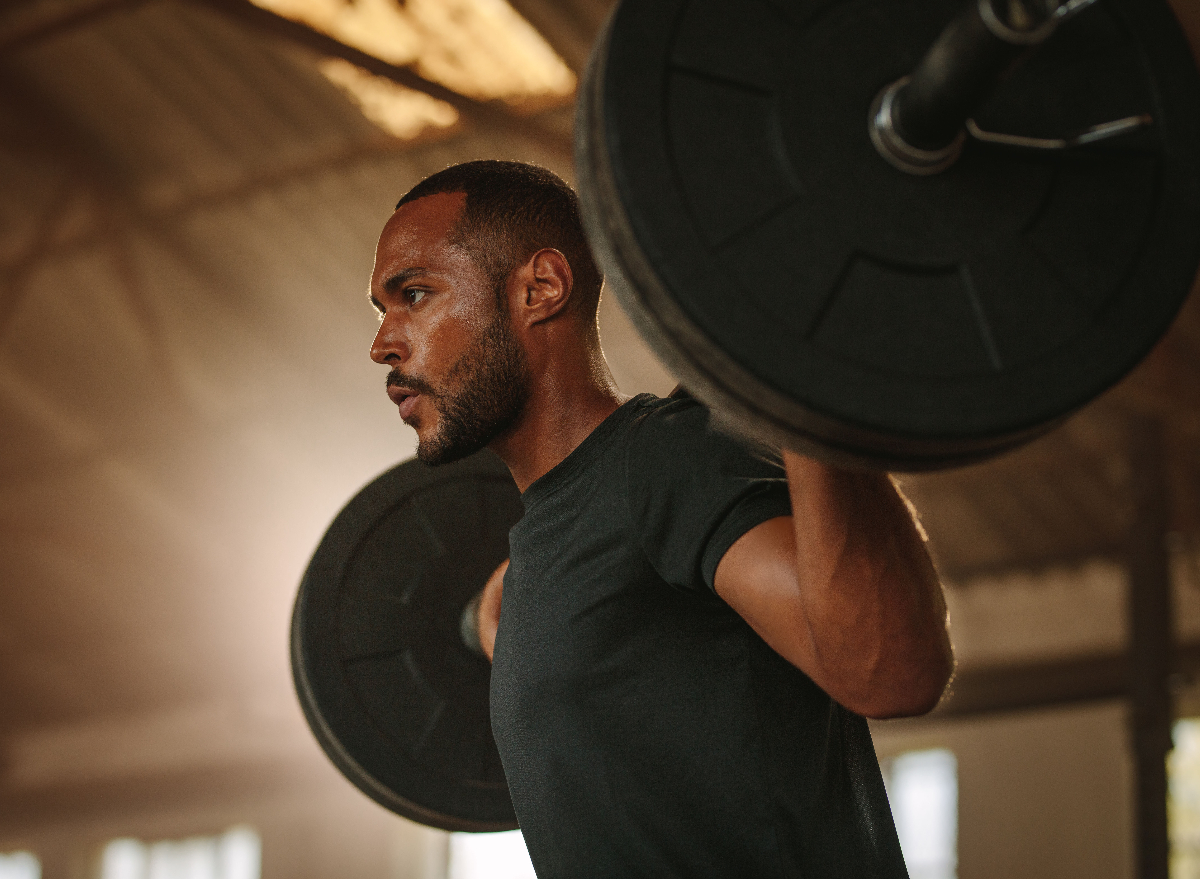
fit man doing barbell lift exercise
Shutterstock

Depending on what you’re looking to achieve, doing two-a-day workouts can be very beneficial. Read explains, “[Two-a-days can help you hit] smaller muscle groups you don’t have time or energy for during your current lifting sessions. As mentioned, if you are an athlete splitting up strength and conditioning from your technique/skill-focused training, this is also a wise move.”

That being said, in some cases, two-a-day workouts that highlight different fitness goals could clash. Read provides an example: If you’re trying to maximize your muscle build, then a cardio workout may not be the best pairing with weight training on the same day. “Cardio itself, in this instance, will potentially reduce your muscle gains, depending on all the factors,” Read explains.

Cardio for health reasons, of course, is always a good addition to any workout regimen.

Advertisement

The Secret Side Effects of Exercising Twice a Day, Expert Shares

Are two-a-day workouts safe?

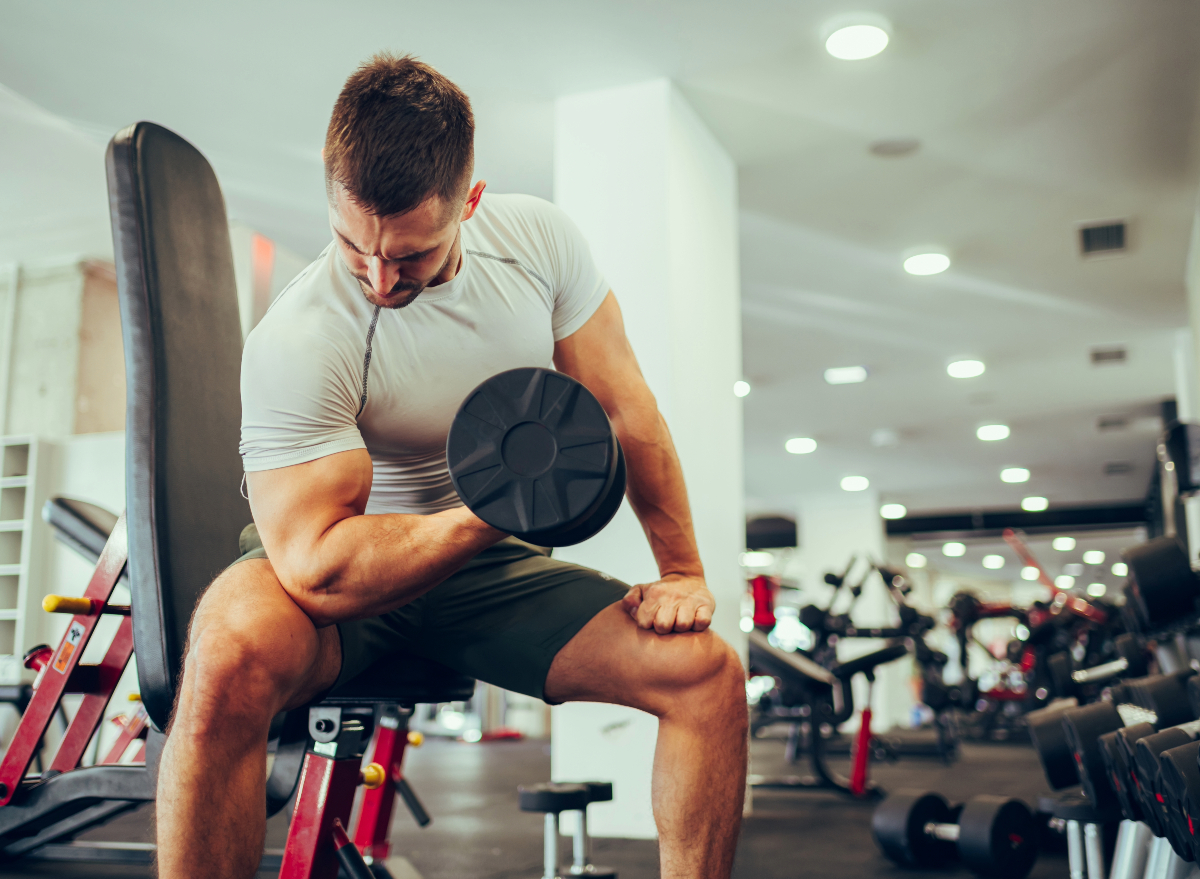
man doing dumbbell curls, concept of habits that damage bodyman doing dumbbell curls, concept of habits that damage body
Shutterstock

If you’re a fitness newbie, Read stresses that two-a-day workouts may not be the ideal training method for you. “You are better off aiming for three to four consistent days per week doing a single workout,” he says.

Two-a-day sessions are really meant for athletes who are more experienced and have sufficient time to dedicate to the recovery process and the workouts themselves, Read explains. These athletes tend to have a professional coach monitoring their workout strategy and fatigue, or they’re very well-seasoned in gauging their own overall training program.

“Additionally, the true means of getting transformational results is the long-term (i.e., years) of consistency in the gym,” Read adds. “Two workouts per day for multiple days per week is not realistic for most people over extended periods of time. It’s important to consider that those who claim to do two per-day workouts may or may not do this long term, have other life obligations, or have other supplementation or inputs that allow them to train at this level and adequately recover.”

If you’re not at an advanced fitness level and your goal is to build muscle, Read recommends training three to four days each week, once per day, for a minimum of six months, before starting a two-a-day workout regimen.

Advertisement

Alexa Mellardo

Alexa is the Mind + Body Deputy Editor of Eat This, Not That!, overseeing the M+B channel and delivering compelling fitness, wellness, and self-care topics to readers. Read more about Alexa

Fitness

Alison Hammond lost 11st and transformed her health by quitting these 3 habits – here’s how

Published

on

Alison Hammond lost 11st and transformed her health by quitting these 3 habits – here’s how

Exercise played a pivotal part in Alison Hammond, 51, losing 11 stone. The This Morning presenter hired personal trainer Ellis Gatfield five years ago, and while introducing regular strength training helped her hit her goal, there were a few fitness habits she was also required to quit.

Below, Gatfield shares exactly what she stopped doing, how doing so helped her lose weight and build muscle and her full weekly workout routine.

A quick caveat: sustainable weight loss isn’t driven by exercise or nutrition alone. Movement helps preserve muscle, support metabolic health and improve how your body uses energy, but what you eat still matters. The most effective approach combines smart training with nourishing, realistic nutrition habits you can maintain long term.

@luimancini//Instagram

1. She stopped doing long treadmill sessions

Gatfield says: ‘She never particularly enjoyed traditional cardio, so instead of forcing long treadmill sessions, I focused on raising her heart rate through resistance training performed in a circuit format, using mainly compound movements. This allowed her to get the cardiovascular benefits while also building strength and shaping her body. The biggest mistake from her training before was believing that exercise had to mean long, boring cardio sessions to lose weight. That mindset made training feel like a chore rather than something to enjoy.’

Advertisement

2. She stopped forcing exercise she didn’t enjoy

Gatfield says: ‘Once we shifted to a style of training she genuinely liked, everything became easier. Training stopped feeling forced, consistency improved naturally, and results followed. Enjoyment is often the missing piece in successful weight loss and it’s something I prioritise with all my clients.

‘Strength training played a huge role in Alison’s weight loss because it allowed her to burn calories, build lean muscle, and improve her metabolism, without relying on long or exhausting cardio sessions. Resistance-based circuits kept her heart rate elevated while also improving strength and body composition which is key for long term fat loss.

‘Just as importantly, she genuinely enjoyed this style of training. She loved being able to come in, work hard for 30 minutes, feel accomplished, and get on with her day. That enjoyment made consistency easy, and consistency is where results come from.

‘With Alison, the priority was keeping training effective, enjoyable, and realistic around her schedule. Sessions were always kept to around 30 minutes, which meant they were easy to commit to and never felt overwhelming.’

3. She stopped skipping rest days

Gatfield says: ‘Rest was equally essential [to her results]. Scheduled recovery days helped regulate stress, reduce fatigue, and allow her body to adapt and improve. That balance between training and recovery meant she could show up strong, train with intent, and sustain results long term.

Advertisement

‘For most women, especially those new to resistance training, I’d recommend two-three sessions per week. The focus should always be on learning proper technique, moving well, and recovering properly. More isn’t always better – consistency and quality matter far more.’

Alison Hammond’s weekly workout schedule

According to Gatfield, a typical week in workouts for Alison included:

  • Monday: 30-minute resistance circuit
  • Tuesday: 30-minute boxing session
  • Wednesday: rest or low-intensity walk
  • Thursday: 30-minute kettlebell circuit
  • Friday: 30-minute boxing session
  • Saturday: rest or low-intensity walk
  • Sunday: rest

oyinda training plan

One of our most frequently asked questions here at Women’s Health? How to build muscle and burn fat at the same time. So, we asked superstar trainer Oyinda Okunowo exactly how to do it. In this 4-week plan – created exclusively for Women’s Health COLLECTIVE members – you’ll get the workouts and nutrition guidance needed to help you on your way to better body composition. Tap the link below to unlock 14 days of free access to Oyinda’s plan and start training today.

Get the plan

Headshot of Bridie Wilkins

As Women’s Health UK’s fitness director and a qualified Pilates and yoga instructor, Bridie Wilkins has been passionately reporting on exercise, health and nutrition since the start of her decade-long career in journalism.

After earning a first-class degree in journalism and NCTJ accreditation, she secured her first role at Look Magazine, where she launched the magazine’s health and fitness column, Look Fit, before going on to become Health and Fitness writer at HELLO!

Advertisement

Since, she has written for Stylist, Glamour, Cosmopolitan, Marie Claire, Elle, The Metro, Runner’s World and Red. Today, she oversees all fitness content across Women’s Health online and in print, spearheading leading cross-platform franchises, such as ‘Fit At Any Age’, which showcases the women proving that age is no barrier to exercise.

She has also represented the brand on BBC Radio London, plus various podcasts and Substacks – all with the aim to encourage more women to exercise and show them how. Outside of work, find her trying the latest Pilates studio, testing her VO2 max for fun (TY, Oura), or posting workouts on Instagram.   

Continue Reading

Fitness

Gary Neville’s 5-Day-a-Week Fitness Routine – and How Exercise Changed His Life After Football

Published

on

Gary Neville’s 5-Day-a-Week Fitness Routine – and How Exercise Changed His Life After Football

If there’s one man who could do with a rest, it’s Gary Neville. But in between managing his media and business interests, the former footballer still starts most weekdays the same way: waking up early for a 6am workout.

‘My whole life has been about routine and repetition,’ Neville told The Times. ‘Even now, I need structure in every part of my life.

‘I’m up every morning at quarter past five. I’ll have a coffee, review all the news – sports news mainly, but news as well. All your papers, so I’m across everything. Five mornings a week I’ll then walk to the gym for six, and finish at 6:50 before walking back home for seven.’

The 51-year-old favours high-intensity, circuit-style training rather than traditional bodybuilding workouts, having regularly attended Barry’s classes over the years. That said, strength work still forms part of his routine.

It’s an approach Neville adopted after learning a difficult lesson in retirement. Having stepped away from professional football in 2011, he admits he spent the first couple of years enjoying himself a little too much.

Advertisement

The Wake-Up Call That Changed Gary Neville’s Fitness

‘The impact of not training every day surprised me,’ Neville said in a social media video.

‘I think I took for granted how training made me feel good about myself – in my body, in my head. And then when I finished playing football, I started to have a glass of wine at night regularly, I started to have a bit of cheese, I started to have more chocolate.

‘I started to think I could just relax and enjoy my life from a nutrition and fitness point of view. I didn’t work very hard at all – in fact I didn’t train much in the first year or two [after retirement].’

The weight gain that followed eventually prompted an intervention from his wife.

‘If you look at those first couple of years outside of football, you’ll see that I put weight on,’ he said.

Advertisement

‘I remember my wife coming up to me one day and saying, “Look, come on, you need to sort yourself out. You’ve been fit all your life.”

‘And it completely transformed the way I thought. From that moment on, I started at it again.’

Why Neville Calls Exercise a Form of Medicine

These days, Neville says training has become non-negotiable.

He’s not preparing for a sporting event or chasing specific performance goals, but he notices a significant difference in both his physical and mental wellbeing whenever he stops exercising for too long.

‘I feel like I can’t go without training,’ he explained. ‘If I go three, four or five days without training then it’s not the end of the world, but if I go two weeks without it, I start to feel heavy.

Advertisement

‘I start to feel like I’m losing strength. You start to feel like you’re going under a little bit. I didn’t prepare for the fact that not training, eating more and not being able to cope without that fitness structure in my life every single day.’

The former Manchester United captain believes the mental benefits are just as important as the physical ones.

‘People who don’t train are missing out on a great medicine,’ he said. ‘I stopped for two to three years and the impact it had on my mental health was terrible.’

More than a decade after retirement, Neville’s routine looks very different to the one he followed as a professional footballer. But the principle remains the same: move regularly, stay consistent and make exercise part of your day rather than something you squeeze in when you get the chance.


If there’s one thing Kori Sampson knows, it’s how to optimise your body composition for performance. To tap into his knowledge as an elite athlete and coach, we asked him to create a 4-week plan to help you move faster, recover quicker and keep pushing when the fatigue sets in – all while improving your muscle-to-fat ratio.

Advertisement

Ready to build muscle, burn fat and come out the other side looking, feeling and performing better? Click here to get 14 days of free access to the plan via the Men’s Health app.


Headshot of Ryan Dabbs

Ryan is a Senior Writer at Men’s Health UK with a passion for storytelling, health and fitness. Having graduated from Cardiff University in 2020, and later obtaining his NCTJ qualification, Ryan started his career as a Trainee News Writer for sports titles Golf Monthly, Cycling Weekly and Rugby World before progressing to Staff Writer and subsequently Senior Writer with football magazine FourFourTwo.

During his two-and-a-half years there he wrote news stories for the website and features for the magazine, while he also interviewed names such as Les Ferdinand, Ally McCoist, Jamie Redknapp and Antonio Rudiger, among many others. His standout memory, though, came when getting the opportunity to speak to then-Plymouth Argyle manager Steven Schumacher as the club won League One in 2023.

Having grown up a keen footballer and playing for his boyhood side until the age of 16, Ryan got the opportunity to represent Northern Ireland national futsal team eight times, scoring three goals against England, Scotland and Gibraltar. Now past his peak, Ryan prefers to mix weightlifting with running – he achieved a marathon PB of 3:31:49 at Manchester in April 2025, but credits the heat for failing to get below the coveted 3:30 mark…

You can follow Ryan on Instagram or on X  

Advertisement

Continue Reading

Fitness

An expert personal trainer says this practical exercise boosts core strength and upper-body stability more than planks

Published

on

An expert personal trainer says this practical exercise boosts core strength and upper-body stability more than planks

It’s often the simplest core exercises that are most effective, and the farmer’s carry fits perfectly into this box. Done with two kettlebells or dumbbells and a bit of space, it’s one that all can do to improve core strength, full-body stability, and strength.

While planks and sit-ups are core exercises with many of the same benefits, this one is particularly unique in how it translates to real life. It’s a functional exercise, says Kate Rowe-Ham, an expert personal trainer, author of The Longevity Solution, and the founder of Owning Your Menopause, translating to everyday movements like carrying shopping or climbing stairs.

Continue Reading
Advertisement

Trending
