Politics
Inside an Arizona abortion clinic: Uncertainty looms and optimism reigns

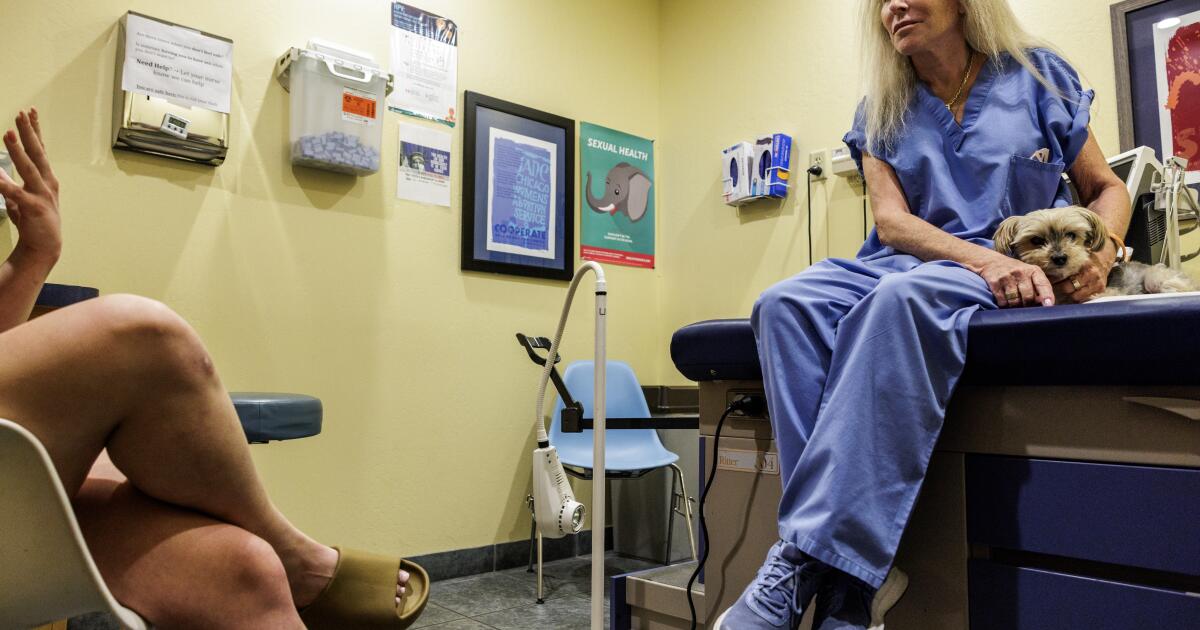
When Anna first read about the Arizona Supreme Court reinstating an 1864 law banning all abortions except when a mother’s life is at risk, she sent the article to her partner with an angry text.
“I was like, ‘God, this makes me so mad,’” she said.
She also decided to take a pregnancy test, just in case. Her period was a few days late, which she figured was because of her new birth control pills.
“I just want to make sure before anything goes into effect,” said Anna, 24, who declined to give her last name. “Thank God I did.”
Days later, she found herself at Camelback Family Planning, discussing her options for an abortion.
The April 9 ruling set off a political hurricane, with both President Biden and former President Trump weighing in and Arizona’s Legislature devolving into chaos over whether to repeal the ban before it goes into effect June 8. But at a Phoenix abortion clinic, in the eye of the debate, it has been business as usual.
On Wednesday, Dr. Barbara Zipkin breezed into an examination room carrying Scooter, her emotional support dog. Although she lives in Sherman Oaks, Zipkin flies to Arizona most weeks, staying at her sister’s house while working three to five days at the Camelback clinic.
With her support dog Scooter staying in his bed, Dr. Barbara Zipkin rushes to an exam room at Camelback Family Planning on April 18, 2024, in Phoenix. The clinic will have to cease performing abortions on June 8 if the 1864 law banning abortions isn’t delayed of overturned.
The doctor, who said she is “somewhere between 40 and death,” recalls the moment in 1973 when Roe vs. Wade took effect: She was on a plane returning to medical school, and she thought, “This is what I’m going to do.” She worked for years as an OB-GYN in Los Angeles, specializing in genetics and performing a lot of second trimester abortions.
“But there are enough providers in L.A.,” she said. “Arizona is unique.”
In the exam room, Zipkin walked Anna through her options — a medication abortion, which the patient had previously experienced with a difficult recovery, or a surgical procedure. Then Zipkin recited a state-mandated “silly consent” form, adding her own caveats to each point.
“Consent says the state of Arizona wants you to believe that there are alternatives to abortion. Well, that’s all well and good, but it’s not really true, because when you’re in this position, you really only have two options. One is carry it and the other is don’t carry it,” Zipkin said. “Adoption and all that — that comes after. You’re either carrying this or you’re not, and it still affects you.”
Anna said she’d always paid attention to the national conversation around abortion, as a woman and especially as an Arizonan. Anna said she had started taking birth control pills within a week of getting pregnant. As a 24-year-old who lives with roommates, she doesn’t consider herself financially able to care for a child.
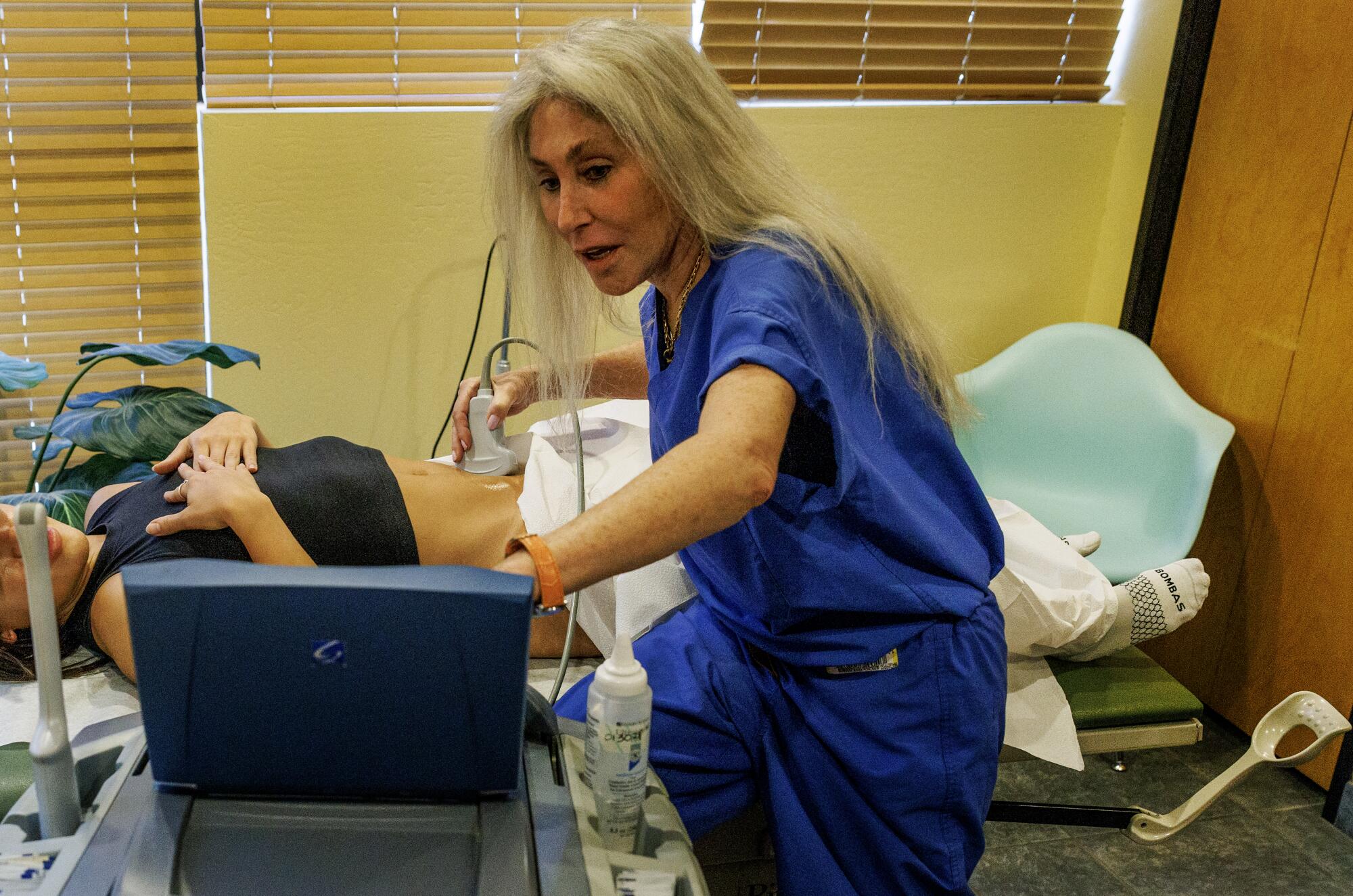
Dr. Barbara Zipkin performs an ultrasound on a 25-year-old patient who didn’t want her name or face shown at Camelback Family Planning on April 18. The patient thought the Arizona 1864 law banning abortion had already taken effect and was planning on going to California for an abortion but she learned that the clinic in Phoenix was still open and performing abortions. “It makes me sad to think that women in the future may not be to have the choice to come here if that law goes into effect,” she said.
“It’s just not the situation I want for myself, or my children in the future. I want a two-parent household in a stable home, or a stable situation,” Anna said. “I just don’t know that I’m in that right now.”
After her 10-minute consultation with Zipkin, Anna scheduled an appointment for the following week, when she would decide whether to have a medication or surgical abortion.
After answering Anna’s questions, Zipkin offered her last bit of guidance: “Before I forget, because I have the attention span of a gnat — vote!”
Abortion is likely to top voters’ concerns in Arizona, where state legislators have yet to vote on a proposed bill repealing the ban.
In the sunny plaza between the two state Capitol chambers, protesters on both sides of the debate milled about Wednesday, some wearing bright orange T-shirts in support of Arizona for Abortion Access, and others in shirts depicting baby’s feet and proclaiming “Choose life.”
Uncertainty at the clinic
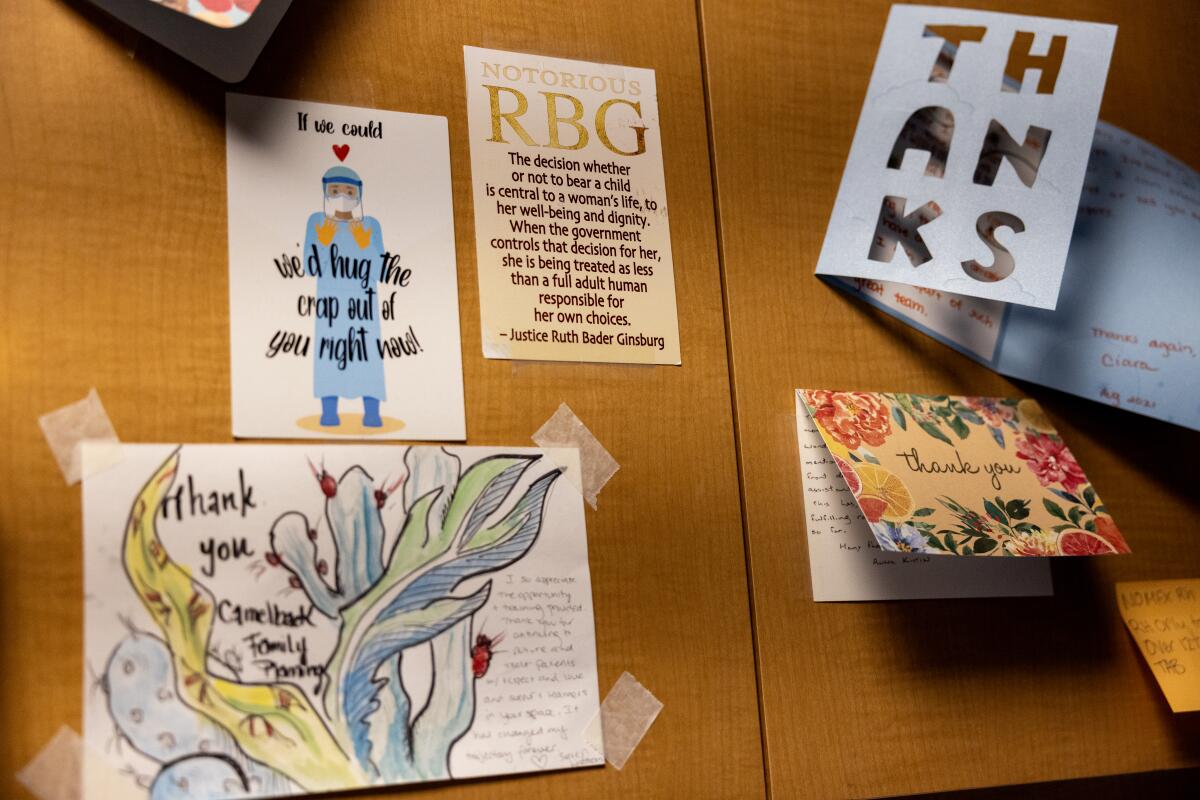
Back at the Camelback clinic, staff members gathered in the break room, decorated with posters and handmade thank you cards, including one with a uterus drawn in place of a “Y.” They discussed what could happen after June 8, and the clinic’s founder, Dr. Gabrielle Goodrick, sought to provide clarity.
1

2
3
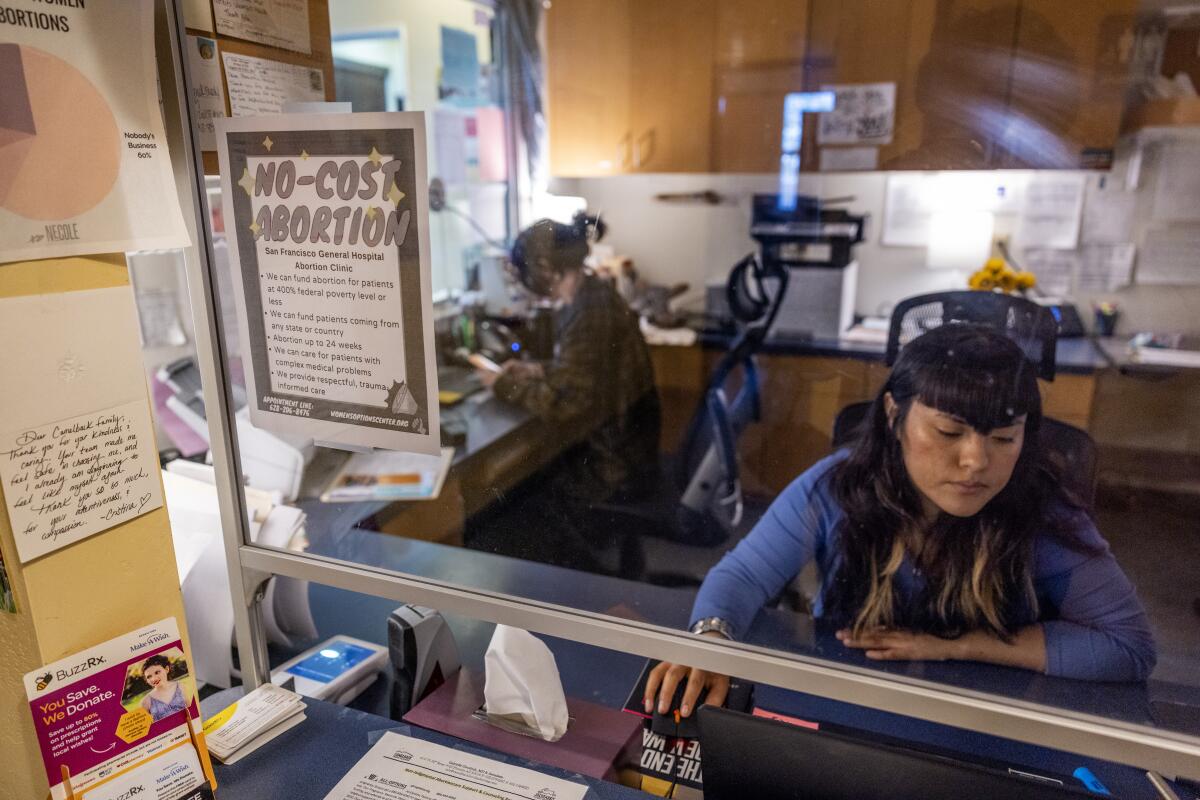
1. A Thank You card hangs on the refrigerator in the beak room at Camelback Family Planning on April 17, 2024 in Phoenix, Arizona. The clinic will have to cease performing abortions on June 8 if the 1864 law banning abortions isn’t delayed or overturned. 2. A Thank You cards hang on a cupboard at Camelback Family Planning on April 18, 2024 in Phoenix, Arizona. The clinic will have to cease performing abortions on June 8 if the 1864 law banning abortions isn’t delayed or overturned. 3. Information on a no-cost abortion clinic in San Francisco hangs on the glass at the reception area at Camelback Family Planning on April 18, 2024 in Phoenix, Arizona. The clinic will have to cease performing abortions on June 8 if the 1864 law banning abortions isn’t delayed or overturned.
She’s hopeful that a constitutional amendment guaranteeing abortion access will be on the November ballot — activists with Arizona for Abortion Access say they have gathered enough signatures.
“People were pretty nervous and stressed that they’re not going to have a job until November,” Goodrick said.
For a clinic rocked by Supreme Court decisions, it has become adept at weathering changes, Goodrick said. A ruling comes down, the staff adjusts its routines and schedules and continues to provide abortions with new limitations, which sometimes includes referring patients to clinics in California or Nevada.
The constant fluctuations have had their toll, though. The clinic, which Goodrick opened in 1999, usually averages about 350 patients a month. That total dropped in 2022 amid patient confusion over what would happen in the wake of Roe vs. Wade being overturned. Her small staff of 12 shrank to six, Goodrick said, as workers grew tired “from the stress of just not knowing.”
The doctor and her staff had just gotten into the swing of their new routine when the state Supreme Court ruling came down.
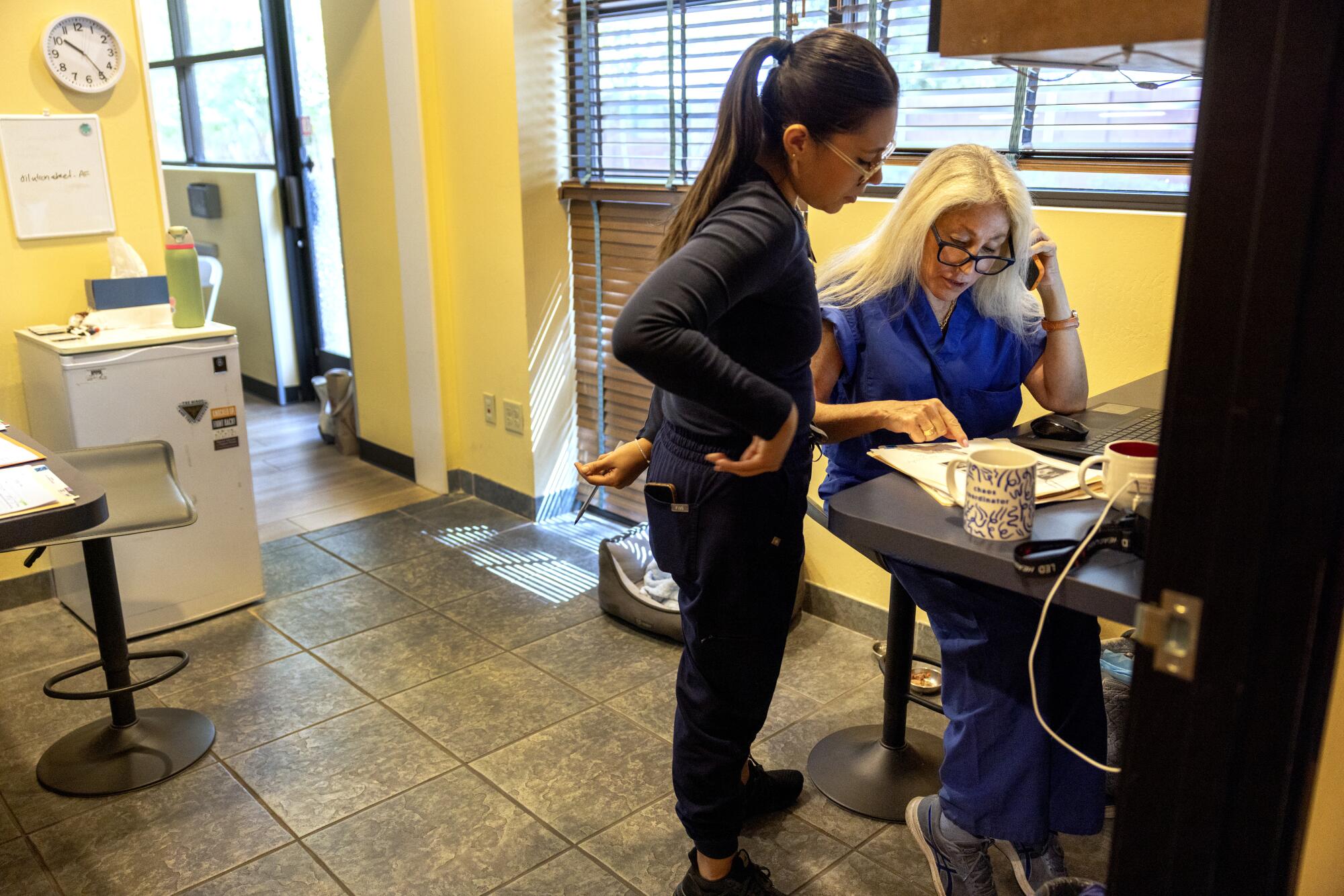
Dr. Barbara Zipkin, right, consults with a co-worker over ultrasound results at Camelback Family Planning . The clinic will have to cease performing abortions on June 8 if enforcement of the 1864 law banning abortions isn’t delayed or overturned.
“The patients are more anxious,” Goodrick said. “It causes what the Republicans want, which is mayhem.”
But this time, she hopes, will be different.
“We just have to get to Nov. 25,” Goodrick said, referring to the date that a constitutional amendment, if approved, would take effect.
Confident that the political fight will turn in her favor, Goodrick has opened the clinic’s doors to media from around the globe, who’ve descended on Arizona to chronicle the latest front in a nationwide battle over abortion.
Nurses wearing “abortion is healthcare” T-shirts moved deftly around the journalists, whom they’ve grown accustomed to filling their workplace recently. On their lunch break, the staff crowded into the break room, bickering over Supreme Court justices.
“Which one’s worse — [Clarence] Thomas or [Samuel] Alito?” one asked.
Sitting at a folding table laden with snacks, Dr. Jessica Holmes peered at the clinic’s schedule on her laptop.

Nurses carry charts to exam rooms past thank you cards tacked to cupboards and artwork of a uterus hanging on a clothesline at Camelback Family Planning.
“Are you doing through June, or only the first eight days?” Holmes asked.
“No, we’ll go through June,” Goodrick answered briskly.
Opposing forces of optimism
Standing on the sidewalk a few yards from the clinic door, antiabortion activists were similarly optimistic about the future of Arizona’s abortion law.
“We accept it as a victory and we’re very excited,” said Matt Engelthaler, 49, who has protested abortions since he was a teenager, when he first joined his parents to pray outside clinics. “But we also realize that changing laws isn’t what’s gonna do anything, it’s just changing hearts. That’s what we pray for.”
Engelthaler fingered rosary beads as he held a sign that said, “Choose life.” A Catholic, he said he prayed the rosary “for the moms, dads and the babies,” and another prayer for the abortion clinic workers, “that they can understand the travesty of what they’re doing and turn away from it.”
A passing car honked, and the driver stuck his middle finger in the air at the protesters.
“People just don’t know how to do the peace sign correctly,” Engelthaler said with a laugh.
A few minutes later, another car honked and the driver gave a thumbs up.
By the clinic door, three volunteers wearing bright, rainbow-colored vests escorted patients from their cars into the clinic, blocking their view of the sidewalk protesters with large, rainbow umbrellas. Michael Buble played on a nearby speaker, ready to drown out any protester’s megaphone.
“When they go loud, we go louder,” said one escort, who declined to give her name. She said her group of volunteers would continue serving at the clinic until they’re told to stop.
One of the patients, a 26-year-old from Phoenix, said the escorts’ music lifted her spirits on an otherwise bleak day. She took Scooter into her arms and, stroking the dog’s back, told the doctor that she found out she was pregnant two days after the state Supreme Court decision.

A 26-year-old patient from Phoenix strokes support dog Scooter in an exam room as Dr. Barbara Zipkin discusses her options for an abortion. The patient found out she was pregnant two days after the Arizona Supreme Court reinstated an 1864 law banning abortion.
“It has just been draining, in that sense of like, wow — this would happen this week,” the patient said.
She said that as Christians, her family vehemently opposes abortion and would support her if she decided to have a baby. The woman said she and her partner decided to keep the abortion private.
“It’s definitely confusing and emotional, considering, like, my upbringing,” she said. But referring to the escorts outside who welcomed her, she added, “it’s also encouraging, in a sense, because you do feel this community.”


NEWYou can now listen to Fox News articles!
Rep. Diana DeGette, D-Colo., a 30-year incumbent, lost to a Democratic Socialists of America (DSA)-backed challenger in a high-profile primary on Tuesday evening.
Melat Kiros, a 29-year-old socialist, defeated DeGette in a Democratic primary for a deep-blue House seat anchored in Denver, according to The Associated Press, scoring a major victory for the socialist left on Tuesday evening.
The DSA had been aiming to cast DeGette’s loss as evidence of its growing momentum after a slate of socialist candidates won Democratic primaries in New York City last week.
“Today, the East Coast, next week the Mountain West,” the DSA wrote in a social media post last week.
Rep. Diana DeGette speaks during a press conference outside the U.S. Capitol building in Washington, D.C., on Jan. 10, 2024. (Samuel Corum/Getty Images)
SOCIALISTS CHEER ‘SHOCKWAVE’ PRIMARY NIGHT AS DSA-BACKED CANDIDATES WIN, ADVANCE ACROSS THE MAP
If elected in November, Kiros, who was born in Ethiopia, will likely join the ranks of the far-left group known as the Squad and become one of a handful of the House chamber’s outspoken socialists.
The millennial challenger was endorsed by Sen. Bernie Sanders, I-Vt., Rep. Alexandria Ocasio-Cortez, D-N.Y., and the anti-incumbent leftist organization Justice Democrats. Controversial socialist streamer Hasan Piker, who has said Hamas is “a thousand times better” than Israel and praised the Chinese Communist Party, also backed Kiros’ insurgent primary run.
DeGette, a member of the Congressional Progressive Caucus who supports abolishing Immigration and Customs Enforcement (ICE), sought to win a 16th House term by flexing her leftist bona fides. She argued her seniority on an influential House committee would allow her to push for Medicare-for-All legislation — a longtime priority of the party’s far-left flank.
DeGette, who was endorsed by former CPC Chairwoman Pramila Jayapal, D-Wash., also spotlighted her experience as an impeachment manager during Trump’s second impeachment trial in 2021.
Though DeGette and Kiros shared few policy disagreements, they diverged sharply over Israel and antisemitism. Kiros also sharply criticized DeGette for accepting corporate PAC contributions.
Kiros, a PhD student and lawyer, was fired from a New York firm in 2023 after publishing an open letter, arguing that pro-Palestinian student protesters calling for the elimination of Israel were not antisemitic and appearing to defend Hamas.
Melat Kiros participated in a League of Women Voters Congressional District 1 candidate forum at Montview Presbyterian Church in Denver on May 28, 2026. (RJ Sangosti/MediaNews Group/The Denver Post)
WATCH: HOUSE DEMS UNLOAD ON TEXAS DEMOCRAT OVER ‘DEMENTED’ ANTISEMITIC COMMENTS
She has also described the Oct. 7, 2023, attacks against the Jewish state as the “inevitable consequence of apartheid” and declined to characterize the deadly firebombing of protesters in Boulder last year who were urging the release of hostages held by Hamas in Gaza as antisemitic.
“I don’t know what was in the heart of the perpetrator,” Kiros told Colorado’s 9News in a recent television interview. “All I know is that he went and attacked innocent people because of what they might have believed.”
A June 2025 bipartisan resolution condemning the attack as part of a “rise in ideologically motivated attacks on Jewish individuals” won every present lawmaker’s support, except for Reps. Rashida Tlaib, D-Mich., and Thomas Massie, R-Ky., who voted present.
Kiros has also suggested the United States deserved 9/11.
“Inevitable in the sense that we destabilized a lot of the Middle East that forced people to believe that another act of violence was the only response,” Kiros told 9News when asked if she thought the terror attack was “the inevitable consequence of American foreign policy.”
“And again, just like I said before, our responsibility is to get rid of those conditions that lead to violence in the first place,” Kiros continued.
DeGette argued that Kiros’ embrace of Piker and her comments about antisemitism and 9/11 were disqualifying.
“I’m shocked and disgusted that Kiros is doubling down on excusing terrorism and the murder of innocent people,” the 30-year incumbent wrote on Facebook earlier this month.
Streamer and creator Hasan Piker speaks at a press conference during day two of Web Summit Vancouver at the Vancouver Convention Centre in Vancouver, Canada, on May 13, 2026. (Sam Barnes/Web Summit via Sportsfile via Getty Images)
CLICK HERE TO DOWNLOAD THE FOX NEWS APP
Colorado’s 1st Congressional District is the most liberal seat in the state and voted for former Vice President Kamala Harris by 56 points in 2024.
The primary fight was further scrambled by University of Colorado Regent Wanda James, also running for DeGette’s seat. Though James did not pose the same threat as Kiros, her vote share could ultimately have swayed the contest.

Gov. Gavin Newsom has signed off on a 100% state tax on money any Californians receive from Trump’s $1.8-billion “anti-weaponization” fund for his political allies.
Newsom unveiled his proposal in May, after Trump’s Justice Department said it would create a fund to compensate Trump’s allies who claim they have “suffered weaponization and lawfare” under Biden’s Justice Department.
The settlement fund was criticized by politicians on both sides of the aisle, including Sen. Mitch McConnell (R-Ky.), who described it as a “slush fund to pay people who assault cops.”
The fund remains in legal limbo. Earlier this month, a federal judge in Virginia extended a court-ordered block on the plan, which critics warned could be used to pay pardoned Jan. 6 rioters.
Fast-tracked into law as part of Senate Bill 122, Newsom’s plan imposes “a tax on any settlement fund payment from the federal Anti-Weaponization Fund, or any subsequent fund, settlement, or agreement, as provided, at a rate of 100%,” according to the bill text. The tax applies to all tax years between 2026 and 2030.
Newsom signed the bill Tuesday. In a statement, his office said the tax is meant to ensure that, should Trump’s fund proceed, California recipients won’t “receive favorable state treatment on those payments.”
“We believe democracy is worth defending, the rule of law matters, and public dollars should support victims—not those who attacked the very institutions that protect our freedoms,” Newsom said in the statement.
University of Southern California law professor Ariel Jurow Kleiman, an expert on tax law and policy, said that while Newsom’s tax is a “novel legal strategy,” she believes there is “no categorical legal restriction” preventing California from implementing it.
States have a “wide degree of discretion” to design their tax systems — including how they define income — so long as they do not violate their constitutions, Jurow Kleiman said.
If a California resident wanted to challenge the tax in court, they would need to show they were harmed by it to have standing to sue, according to Jurow Kleiman. That would mean receiving a payment from Trump’s settlement fund and then paying the 100% California tax. Unless the settlement fund is established and distributes payments, that scenario is unlikely.
While there have been proposals to levy a 100% tax on income above certain thresholds — Sen. Bernie Sanders (I-Vt.) in 2023 said he supports a 100% tax on income exceeding $1 billion — Jurow Kleiman said she is not aware of any governments that have adopted such a policy.

NEWYou can now listen to Fox News articles!
The House has officially shipped a colossal bipartisan housing package to President Donald Trump, and lawmakers are hoping that, at the very least, he doesn’t veto it.
Trump was supposed to sign the 21st Century ROAD to Housing Act last week, but his last-minute decision to ghost the signing ceremony with House Speaker Mike Johnson, R-La., and Senate Majority Leader John Thune, R-S.D., put into question whether the bill was dead.
His refusal to sign the bill, which passed with overwhelmingly bipartisan support in both chambers, was to leverage the Safeguarding American Voter Eligibility (SAVE) America Act, which doesn’t currently have the votes to succeed in the Senate.
WARREN TELLS TRUMP TO ‘SIGN THE DAMN BILL’ AS BIPARTISAN HOUSING PACKAGE REMAINS STALLED IN WASHINGTON
Trump has refused to sign the 21st Century ROAD to Housing Act. (Shawn Thew/EPA/Bloomberg via Getty Images)
Trump appears to be in no hurry to sign the bill, despite Republicans who are hungry for a win in the affordability fight ahead of the midterm elections.
“It’s so unimportant … compared to the SAVE America Act,” Trump told reporters in the Oval Office on Monday. “I think the SAVE America Act is exactly what it says. It’s saving America from crooked elections.”
“Here’s what I would like to sign, much more than a bill that — big deal, it’s a yawn,” he continued. “Some people say it’s wonderful. To me, compared to the SAVE America Act, just about everything is a big yawn.”
GOP INFIGHTING OVER TRUMP’S VOTER ID BILL ERUPTS AS TOP SENATOR CALLS STRATEGY ‘FANTASY’
It’s legislation that is loaded with nearly 60 provisions from both sides of the aisle in both chambers that’s designed to make it easier for homes to be built and for younger Americans to buy their first home. It also includes a ban on hedge funds buying up housing stock that Trump pushed Congress to include during the State of the Union earlier this year.
Sen. Elizabeth Warren, D-Mass., one of the architects behind the bill in the upper chamber alongside Sen. Tim Scott, R-S.C., charged that Congress handed the bill to Trump “on a silver platter.”
“When you ask me what happens next, if he cared about the American people, he’d have already signed the damned thing, and we’d be underway,” Warren said on WCVB’s “On the Record” on Sunday.
But Trump doesn’t have to put his signature on the bill for it to become law.
IRATE REPUBLICANS ACCUSE TRUMP OF HANDING DEMOCRATS A WIN AFTER BLOWING UP HOUSING PACKAGE
The Senate advanced a massive, Trump-backed housing package geared toward lowering the costs of homes and supercharging the housing supply. Sen. Elizabeth Warren, D-Mass., pitched it as legislation to prevent America from becoming a “nation of renters.” (Jemal Countess/Getty Images for Protect Borrowers; Anna Moneymaker/Getty Images)
The Constitution grants presidents the ability to veto a bill within 10 days of it being transferred over to the White House. In that scenario, Congress could override a veto of the housing package.
It’s happened before under the Trump administration. In early 2021, Congress overrode Trump’s veto of the annual National Defense Authorization Act — a massive Pentagon funding authorization package that some House Republicans are trying to use as a vehicle to pass the SAVE America Act.
But during that 10-day period, if Trump doesn’t sign the bill, it would automatically become law. That’s unless Congress completely adjourns, in which case a “pocket veto” could happen. The Senate is currently in recess and the House is scheduled to leave town by week’s end, but neither count as a full adjournment.
CLICK HERE TO DOWNLOAD THE FOX NEWS APP
Johnson, who spent the last few days meeting with Trump at the White House about the housing bill and the SAVE America Act, said: “I hope he does sign it.”
“If he doesn’t, it’s still law,” Johnson said. “We’ll still celebrate it, but he’s trying to make a point, and I think he’s making it very effectively. And the fact that you all ask me every three steps down the hallway illustrates that he has achieved the desired objective, and that is to make SAVE America the number one thing, because if we don’t get that right, everybody’s concerned about what happens next.”
-

 Arizona5 minutes ago
Proposed data centers, ICE facility create mixed emotions in rural Arizona town
-

 Arkansas8 minutes ago
Central Arkansas bike trail breaks ground in Cabot – The Arkansas Leader
-

 California13 minutes ago
California bill to block registered sex offenders from local office rejected by Senate committee
-

 Colorado20 minutes ago
Where to watch Miami Marlins vs Colorado Rockies: TV channel, start time, streaming for July 1
-

 Connecticut23 minutes ago
Lamont signs law in Norwich to stop pay to contractors violating wages
-

 Delaware28 minutes ago
Delaware has gotten these 15 verbal commitments from football recruits
-
 Florida35 minutes ago
Kids with autism are prone to drowning. Florida is trying to prevent that
-

 Georgia38 minutes ago
Bradenton man wanted for murder is found hiding in Georgia

