Entertainment
'The Synanon Fix' shows how the California dream went awry for a rehab group turned cult

In the late 1950s, Charles “Chuck” Dederich started a drug rehabilitation program out of a storefront in Santa Monica. A recovering alcoholic who’d gotten sober through Alcoholics Anonymous, Dederich offered free treatment to self-described “dope fiends” desperate to kick their deadly habit and go cold turkey.
Over the next decade and a half, the group, named Synanon, expanded across the country and evolved into a self-help movement with thousands of members, including many who were not addicts but were simply drawn to its idealistic vision — no drugs, alcohol, or violence — and its primary ritual, an intensely confrontational form of group therapy known as “The Game.”
Yet by the late 1970s, Synanon had strayed dramatically from its original mission, devolving into a dangerous quasi-religious paramilitary organization whose devotees, beholden to Dederich’s increasingly erratic whims, were willing to undergo forced vasectomies, relinquish control over their own children and even attempt to murder a prominent critic by planting a rattlesnake in his mailbox.
The dark saga of Synanon is now the subject of a four-part documentary “The Synanon Fix,” concluding Monday on HBO. Directed and executive produced by Rory Kennedy, the series traces the group’s utopian origins and gradual descent into violence and manipulation. Arriving at a moment when the public’s interest in cults and high-control groups seems almost insatiable, “The Synanon Fix” offers a particularly grim, resonant twist on the familiar tale of the California dream gone awry.
The story “had this really dramatic, almost Shakespearean arc to it,” said writer and executive producer Mark Bailey, in a video chat with Kennedy from their home in California (the couple are filmmaking partners and have also been married since 1999). “The intentions and accomplishments for the first decade or so were really amazing. But where it ended up was really dark and destructive.”
Kennedy, who has made more than a dozen documentaries including “Ghosts of Abu Ghraib” and “Downfall: The Case Against Boeing,” said she was not particularly interested in “quote-unquote cult stories,” but was struck by the drama of Synanon’s 180-degree transformation. “In the beginning the pillars of Synanon were no drugs, no alcohol and no violence. By the end, they had bought more firearms than anybody in the history of California and had an open bar in the facility.”
Not only was the story dramatic, but it contained lessons about the dangers of blindly following a charismatic leader — a topic that feels politically relevant in 2024. Dederich was just such a figure, someone who built a community and inspired intense loyalty from his followers. “Because they’re tethered to him, where he goes, they go. And that’s the danger — as he starts becoming less stable, whether it’s from his alcoholism or mental illness, he takes Synanon with it,” Bailey said. “That felt, to us, like an important thing to say right now.” (Along with many members of her famous family, Kennedy, whose brother Robert F. Kennedy Jr. is running for president as an independent, endorsed President Biden last week.)
Kennedy and Bailey first learned about Synanon about a decade ago while reading “Straight Life,” an autobiography by jazz musician Art Pepper and his wife, Laurie, who met while getting clean in Synanon. “I had never heard of Synanon, but it’s right there on the beach, these folks with shaved heads, playing ‘The Game,’ which sounds like this pretty radical therapeutic treatment,” Bailey said. “I was instantly like, ‘Wow, what was this? And why have I never heard about it?’”
Charles “Chuck” Dederich, founder of Synanon.
(HBO)
The documentary is woven together using extensive archival material — including news reports and visceral footage of members playing “The Game,” in which participants were aggressively pushed to be brutally honest about themselves and each other. It also features audio recordings of Dederich lecturing his followers over “the Wire,” the group’s internal broadcasting system, as well as first-person accounts from roughly 20 former members and interviews with journalists including Narda Zacchino, who wrote about Synanon for The Times.
Some former members were initially wary of sitting for interviews, Kennedy said, because “everybody was aware that there was a way to tell this story that’s pretty sensationalist.” But as she gradually won them over, more people decided to participate in the documentary — including Dederich’s daughter, Jady Dederich Montgomery.
After years of wrangling, the filmmakers were also able to secure access to Synanon’s archives, which included thousands of photos and “a treasure trove of extraordinary footage,” according to Kennedy. Because this happened just weeks before they were set to lock picture, they had to ask HBO for several more months and more money to recut the documentary. “To their credit, they agreed,” said Kennedy.
Interviewing people who spent years in Synanon playing “The Game” was both fascinating and challenging, she said.
“On average for documentaries, which I’ve now been doing for 25 years, the interviews are maybe two to three hours long. None of these were less than seven hours. Some of them went for nine hours, in like a sitting.” At times, Kennedy felt she was playing “The Game” with her subjects. “They would talk back to me more about how they were feeling about the interview as the interview was happening.”
Kennedy takes a straightforward approach in “The Synanon Fix,” allowing the story to unfold chronologically and spending time explaining the group’s origins before diving into the rattlesnakes and mate-swapping.
“This was a community that was taking a big swing at something that was really ahead of its time, in many ways, in terms of how it was treating drug addicts, who had been a very ostracized community,” said Kennedy. “They either went to jail, or they went to a mental hospital, or they died.”
Viewers learn how Synanon, which eventually moved into the historic Hotel Casa Del Mar in Santa Monica, began to attract a wider array of followers with the rise of the counterculture in the late 1960s. “Lifestylers,” as they were known, were people who joined Synanon because they were seeking a sense of purpose and belonging, not to treat their addiction. They saw the group as “a cure for loneliness and alienation,” said Bailey, and “The Game” as a way to heighten connection and sense of community. Some also donated large sums of money and professional services to the organization.
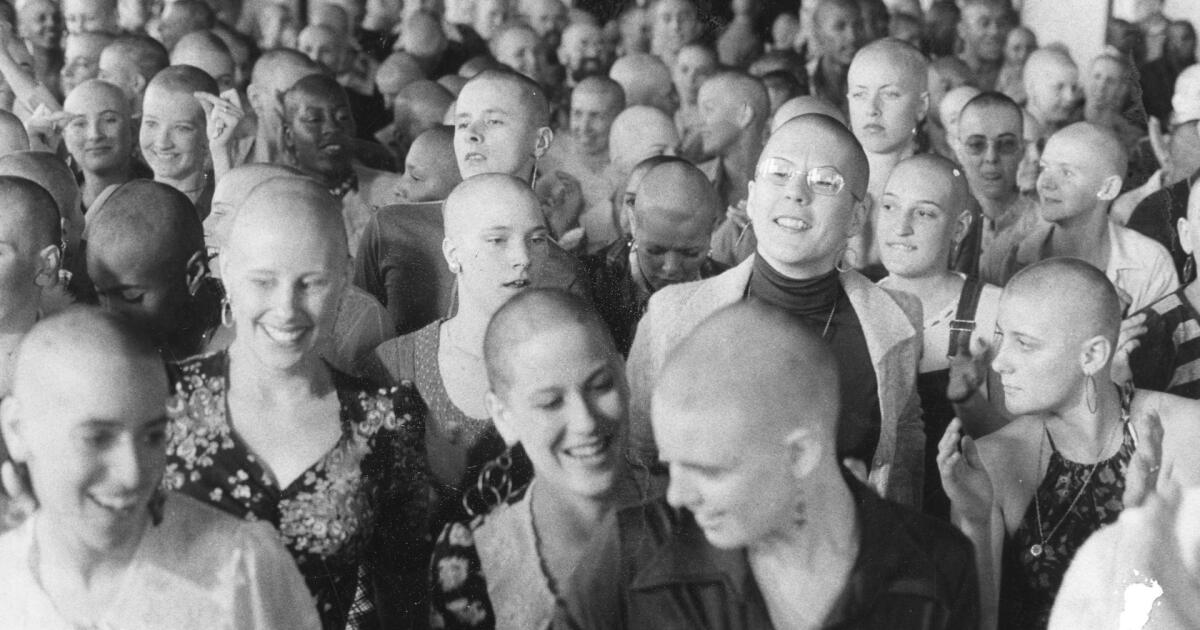
Throughout the ‘70s Dederich became increasingly dictatorial, making bizarre demands of his followers that had little to do with the group’s original mission. He required members to shave their heads and follow stringent diets and exercise regimens. Men were pressured into getting vasectomies and women into having abortions. After his wife died and he remarried, Dederich urged married couples to divorce and take new partners assigned to them. Eventually, Dederich fell off the wagon and rolled back the group’s ban on alcohol. Children were separated from their parents and had to shave their heads and play “The Game” just like adults, even if they lacked the ability to understand it. Some children allegedly were beaten and forced to do grueling labor.
Throughout the decade, Synanon faced mounting criticism including charges of kidnapping and child abuse, but its members grew ever more militant, stockpiling weapons and forming a militia called the Imperial Marines. The group made national headlines in 1978 when a lawyer named Paul Morantz, who had won a $300,000 settlement from Synanon, nearly died from a rattlesnake bite after Synanon zealots planted the animal in his mailbox.
The incident marked a breaking point for some adherents, but not all.
One of the more striking aspects of the series is how many former members still seem to believe in the Synanon cause — and remain grateful to Dederich, who died more than 25 years ago, for saving their lives.

Rory Kennedy, one of the filmmakers of HBO’s “The Synanon Fix.”
(Jon Kopaloff / Getty for HBO)
The series’ central question is “Did the cure become a cult?,” and the filmmakers don’t entirely agree on the answer.
Bailey is not fully convinced Synanon fits the definition of a cult, if only because “there is something that feels too random and disorganized in what it was trying to do,” he said.
Kennedy is more confident in using the term. “I talked to enough people who felt like they compromised their moral compass to follow an idea that drove them in directions that they didn’t feel they should have gone in. That’s a defining quality of a cult,” she said, gently needling her husband for his more ambivalent take. “If you were there, you would have stuck with it to the end, clearly,” she said, laughing. “Sucker is what you are.”
Regardless of how they classify the group, the filmmakers see “The Synanon Fix” as a quintessentially Californian story about the kinds of spiritual seekers who’ve been drawn to the state for generations.
“You think of the people who move West as already kind of having searching in their DNA,” said Bailey. “We came out here about 14 years ago, but both of us were born and raised on the East Coast. And it was really something to get used to how you are allowed to just follow your own weird jam and everybody’s like, ‘Oh, that’s great.’”


While a bit hollow as a character study, painting with broad thematic brushstrokes that often keep its hero at a distance, Young Washington is a compelling historical drama, with a grandiose scope that is rare in Hollywood, and an inspirational story befitting of America at its best.
About the Film
It’s trendy for Hollywood to disparage the United States with films that highlight how the country has fallen short of its lofty ideals (and the beauty of American liberty is that such critical self-reflection is possible). Last year’s One Battle After Another was the darling of the Academy Awards with such a tale. But this Independence Day, and in celebration of 250 years as a nation, audiences can be reminded that (like the men who founded it) America may be imperfect, but the American spirit is a noble and beautiful thing worth fighting for. Young Washington is the origin story, not just of one of those brave Founding Fathers, but of the patriotic spirit and noble values they inspired. While a bit hollow as a character study, painting with broad thematic brushstrokes that often keep its hero at a distance, Young Washington is a compelling historical drama, with a grandiose scope that is rare in Hollywood, and an inspirational story befitting of America at its best.
Director Jon Erwin (House of David, I Can Only Imagine) again proves to be one of the best all-around storytelling talents in Hollywood right now, faith-based or otherwise. Produced and distributed by Angel and Wonder Project, the film is among the most ambitious projects to emerge from the new wave of faith-based entertainment, even if Young Washington isn’t explicitly “faith-based” in a rigid sense. When I interviewed screenwriter Diederik Hoogstraten, he aptly referred to the storytelling approach as “values based.” It may not be a gospel-preaching cinematic tract (and it’s the better for it), but Christians will find plenty to affirm and celebrate here.
If we do count the film among the “faith-based” genre family, then it’s easily a peak achievement. It’s a visually beautiful and well-crafted film. For as good as the modern faith-based genre has become, few movies have warranted a theatrical viewing, being built more on wholesome narrative than visual spectacle. In contrast, seeing Washington gallop on a horse as cannon fire and the pandemonium of battle rages all around him is a full-blown cinematic experience that has rarely been achieved in the genre – other than perhaps Erwin’s own The House of David.
Young Washington is solid from start to finish, but it never fully soars. The film is more interesting than engrossing; good in most areas, but never quite great at any one of them. The clearest comparable, due to the subject matter, is perhaps Mel Gibson’s The Patriot (2000). Historical inaccuracies aside, that film packed a cinematic punch of action, spectacle, and emotional storytelling. Young Washington offers the first two but lacks the third. It’s a story that appeals more to the head than the heart, historically informative, but not making me feel much toward the story.
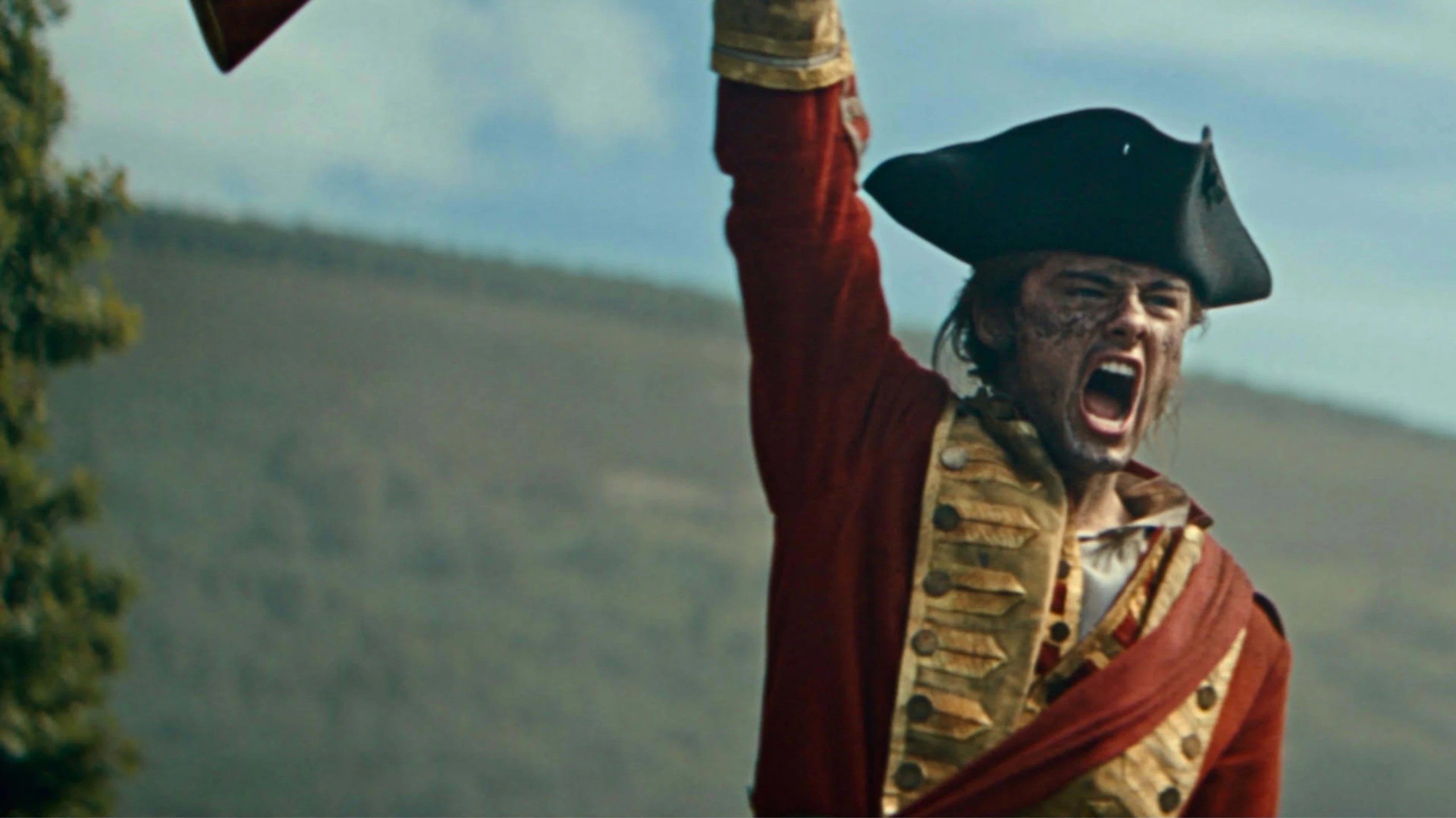
The creative decision to focus the story on a limited, formulative period of Washington’s early life shapes the film in significant ways. Many biopics fall into the trap of dutifully checking boxes, adapting a Wikipedia page more than unfolding a character journey. There’s still some of that with Young Washington, but the limited parameters lend the film a greater sense of focus and an opportunity to breathe. It feels like a story about something more than just putting historical events onto the movie screen.
At the same time, the film also feels like “part one” of a larger story, or a prequel for a film that doesn’t yet exist. The story seems constantly building toward something but then ends on the cusp of reaching it. Perhaps a future sequel is in the cards (although Middle Aged Washington doesn’t have the same ring to it), but the climactic pay off feels lacking. Interestingly, while the movie remains largely historically accurate (as far I can tell), the climactic final battle is more positively framed as a sort of inspirational victory, even when the historical battle was a crushing defeat. It’s perhaps an attempt to manufacture a thrilling third act resolution for a historical figure who was still only in the “first act” of his life. The decision mostly works, and that final battle is the film’s greatest triumph, but the story overall, as told, feels incomplete.

Also notable is that despite the intentionally patriotic release date, and centering on George Washington—arguably the American hero—the “Young” part of the film’s title means that the story pre-dates the revolutionary war. It sees Washington spend the duration of the runtime as a proud officer in the British army. Not quite the patriotic celebration the marketing has promised. Beyond existing knowledge of the historical significance of the protagonist, there is no real “America” at all, beyond a focus on his Virginian regiment, and some hints at the “American Spirit” that would one day define the nation (see themes below).
The fact that it has taken until the end of this review to discuss the character of George Washington himself is also telling. Unfortunately, he is the least interesting part of the film. The fault is not with actor William Franklyn-Miller, who does an admirable job. The problem is with the characterization. Washington has understandable motivations and inner conflict, but they are approached more from the perspective of an outside observer, rather than getting into his own headspace (we are told about struggles but rarely feel his turmoil). The film doesn’t probe deep enough into the root causes of these struggles, or the causes of his insecurity and drive for greatness. I left the film having learned about the events his early life, but without a better understanding of him as a man.
In the end, Young Washington boasts enough entertainment and quality filmmaking to please audiences. It’s a high floor, low ceiling type of film. There are no moments where the film fails to deliver consistent quality, but it just never seems able to achieve anything more. It’s good, but not great, which is something rarely said of George Washington himself. Still, I enjoyed it, and in retrospect, its legacy may be more for how it paved the way for the genre to enter a brighter future. Come to think of it, that sounds befitting of George Washington after all.
On the Surface
For Consideration
On the Surface—(Profanity, Sexual content, violence, etc.).
Language: There are three minor profanities (“d—” x2, “b—ard” x1).
Violence: There is plenty of wartime action, including men shot with rifles and cannon fire, although the action remains relatively bloodless. The most extreme violence comes when a man is hacked with an axe, although it is more implied than depicted on screen.
Sexuality: None.
Beneath The Surface
Engage The Film
The Makings of a Leader
George Washington was a larger-than-life person. By the end of the film, he is depicted as a near mythic figure (although, the scenes are adapted from details provided by several Pulitzer Prize winning biographies, so sometimes real life really is a Hollywood story). But one of the film’s central ambitions, and one emphasized in my interview with the screenwriter, is to humanize that mythical figure.

Early in the film, he is not necessarily even very likeable at times. He is stubborn, and his deep insecurities manifest as the appearance of pride and arrogance. His poor choices and refusal to heed wise counsel, such as the defeat at Fort Necessity, lead to serious consequences. Many biopics are hagiographical (such as the recent Michael), but Young Washington demonstrates the biblical truth that all men have sinned and fallen short of God’s standard (Romans 3:23). It answers the age-old question by suggesting that great leaders are not born great, they must become great.
In an early scene, George and his mother argue about their unfavorable circumstances. George’s mother wishes for her deceased husband back, but says, “Providence denied me this.” George responds, “Then providence is cruel!” His mother eventually counters, “God raises what is well grounded.” That exchange represents the heart of the film. We cannot control our circumstances, but we can shape our character (and allow God to shape it) to respond to them. As one character says, “Failure is the tutor sent by God.” Washington lacks the status and social advantages of others, and at first, he attempts to take it into his own hands to rise to prominence. Ultimately, after great failure, he learns that it is through humility and service that he can be used to do great deeds (Matthew 20:16). Interestingly, at the end of the film, even the pagan Indian tribes recognize God’s anointing on Washington’s life.

Entertainment
’47 Ronin’ director Carl Erik Rinsch sentenced to 30 months in prison for Netflix fraud case

Carl Erik Rinsch, the director of the 2013 Keanu Reeves action film “47 Ronin,” will serve more than two years in federal prison for defrauding Netflix of $11 million.
U.S. District Judge Jed S. Rakoff on Monday sentenced 48-year-old Rinsch to 30 months in prison, the U.S. Attorney’s Office, Southern District of New York, announced. Federal prosecutors convicted Rinsch in December of wire fraud, money laundering and other counts. A legal representative for Rinsch did not immediately respond to a request for comment on Tuesday.
Federal prosecutors indicted Rinsch in March 2025, alleging the $11 million went into Rinsch’s personal accounts. The filmmaker “quickly transferred” the money from the Rinsch Co. account, where it had been deposited March 6, 2020, by Netflix, through additional accounts until about $10.5 million wound up weeks later in a personal brokerage account. He lost more than half of that money in less than two months via risky investments in the stock market, the indictment said.
Though Rinsch told the streamer that his sci-fi show “White Horse” was progressing nicely, the filmmaker allegedly moved the remaining money into cryptocurrency and profited from crypto speculation over the next couple of years. The streamer had invested around $44 million in the show. Rinsch was accused of spending around $10 million on five Rolls-Royces, a Ferrari, watches, clothing, luxury bedding and linens, credit card bills, attorneys to sue Netflix for more money, and lawyers to work on his divorce.
He was arrested in West Hollywood and released the same day after agreeing to post a $100,000 bond to guarantee his appearance in a New York federal court.
Rinsch never finished the Netflix show.
During his sentencing, Rinsch and his legal team told the court his behavior was a result of mental health struggles and medication problems and they are working to address those issues with a new care provider, the Associated Press reported.
“I failed to recognize the danger of the state I was in,” Rinsch said, though his mental issues were not described in court, and his attorneys declined to provide further detail.
Ahead of the sentencing, Reeves — the star of Rinsch’s most notable project to date — penned a letter in May requesting “leniency and mercy as well as justice” in the filmmaker’s sentencing.
In addition to prison time, Rinsch must serve three years of supervised release, forfeit the $11 million and pay $700 in mandatory special assessments, according to Monday’s announcement. U.S. Attorney Jay Clayton said in the announcement: “Today’s sentence sends a deterrent message: fraud will not be tolerated.”
The Associated Press and former Times assistant editor Christie D’Zurilla contributed to this report.

Minions & Monsters, 2026.
Directed by Pierre Coffin and Patrick Delage.
Featuring the voice talents of Pierre Coffin, Trey Parker, Allison Janney, Christoph Waltz, Jeff Bridges, Jesse Eisenberg, Zoey Deutch, Bobby Moynihan, Phil LaMarr, and George Lucas.
SYNOPSIS:
Follows the Minions in 1920s Hollywood as they search for frightening creatures for their monster movie, partner with a green creature, and must save the planet after unleashing monsters.

Minions & Monsters comes with a genius creative choice to reinvigorate a tired schtick. The slapstick antics of the mischievous Minions have always felt partially inspired by comedic stuntwork from the likes of Buster Keaton (at one point, a house comes down over a Minion, paying homage) and Charlie Chaplin, so it’s seamless for director Pierre Coffin (who continues to voice all of them) to place them in the Golden Age of Hollywood. Yes, these movies are critic-proof and will crack one billion dollars regardless, and a case could be made that the filmmakers could have made bank once again going down an artistically bankrupt path, so it is refreshingly welcome that he (directing alongside Patrick Delage and crafting the screenplay with Brian Lynch) chooses to insert these yellow goofballs into a Hollywood love letter that doubles as an avenue for children and anyone else to develop an interest in the era.
Generally, when nostalgia-pandering is discussed or Easter Eggs flood a cinematic experience, it’s about placating fans and giving them what they want out of corporate obligation to put a film in the best position to succeed financially. Minions & Monsters is an animated feature that begins by rewinding the Universal Pictures logo all the way back to when it was The Trans-Atlantic Film Company, with an opening scene that uses The Horse in Motion, the earliest example of photography resembling a motion picture. From there, it’s an adventure involving Minions and Hollywood, giddy to reference anything it possibly can, from classic monsters to Humphrey Bogart to Westerns to Citizen Kane to a plot point that feels ripped out of the recent more cynical and vulgar Babylon, with the red-hot popular Minions struggling and failing to adjust to the transition from silent-era flicks to talkies.

There is a narrative here (more so than in the first two installments, which is a huge part of why this film works in addition to its sincerity) in that a present-day Hollywood museum tour guide (voiced by Allison Janney) educating kids about E.T. the Extra-Terrestrial, The Matrix, George Lucas (voicing himself while locked inside a glass casing), and more, eventually comes across a pair of Minions named James and Henry with quite the sweet friendship and story worth telling. Its initial stages aren’t too far off from what we already know about Minions in that they have always existed looking for evildoers to serve, this time coming across a cyclops, a wizard, a mummy, a viking, and others that they inadvertently kill through slapstick means.
The chaotic up-and-down history leads them to Hollywood, disrupting the shooting of an intense train robbery scene, which sends its director Max (voiced by Christoph Waltz) into a neurotic panic until studio executives, the Bright Brothers (voiced by Jeff Bridges), express that they find these yellow demons utterly hilarious and captivating to watch as they wreak havoc. As previously established, good things don’t last forever, and the Minions find themselves shoved aside in a new movie-making landscape, but not before a montage celebrating numerous genres across silent-era films and leaving James and Henry with a dream to make “the best movie ever”, Minions y Monsters.

This is where the film slightly loses its way, transitioning into a more familiar animated feature/Minions story, as they bust out the sorcerer’s spellbook they found ages ago to summon Cthulhu as their monstrous antagonist. Instead, they conjure up a tiny blob named Goomi (Trey Parker, voicing a different character in the franchise this time while sounding like an amalgamation of about five different South Park characters with plenty of Cartman coming through) who can’t be what they need for the movie but can help find other suitable monsters, all while joined by sidekicks Philips and Howard (voiced by Bobby Moynihan and Phil LaMarr).
While James and Henry (who are joined by Ed as their cinematographer) try to make this dream happen, the other minions search for another villain to serve, stumbling across robot Dort (Jesse Eisenberg voicing a character riffing on Gort from The Day the Earth Stood Still), who turns out to suck at being evil even though he desperately wants to break bad. Rather amusingly, he befriends a suffragette (voiced by Zoey Deutch) in a completely bizarre, random subplot that mostly works because of how out-of-left-field it is. Nevertheless, it’s mostly filler material until the Minions meet their match in the climactic showdown that, unfortunately, has more in common with modern blockbusters than the classical Hollywood it’s trying to imitate, even if the enormous blob they’re up against looks icky, with gross animation details that deserve applause.

Setting that aside, it is noteworthy that even if there are still plenty of jokes with the Minions here that don’t land, it is also funnier when they are interacting with not only recognizable scenes, genres, and movies, but also what shouldn’t be forgotten. There is also a joyous friendship at the center holding it together, whereas I couldn’t tell you a damn thing about the Minions from previous movies other than that one of them was named Bob. Minions & Monsters is still more of the same, while also a testament and celebration of the beauty and magic of making and watching movies, with earnest love for the era that shines through. For the first time, the brain isn’t turning to mush watching one of these.
Flickering Myth Rating – Film: ★ ★ ★ / Movie: ★ ★ ★
Robert Kojder
https://www.youtube.com/watch?v=embed/playlist
-

 Arizona1 minute ago
What areas are affected by the Pocket Fire near Oak Creek Canyon?
-

 Arkansas6 minutes ago
Northwest Arkansas-based Community Clinic aims to acquire multiple Baptist Health-Fort Smith clinics | River Valley Democrat-Gazette
-

 California13 minutes ago
Billionaire tax measure heads to California’s November ballot, with Kern County watching
-

 Colorado16 minutes ago
Smokey skies and critical fire danger conditions continue in southern Colorado
-

 Connecticut21 minutes ago
US Supreme Court to consider challenge to Connecticut assault weapons ban
-

 Delaware28 minutes ago
Delaware Fire Marshal Urges Fireworks Caution Ahead of July 4th – 47abc
-

 Florida31 minutes ago
New details in deadly Florida alligator attack
-

 Georgia36 minutes ago
Friends of Georgia Radio Reveals HOF Class – Radio World

