Lifestyle
Want to engage your dreams? Start with mugwort and a full bladder

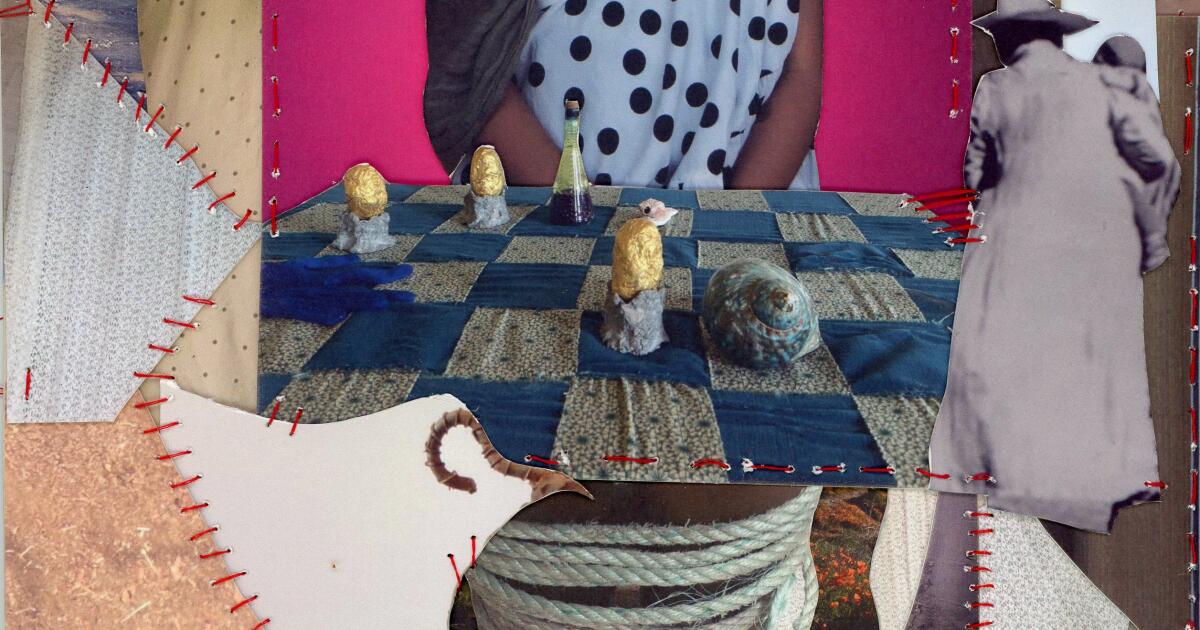
“Visitation,” 2024, photo-collage and thread
(dama / For The Times)
This story is part of Image’s April issue, “Reverie” — an invitation to lean into the spaces of dreams and fantasy. Enjoy the journey.
The first Visitation occurs in a dream on the wings of an aircraft transporting me and my mother to San Antonio, because my sister has died. My sister materializes through golden-hued cumulus clouds, beckons with her hand for me to come to her, and so I do. In my palms, she drops an orb of pure golden light before retreating back into cloud.
Visitations, in addition to meaning a gathering of friends and family for the recently deceased, can also be defined as a visit from the deceased. In my Dreaming Life, my sister returns, randomly yet always intensely, to travel here to me within my perceptible life, to tell me things. It is not always so clear what it is that she has traveled so far to tell me.
Instead of holding a visitation, my family chooses to offer two funeral services. A whole grocery store cannot be shut down, so we opt to hold the service over two nights, to allow my deceased sister’s coworkers to come by between their shifts.
Every person — customers, old school friends, neighbors, children of exes — holds on to me to say how my sister had been their angel and inspiration and life’s guiding light. My sister, who died at age 48 of breast cancer, had become an angel through the workings of Death, but she had — as reaffirmed again and again through the tears and sorrows of the receiving line — also been an angel in her Waking Life.
Visitations occur because those who mourn occupy an unreal space; loss transcends reality or else collapses that once-stable sense of self, space and time.
Visitations occur because those who mourn occupy an unreal space; loss transcends reality or else collapses that once-stable sense of self, space and time. As any of us who have lost know, such deep losses fracture the self. Loss upends our notions of space: The space is now dominated by an insurmountable absence. This absence distorts time or those edges of days or weeks or months that were once so clearly demarcated.
In mourning and grief, it is this very haze of the fracturing of self, space and time that can find, in the practice of Visitation, some temporary bearings within a world upended. To see the familiar faces, to hear the old story, to think about the old song — such remembrances tether us, however frayed and fragile the gossamer of grief, to a world transformed. The world is now distorted: it is a world where someone’s gone missing.
In the world now absent my sister, I cling to each and every Visitation from her as she comes in dreams. I have always had a peculiar interest in the Dreaming Life, and after my sister died, I found that if I wanted to continue some form of communication with her, I would have to be the astronomer and detailed data collector in the observatory of sleep. Only I could keep the lookout; only I could transcribe the fates.
So I began to entangle my Waking Life within the Dreaming Life.
Everyone suddenly, it seems, wants to lucid dream. I say: First dream, but dream actively. Here are some practices I take to ensure an engagement in my Dream Life:
- Keep a notebook bedside. Reach for this notebook first thing upon waking, whatever the hour. Even if you can’t recall any dreams, this practice, which can be difficult to establish, will develop into a habit. If you cannot recall the dream fully formed, then record dreamlets — the fragments of dreams.
- Drink water. The body, of course, is optimal when hydrated, but falling asleep with a full bladder will help you to wake in the middle of the night with a glimmer of a dream. Be sure to discipline yourself to write your dreamlets down before you go to the bathroom and forget. Keep a notebook by the toilet to help you remember.
- Rest your mind before sleep. Tell yourself that you are going to dream and that you will remember your dreams and that you will write them down. It’s OK if you’re stressing or thinking troubled thoughts before bed. Think what you will, but always firmly believe that you will dream. I recommend reading before bed, as it is an activity that stimulates the mind, imagination, openness to surprise, close attention and interpretation: These are the stuffs of reading your own dreams.
- Sleep in. We have more opportunities to dream when we are able to sleep in. Give yourself the gift of this at least once a week.
- Try mugwort in your bedtime tea. After a few weeks of active dreaming, try mugwort tea on the nights when you can sleep and dream more freely. Mugwort is an herb that is easily foraged and induces more vivid dreams. A teaspoon will suffice.
- Ask yourself what is troubling you. Can you reframe this worry through what your dreams have been showing you?
By paying attention to your dreams and collecting your dreamlets, you will begin to see a way out. You can face the situation, in however a veiled or coded way, in your dreams. You can practice your way out or through or in.
In a dream, I was once an unexpected visitor. I came upon a corridor, white and filled with light, through which my sister glided. I ran after her, but I was stopped by an attendant, in white, who told me that I couldn’t go through the doors but that my sister was there, on the other side, making it beautiful for me.
And so who’s to say that in this life, we are not merely visiting? If the dreams of unborn babes are the dreams of practicing at living, for what then is this Waking Life preparing us?
In one dream, my sister wants to go to Brazil. We’re on a highway in San Antonio. We’re going fast around all the cloverleafs and overpasses. We take curves dangerously fast. I tell her that I’m happy to go with her, but does she know the way? Yes, she replies. She says she goes all the time. She knows the way. In the dream, we never get there, but we’re so happy to be free, to just do it, to go wherever, whenever with a sister.
In dreaming, it’s not so easy as paying attention to merely one dream. One dream taken out of your map of dreaming is merely a piece, a clue, a hint toward a totality. One dream is one spot of paint viewed up close on an otherwise vast masterpiece — you won’t know what it is you’re seeing until you’ve amassed enough, connected the dots, done the good work of a detective.
I am a writer who gains through fragments, rarely composing a full essay in one go. I prefer instead to accumulate the bits and pieces, stitch them up, allow happenstance and discovery to arrange the pieces, determine the binding. I like to begin in chaos and have that chaos propel its own focus or refractured brilliance.
My Dreaming Life is no different: I see dreams as fragments of a greater masterpiece. So I jot down my dreams.
My Dreaming Life is no different: I see dreams as fragments of a greater masterpiece. So I jot down my dreams. These dreamlets, these glimmers of a seemingly real and lived experience, eventually pull toward their narratives, eventually show me my struggles and push me on toward a way out in such a way that I can solve the problem in the Dream World while simultaneously tackling a very real-world problem. The two are not inseparable.
I collect the glimmers and connect the dots. My sleuth side sees dreams as not a mere escape from the logic or hardships or realities of the day but rather a world in the making. The dreams enable me to prepare for the next life as it navigates me, night after night, from one realm to the next and back again.
My sister and I entered the scary exhibit at a wax museum on one of the outings we last took together. She was afraid of what might appear. I held her hand and led the way. I knew it would be one of the last times I would hold her hand. My sister, who had always gone first in my fear of dark hallways, was now being led by my hand.
Except, in Waking Life, that is in reality, my sister is the one who goes first into the fear of the dark, into the dream of Death, of which I have always held a tight fear.
If I am to see what there is to see in the ongoing series of Visitation dreams from my deceased sister, then I would have to conclude that she is truly there, on the other side, making it beautiful for me.
Jenny Boully is a Guggenheim Fellow whose books, including “Betwixt-and-Between,” employ dreams alongside real-life entanglements. She has two books forthcoming from Graywolf Press. In addition to teaching at Bennington College, she offers private dream writing guidance.



Once rivals on the tennis court, Martina Navratilova, left, and Chris Evert have become close friends in retirement. They are pictured above at the French Open in 1986.
Trevor Jones/Getty Images Europe
hide caption
toggle caption
Trevor Jones/Getty Images Europe
Chris Evert and Martina Navratilova were the most successful women’s tennis champions of their generation. Both were 18-time Grand Slam tournament winners — and each other’s greatest rivals.
Evert, a Florida native, became a tennis star in her teens. Navratilova was born in communist Czechoslovakia, and emerged as a player after Evert was established. They first faced off during a match in Akron, Ohio, in 1973, when Evert was 18, and Navratilova was 16. Evert won, but Navratilova left an impression.
“I remember thinking to myself, holy cow, when this young girl gets into better shape, she is going to be a force to be reckoned with,” Evert says. “She had so much talent. Her hands were quick, she had a big first serve, she had a big forehand, and she just was so powerful.”

Two years later, on the day she lost a semifinals match to Evert at the U.S. Open, Navratilova defected to the U.S. In the years that followed, her tennis game improved. Though she and Evert had initially been friendly, the friendship cooled as their rivalry heated up.
“Playing Chris was difficult because how can you not like Chris? What’s not to admire?” Navratilova says. “She was like the epitome of cool.”
The new Netflix documentary Chris & Martina: The Final Set tells the story of how Evert and Navratilova re-established their friendship and how they both faced cancer in retirement. Evert was diagnosed with ovarian cancer in 2021; Navratilova was diagnosed with throat and breast cancer in 2022.
“I can’t get away from her,” Evert jokes. “We had a 15-year career, and then we got cancer at the same time. It really is freaky, but I always say: If I want someone to be in the trenches with me, it’s Martina because she has been so supportive and so understanding.”

Navratilova agrees: “We have such a level of trust that we know whatever we say to each other, it stays there. We give each other the best advice we know how to. And there is no ulterior motive, no playing games.”
At the time that this interview was taped, Evert and Navratilova were both in remission from cancer. But late last week, Evert disclosed she’d recently been diagnosed with a recurrence of ovarian cancer.

“We know whatever we say to each other, it stays there,” Martina Navratilova says of her friendship with Chris Evert.
Netflix
hide caption
toggle caption
Netflix
Interview highlights
On supporting each other through cancer
Evert: There are a lot of phone calls between us. … I don’t cook, but Martina would bake bread for me, and her wife Julia would cook, make some chicken soup. … I got a lot of food from Martina. She got a necklace from me.
Navratilova: I get jewelry from Chris, she gets food from me.
Evert: Martina’s and my relationship — because we’ve had one for 50 years — is not the type where we have to talk to each other every day to maintain the closeness. I always knew she was there. She always knew I was there if we needed to talk, and that was that.
On the weakness they experienced with cancer
Navratilova: Chris’ diagnosis and treatment was much more life-threatening than mine, percentage wise, but my treatment was more difficult physically. … I was in New York for seven weeks and I literally sat on a yoga mat, maybe half an hour of the seven weeks, and did some stretching. I couldn’t even do the down dog pose because I would have fallen down. I had absolutely zero strength left.
Evert: The chemo kicked my butt, let’s put it that way. … It left me very weak, very, very weak. After chemo I would have three or four days of intense nausea and I just would feel tingling in my body and it just wasn’t nice. I didn’t have the energy. To walk six blocks was a big deal for me. And it was foreign. You know, it felt like it wasn’t my body, for sure.
On watching the old footage of their matches together for the documentary
Navratilova: For me, it was fun watching with Chris, because we had different reactions to what happened on the court. But what impressed me is how well we played with those wooden rackets. Because you know what? Those rackets are not easy to play with. But you try to put yourself in there physically, what it was like, mentally, what it is like. And it’s like, “Oh, I should have gone down the line,” or, “I can’t believe I missed that shot.” Or “Chris, you had such a great pass.” It was amazing. So it was impressive. … I wish I could still have that six-pack, but anyhow.

Evert: I remember feeling genuinely happy for her. I remember it was her first Wimbledon. That’s always been her dream since she defected. Her family couldn’t be there to watch her. She was all alone. And I just was happy for it. And I knew that this was gonna be one of many for her to win.
On defecting to the U.S. in 1975 when she was 18 years old
Navratilova: I was thrilled to be in the States. I always loved American cars. And when you ordered a ham sandwich, you got, like, two inches of ham and two slices of bread. Whereas growing up, you had thick bread and one slice of ham. So I thought I was in heaven. And it was $2.30 for that sandwich. I still remember it. I couldn’t believe how much ham I was getting.
Lauren Krenzel and Nico Gonzalez Wisler produced and edited this interview for broadcast. Bridget Bentz, Molly Seavy-Nesper and Beth Novey adapted it for the web.

-
World12 minutes ago
‘No MiGs for Ukraine’: Polish defence minister claims Kyiv backed out of deal with Warsaw
-
 News42 minutes ago
Rep. Tom Kean returns to Congress, says depression is why he went missing for months
-

 Los Angeles, Ca2 hours ago
LeBron James informs Lakers he will play elsewhere next year
-

 Detroit, MI2 hours ago
5 realistic cornerback trade targets for the Detroit Lions after Terrion Arnold’s release
-

 San Francisco, CA2 hours ago
Headlines, June 30 – Streetsblog San Francisco
-

 Dallas, TX2 hours ago
LIVE | Ivory Coast, Norway meet for World Cup knockout match at Dallas Stadium
-

 Miami, FL3 hours ago
Every Dolphins head coach’s start in Miami from worst to best
-

 Boston, MA3 hours ago
Historian clears up one of the biggest myths about the Boston Tea Party

