Virginia
Ahead Of 4/20, National Democratic Group Slams Virginia GOP Governor For Marijuana Vetoes


A national Democratic Party group is bashing Virginia Gov. Glenn Youngkin’s (R) “harmful opposition to marijuana reform” ahead of the 4/20 cannabis holiday, calling out the GOP governor’s recent vetoes of bills to legalize retail sales and reduce sentences around past marijuana crimes.
In a statement tied to the 4/20 cannabis holiday and shared exclusively with Marijuana Moment on Friday, the Democratic Legislative Campaign Committee (DLCC), which focuses on electing Democrats to state legislatures, said Youngkin “continues to hold Virginia back and block the progress made by Democrats in control of the legislature.”
Use, possession and limited cultivation of cannabis by adults is already legal in Virginia, the result of a Democrat-led proposal approved by lawmakers in 2021. But Republicans, after winning control of the House and governor’s office later that year, subsequently blocked the required reenactment of a regulatory framework for retail sales. Since then, illicit stores have sprung up to meet consumer demand.
This year, with Democrats in control of both legislative chambers, lawmakers passed a new legal sales bill, sending it to Youngkin for his consideration in late February. A month later, the governor vetoed the bill, writing in a veto message that “the proposed legalization of retail marijuana in the Commonwealth endangers Virginians’ health and safety.”
“Let’s be blunt,” DLCC Communications Director Abhi Rahman said in the new 4/20 statement. “Gov. Youngkin is hindering economic opportunity and needed criminal justice reform in Virginia. Legalizing marijuana sales would diversify Virginia’s economy and open new avenues for economic growth. Reducing the sentence time for petty marijuana offenses would change the lives of hundreds of Virginians.”
DLCC says the reform would have boosted local economies and reduced or commuted the sentences of nearly 400 people imprisoned on marijuana charges.
The group cited a Marijuana Policy Project report from last year showing states have made more than $15 billion in tax revenue from legal marijuana as well as a poll from a year ago showing 60 percent support for the policy change in Virginia. The resentencing bill, meanwhile, would have provided relief to 400 prisoners, DLCC said.
“Support for forward-thinking policies around marijuana is at an all-time high in Virginia, which is why the new Democratic legislative majorities have taken joint action to push the state forward,” Rahman said. “While Youngkin’s vetoes keep Virginia stuck in the past and worse off, the DLCC remains committed to fighting for Democratic power that supports budding industries, economic development, and fundamental freedoms in the states.”
DLCC has consistently used 4/20 as an opportunity to promote cannabis reform, for example tweeting last year that “Almost every state with a Dem-led legislature has acted to ensure people with past cannabis convictions have a path to remove them from their records” and that “There are only 10 states where cannabis hasn’t been legalized or decriminalized – and all of them are run by Republican legislatures.”
There are only 10 states where cannabis hasn’t been legalized or decriminalized – and all of them are run by Republican legislatures. And of the 19 states that still permit jail time for possession of small amounts of cannabis, 18 of them have GOP legislatures.
— Democratic Legislative Campaign Committee (@DLCC) April 20, 2023
A year earlier, DLCC posted that “It’s high time we celebrate how Democrats in the states are blazing a trail to decriminalize, legalize, & regulate marijuana with an important focus on racial justice!”
Following the Virginia governor’s veto of the regulated industry bill, Democratic senators said this week it’s likely legal stores won’t open in Virginia until 2027 or later.
“I’m very direct, and sometimes folks don’t like to hear the harsh truth, but it’s the harsh truth,” said Sen. Aaron Rouse (D), who sponsored the retail sales bill in the Senate. “There’s a really big mountain to climb with this governor and his administration. I think he will veto setting up an adult cannabis market regardless of what we send him.”
“I’m not going to try to rationalize the governor’s statement,” added Sen. Adam Ebbin (D), who sponsored marijuana sales legislation this session and in years past. He said Youngkin “has been antagonistic to this now-legal-to-possess plant in Virginia throughout his remarks on cannabis.”
In the House, Del. Paul Krizek (D), who led this year’s cannabis retail bill in that chamber, has already said he’s intending to support a legal sales bill next session.
“We really did craft a wonderful piece of bicameral legislation that even garnered bipartisan support, albeit not as many members as I would have expected, but that was probably due to Governor’s antipathy toward it,” he told Marijuana Moment after Youngkin’s veto. “So, we have a bill we can introduce next session that will only need some minor adjustments (I did see some small improvements we can make) and gives us a head start.”
The governor this session also greeted less controversial marijuana reforms coldly. In March, he vetoed a separate House proposal that would have prevented the state from using marijuana alone as evidence of child abuse or neglect despite the measure winning unanimous or near-unanimous approval in votes on the Senate floor. Last month he blocked the Senate version that measure.
One cannabis reform that did win Youngkin’s signature this session was legislation to allow public sector workers like firefighters and teachers to use legal medical marijuana without fear of losing their jobs. The governor signed that bill earlier this month.
Ahead of his veto of the legal sales proposal, Youngkin had hinted at his intentions to veto the bill, telling a local reporter: “Anybody who thinks I’m going to sign that legislation must be smoking something.”
At one point earlier this session, however, it appeared the retail cannabis bill could become part of a grand deal between Youngkin and legislative Democrats. In December, Senate President Pro Tempore Louise Lucas (D) alluded to a compromise involving a sports stadium project the governor supported. But that deal never materialized, and Democrats left the governor’s proposed arena plan out of budget legislation.
— Learn more about our marijuana bill tracker and become a supporter on Patreon to get access.
Marijuana Moment is tracking more than 1,400 cannabis, psychedelics and drug policy bills in state legislatures and Congress this year. Patreon supporters pledging at least $25/month get access to our interactive maps, charts and hearing calendar so they don’t miss any developments.
—
The legislation sent to Youngkin would have begun licensing marijuana businesses later this year, with sales slated to kick off on May 1, 2025. Sales to adults 21 and older of up to 2.5 ounces of marijuana flower would be allowed, with purchases taxed at 11.625 percent. Local governments could ban marijuana establishments, but only with the support of local voters.
Here’s what Virginia’s lawmaker-passed retail sales legislation would have done:
- Retail sales could begin as of May 1, 2025.
- Adults would be able to purchase up to 2.5 ounces of marijuana in a single transaction, or up to an equivalent amount of other cannabis products as determined by regulators.
- A state tax of 11.625 percent would apply to the retail sale of any cannabis product. Of that, 8 percent would go to the state, local governments would get 2.5 percent and 1.125 percent would fund schools.
- The Virginia Cannabis Control Authority would oversee licensing and regulation of the new industry. Its board of directors would have the authority to control possession, sale, transportation, distribution, delivery and testing of marijuana.
- Local governments could ban marijuana establishments, but only if voters first approve an opt-out referendum.
- Locations of retail outlets could not be within 1,000 feet of another marijuana retailer.
- Cultivators would be regulated by space devoted to marijuana cultivation, known as canopy size. Both indoor and outdoor marijuana cultivation would be allowed, though only growers in lower tiers—with lower limits on canopy size—could grow plants outside. Larger growers would need to cultivate plants indoors. Secure greenhouses would qualify as indoor cultivation.
- Only direct, face-to-face transactions would be permitted. The legislation would prohibit the use of other avenues, such as vending machines, drive-through windows, internet-based sales platforms and delivery services.
- Existing medical marijuana providers that enter the adult-use market could apply to open up to five additional retail establishments, which would need to be colocated at their existing licensed facilities.
- Serving sizes would be capped at 10 milligrams THC, with no more than 100 mg THC per package.
- No person could be granted or hold an interest in more than five total licenses, not including transporter licenses.
- People with convictions for felonies or crimes involving moral turpitude within the past seven years would be ineligible to apply for licensing, as would employees of police or sheriff’s departments if they’re responsible for enforcement of the penal, traffic or motor vehicle laws of the commonwealth.
- An equity-focused microbusiness program would grant licenses to entities at least two-thirds owned and directly controlled by eligible applicants, which include people with past cannabis misdemeanors, family members of people with past convictions, military veterans, individuals who’ve lived at least three of the past five years in a “historically economically disadvantaged community,” people who’ve attended schools in those areas and individuals who received a federal Pell grant or attended a college or university where at least 30 percent of students are eligible for Pell grants.
- “Historically economically disadvantaged community” is an area that has recorded marijuana possession offenses at or above 150 percent of the statewide average between 2009 and 2019.
- Tax revenue from the program would first cover the costs of administering and enforcing the state’s cannabis system. After that, 60 percent of remaining funds would go toward supporting the state’s Cannabis Equity Reinvestment Fund, 25 percent would fund substance use disorder treatment and prevention, 10 percent would go to pre-K programs for at-risk children and 5 percent would fund a public health and awareness campaign.
- Adults could also share up to 2.5 ounces with other adults without financial remuneration, though gray-market “gifting” of marijuana as part of another transaction would be punishable as a Class 2 misdemeanor and a Class 1 misdemeanor on second and subsequent offenses.
- A number of other new criminal penalties would be created. Knowingly selling or giving marijuana or marijuana paraphernalia to someone under 21, for example, would be a Class 1 misdemeanor, punishable by up to a year in jail and a maximum $2,500 fine, as would knowingly selling cannabis to someone reasonably believed to be intoxicated. It would also be a Class 1 misdemeanor to advertise the sale of marijuana paraphernalia to people under 21.
- Knowingly obtaining marijuana on behalf of someone under 21 would be a Class 1 misdemeanor.
- People under 21 who possess or use marijuana, or attempt to obtain it, would be subject to a civil penalty of no more than $25 and ordered to enter a substance use disorder treatment and/or education program.
- Illegal cultivation or manufacture of marijuana, not including legal homegrow, would be a Class 6 felony, punishable by up to five years imprisonment and a $2,500 fine.
- People could process homegrown marijuana into products such as edibles, but butane extraction or the use of other volatile solvents would be punishable as a Class 1 misdemeanor.
This Will Be The ‘Last 4/20 Celebration’ With Marijuana Still In Schedule I, Congressman Says, While Predicting House Action On Cannabis Banking Bill
Photo courtesy of Chris Wallis // Side Pocket Images.
Marijuana Moment is made possible with support from readers. If you rely on our cannabis advocacy journalism to stay informed, please consider a monthly Patreon pledge.




RICHMOND, Va. — Jerrod Buford first picked up a paintbrush as a kid, never imagining that same creative outlet would carry him through his darkest days in prison.
Buford, who grew up in Williamsburg, was convicted and arrested as a young man and spent almost a decade behind bars. During that time, he struggled deeply.
“Turning to drugs and alcohol to kind of shadow over emotions,” Buford said. “Looking for acceptance, approval. Not just from my parents, but from friends, from, you name it. I mean, I tried to commit suicide, I don’t even know how many times,” Buford said.
WTVR
It was inside prison walls that art became more than a hobby.
“Throughout my prison time, I learned, the freedom that I desired, I’ve always had it. I got, I found it, in a box,” Buford said.
More than three years after his release, Buford continues to advocate for art as a tool for healing. He describes his work as a gift he feels called to share.
“I received a blessing from God that just allowed me to display what he’s given me,” Buford said.
For Buford, creating art is also a way of processing his past.
“That’s what art has done for me. It’s given me the ability to look at parts of my life, all parts of my life, and find the good and the negative, learn from the negative,” Buford said.
He shares his story and artwork with a wide audience through social media, including live sessions on TikTok, and holds art classes with new communities.
The Story Cafe
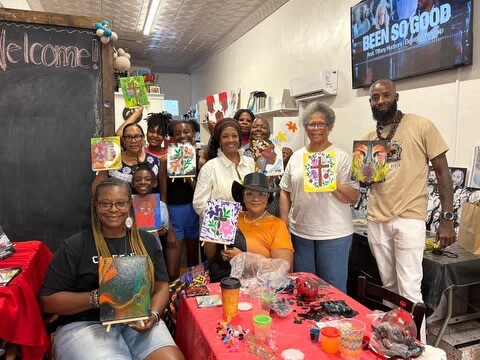
Buford said his mission is to help others find their own path toward healing — whatever form that takes.
“What I strive to do is guide this person to just create, man. Don’t care what people think about your creation, you just need to get it out,” Buford said. “Whether it’s with art, addressing your mental health, getting your life right — just do it.”
CBS 6 is committed to sharing community voices on this important topic. Email your thoughts to the CBS 6 Newsroom.
📲: CONNECT WITH US
Blue Sky | Facebook | Instagram | X | Threads | TikTok | YouTube

This story was initially reported by a journalist and has been converted to this platform with the assistance of AI. Our editorial team verifies all reporting on all platforms for fairness and accuracy. To learn more about how we use AI in our newsroom, click here.

Lovingston, VA (7News) — Good Morning Washington interviews Amanda Beckwith of Virginia Distillery Company- one of the contributing distilleries to the Virginia Spirits Board’s 250th Celebration Trio Pack, a special, exclusive release created to commemorate America’s upcoming 250th anniversary. This limited-edition package features a curated collection of a rum, a gin, and a whiskey, all crafted from scratch by distillers in Virginia to celebrate the rich history and current state of distilling within the Commonwealth.
Beckwith elaborates on VA Distillery Company’s role in the project, noting her focus on Virginia-grown grain to make the bottle of unique whiskey that is included in the Trio Pack. It is also worth noting that the Trio Packs themselves were bottled and produced right here at Virginia Distilling Company!
American single malts are the newest official category of American whiskey, distilled from one grain and from a single distillery. Virginia Distillery Co specializes in this new category of whiskey and crafted their contribution to the Trio Pack with this very specialty. Given the limited remaining availability of the Trio Pack, its historical value and collectible nature, the message it loud and clear encouraging viewers to grab a pack before they are all gone!
BE THE FIRST TO COMMENT
21+ Please drink responsibly, this content is sponsored by Virginia Distillery Company.

Powerball, Mega Millions jackpots: What to know in case you win
Here’s what to know in case you win the Powerball or Mega Millions jackpot.
Just the FAQs, USA TODAY
The Virginia Lottery offers multiple draw games for those aiming to win big.
Here’s a look at June 24, 2026, results for each game:
Powerball
Powerball drawings are held Monday, Wednesday and Saturday at 11 p.m.
13-14-16-21-38, Powerball: 14, Power Play: 2
Check Powerball payouts and previous drawings here.
Saturday, June 27, 2026
Pick 3
DAY drawing at 1:59 p.m. NIGHT drawing at 11 p.m. each day.
Night: 3-1-5, FB: 8
Day: 7-8-8, FB: 4
Check Pick 3 payouts and previous drawings here.
Pick 4
DAY drawing at 1:59 p.m. NIGHT drawing at 11 p.m. each day.
Night: 4-7-2-1, FB: 7
Day: 7-3-4-6, FB: 3
Check Pick 4 payouts and previous drawings here.
Pick 5
DAY drawing at 1:59 p.m. NIGHT drawing at 11 p.m. each day.
Night: 7-5-2-6-9, FB: 0
Day: 6-9-4-0-7, FB: 0
Check Pick 5 payouts and previous drawings here.
Cash Pop
Drawing times: Coffee Break 9 a.m.; Lunch Break 12 p.m.; Rush Hour 5 p.m.; Prime Time 9 p.m.; After Hours 11:59 p.m.
Coffee Break: 12
After Hours: 08
Prime Time: 13
Rush Hour: 01
Lunch Break: 14
Check Cash Pop payouts and previous drawings here.
Cash 5
Drawing every day at 11 p.m.
09-12-15-24-43
Check Cash 5 payouts and previous drawings here.
Bank a Million
Bank a Million draws are held every Wednesday and Saturday at 11 p.m.
18-21-25-33-36-39, Bonus: 13
Check Bank a Million payouts and previous drawings here.
Millionaire for Life
Drawing everyday at 11:15 p.m.
03-04-10-36-37, Bonus: 05
Check Millionaire for Life payouts and previous drawings here.
Feeling lucky? Explore the latest lottery news & results
This results page was generated automatically using information from TinBu and a template written and reviewed by a Center for Community Journalism (CCJ) editor. You can send feedback using this form.
-

 News12 minutes ago
“It’s blood money”: Family of exonerated man in Texas yogurt shop murders speaks out after settlement
-

 Los Angeles, Ca2 hours ago
Woman ambushed, violently attacked by robber in downtown Long Beach
-

 Detroit, MI2 hours ago
Where to watch Houston Astros vs Detroit Tigers: TV channel, start time, streaming for June 26
-
San Francisco, CA2 hours ago
I own a Turkish Restaurant in San Francisco. Turkey’s World Cup match here has changed my business.
-

 Dallas, TX2 hours ago
Australia advances at World Cup, how to buy Australia soccer tickets
-

 Miami, FL2 hours ago
2 detained after police pursuit ends with bailout, neighborhood search in NW Miami-Dade – WSVN 7News | Miami News, Weather, Sports | Fort Lauderdale
-

 Boston, MA2 hours ago
Delta flight returns to Logan after smoke scare in cockpit – Boston News, Weather, Sports | WHDH 7News
-

 Denver, CO2 hours ago
Pat Surtain II Gets More Bad News Amid Broncos’ Uncertainty

