Never before has a television series garnered so much excitement, attention and concern among California’s expatriate Vietnamese community, the world’s largest, as “The Sympathizer.”
HBO’s seven-part espionage thriller depicting the Vietnam War and its aftermath — or the American War, as seen on the title card that opens the series — premiered Sunday and new episodes will air weekly through May 26. It was co-created by South Korean director Park Chan-wook and Don McKellar, and features Oscar-winning actor Robert Downey Jr. in several roles (he is also an executive producer). “The Sympathizer” is based on Viet Thanh Nguyen’s Pulitzer Prize-winning novel of the same name, which follows a French Vietnamese communist spy.
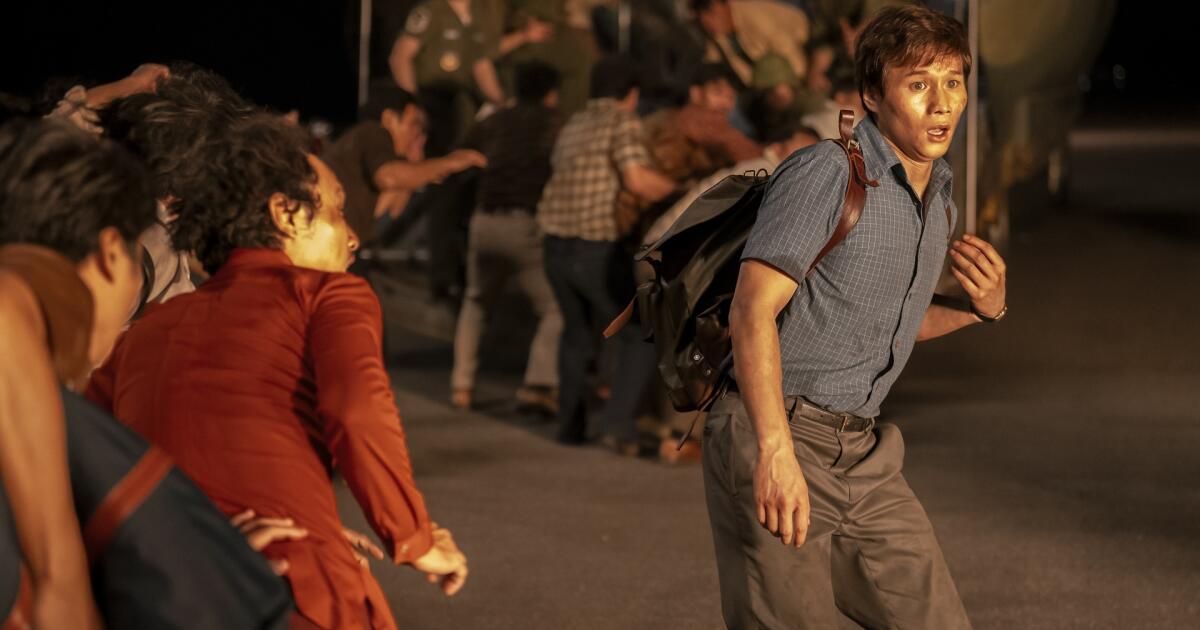
The series is groundbreaking for casting actors who are Vietnamese or of Vietnamese descent in lead roles and much of the dialogue is spoken in Vietnamese, though it was made for American audiences. And the opening episode takes place in Vietnam, depicting the fall of Saigon and a harrowing escape on an airstrip.
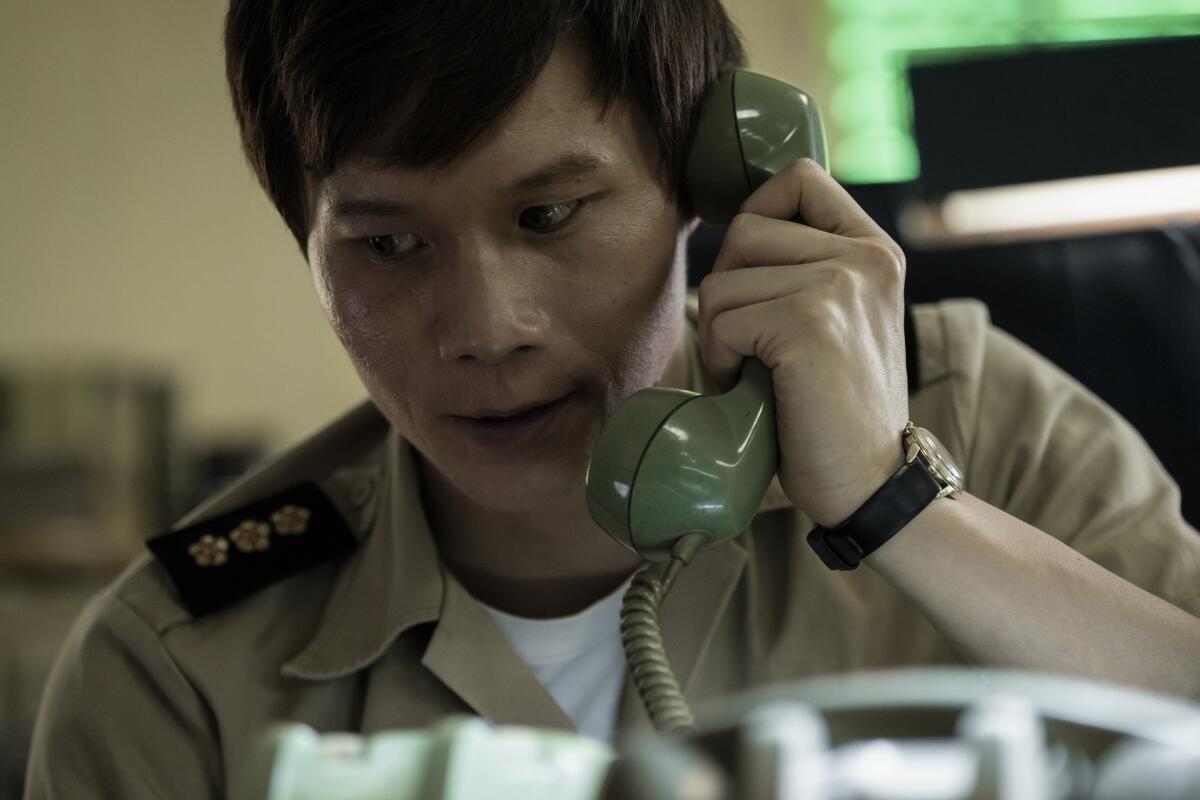
For a younger generation, the series is an opportunity to showcase Vietnamese stories globally, but for an older generation, “The Sympathizer” has stirred some discontent, especially among those who fought in the war. They point to the show’s lead character, the Captain — a communist spy who infiltrates the South Vietnamese army and follows the General, his boss, to Los Angeles, where they resettle — saying it glorifies the communists, the enemy — by presenting the spy’s disparaging viewpoints about the South.
Such sentiments were among those shared at a viewing party organized by Alan Vo Ford, held at Pink Moon, a Chinese restaurant in Beverly Hills, where the premiere episode was streamed for 30 friends from the Los Angeles and Orange County area on Sunday. Ford, 49, a Westminster resident, real estate broker and film producer of Vietnamese movies such as “A Fragile Flower” and “Journey From the Fall,” said he felt compelled to organize the event because it’s so rare for a major Hollywood series about Vietnamese people to be made.
Advertisement
“I felt it was my duty as a Vietnamese American to spread the word so the world would know about Vietnam and American history during this historic period of time,” he said. Ford said when he was a baby, his mother held him while “running and dodging bombs during the final days,” just like in the last scenes of the first episode. His father was in a reeducation camp for 9 years, and his family arrived in the U.S. in 1985.
“This is a breakthrough series for the Vietnamese community to be on HBO and work with superstars like Robert Downey Jr.,” said Don Nguyen, 55, a retired U.S. Air Force lieutenant colonel and cybersecurity consultant, who attended the party. He said that as someone who was part of the first generation of Vietnamese to join the U.S. military, he knows what it’s like to break barriers. “It’s a signal to the global community that we’ve arrived in Hollywood.”
“We have many talented doctors, lawyers, engineers [in the community]. But in films we’re still in the infant stage,” he said. He’s the son of Thanh Tuyen, a Vietnamese singer whose trademark Bolero songs were popular during the war.
Despite some of the generational differences, there is agreement in the community that this is a significant moment for Vietnamese representation in Hollywood that furthers their desire for more Vietnamese stories to be told.
And that’s what Viet Thanh Nguyen advocated for, to have the series, like his book, present a Vietnamese point of view on the war. He said that for too long, Hollywood has portrayed “Vietnamese characters to be killed, raped, wounded, silenced, demonized, or rescued while we serve as the backdrop for American moral dilemmas.” The war and its aftermath have been depicted in pop culture largely through an American lens in films such as “Apocalypse Now” and “Rambo.”
Advertisement
“We should have at least as many Vietnamese perspectives on this war being told as we have American perspectives,” he said.
The cast of the series is predominantly Vietnamese, with Hoa Xuande, an Australian actor of Vietnamese descent, in the lead role as the Captain. Other actors in supporting roles include Kieu Chinh, Toan Le, Fred Nguyen Khan, Vy Le, Nguyen Cao Ky Duyen and Alan Trong.
“This is a historical moment for Vietnamese artists, writers and filmmakers in Hollywood,” said Chinh, an acclaimed Vietnamese actress who plays the mother of the Major (Phanxinê, a Vietnamese filmmaker in his acting debut), a character whose story comes into focus midseason. She knows firsthand what the war was like, having lived through it. The chaotic evacuation scene at the end of the first episode was familiar.
Kieu Chinh, left, with Phanxinê in a scene from “The Sympathizer.”
(Hopper Stone/HBO)
Advertisement
“I heard loud bomb explosions all around us as we were trying to flee. It was frightening and very emotional,” Chinh said. “During the filming, I just relived my past. I didn’t have to act.”
The actor is well-known for her role as Suyuan Woo in 1993’s “The Joy Luck Club,” an adaptation of Amy Tan’s bestselling novel. It marked the first time that a film featuring a nearly all-Asian cast was a Hollywood box office success. However, despite the film’s success, it did not bring an increase in Asian-centered films or roles for Asian actors then. Chinh said she believes that “The Joy Luck Club” was too early for a breakthrough. Now, she thinks that it is time for a Vietnamese series to be featured on mainstream TV.
Anna Chi, a filmmaker whose work includes “The Disappearance of Mrs. Wu,” worked on “The Joy Luck Club” as a director’s assistant while studying at UCLA’s film school; she attended the viewing party with her husband, Douglas Smith, a visual-effects Oscar winner for “Independence Day.” She agrees with Chinh that “The Joy Luck Club” was ahead of its time. Although progress has been made, Chi said there is still much work to be done for Asian cinema. She sees “The Sympathizer” as an important step toward this goal.
While “The Sympathizer” isn’t the first time a story from a Vietnamese point of view has been told, previous efforts haven’t been as well received because of tensions that have lingered since the war. In January 1994, when Le Ly Hayslip, author of “When Heaven and Earth Changed Places,” visited Orange County on a press tour for the Oliver Stone film based on her memoir, dozens of protesters called her a traitor. It was billed as the first movie about the Vietnam War from a Vietnamese perspective, but anticommunist protesters were incensed that she had aided Viet Cong soldiers.
Advertisement
The premiere of “The Sympathizer” comes two weeks before the 49th anniversary of the fall of Saigon on April 30, known as Black April or Tháng tư đen in Vietnamese. The Vietnam War, the second longest war in U.S. history, killed hundreds of thousands of Vietnamese people and American soldiers. For those who fought on the side of the South and were displaced, the wounds from the war remain unhealed.
“Viet sensationalized things to fit the American spy novel and from that perspective, the show is very intriguing to the viewers. He wrote it from the perspective of a Viet Cong communist spy and therefore the South Vietnamese were depicted as corrupted and cruel,” said Quan Nguyen, a physician and director of the Museum of the Republic of Vietnam, a nonprofit in Little Saigon in Orange County. It was opened in 2016 to honor veterans who fought for South Vietnam and to educate future generations.
“This could reopen a lot of deep wounds within our anticommunist community,” says Quan Nguyen, whose father was an army physician.
In “The Sympathizer,” Hoa Xuande plays the Captain, a communist spy in the South Vietnamese army.
(Hopper Stone/SMPSP/Hopper Stone/SMPSP)
Advertisement
Jenny Thai, 58, a guest at the viewing party who is from Garden Grove, agrees. Thai said it has inspired her to make a film of her own that highlights South Vietnamese heroes. She recalls when she was a child in Vietnam, in the final days of the war, everyone was huddled around the radio and the announcement came that Saigon had fallen, and the adults around her broke down in tears. Weeks later, all the men and women associated with the former regime were sent to reeducation camps. She says her family later escaped Vietnam by boat in 1990.
“Most of the Saigoners stayed home and listened to the radio. It was the only way we could follow what was going on,” says Thai, who has produced short films. “Only a small portion of those who worked with the embassy or with U.S. officers knew about the evacuation.”
She adds, “I’m anticommunist, but I don’t hate the Northerners. We are all Vietnamese; we are all brothers and sisters from the same country. It’s the politics that destroyed us, the war.”
Though there are differing views, “The Sympathizer” has nonetheless spurred conversations about representation in Hollywood, how the story of the war is told and by whom. Ysa Le, executive director of the Vietnamese American Arts & Letters Association, a nonprofit that co-hosted a “Sympathizer” screening and press meeting with the show’s cast in Orange a week before its debut, says she welcomes the series.
“For the first time, we have so many Vietnamese talents, both in front of and behind the camera working on this American series,” said Le, 53, a pharmacist in Fountain Valley. She was 5 when the war ended, and her father was sent to a reeducation camp for six years after being unable to flee Vietnam.
Advertisement
“It could inspire aspiring filmmakers to pursue their own projects,” Le said.
Phong Dinh, 91, a former two-term councilman of the seaside resort city of Vung Tau, Vietnam, who spent three years in a reeducation camp, said he understands the antipathy toward the communists, but the spy character created by Viet Thanh Nguyen and depicted in the series doesn’t bother him.
“It was a well-known fact they infiltrated our government since President [Ngo Dinh] Diem’s regime, and continued with President [Nguyen Van] Thieu,” he said. A father of seven, Dinh experienced tragedy after the war, losing his youngest daughter to malaria because no medication was available, and his wife suffered permanent hearing damage from an artillery explosion near their home.
Now a Huntington Beach resident, Dinh joined his youngest son, Viet, former Fox Corp. chief legal officer and U.S. assistant attorney general, to watch the premiere episode. He gave it an A+.
“Our people have suffered immeasurably. I’m blessed to have my family. I want my children and their children to be good citizens, contribute to society in America and help our people,” he said. “If this TV series opens doors for our younger Vietnamese, then it’s worth it.”
NEW YORK (OSV News) – At what is meant to be a poignant moment in the DC Comics adaptation “Supergirl” (Warner Bros.), the title character, played by Milly Alcock, is told by her mother (Emily Beecham) that she doesn’t have to be nice but she must be good. The recipient of this advice takes it to heart in a way that lends the whole film an unpleasant tone.
We’re not talking Deadpool depths of obscene snark here. Yet scrappy Supergirl, aka Kara Zor-El, in contrast to her affable cousin — and fellow Kryptonian — Superman (David Corenswet), does not come across as especially likeable.
Nor is she a figure to be imitated since, before she embarks on the quest to which most of the running time is devoted, early scenes show her waking up with a succession of staggering hangovers. She gets blotto, we later learn, in an effort to blot out her troubled past. The only positive ingredient in her current life is the bond she shares with her beloved dog, Krypto.
So when evil alien Krem of the Yellow Hills (Matthias Schoenaerts) wounds Krypto with a poisoned dart, leaving him with only hours to live, Supergirl is desperate to help the pup survive. Learning that Krem carries the antidote with him wherever he goes, she sets off on an interplanetary hunt for the villain, racing against time.
Supergirl has already crossed paths with another of Krem’s victims, Ruthye (Eve Ridley). Having watched as Krem slaughtered her entire family, Ruthye is out for revenge and wants to join forces with Supergirl.
Advertisement
Since Ruthye, though courageous, is undersized and completely untrained for combat, Supergirl initially tries to ditch her. But Ruthye is not to be so easily rebuffed.
The unlikely duo eventually acquire an informal ally in the person of cigar-chomping, motorcycle-riding freelance warrior Lobo (Jason Momoa). Lobo has reasons of his own for hating the band of brigands Krem leads.
As scripted by Ana Nogueira, director Craig Gillespie’s scifi adventure includes more than one exchange in which Supergirl warns Ruthye about the morally corrupting effects of exacting vengeance. Yet this thoroughly respectable ethical message is completely undermined as the action reaches its climax.
“Supergirl” may not be a dose of Kryptonite. But it’s no energy-infusing sunbath either.
The film contains much harsh but bloodless violence, a scene of urination, a passing reference to nonscriptural religious ideas, a couple of mild oaths, several uses each of crude and crass language and an obscene gesture. The OSV News classification is A-III – adults. The Motion Picture Association rating is PG-13 — parents strongly cautioned. Some material may be inappropriate for children under 13.
A crazed newscaster prompts his viewers to do a wild thing: open their windows and shout, “I’m as mad as hell and I’m not going to take this anymore.” And they do it, from Atlanta to Baton Rouge, so much yelling. It’s a prescient scene in “Network” from 1976, the year of America’s bicentennial. Fast forward to the semiquincentennial and Americans holler versions of that slogan through windows in real life, just on phones and computers.
When the national mood wobbles, we turn to the arts, which have the power to free buried desires, soothe souls and cross divides. So as America turns 250, the Entertainment team considered how this country’s ups and downs have shaped what we watch, listen to and read. Throughout this week those stories will appear here. Bookmark this page to come back for more.
To start, “Network” makes our list of movies that illustrate frictional historical moments. (“Team America: World Police” does too so expect range!) We also spotlight a new generation of playwrights reimagining Americanness with a sense of hope that America’s best years are still ahead of us. —Brittany Levine Beckman, Entertainment and Features editor
In K M Chaitanya’s Aa Dinagalu (2007), actor Atul Kulkarni, playing gangster Agni Sreedhar, says man is the biggest weapon in the underworld. “The rest are just properties,” he adds. The yesteryear Kannada crime drama, based on the real incidents from a big chapter of the Bengaluru underworld, stood out for its understated storytelling.
In Balaramana Dinagalu, which has the skeleton of a sequel to Aa Dinagalu, weapons are seen in the first scene. As the film progresses, we encounter an arsenal of knives, razors, machetes, and guns — each an extension of the gangsters’ identities and an indispensable tool in their quest to remain feared and lethal. Chaitanya attempts to make the movie a mix of reality and entertaining tropes.
Storyline: Balarama, an ordinary young man from a remote village in Karnataka, becomes a dreaded gangster who rules Bengaluru
The director has roped in the same cast, who played the dreaded gangster trio of Kotwal Ramachandra (essayed by Sharath Lohitashwa), Jayaraj (Ashish Vidyarthi), and Agni Sreedhar (Atul) in Aa Dinagalu. That’s what makes one instantly curious about Balaramana Dinagalu. The only difference in the latest movie from the previous one is the fictionalised names of the real dons. Jayaraj becomes Jayaram, Sreedhar is Shashidhar, and Muthappa Rai is called Monnappa Rai (played by Ramesh Indira).
Even if these characters are the big draw in the movie, the plot revolves around the journey of Balarama, a character with a small yet significant presence in Aa Dinagalu. Vinod Prabhakar’s portrayal of the titular role is the film’s biggest takeaway. He makes us feel for the character, and is quite impressive in the final portions of the movie, where Balarama struggles to break free from the underworld’s trap.
Balaramana Dinagalu is impressive when it reflects the psychology of a gangster. Jayaram is shown helping the needy while Balarama urges young boys to focus on education. It’s as if these men who commit heinous acts, have a heart as well. Shashidhar is often called “intellectual gangster”, as the film reflects how the underworld fears well-read men in the field. Politicians and policemen, the supposedly the protectors of people being part of the crime nexus, strengthen the movie’s world-building.
The film falters in its inability to rise above the plot’s predictability. Balarama’s journey is no different from the often-seen life of an innocent man from a small town who becomes a gangster owing to uncontrollable circumstances. I wish the film had delved a bit more into Balaram’s personality. Why does he not resist becoming a gangster? What dreams did he have when he moved to Bengaluru from a small town?
Advertisement
“My hands speak louder than my words,” says Balarama. This signals that he is someone who settles conflicts with fists rather than conversations. Despite this detail, Balaram’s entry into the underworld feels too sudden. The predictability strips the sheen away from the well-shot action sequences, as the result of every fight is known beforehand.
Chaitanya is careful not to glorify the act of violence. He wants to portray the negative effects of violence on the children in a family, as the movie ends with a hard-hitting frame. It’s impressive that the actor-director duo has delivered a non-hero-worshipping gangster saga.
That said, the movie could have benefited from a couple of gripping episodes. While it’s important not to romanticise the life of a gangster, there is no harm in delivering moments of peak tension, the biggest plus of the genre.
The assassination of Jayaram, the impact of Kotwal’s elimination on the underworld, or the Sakleshpura incident involving Monnappa Rai, had the potential to offer edge-of-the-seat, high-stakes portions, but they are rushed. The love story is simple, but it lacks emotional intensity between the lead couple. Santhosh Narayanan’s dance numbers are forgettable (despite it being his forte) while his montage melodies are beautiful.
Balaramana Dinagalu adopts a restrained, almost clinical approach to the gangster genre. While that keeps it from glorifying violence, it also leaves the narrative feeling a touch too neat and emotionally muted.
Advertisement
Balaramana Dinagalu is currently running in theatres