Politics
This trans author toured red-state libraries. What she found might surprise you

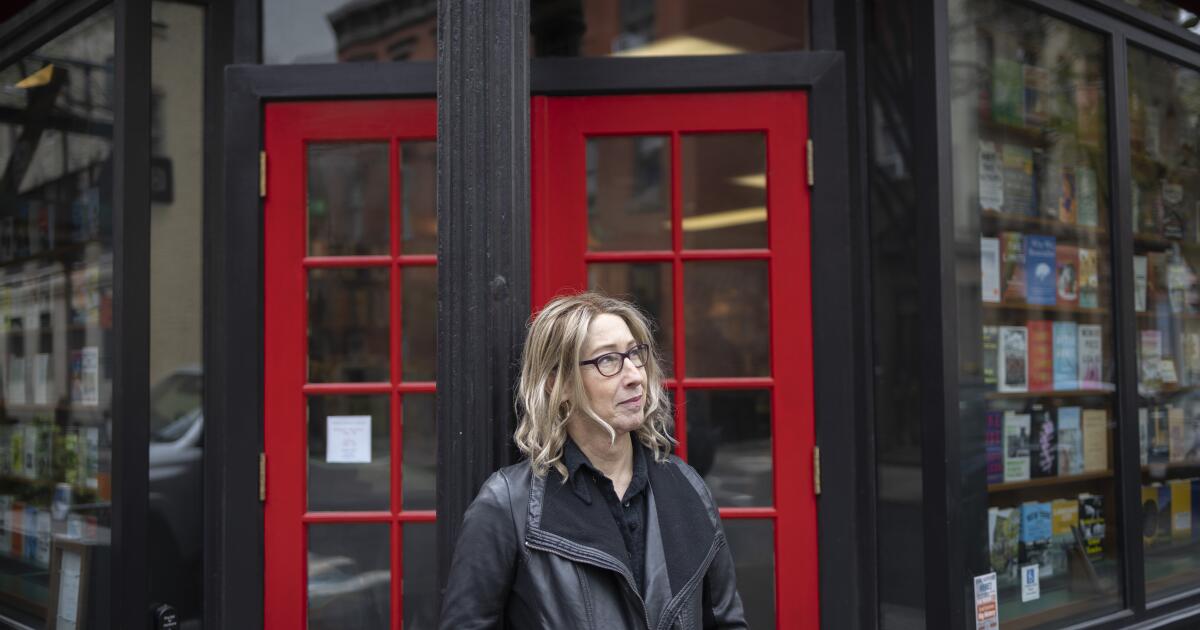
The small brick plaza in front of the Pella, Iowa, public library was teeming with people. A gray-haired woman in a T-shirt stood stoically beside a large banner bearing a Bible quote with chapter and verse notation. There were a handful of other signs in the crowd. I can’t quote any of them because I kept my head down as I entered the plaza.
Inside the library, there were event posters with my face on them. I didn’t know if I’d be recognized in the crowd — or clocked as transgender. It occurred to me that in Iowa you don’t need a permit to carry a gun — open or concealed. A current of people was funneling into the library, and I joined them. I sensed, eerily, that some who were entering alongside me were protesters. I didn’t turn to look.
The event room was filling up fast, despite the fact that library director Mara Strickler held off on posting my visit to social media until three days before, opting instead for a word-of-mouth campaign. The crowd was mixed — age-wise and gender-wise — and overwhelmingly white (Pella, population 10,500-plus, is 95% white). A friend of mine who’d come from Iowa City told me later that some people in the back were giving out copies of my 2022 book, “This Body I Wore,” which had just come out in paperback. The gray-haired woman in the T-shirt filed in and took a seat.
An audience member holds a flag during a June town hall meeting in Pella, Iowa, with then-Republican presidential candidate Sen. Tim Scott (R-S.C).
(Charlie Neibergall / Associated Press)
I found Strickler, who said there were only a few protesters inside the room and that I wouldn’t be using a microphone. She had a gift for me, and hoped I’d stick around long enough to receive it. Until then, it would just be me, my book and my naked voice in a packed room where I had no idea what was going to happen.
:::
Last summer I embarked on a red-state library tour: visiting, free of charge, any library that invited me to do a book talk and presentation on the freedom to read. The tour was an idle thought I entertained early in 2023 — an extravagant, albeit enticing, “what if?” — when the American Library Assn. selected “This Body I Wore” for its Notable Books List.
When my agent called with an offer of a paid speaking gig at an arts club in Arkansas, I thought, That puts me in a red state. With a single pin in a map, the tour began to take shape. I started contacting state library associations (every state has one) to get the word out. I’d traveled to Arkansas, Missouri, Kansas, Virginia, North Carolina and seven other libraries in Iowa before I arrived in Pella in late July. Florida, which leads the U.S. in book bans, was on my calendar for September.
I’d been following the wave of book bans and attacks on libraries, and reading local newspapers online, in addition to legislative bills, court filings and library board minutes. I published an op-ed in the Tampa Bay Times highlighting the most salient feature of the book bans — the fact that a majority of the targeted books, as tracked by PEN America and the ALA, were by and about minorities, particularly Black and LGBTQ people.
I felt uniquely positioned — even qualified — for this tour. The 2023 Notable Books List citation was perfectly timed. The setting of my pre-transition memoir, in the conditions facing the budding trans communities of the late 20th century — when few of us were safe, accepted, employed, afforded medical care or visible in the media and libraries — also spoke to the current moment. Red-state legislatures were (and still are) trying to reverse decades of progress for trans freedom. (ABC news reports the ACLU recorded “at least” 508 anti-LGBTQ bills introduced in 2023; 84 of them passed.)
The other thing that qualified me were my years as a New York City public school teacher and a touring poet, experiences that trained me to be compelling and relevant in a hurry. And six years of teaching in a juvenile jail in the South Bronx knocked out any stage fright I could feel in front of a group.

Diana Goetsch’s red-state library tour included a stop at the Salem Church Library in Spotsylvania, Va.
(From Diana Goetsch)
For safety, I decided on two rules: 1) Never post my itinerary online; and 2) Never stay in a town where I’m presenting. The thing that concerned me most (a concern shared by several librarians I spoke to) was the possibility of a book vigilante from a surrounding county or state strapping on a gun and getting behind the wheel.
As it turns out, these precautions, for the most part, weren’t needed. My invitations came from libraries that were supported by communities and library boards overwhelmingly in favor of the freedom to read. These tended to be in larger cities, such as Springfield, Mo., or Davenport, Iowa, or in college towns, like Grinnell, Iowa, or Chapel Hill, N.C. Other than in Pella, small-town libraries under threat didn’t invite me.
Of course, nothing prevented me from turning off the road and walking, unannounced, into any library. Had I not done so, I wouldn’t have learned half as much.
:::
The Eureka Springs Public Library, uphill from the center of a historic Arkansas mountain town, was empty except for two assistant librarians behind the reference desk. I asked if they were getting many book challenges. They told me they weren’t allowed to talk about the subject. One of them took out a printed paragraph and read it aloud: “Our library is a plaintiff in a lawsuit challenging the constitutionality of Act 372,” she began. Act 372, a law criminalizing librarians and booksellers for “furnishing a harmful item to a minor,” was signed by Gov. Sarah Huckabee Sanders, and is set to take effect Aug. 1, 2023. After one assistant finished reading, the other one said, “I hate politics.”
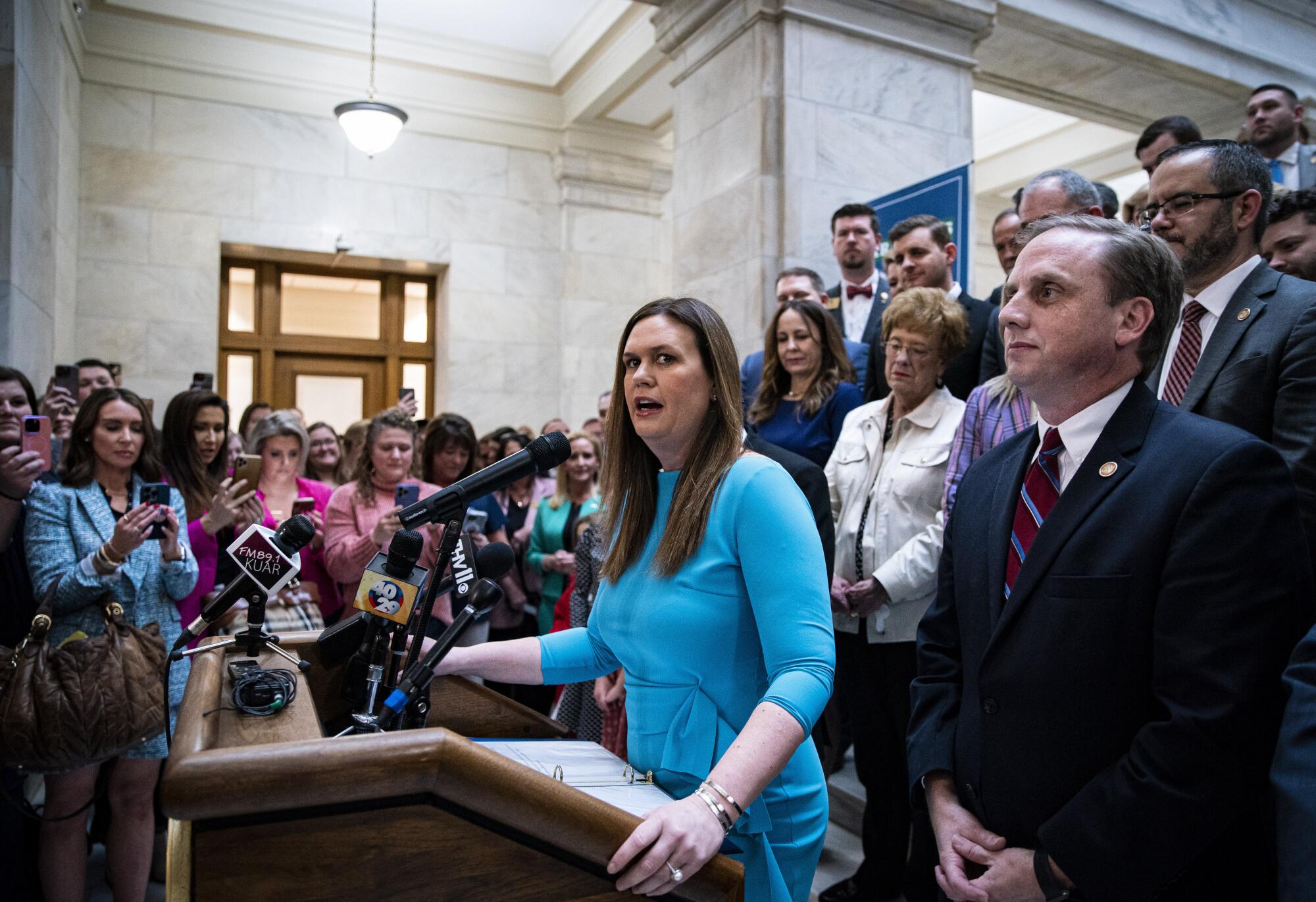
Gov. Sarah Huckabee Sanders speaks while unveiling the Arkansas LEARNS education bill — which gives parents money in the form of vouchers to enroll their children in private, religious or home school — at the Arkansas State Capitol in Little Rock in 2023.
(Al Drago / Getty Images)
I walked into a good-sized library in a town in the Missouri Ozarks, asked to speak to a librarian and was pointed to a nervous blond woman who looked to be in her 30s. She knew a couple of things about me right away: that I’m trans, and that I’m an author. She knew this because I used my ALA-approved book as a calling card whenever I walked into a library.
Before I could ask my standard opening question of librarians — “Do you feel safe?” — the librarian had something she wanted me to know: “I don’t care if a person is rich or poor or homeless, black or white or gay or whatever. I’m here to help everybody.” That declaration, akin to the postman’s creed, is something any librarian would say. The odd thing was where she chose to declare it — in the office behind the circulation desk, where she brought me to speak in private.
At the Salem Church Branch of the Central Rappahannock Regional Library in Spotsylvania, Va., I spoke with a librarian named Dinah King. In 2021, King was an elementary school librarian in the Spotsylvania school district, where the school board voted unanimously to ban 14 books. Two of the members called for burning them. Soon after, someone created a Facebook “Book Burning event” page, exhorting parents to get their kids to remove “books you do NOT want in our schools,” and bring them to a spot across the street from Riverbend High School, where the school board met.
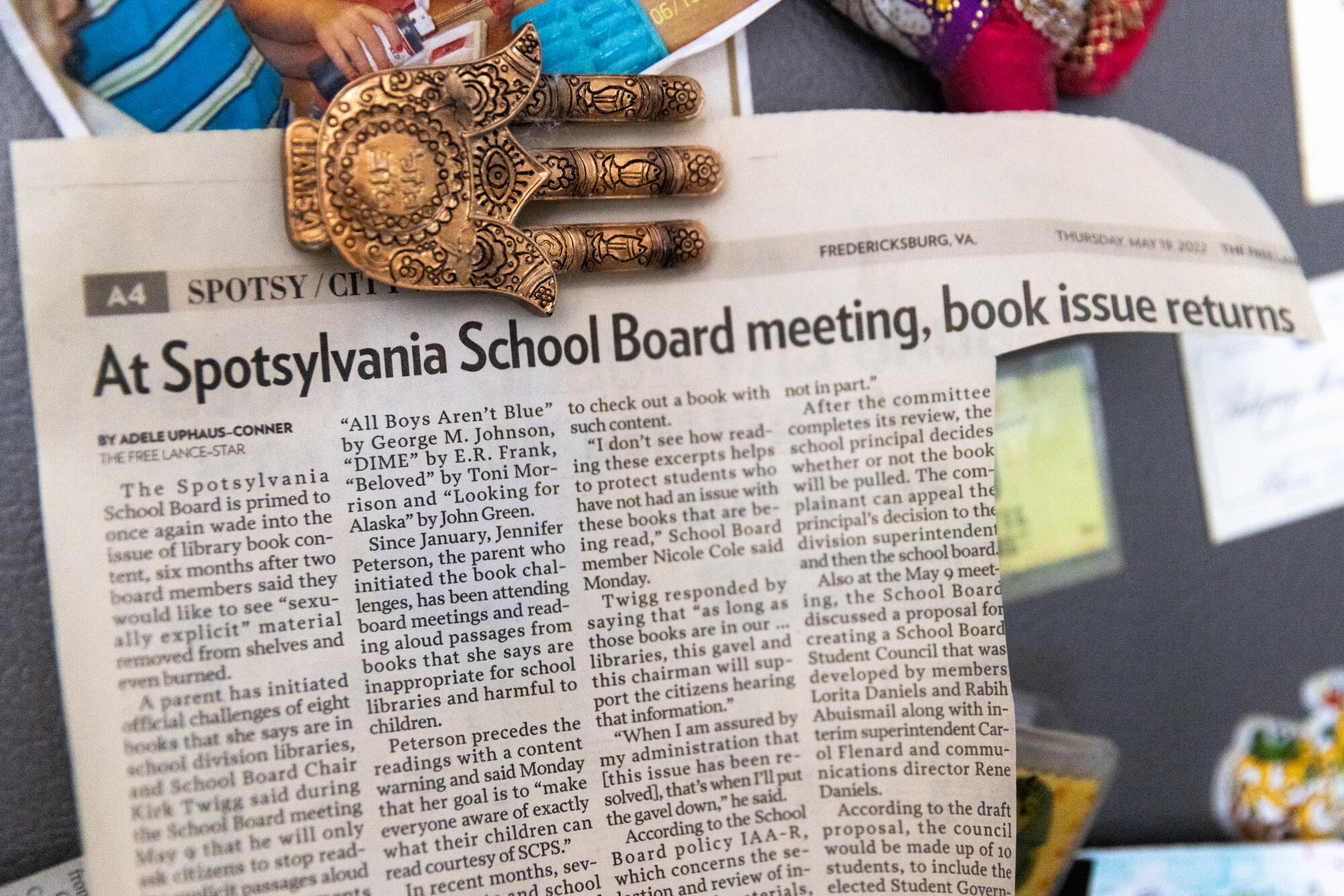
A Hamsa Hand magnet holds a newspaper clipping about book challenges on Jennifer Petersen’s refrigerator. Petersen filed challenges against 71 books with Spotsylvania County Public Schools.
(Julia Nikhinson / Getty Images)
King doubted the Facebook mob would follow through with their plan (they didn’t — the police showed up in force). What upset her far more was being forced to pull every book from her elementary school library’s shelves to check for “inappropriate” content according to some nebulous definition. One day a fourth grader appeared in front of her with a book about gay civil rights leader Harvey Milk and parroted the line, “This book is an abomination.”
:::
Before heading to Pella, I connected with veteran Iowa journalist Robert Leonard, who was described by the Des Moines Register as a “Trumpland translator” and had been covering a string of disturbing anti-trans incidents in the area. He’d recently reported on a proposal that would effectively ban trans people from an outdoor farmers market in Pella.
Leonard and I met for an interview in a study room in the library on the day of my event. Librarians there, he told me, “are afraid for their safety, for their funding, for their staff, because a small minority of people want to … erase a group of people off the face of the Earth.”
Late in 2022, some townspeople tried to ban the award-winning graphic novel “Gender Queer” from the public library. They also wanted to inspect every book. The library board was having none of it, though there was a push for a ballot resolution that would give the city council control of the library.

“Gender Queer” by Maia Kobabe tops the American Library Assn.’s “challenged books” list.
(Oni Press)
In our interview, Leonard and I discussed my red-state tour and why I was doing it. I described what I saw as two layers to the book bans: politically connected groups such as Moms for Liberty spreading propaganda about “protecting children” and a MAGA base genuinely believing the propaganda. I was trying to reach a third group, the so-called “moveable middle” who might be listening to what are considered neutral sources of journalism — and were being told the book bans are part of a culture war.
“It is not a culture war,” I said to Leonard.
“Now [that’s] just pretty amazing to me,” he said, stopping to register what he called an epiphany. “Just that statement — ‘It’s not a culture war’ — sort of reimagines my relationship with the media and my writing.”
Really? Surely he knew the difference between a political wedge issue and ethnic extermination, so why was this an “epiphany”? Maybe it’s because his colleagues throughout the media — at the very outlets that reported doxxing, smear campaigns and death threats to librarians — persist in misframing the crusade as “a culture war.” This includes sources and commentators across the political spectrum — not just the New York Post and Fox News but also PBS, NPR, the New York Times, the Associated Press and Reuters.
It’s one thing to have a culture war debate about school prayer, or a provocative painting in a museum; it’s quite another to stalk and hunt down library staff, to have Proud Boys descend on a library and terrify parents and children. Some of the methods being used — including threats of bombing, shooting and physical harm, and branding one’s opponents pedophiles — are straight out of the Nazi playbook.
This is why, when I spoke in libraries, I showed footage of the Nazi book burnings. Three months after Hitler came to power there were book burnings in 34 university cities and towns across Germany on the same night — May 10, 1933. But we only ever see newsreel footage of one: the bonfire in the public square outside the Berlin opera house.
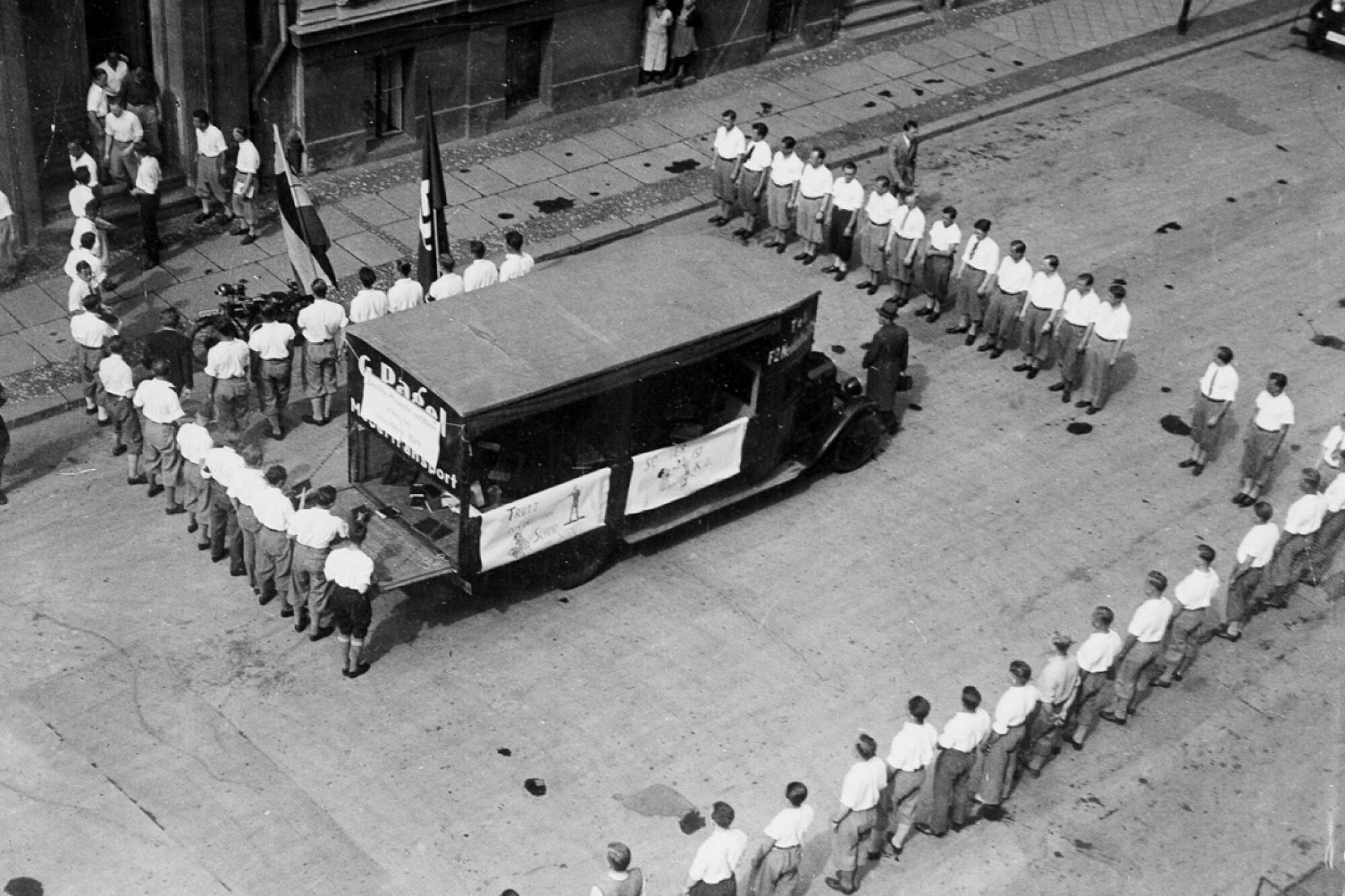
Nazis staged massive public book burnings in Germany in 1933.
(Associated Press)
As the newsreel played, I explained that the books going into that particular fire were not by Jewish authors; rather, they were burning the 20,000-volume library of a nearby gender clinic, the Institute for Sexual Research, founded by Dr. Magnus Hirschfeld. The library contained the best of what was known in medical and social science pertaining to sex and gender, along with testimonials — memoirs — of LGBTQ people. I wanted people to see the parallels between today and Nazi Germany, where the government was defining many minorities as “un-German” and weaponizing “traditional values.”
When Propaganda Minister Joseph Goebbels appears, addressing the crowd in that Berlin square, I pointed out something else: While the book burnings were organized by “grassroots” student groups, the Nazi government was fully looped in. It’s not hard to connect the dots to today when I show them the lineup of MAGA elected officials at the Moms for Liberty convention in Philadelphia, or the video clip of them cheering for Hitler — and I never got any pushback.

Former President Donald Trump speaks at the Moms for Liberty meeting in Philadelphia in June 2023.
(Matt Rourke / Associated Press)
:::
The crowd for my talk at the Pella Public Library was buzzing in a way I’d never experienced. I introduced my book, and read a passage about the Fabric Factory bar in Times Square and the gender-nonconforming people who gathered there in the late 1980s — “people we were 20 years away from having any respectable words for.” I read a scene from 1977, when I watched Howard Cosell interview Renée Richards on ABC’s “Wide World of Sports,” after she’d won the right to compete in the women’s division of the U.S. Open as a “transsexual.” I was 14 and had never heard that word, or thought such a person could exist, even though I was such a person and somehow knew it.
People were listening; no one was interrupting.
I closed my book and turned to the subject of book bans. I had three points to make: 1) The groups leading the book bans don’t give a damn about protecting children; if they did they’d be talking about assault weapons and smartphones; 2) The groups are highly organized and politically connected; and 3) Their goal, like in Nazi Germany, is to “synchronize culture” with white supremacy.
A man asked why we’re pretending that trans people are something new, when they’ve always existed. I said he had a great point and asked if he knew about the “trans panic” murder defense, a legal tactic now banned in 19 states. For decades, criminal defense attorneys argued that when a man discovers someone he’s attracted to is trans, it can induce panic and cause him to murder one of us.
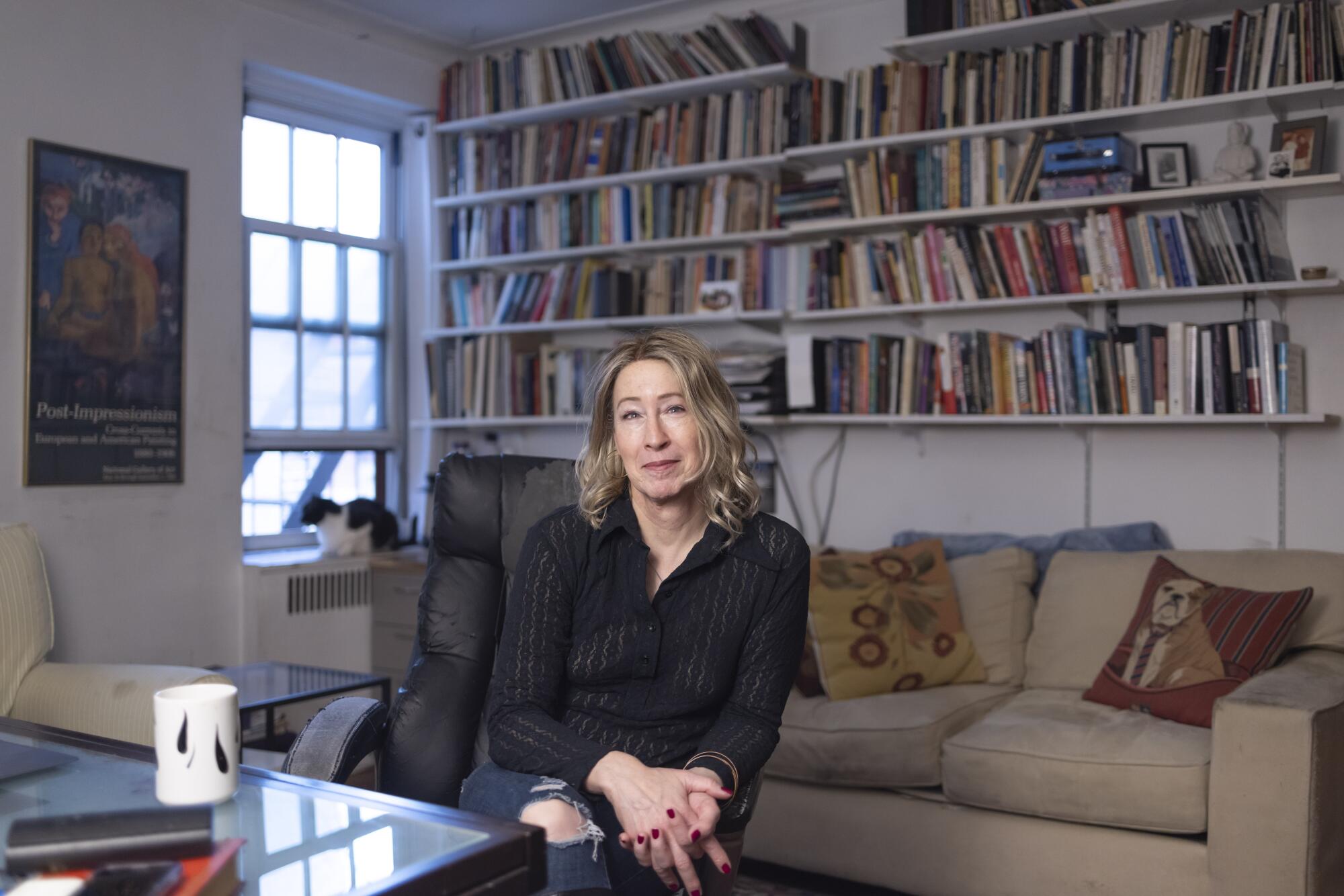
When Diana Goetsch was asked what advice she would give to librarians, she replied: “Advice? I don’t know. They know their situations better than I do. I would just tell them they’re heroes.”
(Andrew Kelly / For The Times)
“Politically,” I said, “MAGA Republicans are trying to induce national trans panic.” They are taking advantage of widespread ignorance about trans people. They want the public voting for candidates who promise to prevent us from transitioning or being seen. This is why they panic when someone trans is accepted and normalized, such as Jeopardy! champion Amy Schneider, who had grandmas across America rooting for her. They don’t want books dispelling ignorance about us in libraries, and they especially don’t want trans children to assimilate and grow up in their gender.
Someone asked what would help librarians. “This,” I said, indicating the roomful of people who showed up to defend the freedom to read.
“Having traveled around, what advice would you give to librarians?”
“Advice? I don’t know. They know their situations better than I do. I would just tell them they’re heroes.”
Afterward Mara Strickler and I shared a hug. The gift she had for me was an assortment of fruit-tinged local beers. I poured a can for myself when I got back to my motel room — 30 miles away in Colfax, Iowa.
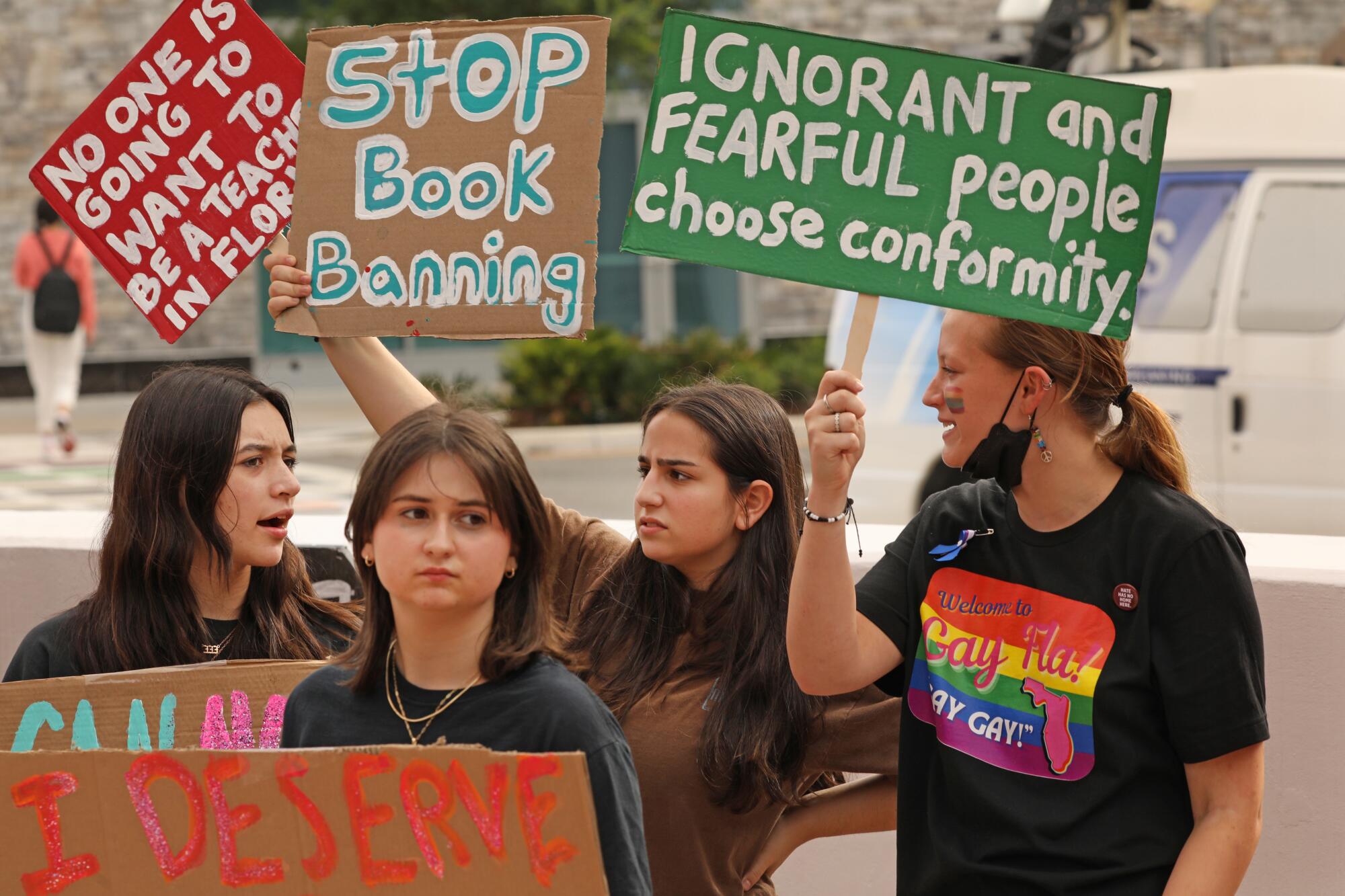
People at an Orange County school board meeting in Orlando, Fla., on April 11, 2023, protest the move by the school boards and the Florida legislature to remove books from school library shelves and limit education on race and LGBTQ issues.
(Carolyn Cole / Los Angeles Times)
:::
The goal of My Red-State Library Tour was to defend an institution I loved and to send the message that the book bans are a fascist-style campaign of cultural erasure, which our media has failed to grasp. I don’t know if I succeeded, though I would love for there to be copycats — other authors who travel to libraries to speak, repaying the favors they do for us.
But maybe the main thing I accomplished was simpler than any of that. On election night in 2016, when Florida was called for Donald Trump, I felt, instantly, my country get narrower. I would watch a growing number of trans refugees flee red states, give up their homes and often their jobs, to protect themselves or their kids. My tour was an affirmation, to myself as much as anyone else, that my body belongs in every state of this country. All of ours do, and our books belong in libraries.
Last year on election day, Moms for Liberty candidates were “annihilated” by members of actual parents’ rights groups. My eyes, however, were fixed on a town in southern Iowa and “Resolution No. 6442” — a measure to allow political officials to control the library in Pella, which went for Trump by 68% in 2020. That resolution was voted down, and a great institution remains independent. The vote was close: 51% to 49%, a difference of 87 people. I’d like to think some of those 87 were in the room when I spoke there.



Politics
Jacob Frey praises Somali community as Minnesota faces renewed scrutiny over fraud investigations

NEWYou can now listen to Fox News articles!
Minneapolis Mayor Jacob Frey told members of the city’s Somali community over the weekend that they are “our family,” pledging solidarity and praising their contributions to the city during remarks celebrating Somali Independence Day.
Frey’s remarks came as Minnesota continues to face scrutiny over several high-profile fraud investigations and weeks after a Republican-led House Oversight Committee report alleged the Minnesota Governor Tim Walz’s administration failed to act on repeated warnings about widespread fraud in the state’s social services programs.
“Through the most difficult of times and through Operation Metro surge, we all saw that they tried to come for some of us,” Frey told members of the Somali community on Saturday. “And when that happens, we say that you’re coming for all of us.”
BLUE STATE’S ANTI-ICE PLEDGE COLLAPSES AS GOP WARNS OF NEW SANCTUARY ‘CONFEDERACY’
Minneapolis Mayor Jacob Frey speaks during a Somali Independence Day celebration in Minneapolis as attendees stand on stage holding Somali flags. (Credit: Mayor Jacob Frey X Post)
“In Minneapolis, we loved our neighbors. In Minneapolis, we do not see you as immigrants. We see you as our family,” he added. “You are our brothers. You’re our sisters. You have done so much for this incredible city, and for that, we stand with you.”
Frey appeared to reference Operation Metro Surge, the Trump administration’s immigration and public safety initiative in Minnesota.
The operation concluded in February after border czar Tom Homan announced it had resulted in the arrest of more than 4,000 people in the Minneapolis-St. Paul area and had reduced what he described as public safety threats.
BLUE STATE’S ANTI-ICE PLEDGE COLLAPSES AS GOP WARNS OF NEW SANCTUARY ‘CONFEDERACY’
Minneapolis Mayor Jacob Frey speaks to the media at City Hall on Jan. 9. (Aaron Lavinsky/The Minnesota Star Tribune via Getty Images)
Frey shared the video on X, writing, “Happy Somali Independence Day.”
“Here in Minnesota, home to one of the largest Somali communities in the United States, we celebrate the resilience, culture, and leadership that continue to enrich our city and community,” he said.
Earlier this month, a Republican-led House Oversight Committee report alleged Walz’s administration repeatedly failed to act on warnings about fraud involving state social services programs, including the Feeding Our Future scandal.
WALZ ADMINISTRATION IGNORED FRAUD WARNINGS AS BILLIONS VANISHED, HOUSE OVERSIGHT REPORT ALLEGES
Democratic Gov. Tim Walz speaks during a news conference on Tuesday, Jan. 6, 2026, in Minneapolis, Minnesota. (Alex Kormann/Star Tribune via AP)
The committee said more than 110 people have been charged in connection with various fraud schemes in Minnesota, including many defendants identified as members of Minnesota’s Somali immigrant community.
The report also alleged concerns about potential racial discrimination claims contributed to delays in addressing suspected fraud and estimated Minnesota lost roughly $300 million in stolen federal child nutrition funds during the COVID-19 pandemic.
CLICK HERE TO DOWNLOAD THE FOX NEWS APP
Walz administration officials have disputed the committee’s findings.
Fox News Digital’s Adam Pack contributed to this report.

For as long as I’ve been a journalist, which is a really long time, public entities have hated public records requests, even while claiming they don’t.
Ask your typical elected or hired official, from the governor to the animal control folks, and they’ll tell you transparency is vital and sunshine in government a key value.
Then turn in the most benign of public records requests — access to a calendar, for example — and prepare for weeks of delays and excuses. Want emails or financial records or, heaven forbid, anything from the police? Months or even years may pass before a single page is delivered, no joke.
That’s why I am deeply concerned about a bill winding its way through the California Legislature that would definitely slow down public records requests and likely make them more difficult and expensive. At its worst, it could push people into costly court battles just for having the audacity to ask for information.
The legislation, Assembly Bill 1821, is authored by Democratic Assemblymember Blanca Pacheco, whose district includes Norwalk, Downey and Bell, where legendary scandals are Example 1 of why public records matter.
Pacheco’s office told me Wednesday that the troubles with the bill are far from what Pacheco set out to do.
“It was never the author’s intention to take away people’s rights to a [Public Records Act] request,” said her chief of staff, Nikki Johnson.
Johnson said the bill was meant to curtail malicious records requests, which do happen, where a citizen goes after copious amounts of records just to be a jerk and cost the government time and money.
It was also meant to address the growing problem of artificial intelligence and other for-profit businesses requesting thousands of records with the intent of using the information to create money-making products — think of sites that already sell publicly available personal information as “background checks.”
I believe Johnson on the good intentions of the bill in addressing those real if nebulous difficulties, but you know what they say about the best-laid plans.
The bill passed through the Assembly recently with ease, largely because most of its problematic portions (I’ll get to those in a minute) were removed — though not all. Even in a watered-down form, which basically gave government more time to answer requests, I found myself in the unlikely position of agreeing with conservative Republican Assemblymember and Trump supporter Carl DeMaio of San Diego, who offered some of the only opposition from elected leaders during the Assembly vote.
“We cannot police the public’s right to know, and we want to err on the side of transparency in how government agencies operate,” DeMaio said.
Amen, brother.
But the Democratic-controlled Assembly erred on the side of secrecy and slowdown instead, and the measure sailed to the Senate, where seemingly out of the blue, a bunch of new provisions were added that fill it with loopholes, vague language and tons of room for abuse.
David Snyder, executive director of the First Amendment Coalition, said the bill as written now was “comprehensively bad for transparency and therefore for government accountability.”
Sean McMorris, transparency, ethics and accountability program manager for the advocacy organization California Common Cause, put it even more forcefully. He pointed out that “public records are the public’s records.”
“They’re not owned by the government,” he said. But this bill would shift that paradigm and make the public “prove why you need them.”
“It’s going to chill people who want to make requests, and it’s going to complicate the process, and it’s just wrong,” McMorris said.
In its new form, the bill basically allows government entities to decide if they feel a public records request is malicious or for commercial gain. If they do, they can petition a court to intervene — potentially sparking both legal costs and new fees associated with fulfilling the request.
It would also, Snyder said, force a requester to explain why they wanted the records — something California law has repeatedly avoided because it gives power to government to treat those it perceives as enemies differently.
In this age of fairness and reason, it’s hard to imagine a government official misusing power to keep secrets, but I’m told it happens. That makes it all the more crucial that people not be forced to explain why they want information, or if they will use it to, say, expose corruption — be it wrongdoing by a single individual or the entire system.
Faced with unintended consequences, Assemblymember Blanca Pacheco (D-Downey), shown in 2023, will seek to scale back the bill to its original form, according to her chief of staff.
(Rich Polk / Getty Images for Equality California)
“I have little doubt that some agencies will use that provision to overburden requesters that they view as political opponents, requesters that they view as just a hassle, requesters that ask for things the government doesn’t want to disclose,” Snyder said. “They can bring the requester into court, and at a minimum, slow down the process, and probably more likely get the requester to simply withdraw.”
As written, the bill also gives a shoddy carve-out meant to protect journalists, but which in reality could be used to curtail requests from freelancers, student journalists and more.
McMorris said access to public records is a “moral issue,” and fixing any problems with the current law requires “a scalpel, not a meat ax.”
This bill, he warned, is a meat ax.
“I don’t discount that there are abusive requests, and that there are requests that really are a burden on government agencies, but the law right now has ways for government agencies to address that,” he pointed out. “Once these laws go into place, they’re going to be hard to roll back.”
It could “fundamentally change” our access to public records, he said.
Johnson, Pacheco’s chief of staff, told me that faced with all these unintended consequences, the Assembly member is going to ask for the amendments to be removed, and for the bill to progress as it was written when it passed the Assembly. That could happen as early as next week, when the bill with the new provisions is scheduled to come up again in a Senate committee for debate.
Reverting to the bill the Assembly voted on would be better, but slowing down public records is in government’s best interests, not the people’s. The bill does nothing to address the problems it seeks to fix, but stretches out the time officials have to simply tell a requester if any records do exist — never mind delivering them.
So even back to its watered-down form, the bill remains a meat ax for a scalpel problem, chopping up transparency with good intentions.

NEWYou can now listen to Fox News articles!
Former President Joe Biden appeared to briefly seek directions before exiting the stage after delivering remarks at a Democratic gala Saturday night, capping his speech with an awkward onstage moment.
After delivering a roughly 10-minute keynote speech at the Maryland Democratic Party’s “Fight Back & Win Gala” near Baltimore, the 83-year-old paused onstage and looked toward the wings before pointing in two different directions, seemingly trying to determine where to exit. After receiving guidance, Biden turned and walked off the stage with his back to the audience.
Unlike several other speakers at the gala, who exited on the opposite side of the stage after their remarks, Biden left in a different direction.
EX-DEM INSIDER REVEALS SHE WILL EXPOSE DEMOCRATS WHO COVERED UP BIDEN’S COGNITIVE DECLINE IN NEW BOOK
Former President Joe Biden exits the stage after delivering remarks at the Maryland Democratic Party’s Fight Back and Win Gala near Baltimore on Saturday. (CSPAN)
The moment came after Biden delivered one of his sharpest public critiques of President Donald Trump since leaving office. During his remarks, Biden defended his own administration’s record while accusing the Trump administration of corruption. He also took aim at what he described as Trump’s “vanity projects,” including renovations to the White House, changes at the Kennedy Center and the ongoing saga with the reflecting pool on the National Mall.
“Whoa, what a loser,” Biden said.
After pausing several times to cough throughout his remarks, Biden concluded with a call for Democrats to “fight back,” saying the country could overcome its challenges by acting together.
“Folks, I guarantee we can do this. And we will. We just remember who in the hell we are. We’re the United States of America,” Biden said. “There’s nothing, nothing beyond our capacity if we act together. So let’s get up and fight back, God darn it.”
The latest onstage moment comes just days after another widely shared incident at the opening of the Obama Presidential Center in Chicago.
WATCH: BIDEN LEFT SEARCHING FOR FAMILY AFTER OBAMA PRESIDENTIAL CENTER CEREMONY
The star-studded ceremony brought together former Presidents Barack Obama, Bill Clinton and George W. Bush, along with former Secretary of State Hillary Clinton, former Vice President Kamala Harris and other political leaders and entertainers. At the conclusion of the event, Biden remained onstage after others had exited before calling out, “Where’s my granddaughter?”
Former First Lady Jill Biden then returned to the stage, took his hand and guided him off.
SIGN UP TO GET THE POLITICS NEWSLETTER
Former U.S. President Joe Biden and Former first lady Jill Biden appear on stage during the dedication ceremony for the opening of the Barack Obama Presidential Center in John Lewis Plaza on June 18, 2026 in Chicago, Illinois. (Scott Olson / Getty Images)
Biden has largely stayed out of the public eye since withdrawing from the 2024 presidential race after facing intense pressure from fellow Democrats to end his reelection bid.
CLICK HERE TO DOWNLOAD THE FOX NEWS APP
The former president has since made only occasional public appearances and recently disclosed that he is undergoing treatment for Stage 4 prostate cancer.
-

 New York7 minutes ago
How a Global Researcher Lives on $110,000 in Long Island City
-

 Los Angeles, Ca10 minutes ago
Mass shooting at L.A. street takeover leaves 1 dead, 6 injured
-

 Detroit, MI30 minutes ago
On the front lines of chronic absenteeism: What Detroit’s Health Hubs do to get kids to school
-

 San Francisco, CA40 minutes ago
S.F. police arrest 20 at 300-person SoMa block party during Pride
-
Dallas, TX45 minutes ago
CJ Goodwin announces retirement after 8 seasons with Cowboys
-

 Miami, FL47 minutes ago
Several people reportedly hurt in ‘mass casualty’ crash near Miami Gardens – WSVN 7News | Miami News, Weather, Sports | Fort Lauderdale
-

 Boston, MA52 minutes ago
Inside Britten’s Record-Breaking Boston Waterfront Activation
-

 Denver, CO55 minutes ago
Denver area events for June 29

