Politics
This trans author toured red-state libraries. What she found might surprise you

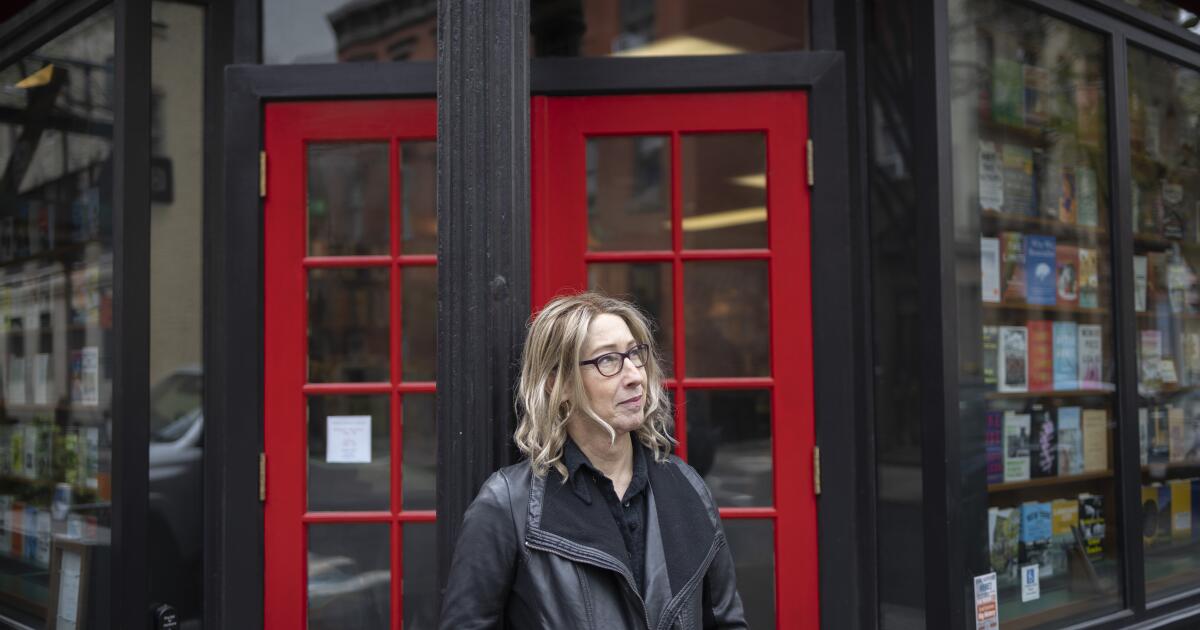
The small brick plaza in front of the Pella, Iowa, public library was teeming with people. A gray-haired woman in a T-shirt stood stoically beside a large banner bearing a Bible quote with chapter and verse notation. There were a handful of other signs in the crowd. I can’t quote any of them because I kept my head down as I entered the plaza.
Inside the library, there were event posters with my face on them. I didn’t know if I’d be recognized in the crowd — or clocked as transgender. It occurred to me that in Iowa you don’t need a permit to carry a gun — open or concealed. A current of people was funneling into the library, and I joined them. I sensed, eerily, that some who were entering alongside me were protesters. I didn’t turn to look.
The event room was filling up fast, despite the fact that library director Mara Strickler held off on posting my visit to social media until three days before, opting instead for a word-of-mouth campaign. The crowd was mixed — age-wise and gender-wise — and overwhelmingly white (Pella, population 10,500-plus, is 95% white). A friend of mine who’d come from Iowa City told me later that some people in the back were giving out copies of my 2022 book, “This Body I Wore,” which had just come out in paperback. The gray-haired woman in the T-shirt filed in and took a seat.
An audience member holds a flag during a June town hall meeting in Pella, Iowa, with then-Republican presidential candidate Sen. Tim Scott (R-S.C).
(Charlie Neibergall / Associated Press)
I found Strickler, who said there were only a few protesters inside the room and that I wouldn’t be using a microphone. She had a gift for me, and hoped I’d stick around long enough to receive it. Until then, it would just be me, my book and my naked voice in a packed room where I had no idea what was going to happen.
:::
Last summer I embarked on a red-state library tour: visiting, free of charge, any library that invited me to do a book talk and presentation on the freedom to read. The tour was an idle thought I entertained early in 2023 — an extravagant, albeit enticing, “what if?” — when the American Library Assn. selected “This Body I Wore” for its Notable Books List.
When my agent called with an offer of a paid speaking gig at an arts club in Arkansas, I thought, That puts me in a red state. With a single pin in a map, the tour began to take shape. I started contacting state library associations (every state has one) to get the word out. I’d traveled to Arkansas, Missouri, Kansas, Virginia, North Carolina and seven other libraries in Iowa before I arrived in Pella in late July. Florida, which leads the U.S. in book bans, was on my calendar for September.
I’d been following the wave of book bans and attacks on libraries, and reading local newspapers online, in addition to legislative bills, court filings and library board minutes. I published an op-ed in the Tampa Bay Times highlighting the most salient feature of the book bans — the fact that a majority of the targeted books, as tracked by PEN America and the ALA, were by and about minorities, particularly Black and LGBTQ people.
I felt uniquely positioned — even qualified — for this tour. The 2023 Notable Books List citation was perfectly timed. The setting of my pre-transition memoir, in the conditions facing the budding trans communities of the late 20th century — when few of us were safe, accepted, employed, afforded medical care or visible in the media and libraries — also spoke to the current moment. Red-state legislatures were (and still are) trying to reverse decades of progress for trans freedom. (ABC news reports the ACLU recorded “at least” 508 anti-LGBTQ bills introduced in 2023; 84 of them passed.)
The other thing that qualified me were my years as a New York City public school teacher and a touring poet, experiences that trained me to be compelling and relevant in a hurry. And six years of teaching in a juvenile jail in the South Bronx knocked out any stage fright I could feel in front of a group.

Diana Goetsch’s red-state library tour included a stop at the Salem Church Library in Spotsylvania, Va.
(From Diana Goetsch)
For safety, I decided on two rules: 1) Never post my itinerary online; and 2) Never stay in a town where I’m presenting. The thing that concerned me most (a concern shared by several librarians I spoke to) was the possibility of a book vigilante from a surrounding county or state strapping on a gun and getting behind the wheel.
As it turns out, these precautions, for the most part, weren’t needed. My invitations came from libraries that were supported by communities and library boards overwhelmingly in favor of the freedom to read. These tended to be in larger cities, such as Springfield, Mo., or Davenport, Iowa, or in college towns, like Grinnell, Iowa, or Chapel Hill, N.C. Other than in Pella, small-town libraries under threat didn’t invite me.
Of course, nothing prevented me from turning off the road and walking, unannounced, into any library. Had I not done so, I wouldn’t have learned half as much.
:::
The Eureka Springs Public Library, uphill from the center of a historic Arkansas mountain town, was empty except for two assistant librarians behind the reference desk. I asked if they were getting many book challenges. They told me they weren’t allowed to talk about the subject. One of them took out a printed paragraph and read it aloud: “Our library is a plaintiff in a lawsuit challenging the constitutionality of Act 372,” she began. Act 372, a law criminalizing librarians and booksellers for “furnishing a harmful item to a minor,” was signed by Gov. Sarah Huckabee Sanders, and is set to take effect Aug. 1, 2023. After one assistant finished reading, the other one said, “I hate politics.”
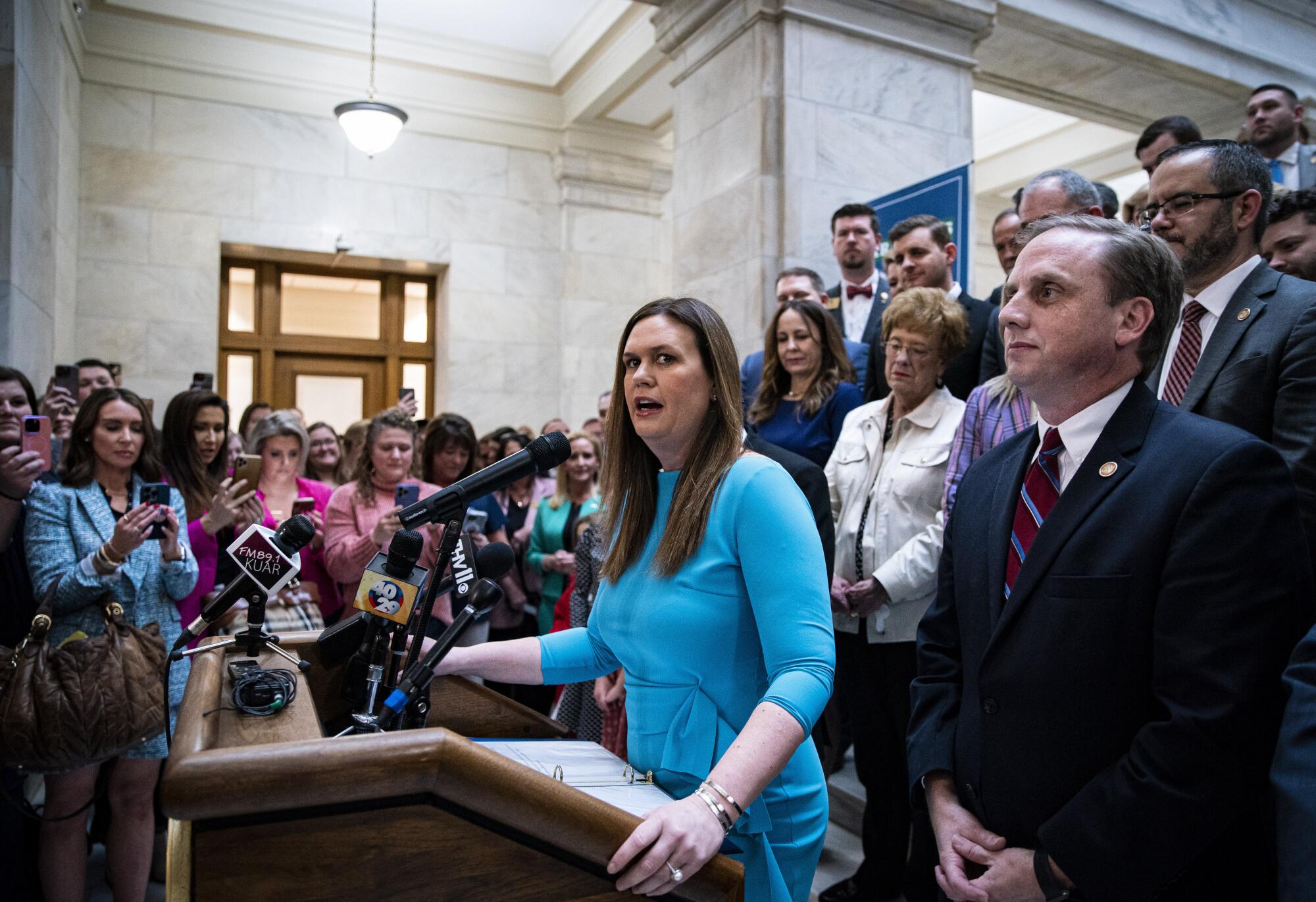
Gov. Sarah Huckabee Sanders speaks while unveiling the Arkansas LEARNS education bill — which gives parents money in the form of vouchers to enroll their children in private, religious or home school — at the Arkansas State Capitol in Little Rock in 2023.
(Al Drago / Getty Images)
I walked into a good-sized library in a town in the Missouri Ozarks, asked to speak to a librarian and was pointed to a nervous blond woman who looked to be in her 30s. She knew a couple of things about me right away: that I’m trans, and that I’m an author. She knew this because I used my ALA-approved book as a calling card whenever I walked into a library.
Before I could ask my standard opening question of librarians — “Do you feel safe?” — the librarian had something she wanted me to know: “I don’t care if a person is rich or poor or homeless, black or white or gay or whatever. I’m here to help everybody.” That declaration, akin to the postman’s creed, is something any librarian would say. The odd thing was where she chose to declare it — in the office behind the circulation desk, where she brought me to speak in private.
At the Salem Church Branch of the Central Rappahannock Regional Library in Spotsylvania, Va., I spoke with a librarian named Dinah King. In 2021, King was an elementary school librarian in the Spotsylvania school district, where the school board voted unanimously to ban 14 books. Two of the members called for burning them. Soon after, someone created a Facebook “Book Burning event” page, exhorting parents to get their kids to remove “books you do NOT want in our schools,” and bring them to a spot across the street from Riverbend High School, where the school board met.
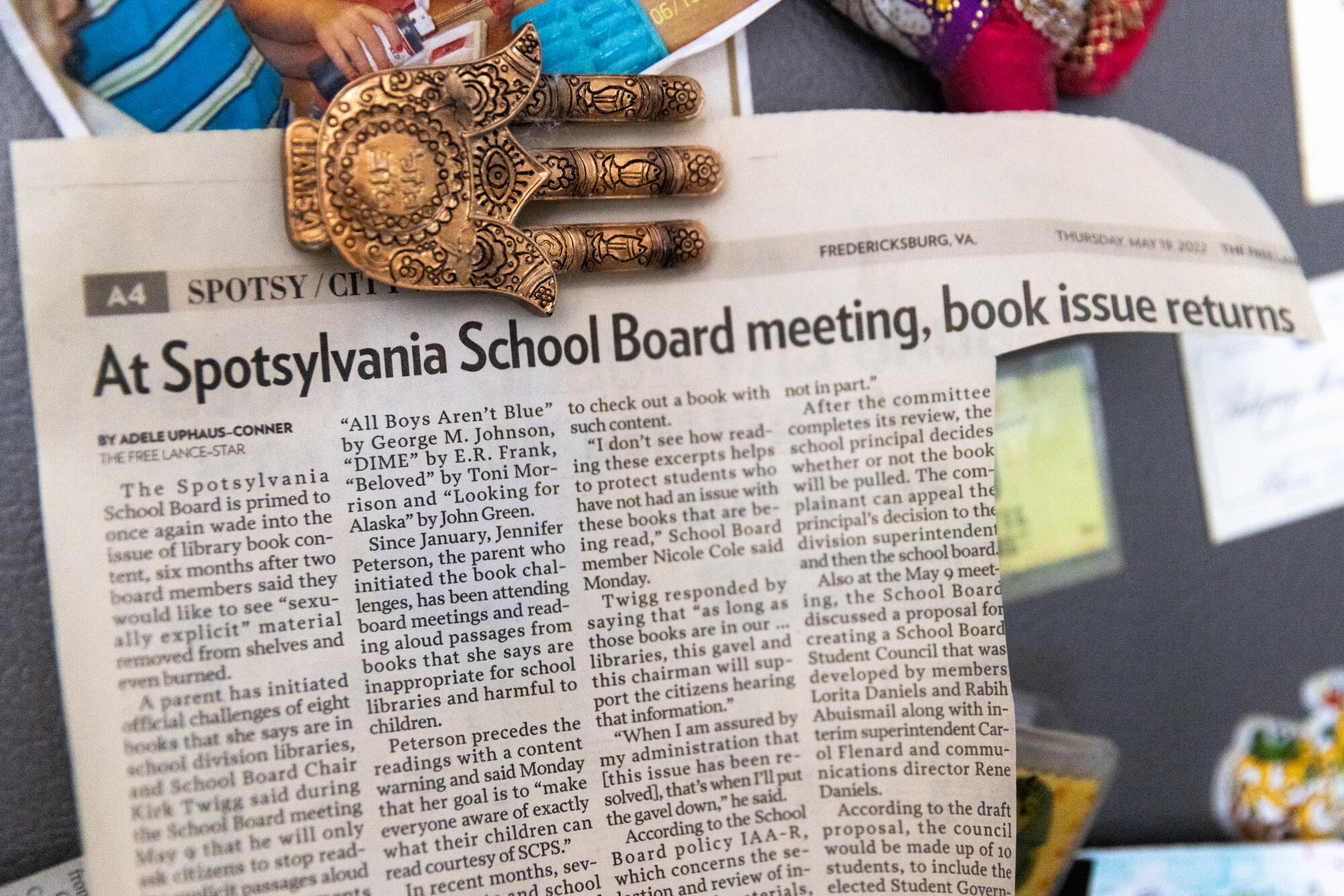
A Hamsa Hand magnet holds a newspaper clipping about book challenges on Jennifer Petersen’s refrigerator. Petersen filed challenges against 71 books with Spotsylvania County Public Schools.
(Julia Nikhinson / Getty Images)
King doubted the Facebook mob would follow through with their plan (they didn’t — the police showed up in force). What upset her far more was being forced to pull every book from her elementary school library’s shelves to check for “inappropriate” content according to some nebulous definition. One day a fourth grader appeared in front of her with a book about gay civil rights leader Harvey Milk and parroted the line, “This book is an abomination.”
:::
Before heading to Pella, I connected with veteran Iowa journalist Robert Leonard, who was described by the Des Moines Register as a “Trumpland translator” and had been covering a string of disturbing anti-trans incidents in the area. He’d recently reported on a proposal that would effectively ban trans people from an outdoor farmers market in Pella.
Leonard and I met for an interview in a study room in the library on the day of my event. Librarians there, he told me, “are afraid for their safety, for their funding, for their staff, because a small minority of people want to … erase a group of people off the face of the Earth.”
Late in 2022, some townspeople tried to ban the award-winning graphic novel “Gender Queer” from the public library. They also wanted to inspect every book. The library board was having none of it, though there was a push for a ballot resolution that would give the city council control of the library.

“Gender Queer” by Maia Kobabe tops the American Library Assn.’s “challenged books” list.
(Oni Press)
In our interview, Leonard and I discussed my red-state tour and why I was doing it. I described what I saw as two layers to the book bans: politically connected groups such as Moms for Liberty spreading propaganda about “protecting children” and a MAGA base genuinely believing the propaganda. I was trying to reach a third group, the so-called “moveable middle” who might be listening to what are considered neutral sources of journalism — and were being told the book bans are part of a culture war.
“It is not a culture war,” I said to Leonard.
“Now [that’s] just pretty amazing to me,” he said, stopping to register what he called an epiphany. “Just that statement — ‘It’s not a culture war’ — sort of reimagines my relationship with the media and my writing.”
Really? Surely he knew the difference between a political wedge issue and ethnic extermination, so why was this an “epiphany”? Maybe it’s because his colleagues throughout the media — at the very outlets that reported doxxing, smear campaigns and death threats to librarians — persist in misframing the crusade as “a culture war.” This includes sources and commentators across the political spectrum — not just the New York Post and Fox News but also PBS, NPR, the New York Times, the Associated Press and Reuters.
It’s one thing to have a culture war debate about school prayer, or a provocative painting in a museum; it’s quite another to stalk and hunt down library staff, to have Proud Boys descend on a library and terrify parents and children. Some of the methods being used — including threats of bombing, shooting and physical harm, and branding one’s opponents pedophiles — are straight out of the Nazi playbook.
This is why, when I spoke in libraries, I showed footage of the Nazi book burnings. Three months after Hitler came to power there were book burnings in 34 university cities and towns across Germany on the same night — May 10, 1933. But we only ever see newsreel footage of one: the bonfire in the public square outside the Berlin opera house.
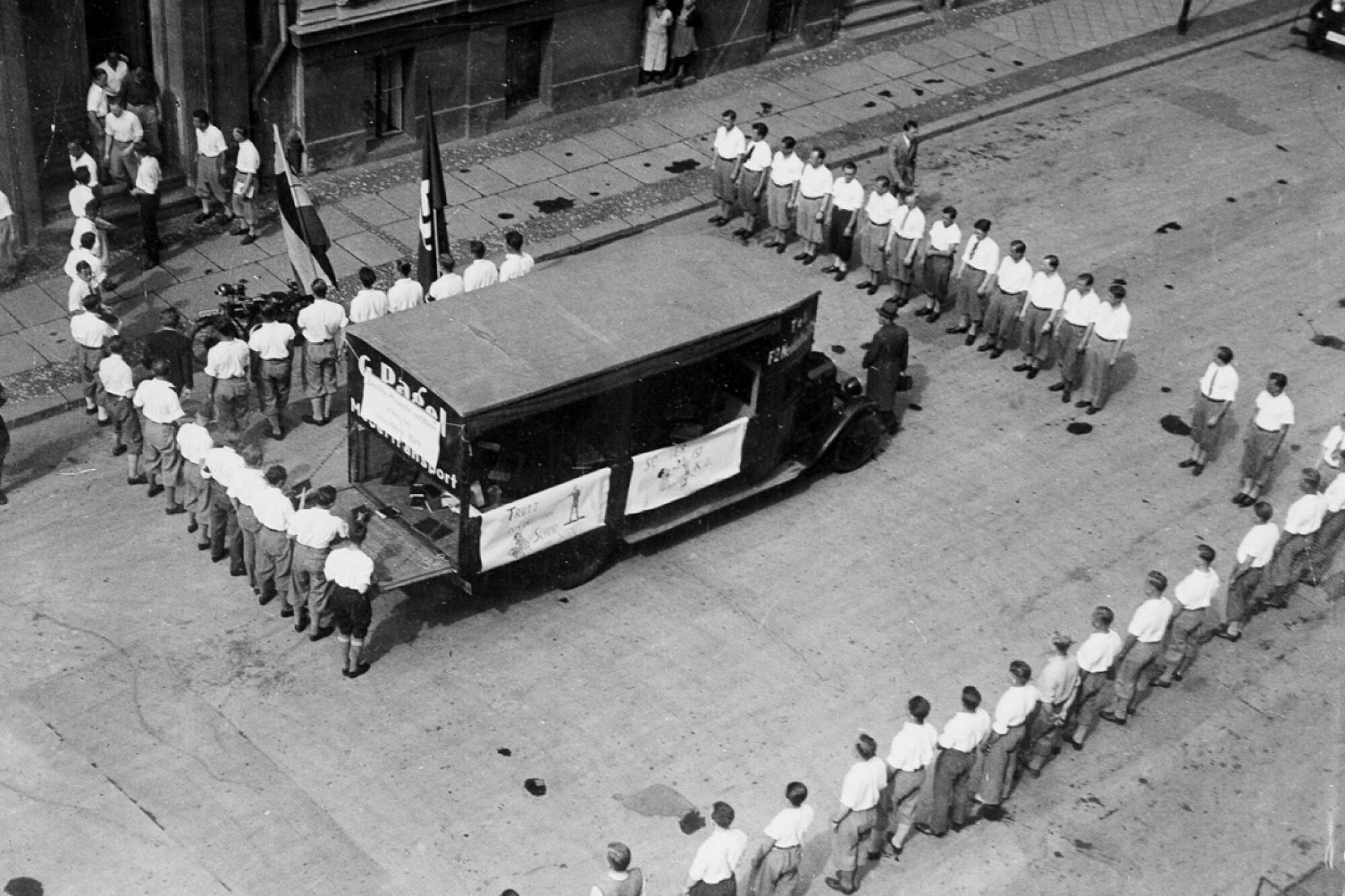
Nazis staged massive public book burnings in Germany in 1933.
(Associated Press)
As the newsreel played, I explained that the books going into that particular fire were not by Jewish authors; rather, they were burning the 20,000-volume library of a nearby gender clinic, the Institute for Sexual Research, founded by Dr. Magnus Hirschfeld. The library contained the best of what was known in medical and social science pertaining to sex and gender, along with testimonials — memoirs — of LGBTQ people. I wanted people to see the parallels between today and Nazi Germany, where the government was defining many minorities as “un-German” and weaponizing “traditional values.”
When Propaganda Minister Joseph Goebbels appears, addressing the crowd in that Berlin square, I pointed out something else: While the book burnings were organized by “grassroots” student groups, the Nazi government was fully looped in. It’s not hard to connect the dots to today when I show them the lineup of MAGA elected officials at the Moms for Liberty convention in Philadelphia, or the video clip of them cheering for Hitler — and I never got any pushback.
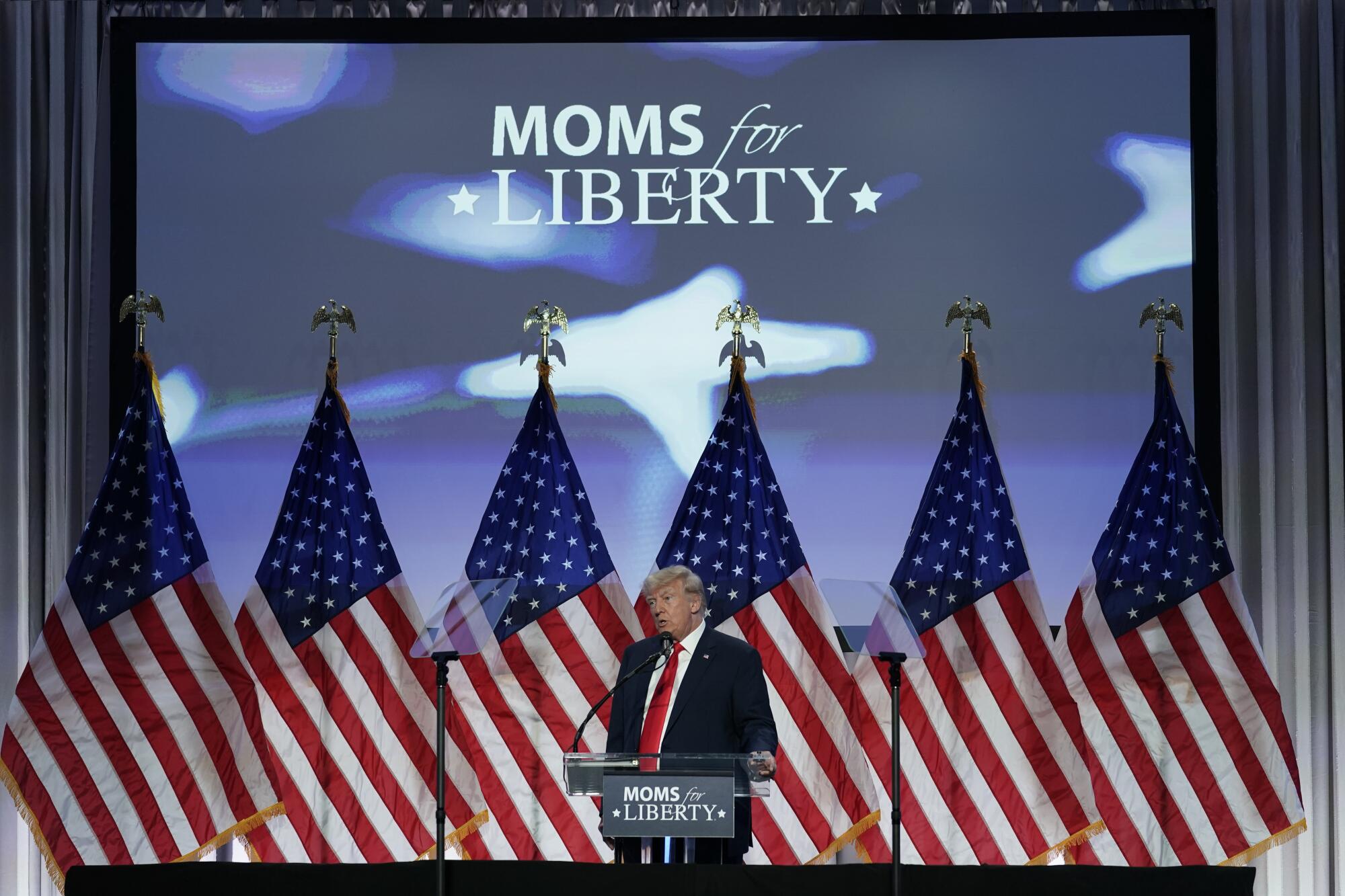
Former President Donald Trump speaks at the Moms for Liberty meeting in Philadelphia in June 2023.
(Matt Rourke / Associated Press)
:::
The crowd for my talk at the Pella Public Library was buzzing in a way I’d never experienced. I introduced my book, and read a passage about the Fabric Factory bar in Times Square and the gender-nonconforming people who gathered there in the late 1980s — “people we were 20 years away from having any respectable words for.” I read a scene from 1977, when I watched Howard Cosell interview Renée Richards on ABC’s “Wide World of Sports,” after she’d won the right to compete in the women’s division of the U.S. Open as a “transsexual.” I was 14 and had never heard that word, or thought such a person could exist, even though I was such a person and somehow knew it.
People were listening; no one was interrupting.
I closed my book and turned to the subject of book bans. I had three points to make: 1) The groups leading the book bans don’t give a damn about protecting children; if they did they’d be talking about assault weapons and smartphones; 2) The groups are highly organized and politically connected; and 3) Their goal, like in Nazi Germany, is to “synchronize culture” with white supremacy.
A man asked why we’re pretending that trans people are something new, when they’ve always existed. I said he had a great point and asked if he knew about the “trans panic” murder defense, a legal tactic now banned in 19 states. For decades, criminal defense attorneys argued that when a man discovers someone he’s attracted to is trans, it can induce panic and cause him to murder one of us.
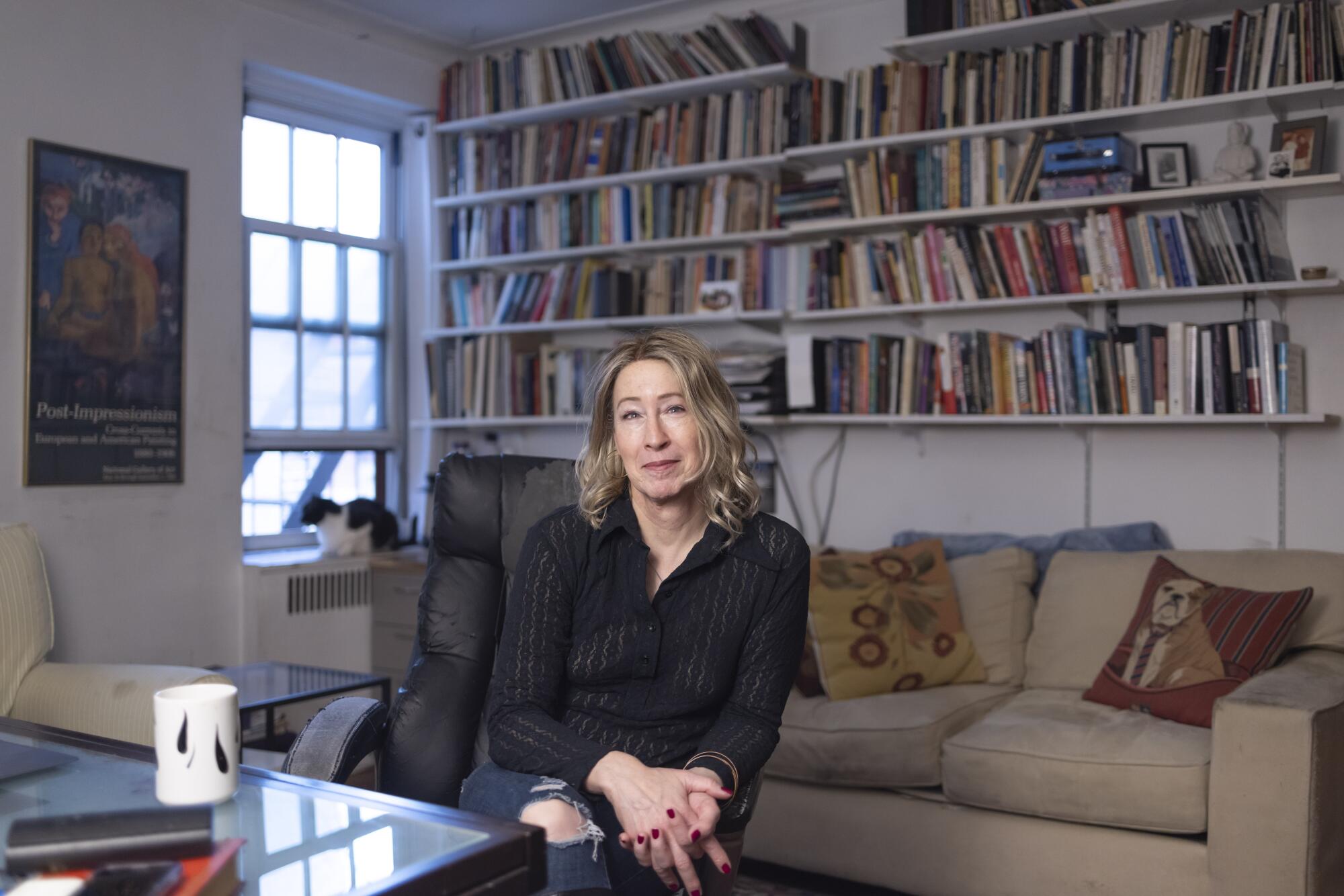
When Diana Goetsch was asked what advice she would give to librarians, she replied: “Advice? I don’t know. They know their situations better than I do. I would just tell them they’re heroes.”
(Andrew Kelly / For The Times)
“Politically,” I said, “MAGA Republicans are trying to induce national trans panic.” They are taking advantage of widespread ignorance about trans people. They want the public voting for candidates who promise to prevent us from transitioning or being seen. This is why they panic when someone trans is accepted and normalized, such as Jeopardy! champion Amy Schneider, who had grandmas across America rooting for her. They don’t want books dispelling ignorance about us in libraries, and they especially don’t want trans children to assimilate and grow up in their gender.
Someone asked what would help librarians. “This,” I said, indicating the roomful of people who showed up to defend the freedom to read.
“Having traveled around, what advice would you give to librarians?”
“Advice? I don’t know. They know their situations better than I do. I would just tell them they’re heroes.”
Afterward Mara Strickler and I shared a hug. The gift she had for me was an assortment of fruit-tinged local beers. I poured a can for myself when I got back to my motel room — 30 miles away in Colfax, Iowa.
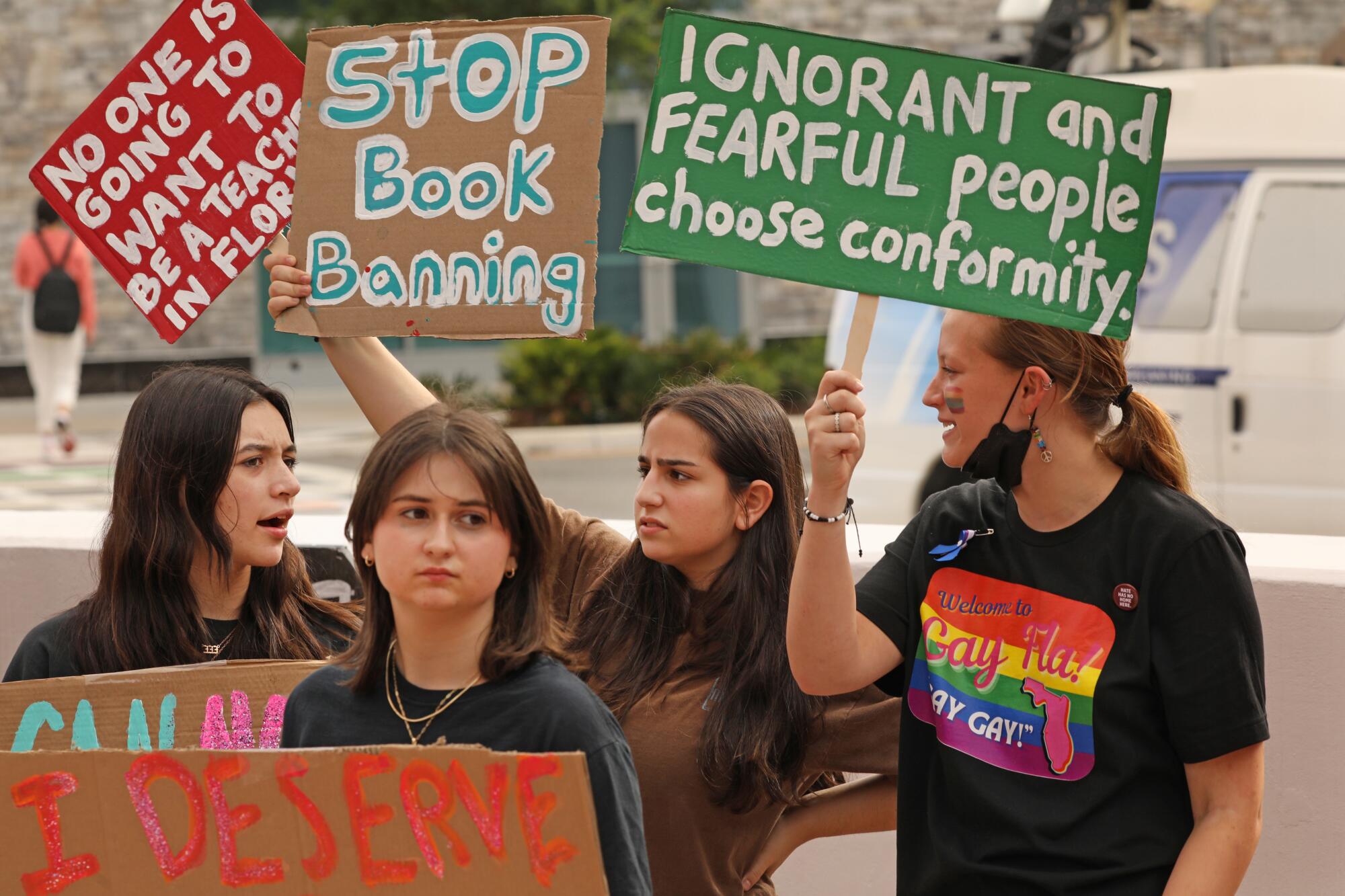
People at an Orange County school board meeting in Orlando, Fla., on April 11, 2023, protest the move by the school boards and the Florida legislature to remove books from school library shelves and limit education on race and LGBTQ issues.
(Carolyn Cole / Los Angeles Times)
:::
The goal of My Red-State Library Tour was to defend an institution I loved and to send the message that the book bans are a fascist-style campaign of cultural erasure, which our media has failed to grasp. I don’t know if I succeeded, though I would love for there to be copycats — other authors who travel to libraries to speak, repaying the favors they do for us.
But maybe the main thing I accomplished was simpler than any of that. On election night in 2016, when Florida was called for Donald Trump, I felt, instantly, my country get narrower. I would watch a growing number of trans refugees flee red states, give up their homes and often their jobs, to protect themselves or their kids. My tour was an affirmation, to myself as much as anyone else, that my body belongs in every state of this country. All of ours do, and our books belong in libraries.
Last year on election day, Moms for Liberty candidates were “annihilated” by members of actual parents’ rights groups. My eyes, however, were fixed on a town in southern Iowa and “Resolution No. 6442” — a measure to allow political officials to control the library in Pella, which went for Trump by 68% in 2020. That resolution was voted down, and a great institution remains independent. The vote was close: 51% to 49%, a difference of 87 people. I’d like to think some of those 87 were in the room when I spoke there.

Politics
Tulsi Gabbard’s brother charged after allegedly trying to lure children to Waikīkī hotel room: police

Tulsi Gabbard releases documents on Fauci, alleged COVID cover-up
Fox News senior medical analyst Dr. Marc Siegel joins ‘America Reports’ after outgoing DNI Tulsi Gabbard released documents raising questions about Dr. Anthony Fauci’s role in funding COVID-19 origins experiments in Wuhan, China. Intelligence officials weighed lab leak theory early on.
NEWYou can now listen to Fox News articles!
The older brother of former Director of National Intelligence Tulsi Gabbard has been charged after Honolulu police say he allegedly tried to lure several children to his Waikīkī hotel room by offering them gum and money, as his family says he is continuing to receive psychiatric treatment.
Batarti Gabbard, 55, was charged with second-degree custodial interference after the July 12 “stranger danger” incident at a Waikīkī hotel pool, according to police.
Honolulu police allege Gabbard approached several children, including a 9-year-old boy, asked for their names, wrote them in a notebook and offered them money and gum if they would accompany him to his hotel room.
EXCLUSIVE: TULSI GABBARD RESIGNS FROM TRUMP CABINET
People on Waikīkī Beach in Honolulu, Hawaii. (Eugene Tanner/AFP, File)
Fox News Digital obtained new comment from Gabbard’s father, Hawaii state Sen. Mike Gabbard, who declined to discuss the allegations, but confirmed his son continues to receive medical and psychiatric treatment.
“We love him, and asked him to follow the protocol at the hospital, which he says he will do,” Mike Gabbard told Fox News Digital. “We’re praying for his speedy recovery, and would appreciate the prayers of others.”
Fox News Digital also reached out to Tulsi Gabbard through her public office and left a voicemail requesting comment.
She did not immediately respond.
GABBARD CLAIMS ‘COORDINATED EFFORT’ BY INTELLIGENCE COMMUNITY TO ADVANCE NARRATIVE TO IMPEACH TRUMP
Former Director of National Intelligence Tulsi Gabbard’s older brother, Batarti, is facing charges in Hawaii. (Win McNamee/Getty Images, File)
Police said the incident occurred around 2 p.m. on July 12 at the pool area of an unnamed Waikīkī hotel, where Batarti Gabbard allegedly approached several children.
According to police, the children refused and Gabbard walked away.
A 42-year-old woman reported the incident to police.
MIKE WALTZ, TIM TEBOW LAUNCH EFFORT TO COMBAT ONLINE CHILD EXPLOITATION: ‘IT’S HAPPENING IN THEIR BACKYARD’
The skyline in Honolulu along Waikīkī Beach on Hawaii’s island of Oahu. (Carol M. Highsmith/Buyenlarge/Getty Images)
According to KITV, Gabbard had also been arrested July 16 on charges of theft.
He pleaded not guilty to the theft charge Friday morning, was released and is scheduled to appear in court Aug. 14 in that case.
CLICK HERE TO DOWNLOAD THE FOX NEWS APP
KITV reported that no court date has yet been set on the custodial interference charge.
Honolulu Police confirmed to Fox News Digital that Gabbard is no longer in custody.

Thirty years ago this fall, a Republican politician cried electoral fraud after losing a close race.
Orange County Rep. Bob Dornan couldn’t accept the most logical explanations for why Loretta Sanchez beat him in a historic upset: that voters had tired of his polarizing politics. That his Latino-majority district wanted one of their own to represent them. That he was an ideologue who never brought anything back from D.C. for his constituents.
Instead, Dornan and his supporters settled on the craziest excuse of them all: Illegal immigrants.
California voters were passing anti-immigrant laws by the boatful, so Dornan’s fevered tales about nonprofits registering noncitizens to vote and take him down landed with Republicans. A compliant Congress investigated Dornan’s claims, while local lawmakers proposed bills that would force voters to show government-issued identification every time they cast a ballot — a voter suppression tactic going back to the segregationist South.
The congressional investigation flopped like a soccer player fishing to draw a red card, finally concluding in 1998. Yes, noncitizens did vote for Sanchez, but only an infinitesimal number — less than 1% of the total votes tallied and not enough to overturn the results. No one was charged for illegally voting on purpose or improperly registering noncitizens to vote.
When Dornan ran again in 1998, with volunteers vowing to pursue any election irregularities, Sanchez walloped him, and he was swept into the dustbin of political history.
I teach this episode in my O.C. history college classes as a case study in what happens when political parties succumb to the spell of a vindictive demagogue who blames everyone for their failures except themselves. I also point out that Dornan had the last laugh: the idea that illegal immigrants regularly vote in elections, throwing them toward Democrats, has become gospel for many Republicans.
And here we are.
Republican U.S. Congressional candidate Bob Dornan speaks to a group of young adults at the Orange County Conservation Corps. in Anaheim, California in 1998. He was seeking to regain his old seat from Democratic incumbent Loretta Sanchez, who beat him in a historic 1996 upset.
(John Hayes/Associated Press)
On Thursday, President Trump’s obsession over losing to Joe Biden in 2020 reached a phlegmatic nadir with a speech on debunked election fraud theories that weaved in everything from communist China to deposed Venezuelan leader Nicolás Maduro to — who else? — alleged noncitizen voters.
The tirade was so pathetic and noneventful that most networks didn’t bother to air it. Even Fox News host Sean Hannity — whose tongue is probably two parts shoe polish after spending the last decade as Trump’s personal spit shine — moved on just minutes after Trump finished.
The president insisted that the U.S. Senate pass a bill ahead of this November’s midterms, mandating in the name of election integrity that voters show proof of citizenship before casting a ballot.
In California, a clown car of MAGA loyalists — state Assemblymember Carl DeMaio, state Sen. Tony Strickland, wannabe Southern California U.S. Atty. Bill Essayli — are pushing something similar. Proposition 39 would require California election officials to verify the citizenship of registered voters and require voters to show government-issued identification when they cast a ballot.
By law, voters in federal elections must be U.S. citizens. Only a handful of municipalities allow noncitizens to vote in local elections. Despite Trump’s trumpeting of supposed evidence that 278,000 noncitizens are registered to vote in California, Pennsylvania, New Jersey and Nevada, actual instances of them casting a ballot are as rare today as in Dornan’s time.
That hasn’t stopped Trump and his lackeys from claiming, as Dornan and his supporters did, that they are trying to restore faith in a system corrupted by liberals and their undocumented puppets. But, just like back then, this amounts to a dog whistle for people freaked out about changing demographics and massive GOP midterm losses.
It’s the last, most dangerous gasp of a wheezing political movement whose supporters are clinging to power at all costs and just can’t understand why more and more voters are tired of Trump’s flailing foreign policy and failing economy.
These people are so delusional that they point to last month’s California primaries as proof of election fraud, arguing that the results in two prominent races should have been different.
No Republican has won a statewide election in 20 years, so it’s not surprising that Republican Steve Hilton finished second to Democrat Xavier Becerra in the gubernatorial primary, with both advancing to the general election. Nor was it a shock that in the primary for Los Angeles mayor, progressive incumbent Karen Bass and democratic socialist City Councilmember Nithya Raman finished first and second over Republican reality television star Spencer Pratt.
That didn’t stop Trump from insisting that both Republicans should have won outright and crying conspiracy when they didn’t. The president continued his laughable tune in his White House speech.
“Took a month to count the votes,” he whined about California’s sloth-like approach to counting ballots. “I wonder what they were doing. This is worse than any Third World country. There’s no Third World country that has elections like we have.”
Actually, many Third World countries elect despots like Trump — but that’s neither here nor there.
A May poll by the Public Policy Institute of California found that Proposition 39 was in a statistical dead heat, with 49% of voters favoring it and 51% opposed. All Prop. 39’s opponents have to do is cite Trump’s stark-raving mad comments about electoral fraud, and support for the ballot initiative will melt faster than the Sierra snowpack.
The Republican crusade against imaginary noncitizen voters may pay off in the short run but will inevitably, spectacularly backfire.
Look at what happened in my native Orange County. Sanchez’s victory was the first ripple in a blue wave that eventually turned O.C. purple. Our once-mighty GOP is now increasingly isolated to wealthier pockets of the county and no longer commands national attention — hell, they couldn’t even deliver O.C. to Trump in any of his elections.
The crazy thing is, when Republicans put in the work to appeal to immigrant and Latino voters instead of obsessing about how they’re supposedly anti-democracy invaders, it pays off. Just look at 2024, when a record number of Latino GOP legislators won seats in California and Trump won a larger share of the national Latino electorate than any Republican presidential candidate ever had.
That happened because the party largely stayed quiet on noncitizen voting and focused on what swing voters wanted to hear: a promise to clamp down on unchecked migration and too much wokeness, while fattening average Americans’ pocketbooks.
Trump’s success with Latino voters seemed to represent a tectonic shift in American politics. Now, it feels like an aberration.
Trump still doesn’t seem to get how desperate the situation is for Republicans, just four months before election day, and how much of it is of his own making.
Near the end of his speech, he sputtered, “The only reason you wouldn’t do [mandated voter ID] is you want to cheat because your policies are so bad, and your candidates are so pathetic that you can’t get away or can’t get elected any other way.”
Paging Bob Dornan …

The Maine Democratic Party unveiled its plan to replace Graham Platner, the Senate nominee who withdrew from his race after a woman accused him of sexual assault. The replacement process is scheduled to happen at a remarkably fast pace — within just three weeks of Mr. Platner’s withdrawal.
If all goes to plan, the eventual Democratic nominee will have just under 100 days to campaign against Senator Susan Collins, the Republican incumbent, in what is expected to be one of the most competitive Senate races of the midterms.
Replacing a Senate candidate is rare, and procedures vary by state and by timing. Here is how the Maine Democratic Party plans to pick Mr. Platner’s replacement.
July 15: Candidacy deadline
Twelve Democrats have declared themselves candidates. Nine who had submitted their intent to run by Tuesday were invited to a debate hosted by News Center Maine on Thursday.
At the debate, the candidates tried to embrace Mr. Platner’s grass-roots energy while not condoning his behavior, and they assailed Ms. Collins for siding with President Trump on various issues. They also spent much of the debate denouncing the presence of Immigration and Customs Enforcement agents in Maine, in light of the fatal shooting in Biddeford on Monday.
July 18-19: County meetings
Each of Maine’s 16 counties will host a meeting this weekend, either in person or virtually, to select a total of 500 delegates to attend the state convention on July 25. The delegates will not be pledged to a particular candidate, but many delegate candidates have made their preferences known.
Thousands of Mainers have registered as a candidate to be one of the delegates or as a participant in these meetings.
Each county will select an allotted number of delegates based on the number of Democratic votes in the 2024 presidential election in that county. Cumberland County, which includes Portland, the most populous city in Maine, will elect the most delegates.
The Maine Democratic Party will send another 101 delegates from its state committee.
Cumberland County: 149 delegates
Democratic State Committee: 101
July 20: Signature deadline
Senate candidates must gather at least 500 signatures. They need to have at least 50 signatures from at least eight different counties.
July 23: Debate
Two days before the state convention, CNN and The Bangor Daily News will host a two-hour debate. There will be a live audience that will include some county delegates.
July 25: State convention
Delegates will gather at the convention in Bangor to vote for the nominee to replace Mr. Platner.
Voting will happen in rounds until one candidate reaches a majority. Here’s how that voting process could work.
The Maine Democratic Party must submit the nominee’s name to Shenna Bellows, Maine’s secretary of state, by July 27. Ms. Bellows is also one of the candidates to replace Mr. Platner.
-

 California3 minutes ago
America’s Top Architects: An Off-Grid California Retreat By Anacapa Architecture
-

 Colorado9 minutes ago
‘Big Boy’ train returns to Colorado in late July. Where to see it
-
Connecticut15 minutes ago
Where to watch Connecticut Sun vs Phoenix Mercury on July 19: TV channel, start time and streaming
-

 Delaware21 minutes ago
New Castle County sees lower home prices, fewer sales
-
 Florida27 minutes ago
Florida’s jobless rate drops for the first time since 2024
-

 Georgia33 minutes ago
Georgia Bulldogs News: Big time commitment, injury rumor, Stetson Bennett disrespect
-

 Hawaii39 minutes ago
Hilo Orchid Show returns – Hawaii Tribune-Herald
-

 Idaho45 minutes ago
OPINION: Repudiating Idaho’s voters is tempting fate

