Politics
Why Biden is getting little credit for the economy, especially in California


As President Biden struggles to sell Bidenomics to skeptical voters, he’s facing the all-too-real consequences of stubbornly higher inflation, but he’s also battling human psychology.
And both of those factors may be especially strong in California.
Most economists agree that the American economy during Biden’s presidency has made a remarkable recovery from the pandemic. And it continues to outperform expectations, even if California isn’t doing quite as well. But polls have consistently shown that the public by and large holds a negative view of the economy and, by extension, Biden’s handling of it.
While partisan politics, pandemic hangover and other factors have colored people’s attitudes, experts say inflation appears to be the single biggest economic albatross for Biden.
He entered office with an approval rating of 57%, but in Gallup’s latest poll in March that number was 40%, with his handling of the economy perceived as one of his biggest weaknesses.
This even though the rate of inflation has come down significantly from earlier highs and the incomes of Americans, on average, have risen to equal or often exceed the higher costs for most goods and services.
On Wednesday the government reported that inflation, as measured by U.S. consumer prices, edged up in March to 3.5% from a year ago. It was a little higher than expected, driven partly by bigger price increases for transportation, electricity and medical services. Food inflation was subdued, but shelter and energy prices are still running a bit too hot
Although the rate of inflation has declined since hitting a 40-year high of 9.1% in June 2022, it’s still well above the Federal Reserve’s 2% target, which could delay a much hoped-for cut in interest rates.
What’s more, experts say the slowdown in inflation isn’t what most people notice. Nor do they seem as relieved by the seemingly encouraging decline in inflation from 2022 as professional economists are. After all, it’s not that prices have fallen dramatically; they’re just not rising as fast as before.
That’s where basic elements of human nature come in, some economists and other analysts say: Consumers instinctively pay more attention to the dollars they have to shell out than they do to the increases in their paychecks.
That’s especially true when the purchases are for everyday items such as gasoline, for which prices in California are higher than elsewhere in the United States.
Today, U.S. consumers are paying 20% more for milk, about 30% more for bread and more than 50% more for eggs than they were in February 2020, just before the COVID-19 pandemic began, according to the U.S. Bureau of Labor Statistics report Wednesday.
Rents are up more than 20% from pre-pandemic levels and electricity costs about 30% more.
For Californians, even with wage gains matching or exceeding consumer price increases, higher inflation may have an even stronger real and psychological impact because the state is so much more expensive to begin with.
“They worry whether inflation is coming back,” said Mark Baldassare, the statewide survey director at the Public Policy Institute of California. “It creates a new set of circumstances and anxiety in California, where housing and the cost of living is a major concern, especially for lower-income but also middle-income and younger Californians.”
In a statewide survey he conducted last fall, Baldassare found that a growing percentage of Californians were “not too happy” (26% compared with 20% in 2011 and 13% in 1998). And among the groups who are the least happy: 18-to-34-year-olds; renters; and those with household incomes of $40,000 or less.
Nationwide, prices for all goods and services have jumped about 20% over the last four years. And it’s been an especially startling jolt to many consumers because the vast majority of them had never experienced anything like it in their adult lives.
The last time inflation was at or near double-digits was in the early 1980s, and for most of the last 30 years it’s been close to the Federal Reserve’s 2% target.
“Part of the story is not just that we’ve had high inflation, but we’ve had high inflation with a generation that’s ill-equipped to deal with it,” said Justin Wolfers, professor of public policy and economics at the University of Michigan. “Young people today might think prices have risen by 20% and no one’s ever going to make me whole.”
But, in fact, Wolfers noted, gains in wages and salaries, on average, have actually outpaced inflation since the pandemic, with lower-income workers seeing the highest percentage gains.
Older people who went through substantial inflation before may have learned that it usually turns out to be a temporary problem: For at least the last half-century, when the cost of living has risen sharply, so have workers’ incomes, though not immediately.
Older generations understand the dynamic: “Inflation takes away with higher prices and then it gives back with higher wages,” Wolfers said.
In California, workers on average earned $1,595 a week in the third quarter of 2023, the latest available data from BLS. That’s 23% higher than the same quarter in 2019.
And it’s about five percentage points higher than the increase in prices over a similar period in California, based on data from the state’s Department of Finance.
But even though average paychecks have now matched or exceeded price increases — meaning most consumers’ purchasing power has not been eroded, Wolfers and other economists say — that’s not the way people process things.
When prices go up sharply, people get upset, thinking it unfair and unjust, and looking at the government or someone else to blame. But if their wages go up by just as much, people tend to “externalize” the increase, feeling they earned it, although in reality the bigger paycheck is largely the result of higher prices — and the resulting ability of employers to pay their employees more.
That psychology presents a big challenge for Biden, since it takes time for consumers to get over what they’ve internalized about high inflation. And although California will probably not be in play in November’s presidential balloting, the downcast mood of many residents due to inflation may only be magnified because the state’s economy has been lagging behind the nation.
Between February 2020 and February 2024, California’s payroll jobs have increased by 1.7%, half of the national job growth rate. The unemployment rate in California in February was 5.3%, compared with 3.9% for the U.S as a whole, although the state Finance Department’s chief economist, Somjita Mitra, said California’s share of long-term unemployed is comparatively much smaller.
The latest survey of consumer confidence by the Conference Board shows California significantly trailing other big states such as Florida, Texas, and New York.
And there are fresh signs that more California consumers are struggling financially. The share of credit card delinquencies, for example, rose in December to the highest level since late 2009 around the time of the Great Recession, according to the California Policy Lab at UC Berkeley.
“In California, the credit trends are deteriorating; they’re not headed in a good direction,” said its executive director, Evan White.
Household surveys by the Census Bureau, most recently in February and March, found that Californians are struggling more with housing finances and paying for usual living expenses than the national average. And a significantly larger share of Californians than most other states reported to the census that they had changed their driving behavior due to the cost of gas.
Gasoline prices in both the U.S. and California are up about 29% from February 2020, according to the U.S. Energy Information Administration. But the average price for a gallon of gas in California was $4.83 last month, compared with the national average of $3.45.
Gas prices have been rising again in recent weeks, and if that continues it could be another big impediment for Biden, said Mark Zandi, chief economist at Moody’s Analytics.
The other key economic factor that Zandi thinks could sway some voters is whether interest rates come down.
For homeowners, higher inflation has meant higher home prices too. But renters, particularly those in their prime home-buying years, in their 30s and 40s, have felt locked out of the market due to high inflation and mortgage rates — particularly in pricey California.
“That really undermines their thinking about the economy and their own financial health,” Zandi said.

Politics
Commentary: On Skid Row, it’s been decades of frustration. Will the next mayor have a plan?
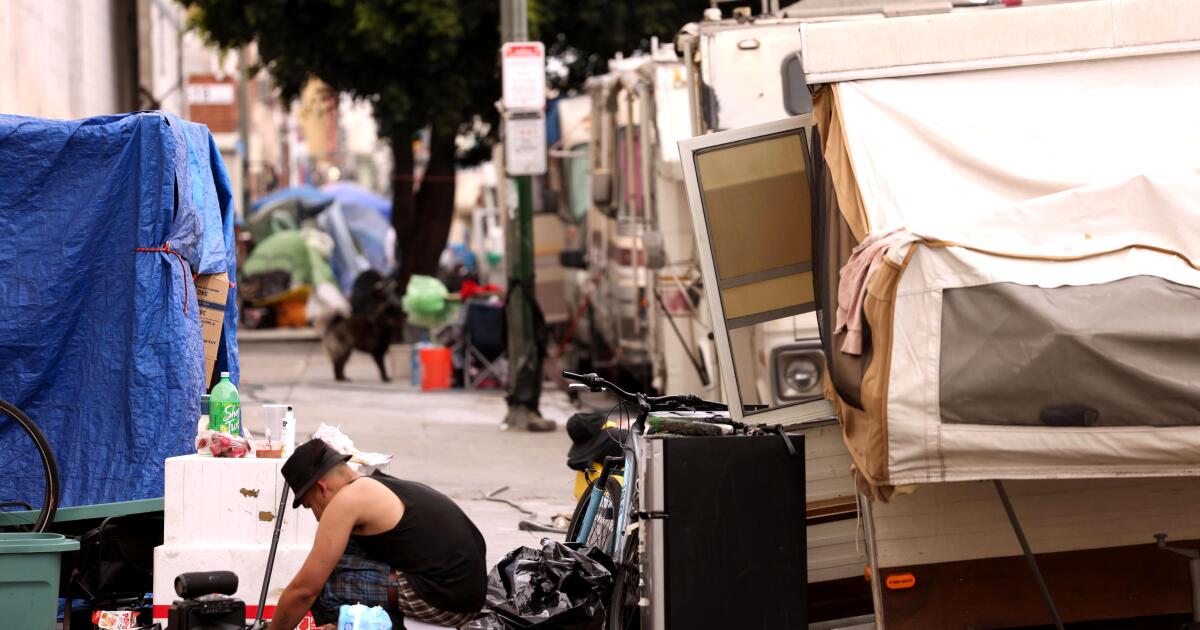
On my way through Skid Row to meet up with Estela Lopez, things looked pretty much as they did when I spent time there more than 20 years ago and first heard the promises that things would be better soon.
Tents lined some of the sidewalks, making them unpassable. Some people wore the damage of physical or mental disease, addiction, poverty, or all of the above. Outreach workers with ID lanyards strode through the trash-strewn landscape like lifeguards working against endless tides of fresh emergencies.
When I arrived at Lopez’s office in the 700 block of Crocker Street, where she runs a business improvement district on behalf of 600 or so beleaguered merchants, she had just completed a tour of the neighborhood with John McKinney, a candidate for city attorney.
She held a note card in her hand and shared some numbers, telling McKinney that by her latest count, 131 of the 702 streetlights in the district were out, 27 children were living on Skid Row, and 72 RVs were parked in the area.
“I came out here because I think this symbolizes the greatest failure in government,” McKinney said. “I think it’s the result of bad law and bad policy. I think it’s the result of a lack of leadership and indifference to the way people are living out here. To me, it’s completely untenable.”
But will anything ever change?
It’s a question two people in particular need to address, and I’ll get to that in a minute.
A lot of people I trust and admire work tirelessly to make a difference on Skid Row, and they’re always eager to share the success stories of those who move through and move on. (I’ve got a column on that coming up soon.)
The long-standing problem is that Skid Row is both a social service center and a mecca of drugs and other vices, with traps on every block. And so it’s a neighborhood at war with itself, with some viewing Skid Row as one of the largest recovery centers in the country while others see a snapshot of social collapse.
Estela Lopez has reached out to me several times over the years. About illegal dumping. Typhus. Calls to City Hall that don’t get answered. About the relentless plague of fires, overdoses and assaults.
“Can you imagine, in 24 years, how many people I’ve seen dead on these streets?” Lopez asked me near her office last week.
Estela Lopez runs a business improvement district on behalf of 600 or so beleaguered merchants.
(Genaro Molina / Los Angeles Times)
When the local post office closed recently in part because of security issues, Lopez told The Times’ Melissa Gomez that “we have reached a point in this city where we are unable to address criminal activity. … It’s surrender.”
We walked to the corner of 8th Street, where paramedics had just pulled away from a medical emergency. Cars and pedestrians stopped at tents for brief transactions, leaving little doubt as to the nature of the business being conducted.
We passed a caged dog and saw a puppy on a short leash being loaded into a vehicle. There’s a lot of talk about dogs being bred and sold, and Lopez said she’s seen evidence of animals being mistreated.
On 7th Street we passed the charred residue of a recent fire. A half block east, four men were slumped on the sidewalk, hitting pipes. Lopez gets calls from exasperated merchants dealing with vandalism and with people blocking their storefronts.
“I’ve never seen so many people overdose right here,” said Sergio Moreno, who runs a check-cashing business and said his family has been in business going back to the ‘70s. He said he’s seen paramedics use naloxone to revive opioid users, only to see the same people go down again just days later.
“How can you run a business?” asked Moreno, who chairs the board of the business improvement district Lopez runs. “This business is our life. This is how we got through school, this is how we put our kids through school.”
And yet despite paying city taxes and BID fees, Moreno said, problems persist and his customers fear for their safety.
Dr. Susan Partovi, a street medic for 22 years, has been advocating for more proactive intervention for those in obvious distress. Partovi told me she recently saw a man rise from a gutter, pull down his pants and defecate in front of her. She called to get help for him but said neither paramedics nor police determined him to be gravely disabled.

Lopez walks past residents of Skid Row last week. By her latest count, 131 of the 702 streetlights in the district were out, 27 children were living on Skid Row, and 72 RVs were parked in the area.
(Genaro Molina / Los Angeles Times)
“We have become complacent with having people lying in the gutter, having diarrhea, speaking nonsensically and putting their lives at risk,” said Partovi, whom I once accompanied as she administered long-acting anti-psychotic injections, arguing that people need clear heads to make better choices.
One sore point for Lopez is the Skid Row Care Campus in the 400 block of Crocker Street, which opened a little more than a year ago and offers all sorts of social services, meds that reduce drug cravings, and supplies that allow for safe use of drugs.
Lopez said she understands the theory of harm reduction: Engage people with a goal of getting them into treatment and back on track. But she wonders how successful such programs are, and argues that they become magnets for lawlessness.
As we talked, a young man approached and told Lopez he’d seen her airing her grievances on TV news.
“I’m wondering, what would be your solution?” he asked.
“I would hope that people could return to life in sobriety,” Lopez responded.
The man said he is “trying to elevate” himself, but that he’d been on a waiting list for housing for six months.
Lopez is tired of being on a waiting list, too.
“If something is working down here,” she told me, “you can’t prove it by me.”
Progress is undeniable, said Sieglinde von Deffner, a social worker and Skid Row coordinator for the Los Angeles County Department of Homeless Services and Housing. But given the “highly vulnerable” nature of the population, “the need is colossal,” she said.

A man stands among his belongings along 7th Street in Skid Row in downtown Los Angeles.
(Genaro Molina / Los Angeles Times)
“I have not yet met someone here who doesn’t want housing of some kind. We just don’t have enough affordable housing for everyone,” Von Deffner said, and long-term homelessness makes people harder to reach. “Now, if we could just stop the inflow.”
Dennis Culhane, a University of Pennsylvania professor who researches homelessness and served as an L.A. County consultant, said there are other ways to get people indoors than investing billions of dollars in new housing that takes years to build. Culhane said single adults who are not veterans, including the elderly and disabled, constitute a majority of the homeless population. But assistance is scarce.
“It’s like you have a famine, and you’ve only got food for 15% of the people,” Culhane said.
Rapid rehousing is critical for the newly homeless, he said. But it can take two years for them to qualify for Social Security disability, and once they do, the $1,000 a month “is completely deficient in the face of rising rents.”
Culhane recommends faster approval of SSI benefits and supplementing that income with additional sources of rental assistance. He believes there are enough vacancies at the low end of the housing market to make a sizable dent in homelessness without new construction.

Judy Mauricio, 65, who has been homeless for nine years, rests inside her tent next to her walker. She says her drug addiction has kept her on the street. She receives state disability funds and says she has cancer.
(Genaro Molina / Los Angeles Times)
As campaign season warms up, I’d like to know if Mayor Karen Bass and her challenger, Councilmember Nithya Raman, agree.
The mayor of L.A. is limited by a power split with the City Council, and the county oversees most addiction and mental health services. But Skid Row sits just a few blocks from the seat of city authority, and nobody has more power or responsibility to address the decades-long human catastrophe on Skid Row than the mayor.
Estela Lopez and the merchants deserve better. The people on the street deserve better. Thousands of housed residents deserve better.
Does Bass have a plan other than what’s currently in place? Does Raman have a better one?
If so, I’d like to hear the details, and I’m available.
steve.lopez@latimes.com
Politics
EXCLUSIVE: FBI adds alleged COVID fraudster accused of taking $5M from kids’ meal program to Most Wanted list

FBI makes first arrest from its ‘most wanted fraudsters’ list
FBI Director Kash Patel announces the first arrest on the “Most Wanted Fraudsters” list. Said Ereg, a Minneapolis man, is accused of stealing over $4.2 million from a federal child nutrition program during the COVID-19 pandemic. Minnesota Senate candidate Michele Tafoya emphasizes the need for accountability for fraudulent activities.
NEWYou can now listen to Fox News articles!
EXCLUSIVE: The FBI is adding Fahad Mohamed Nur to its Most Wanted Fraudsters List, accusing the Minnesota businessman of allegedly stealing more than $5 million that was intended to feed children during the COVID-19 pandemic.
Nur has been on the run since 2022 and is wanted for his alleged role in a fraud scheme that exploited Minnesota’s Federal Child Nutrition Program during the COVID-19 pandemic, according to the FBI. The bureau alleges he owned a vendor and purported food supplier that received more than $5 million in fraudulent program funds by submitting fake invoices before laundering the proceeds.
The Bureau believes Nur has ties to Somalia and may currently be living there.
The FBI is offering a reward of up to $150,000 for information leading to Nur’s arrest and conviction.
OWNER OF DAYCARE IN VIRAL NICK SHIRLEY VIDEO CHARGED IN $4.6M DAYCARE FRAUD SCHEME, PROSECUTORS SAY
Fahad Mohamed Nur has been on the run since 2022 and may be in Somalia, according to the FBI. (Federal Bureau of Investigation)
Nur is the latest addition to the FBI’s Most Wanted Fraudsters List, which officials say has already resulted in the arrests of two fugitives within weeks of its launch.
“Under President Trump’s and Vice President Vance’s leadership with the White House Task Force to Eliminate Fraud, the FBI’s historic ‘Most Wanted Fraudsters list’ has already seen tremendous success – with two subjects brought to justice in a matter of weeks, apprehended out of Somalia and the Philippines,” FBI Director Kash Patel said in a statement to Fox News Digital.
Patel said the early arrests demonstrate that the FBI is aggressively pursuing fugitives accused of stealing from American taxpayers.
FBI ADDS 2 FUGITIVES TO ‘MOST WANTED FRAUDSTERS’ LIST AMID HISTORIC $6.5B HEALTHCARE TAKEDOWN: PATEL
FBI Director Kash Patel conducts a news conference at the Department of Justice on Thursday, December 4, 2025. (Tom Williams/CQ-Roll Call, Inc via Getty Images)
“Our newest subject – Fahad Mohamed Nur – has been on the run since 2022 for allegedly stealing over $5 million from a child nutrition program in Minnesota.”
Patel added: “Collectively, the Task Force has already uncovered more than $13 billion in fraud, and the rapid success of the Most Wanted Fraudsters List should show all Americans that this FBI will [be] at the forefront pursuing the worst of the worst who stole from hardworking American taxpayers.”
DR OZ WARNS MEDICARE SCAMMERS ARE STEALING BILLIONS — AND YOUR PERSONAL INFORMATION COULD BE NEXT
Federal agents enter an office building as a search warrant is executed at Ultimate Home Health Services over potential Medicaid fraud, on December 18, 2025 in Bloomington, Minnesota, United States. (Christopher Juhn/Anadolu via Getty Images)
Federal officials say the investigation is part of a broader government effort targeting pandemic-era fraud.
“The Department’s robust partnership with the FBI and the White House Task Force to Eliminate Fraud has already delivered historic results. That partnership grows even stronger today with the addition of this latest subject to the Most Wanted Fraudsters list,” said Acting Attorney General Todd Blanche. “President Trump has made it clear: Fraudsters no longer have a safe haven in America. Law enforcement will continue to use every tool at its disposal to bring those who steal from American taxpayers to justice.”
The White House Task Force to Eliminate Fraud, led by Vice President JD Vance, has already uncovered more than $13 billion in fraud, according to the FBI.
CLICK HERE TO DOWNLOAD THE FOX NEWS APP
Anyone with information about Nur’s whereabouts is urged to contact the FBI at 1-800-CALL-FBI, their local FBI office, the nearest U.S. Embassy or Consulate, or submit a tip online at tips.fbi.gov.

With the 2026-27 season premiere of “60 Minutes” just two months away, CBS News leadership is getting closer to deciding who will fill the recent departures of longtime correspondents Scott Pelley, Sharon Alfonsi, Cecilia Vega and Anderson Cooper.
Seth Doane, a longtime correspondent based in Italy who is often seen on “CBS Sunday Morning,” is under consideration, along with chief investigative correspondent Jim Axelrod, who currently has a lead role in the “Eye On America” series featured on the “CBS Evening News with Tony Dokoupil.”
Sir Trevor Phillips, a British journalist and former politician who recently joined CBS News as senior global affairs correspondent, is expected to have a role on the program, according to people briefed on the plan. Phillips had a long career in the U.K., producing and writing documentaries and most recently hosted the Sky News program “Sunday Morning with Trevor Phillips.”
Phillips received a knighthood in 2022 for his service to equality and human rights for the U.K. But he also generated controversy over his career for comments about the British Muslim community, which led to a yearlong suspension from the Labour Party in 2020.
A CBS News representative declined comment beyond saying the division is looking at a number of internal and external candidates.
Dokoupil is expected to deliver four “60 Minutes” pieces a season. Major Garrett, the network’s chief Washington correspondent, will also have a contributor role.
Matt Gutman, hired from ABC News last year as national correspondent, is under strong consideration. He is being put in front of test audiences, according to several people at the network.
Holly Williams, a foreign correspondent working out of Istanbul for CBS News since 2012, and Mariana van Zeller, a journalist for National Geographic Channel, are both said to remain in contention.
The newcomers will join Bill Whitaker, Leslie Stahl, Jon Wertheim and Norah O’Donnell, who are all returning as correspondents. O’Donnell will also continue in her role as senior correspondent for the network, occasionally anchoring specials.
The rebuild of the talent line-up comes after the upheaval at the program that has occurred since Bari Weiss joined CBS News as edtior in chief in October.
Longtime correspondent Scott Pelley was fired last month after confronting management about the May 28 dismissal of his colleagues Alfonsi and Vega along with the program’s executive producer Tanya Simon and her second-in-command Draggan Mihailovich.
In February, Cooper decided not to sign a new deal as a “60 Minutes” contributor, as the CNN anchor cited a desire to spend more time with his family. But Cooper has reportedly told colleagues that he does not want to work for Weiss.
The internal disruption at “60 Minutes” followed a highly successful season. In its 57th season, “60 Minutes” was the most watched news program on television with an average of 9.1 million viewers a week according to Nielsen data. The program bucked the overall decline in traditional TV viewing by growing 9 percent over the previous season.
After the dismissal of his “60 Minutes” colleagues, Pelley accused Weiss of trying to “murder” the program and claimed she was putting “her thumb on the scale” for more favorable coverage of the Trump administration. He was fired with cause after confronting management at a June 1 meeting.
Weiss came to CBS when parent company Paramount acquired her digital web site The Free Press, known for its criticism of progressive policies and its strong support of Israel.
Weiss was hired by Paramount Chief Executive David Ellison with a mandate to move the news division to the political center. The pronouncement has created the perception that CBS News is looking to placate the Trump administration as Paramount sought regulatory approval for its $111 billion acquisition of Warner Bros. Discovery, which will also give the company ownership of CNN.
The noise surrounding Weiss has hurt CBS News despite strong reporting that is often far from being pro-MAGA. This past weekend’s “CBS Sunday Morning” featured a segment from national security correspondent David Martin about the Department of Defense interfering with the editorial independence of Stars & Stripes, the military newspaper.
Trump complained vehemently about his last interview with O’Donnell on “60 Minutes,” — conducted the day after a gunman tried to enter the White House Correspondents Assn. dinner in Washington on April 25.
-

 Lifestyle2 minutes ago
Urban Jürgensen: Introducing Elite Watchmaking to New Audiences
-
Politics7 minutes ago
Commentary: On Skid Row, it’s been decades of frustration. Will the next mayor have a plan?
-
 Science14 minutes ago
What’s the deal with … coffee enemas?
-
 Sports17 minutes ago
LAPD weighs canceling academy classes to get more cops on streets for Olympics
-

 World29 minutes ago
Trump ordered to pay E Jean Carroll $5.8m after failed appeal
-
 News52 minutes ago
Supreme Court financial disclosures reveal how their books add to their income
-

 Los Angeles, Ca2 hours ago
Waymo video could determine charges after teens’ bizarre California ride
-
Detroit, MI3 hours ago
DPD investigating after human remains found in home on Detroit’s west side


