Politics
One far-right leader ousted. Another barely hangs on. Is Shasta rejecting MAGA politics?

Shasta County voters have booted from office a key figure in the county’s hard-right shift, even as the fate of a second far-right crusader on the powerful Board of Supervisors still hangs in the balance.
Patrick Jones, a former chair of the five-member board, was soundly defeated in the Super Tuesday election, according to results released by the county registrar Friday afternoon. With 98% of the vote counted, Jones’ opponent, Matt Plummer, a nonprofit adviser, was winning outright with nearly 60% of the vote.
It marked a stunning turn for Jones, a gun store manager who in his one term in office has emerged as a leading voice in an ultraconservative insurgence that transformed this largely rural Northern California county into a national poster child for hard-right governance and election denialism.
In recent months, Jones led the conspiracy-laden charge to dump Dominion voting machines and return the county to hand-counting its ballots. He helped push through a county resolution pledging fealty to the 2nd Amendment and a measure to allow concealed weapons in local government buildings, in defiance of state law.
More broadly, he worked with militia members and secessionists on campaign efforts that dramatically reshaped governance in a county long run by mainstream Republicans.
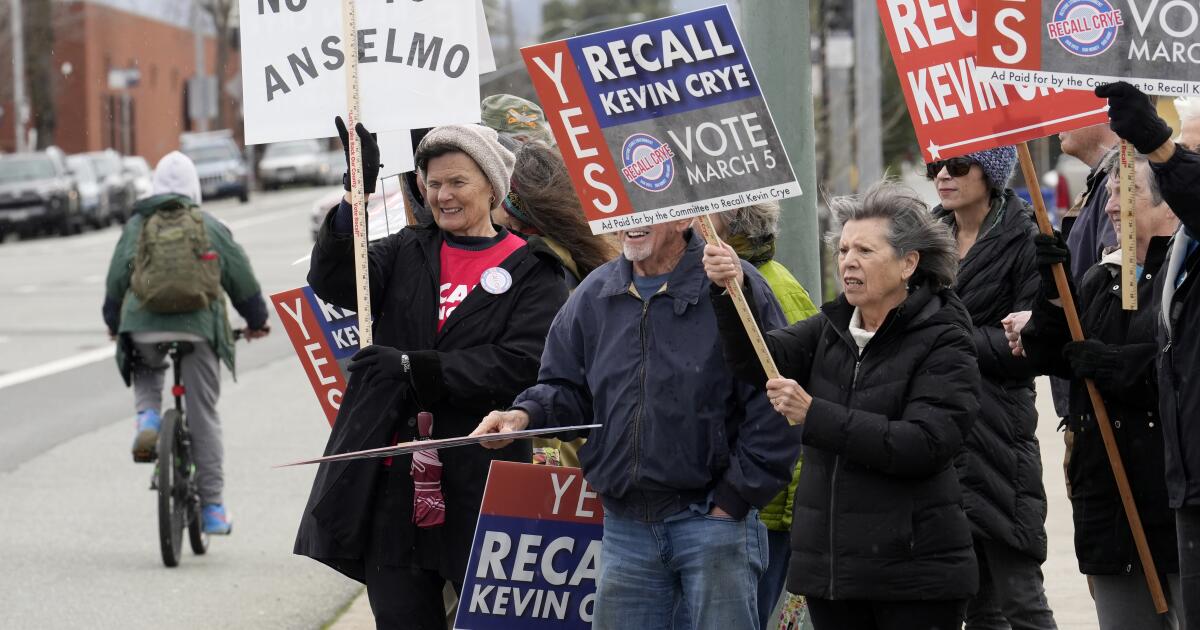
In another closely watched primary race, Jones’ political ally, Supervisor Kevin Crye, was surviving a recall election by just 46 votes. Crye made headlines last year when he enlisted support for nixing Dominion machines from Mike Lindell, the MyPillow chief executive and pro-Trump election denier.
Meanwhile, Allen Long, a retired Redding police lieutenant and relative moderate, was the front-runner in a race to fill an open board seat representing western Shasta County. In a four-way race, Long had 50.3% of the vote on Friday and was narrowly avoiding a runoff.
On the campaign trail, Long said, many voters shared his horror at what they heard coming out of supervisors’ meetings and felt “a desperation for change.” The county government, he said, should focus on issues like homelessness and making local communities safer from wildfires.
“I was watching the politics here in our county, and I thought, ‘Wow, this has really become extreme,’” he said. “I wanted to guide us back to the middle.”
Running a distant second, with 19% of the vote, was Laura Hobbs, who said in her candidate statement she is a stay-at-home mom who is “100% MAGA and America First.” She recently accused incumbent Supervisor Mary Rickert — a moderate Republican who regularly opposes Jones and Crye — of worshiping Satan because her license plate has the number “666” on it.
In her own reelection bid, Rickert led with 40.4% of the vote, but appears to be headed for a runoff against quarry owner Corkey Harmon. Win Carpenter, a prominent far-right voice in the State of Jefferson secessionist movement, was running third.
Taken as a whole, the election results could signal a shift toward the political center in Shasta County — or at least a desire for a local government more focused on day-to-day life and operations.
“The last couple of years have been exhausting. And difficult,” said Jenny O’Connell, a Redding resident who voted in favor of Crye’s recall. “People are saying, ‘I just need this to stop. I need just sanity and normalcy.’”
“Part of the problem of dealing with constant insanity,” she added, “is that after a while you forget how crazy it is.”
Even if Crye survives the recall, Jones’ loss is expected to upend leadership on the board, where ultraconservatives currently have a 3-2 majority.
Shasta County Supervisor Patrick Jones, shown here at his family’s Redding gun store, has helped spearhead a far-right shift in local governance.
(Gary Coronado / Los Angeles Times)
In an interview Friday, Jones took his loss in stride. He has about nine months left in his current term and said the conservative bloc still has time to carry out its agenda.
“I’m real happy,” he said. “We got a lot of stuff done last year. This year, we still have all year to continue with our policies.”
The registrar’s office said 1,208 ballots were still unprocessed, including some that are damaged and others that need further review.
As the votes were being counted, questions swirled about Jones’ connection to a controversial radio ad, aired a week before the election, that claimed a large number of incorrect ballots, including some for dead people, had been mailed to residents. The ad, aired on news station KQMS, provided listeners with a phone number to call if they received voting materials that did not belong to them.
The county administrative office quickly put out a statement saying the ad had not been approved by elections officials or the Board of Supervisors and that the phone number provided was registered to a private citizen.
In a reported story, KQMS said Jones and Bev Gray — Jones’ appointee to a newly created citizens’ elections commission — were responsible for the ad. Jones said Gray wrote the ad but that he took her to the radio station to show her how to record it. The radio station said an invoice showed it was billed to Jones Fort, his family’s Redding gun store.
Jones dismissed concerns about the propriety of the ad, accusing his opponents of “trying to make something out of nothing.”
The Shasta County district attorney’s office said in a statement that the incident had been referred to them for investigation, but offered no details.
Jones told The Times that Dist. Atty. Stephanie Bridgett, “to try to intimidate” him, sent two detectives to the radio station. “Of course, that stuff doesn’t work, and she should know better,” Jones said. “If she has that much time on her hands, we may want to take a look at her budget, come June.”
Jones, a former Redding mayor, was the first hard-right figure elected to the board, as conservative backlash over COVID-19-related lockdowns, masks and vaccines coalesced with rage over President Trump losing the 2020 election. (Shasta County overwhelmingly supported his reelection bid.)
Jones’ introductory meeting was Jan. 5, 2021 — the day before the deadly siege at the U.S. Capitol. Jones showed up to what was supposed to be a virtual meeting, unlocked the supervisor chambers and let an angry crowd into the county building.
Residents poured in, unmasked, and some threatened supervisors over their so-called government tyranny. “When the ballot box is gone, there is only the cartridge box,” one audience member snarled. “You have made bullets expensive. But luckily for you, ropes are reusable.”
In early 2022, ultraconservatives — bankrolled by Reverge Anselmo, a former Hollywood filmmaker who left the county after a land dispute — shocked the state’s political establishment by pushing the successful recall of Supervisor Leonard Moty, a Republican former police chief, in part because he abided by state coronavirus mandates.
Crye, the current board chair, and Supervisor Chris Kelstrom were elected to the board later that year.
Shasta County Supervisor Kevin Crye poses for a photo on the Sundial Bridge in Redding.
(Rich Pedroncelli / AP)
For the local vector control board, the board majority appointed a right-wing political activist who warned of mosquitoes being used as “flying syringes” for mass vaccination. And they named an outspoken critic of COVID-19 vaccine mandates to be the county’s new health officer.
And then there were the voting machines.
Last year, the Board of Supervisors upended the county’s elections process, canceling its contract with Dominion Voting Systems because of unfounded voter fraud claims pushed by Trump. The supervisors opted to pursue hand-counting ballots for the county’s more than 112,000 registered voters, making Shasta the largest government entity in the U.S. to employ hand counts. Voters’ rights organizations were aghast. In October, Gov. Gavin Newsom signed a law — which Jones vowed to challenge — that limited counties from hand-counting votes.
For years, Jones directed his ire at the longtime registrar-recorder, Cathy Darling Allen, the only Democrat elected to countywide office, publicly accusing her of lying about voting machines.
Elections staffers have been harassed, and during a June 2022 election, someone hung a trail camera — the kind hunters use to track wildlife — in the alley behind the registrar’s office. Darling Allen, 55, recently announced that she will retire this spring because she has been diagnosed with heart failure and needs to reduce her stress level.
Jones’ opponent, Plummer, told The Times he had knocked on nearly 9,000 doors while campaigning and that people didn’t want to talk about partisan politics but preferred to discuss issues integral to their daily lives like crime and roads.
“We disassociated politics from those everyday issues, because a lot of politics has become about rhetoric and ideology instead of the core issues,” Plummer said.
Many residents have grown tired of the drama.
John Deaton joins a February demonstration in Redding calling for the recall of Shasta County Supervisor Kevin Crye.
(Rich Pedroncelli / AP)
Last spring, after the Dominion vote, residents in Crye’s district launched a recall — just months after he took office in an election he won by 90 votes. Organizers said they were angered by his decision to upend the voting system, as well as his exploring the idea of hiring a California secessionist leader as the county’s chief executive.
“He hadn’t told us that he was going to do all these things,” said retired public defender Jeff Gorder, a leader of the recall effort. “In our view, he lied about what he was going to do and he started pursuing this extremist agenda.”
Crye did not respond to requests for comment. But he did talk about the recall on his radio show last month, saying the attacks on him have been painful. He called the people behind the recall “flat-out liars.”
Supervisor Kelstrom, a local chamber of commerce director whose 2022 campaign platform included a desire “to bring the ‘punishment’ back to crime and punishment,” remains on the board as an ultraconservative member. He was not up for reelection and could not be reached for comment.



Habitual marijuana users cannot be barred from owning guns, Supreme Court rules
Fox News host Sean Hannity reports the Supreme Court unanimously limits a federal gun law, ruling habitual marijuana users cannot be banned from owning guns. Legal Analyst Gregg Jarrett explains the 9-0 decision, distinguishing between recreational use and serious addiction, contrasting it with Hunter Biden’s crack cocaine and gun charges.
NEWYou can now listen to Fox News articles!
FIRST ON FOX: A powerful House committee is escalating its probe into the Biden administration for alleged collusion with gun control activists.
House Oversight Chairman James Comer, R-Ky., is demanding that the Bureau of Alcohol, Tobacco, Firearms and Explosives (ATF), the federal agency responsible for enforcing gun laws, hand over documents detailing Biden aides’ communications with Everytown for Gun Safety, an influential gun control group founded by billionaire Michael Bloomberg.
Comer’s panel has argued that a now-defunct Biden office may have collaborated with Everytown to help facilitate its lawsuit with the city of Chicago against the gunmaker Glock Inc.
“These records will inform the Committee as to whether the Biden Administration and Everytown colluded to attack private gun manufacturing companies through lawfare to circumvent Second Amendment rights,” Comer wrote in a letter Wednesday to the ATF that was reviewed by Fox News Digital.
Rep. James Comer arrives at the U.S. Capitol in Washington, D.C., on June 10, 2026. (Tom Brenner/Getty Images)
CITY OF CHICAGO SUES GLOCK INC. OVER ‘FACILITATING’ ILLEGAL GUN CONVERSIONS
Chicago’s lawsuit, listing Everytown’s legal arm as the plaintiff’s counsel, was filed in March 2024 and alleges Glock sold pistols that the firearms manufacturer knew could be easily modified to fire like machine guns.
“Glock knows that it takes little effort to convert its pistols into illegal machine guns and that criminals frequently do so,” the lawsuit alleged. “Glock also knows it could fix the problem, but has chosen not to, putting profits over public safety and violating the law.”
In the letter, Comer cited a 2023 meeting between the White House Office of Gun Violence Prevention (WHOGVP) and representatives from Glock, during which Biden officials pressed the gun manufacturer to modify its pistol designs.
When Chicago sued Glock three months later, John Feinblatt, president of Everytown, wrote on X, “Federal officials recently contacted Glock to discuss implementing new ways to modify Glock pistols to make it harder for Glock switches to be installed. Rather than help, Glock has falsely insisted there is nothing they can do.”
Comer argues Feinblatt “appears to have had insider information regarding the WHOGVP’s private meeting with Glock, which raises questions about whether the Biden Administration colluded with Everytown to initiate their lawsuit against Glock,” according to the letter.
The lawsuit is still moving through the court system, with a Cook County judge denying Glock’s motion to dismiss the case in September 2025.
Members of Everytown for Gun Safety rally outside the U.S. Capitol in Washington, D.C., on May 26, 2022. (Chip Somodevilla/Getty Images)
STATES’ TOP COPS GANG UP ON LETITIA JAMES IN CRUSADE WITH POTENTIAL NATIONWIDE CONSEQUENCES
The Kentucky lawmaker has also highlighted close ties between the Biden White House and Everytown. The letter notes that Biden aide Rob Wilcox worked at Everytown for eight years prior to his employment with the WHOGVP.
Biden also headlined Everytown action fund’s annual training conference, known as Gun Sense University, in June 2024, during which he reiterated his support for a nationwide ban on so-called assault weapons.
Wednesday’s letter comes after the GOP-led panel asked the National Archives and Records Administration (NARA) in April for communications between the Biden White House and Everytown.
House Oversight Republicans previously subpoenaed the Biden ATF and Everytown for all communications related to their “potential collaboration efforts,” but neither party complied with the request.
President Joe Biden speaks about gun safety at Everytown’s Gun Sense University at the Washington Hilton in Washington, D.C., on June 11, 2024. (Saul Loeb/AFP)
CLICK HERE TO DOWNLOAD THE FOX NEWS APP
Comer has also argued that the committee’s probe will help lawmakers evaluate whether new legislation is needed to combat officials violating recordkeeping requirements or using their roles to leak private information to politically aligned third parties.
A spokesperson for the ATF did not immediately respond to a request for comment.

The June 16 appearance by Vance gave the program its most-watched episode since November 2024.
The first appearance by Vice President JD Vance on ABC’s “The View” delivered the most-watched edition of the talk show since November 2024.
The June 16 program averaged 3.3 million viewers, according to Nielsen data. The figure was well above the average of 2.6 million viewers for “The View” in the 2025-26 season.
Vance appeared on the liberal-leaning program to promote his new book on his decision to become a Catholic. While the co-hosts mostly questioned him on the Trump administration’s policies on immigration and race, the discussion was cordial.
The panel of co-hosts — Whoopi Goldberg, Joy Behar, Ana Navarro, Sunny Hostin and Alyssa Farah Griffin — did not ask Vance to address the program’s ongoing tension with the Federal Communications Commission.
FCC Chairman Brendan Carr has questioned whether “The View” should have the status of news programs, which are exempt from giving equal time to the opponents of political candidates who appear as guests.
ABC has asked the FCC to rule on the status of “The View,” which received an exemption from the rarely enforced equal time provision in 2002. ABC has maintained that “The View” books politicians based on newsworthiness and not partisanship.
The FCC is currently taking comments from the public on the matter. ABC is running on-air spots urging viewers to support the program.
“‘The View’ has welcomed your favorite guests and covered the issues you care about for nearly 30 years,” the spot says. “Now the FCC wants to control who is allowed to appear on the show.”
The National Republican Senatorial Committee and the National Republican Congressional Committee submitted comments Monday, asserting that “The View” takes advantage of its exemption and favors Democratic candidates and permits “only rare appearances by Republican-aligned figures.”
ABC has told the FCC that “The View” has invited politicians from both sides of the aisle to appear on “The View,” including Health Secretary Robert F. Kennedy Jr., Secretary of State Marco Rubio and entrepreneur Elon Musk. They have declined the invitation as did Vance before his appearance last week.
The letter from the GOP committees also cited the ideological leanings of the co-hosts, saying they are “not selected for their journalistic talent or excellence in commentary, but for their partisan tilt.”
Over the last two decades, “The View” has used five liberal hosts and filled one seat designated for a conservative voice. The right-leaning co-host role has had the most turnover.
“The View” has been the most-watched daytime program for the last nine years. As a live, topical program, it has remained an important media platform while the rest of the talk show genre has largely faded due to diminishing audiences.
Carr’s targeting of “The View” is part of his ongoing criticism of broadcast platforms that annoy President Trump, who has urged that TV station licenses be pulled when he’s been unhappy with coverage.
Politics
Trump to kick off Great American State Fair as 250th anniversary celebrations take over National Mall

Washington DC to host Great American State Fair for America250
Ambassador Monica Crowley discusses the Great American State Fair, set to transform the National Mall in Washington D.C. from June 25 to July 10. Celebrating America’s 250th anniversary, the 16-day event will feature pavilions from all 50 states and six territories, a 110-foot Ferris wheel, traditional games, and rodeo competitions, aiming to unite the country.
NEWYou can now listen to Fox News articles!
President Donald Trump will kick off the Great American State Fair Wednesday evening as part of celebrations surrounding the nation’s 250th anniversary.
“President Trump promised the greatest 250th birthday celebration in American history, and Freedom 250 is proud to help deliver it for the American people,” Freedom 250 CEO Keith Kranch told Fox News Digital.
“This celebration is about what makes America exceptional—our freedom, our faith, our optimism, and our people. We are honored to welcome President Trump as he helps kick off these historic festivities tomorrow and begin a nationwide celebration of our Nation’s 250th birthday,” Krach added.
The fair brings together all 50 states and six U.S. territories for a national celebration stretching from the Capitol to the Washington Monument featuring military flyovers, musical performances and civic programming. Trump announced he will deliver remarks after a handful of musical artists pulled out of their musical performances, turning the bash into a “Make America Great Again Rally.”
TRUMP FLOATS REPLACING 250TH ANNIVERSARY CONCERT WITH MASSIVE MAGA RALLY AFTER ARTISTS PULL OUT
Organizers describe the Great American State Fair as a modern-day World’s Fair celebrating America’s 250th anniversary. (Aaron Schwartz/Bloomberg via Getty Images)
The event is scheduled to run from June 25 through July 10, 2026, celebrating patriotism to bring together the nation for a celebration of unity.
TRUMP’S DC BEAUTIFICATION PUSH WINS RARE DEM PRAISE AS PRESIDENT SNAPS LANDMARKS BACK TO LIFE
U.S. President Donald J. Trump watches the UFC lightweight championship fight during the UFC Freedom 250 event on the South Lawn at the White House on June 14, 2026 in Washington, DC (Jeff Bottari/Zuffa LLC)
Trump’s anticipated remarks follow his signature last week on a Memorandum of Understanding with Iran, launching a 60-day negotiating period aimed at preventing Tehran from ever obtaining nuclear weapons capability.
The world’s fair-scale event will have pavilions touching on five national themes: Made in America, American Heartland, American Innovates, The American Canvas, and Faith & Family.
There will also be a 110-foot Ferris wheel and the refurbished Smithsonian carousel for families to enjoy.
Rending of 110-foot ferris wheel coming to National Mall for “Great American State Fair.” (Freedom250)
The U.S. has hosted over two dozen variations of the world’s fair since first hosted in Philadelphia in 1876, according to the State Department.
CLICK HERE TO DOWNLOAD THE FOX NEWS APP
Freedom250, the nonpartisan group helping coordinate the broader America250 effort, said the fair will feature food, games, exhibits and themed attractions designed to showcase the country’s culture, history and innovation.
-

 Wyoming58 seconds ago
Speedy Cow community-owned internet service goes live in Wyoming County
-

 Crypto8 minutes ago
14 AI Models Including Claude, ChatGPT and Grok Predict Bitcoin’s Price Outlook
-

 Finance11 minutes ago
G7 Recommits to Development, Investment Finance to Drive Shared Prosperity
-

 Fitness11 minutes ago
Social Fitness: Why Independent Living Communities Are Vital for Healthy Aging
-

 Movie Reviews26 minutes ago
‘Supergirl’ review: DC Studios serves up a second less-than-super movie
-
World38 minutes ago
FACT FOCUS: Norway brought its own food to the World Cup. But not because it distrusts US products
-

 Health1 hour ago
Does Metformin Help With Weight Loss? How To Maximize Your Results
-
 Lifestyle1 hour ago
A judge says the Kennedy Center must update him on its plans — and address that tarp

