Virginia
Slipek: Virginia Union takes on residential real estate development – Richmond BizSense


The abandoned old Richmond Community Hospital is owned by Virginia Union University. (BizSense file photo)
In Sunday night’s episode of “Abbott Elementary” on ABC-TV, the faculty and administration of the fictitious school were at odds over their building being designated a Philadelphia historic landmark. Upon researching the school’s namesake, they found that Willard R. Abbott, was no saint. The naysayers recoiled at the idea of installing an honorific plaque in the lobby.
But, hey, at least no one in Philly suggested that the schoolhouse itself be demolished.
Recently, Richmond Public Schools demolished the historically and architecturally worthy George Mason Elementary School on Church Hill at 813 N. 31st St. Its demise provided playground space for the school’s replacement, Henry L. Marsh III Elementary. An alumnus of George Mason Elementary, Marsh (1933-and retired) was a prominent civil rights lawyer, the city’s first Black mayor (elected in 1977) and a Virginia state senator. He is highly worthy of the naming honor (full disclosure: he’s a friend of mine). But did we need to lose this 100-year-plus notable African American landmark for a few plastic swing sets and slides?
A plaque or a stack of old stones or bricks, no matter how attractively configured, may attempt to memorialize a lost building, but they are no substitutes for still-standing remains of the day. When adapted to meet new and contemporary uses, fine old structures add priceless historical continuity, teach cultural and socio-economic lessons, and add rich aesthetic pleasures for young and old. Richmond is nothing if not good at the adaptive reuse of buildings.
But for a community of our size, age and aspirations, aside from many churches, Richmond has precious few historic structures that embody the African American past. Such places can be counted on a few fingers: the First Battalion Armory that houses the Black History Museum and Cultural Center of Virginia, the Winfree cottage, the Maggie L. Walker house, the former Rosa Bowser Branch of the Richmond Public Library and the Hippodrome and Bill “Bojangles” Robinson theaters.
Let’s look at some landmark losses:
The Jackson Ward offices of political firebrand John Mitchell Jr. (1863-1929) who edited the Richmond Planet newspaper for 50 years. He was also a trailblazing city council member and a gubernatorial candidate.
Great swaths of Jackson Ward and Randolph were sliced out of the cityscape with the construction of Interstates 95 and 64 and the Downtown Expressway, respectively.
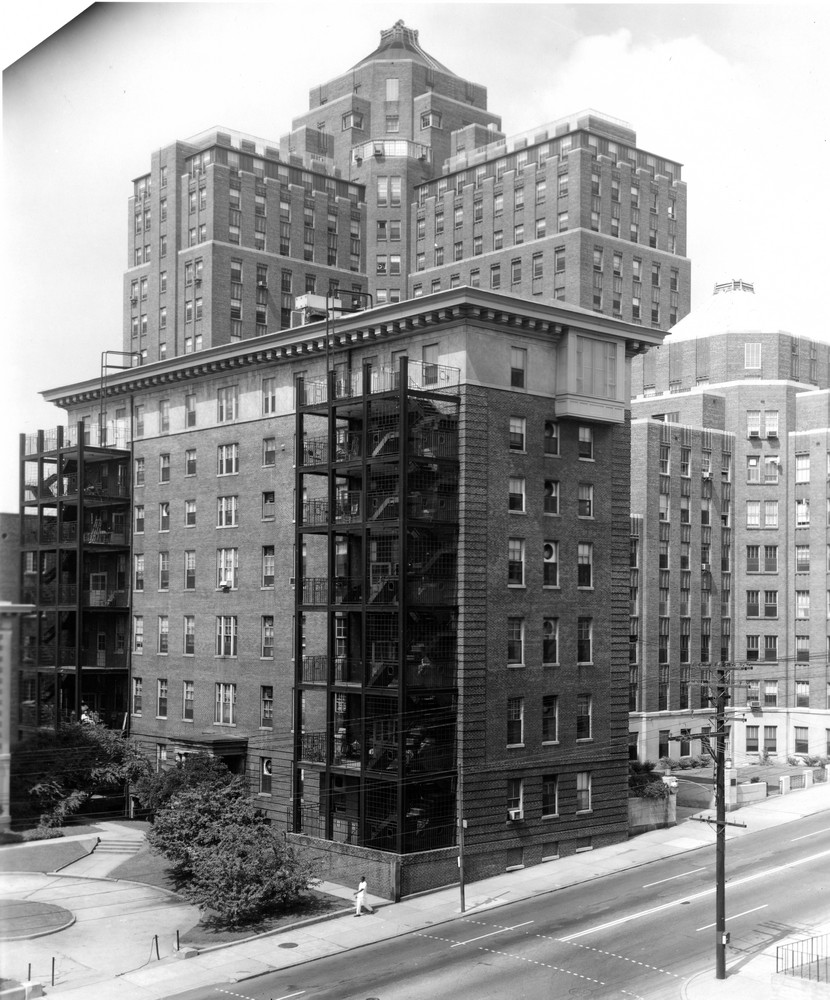
The former St. Philip Hospital in the foreground. (Image courtesy VCU Libraries Gallery)
The handsome former headquarters of Maggie L. Walker’s Consolidated Bank & Trust Company (designed by Black architect Charles T. Russell, 1875-1952) was torn down for a small parking lot when a new bank was completed across North Second Street at East Marshall Street.
On the downtown VCU Health campus, a lonely, salvaged stone door frame embedded in the Marshall Street sidewalk is all that’s left where adjacent, handsome hospitals once stood – the Dooley Hospital for children and St. Philip for Black adults.
Back in Jackson Ward, the former Eggleston Hotel once stood at 813 N. Second St. and hosted such luminaries as Mohammed Ali, Louis Armstrong, Duke Ellington, Billie Holiday and Martin Luther King Jr. The building’s rear partially collapsed in the spring of 2009 and could have been shored up and restored. But no. In the middle of an April Saturday night, the entire building was bulldozed.
But some positive developments are on the horizon. The City of Richmond is finally recognizing and acquiring all-but-forgotten Black cemeteries – a major preservation victory. And after years of discussion, an ambitious master plan was recently unveiled for Shockoe Valley, a fraught part of town. The area will tackle the stories and honor the memory of enslaved people who passed through there.
And more modestly at Virginia Union University, whose Northside grounds and buildings have composed our city’s piece de resistance of Black architectural history for 156 years, the long-forlorn granite-walled Industrial Hall is being restored and transformed into a university gallery museum.
But wait, there’s more. And it isn’t good.

The entryway of the old Richmond Community Hospital.
In early February, as a back-handed slap to Black History Month no less, Virginia Union announced plans to demolish the abandoned but sturdy former Richmond Community Hospital that sits on university-owned property adjacent to the campus. It will be cleared to open up a site for 130 housing units. They will be for rent or purchase by the general public. The university is partnering with the Steinbridge Group, a New York-based investment firm that has pledged $42 million for the project. This will be the first phase of implementing a $500 million master plan that the university announced earlier in the year. “Why should we allow our students … not to become homeowners in this great city of Richmond?’” Hakim Lucas, VUU president, asked rhetorically in a Feb. 7 post by Virginia Public Media.
Say what? Within what university department can we find that program listed?
The old Richmond Community Hospital is an overlooked Art Deco gem at 1209 Overbrook Road. It was designed by Charles T. Russell, a VUU professor of the building and industrial arts as well as prominent local architect. After a major fundraising campaign, the hospital was opened in 1932 in the midst of the Great Depression. The aging facility was much later acquired by Bon Secours, which passed it to Virginia Union.

Small trees have taken root above the old hospital’s front door.
Since the university’s announcement of the project, the Richmond Free Press has become a weekly forum for pushback to the possible – and inexplicable – destruction of a fine building and major community landmark. Finding a new use should be no problem.
Wrote Grace H. Townes to the Free Press: “[The building] holds immense historical significance as a crucial landmark of African-American legacy in our city. During an era of segregation and medical mistrust, this hospital served as a beacon of trust and safety. The doctors who practiced there were not just health care providers; they were pillars of our community who looked like us, understood our needs, and provided care with compassion and understanding. … My four children were born at Richmond Community.”
The Rev. Jabriel M. Hasan of Sandston also weighed in: “For various reasons, ranging from racial injustices to intra-communal neglect and mismanagement, hardship marks the legacy of local, Black historic preservation,” he wrote. “Now that an opportunity arises to safeguard a monument to a way Black people united for community uplift, the choice becomes to tear it down, leaving only a marker in its place.”
Removing this unique and modest building would be a loss to Richmond’s physical character, history and Virginia Union’s intellectual integrity. American college campus structures and landscapes hold deep meaning not only for students but for alumni, staff, visitors and the broader community. The record of struggles and achievements are interwoven into such buildings as this. While not a part of the original VUU campus, the former hospital is now an embedded component of the academic and residential village that grew up near the intersection of Brook and Overbrook roads.


RICHMOND, Va. (WSET) — Our very own Noreen Turyn was honored at the Virginia Capitol as she prepares to step away from the desk after more than three decades.
The Virginia House of Delegates recognized Turyn in honor of her retirement after 36 years with ABC13. Lawmakers unanimously adopted House Resolution 2072, patroned by Del. Wendell Walker of the 52nd District, recognizing her decades of service to Central Virginia journalism.
Since joining the station in 1990, Turyn has become one of the region’s most trusted news voices, earning a regional Emmy Award and recognition for her investigative reporting.
“Noreen’s legacy in Central Virginia is the confidence that she’s inspired viewers and countless journalists tahts he has mentored along the way,” Walker said.
During the House proceedings, the vote was called and approved: “All those in favor of the motion say aye. All those in denial say naye. The motion is passed. Congrats.”
Walker said Turyn’s impact extends beyond the anchor desk through the viewers she informed and the journalists she mentored throughout her career.

The government has a bridge to sell you.
North Carolina State Auditor Dave Boliek said the taxpayers have been paying for it since 1995 to the tune of about $61 million. To this day, construction has not begun between Aydlett and Corolla. https://www.wavy.com/news/north-carolina/61-million-spent-on-troubled-mid-currituck-bridge-project/


Powerball, Mega Millions jackpots: What to know in case you win
Here’s what to know in case you win the Powerball or Mega Millions jackpot.
Just the FAQs, USA TODAY
The Virginia Lottery offers multiple draw games for those aiming to win big.
Here’s a look at June 22, 2026, results for each game:
Powerball
Powerball drawings are held Monday, Wednesday and Saturday at 11 p.m.
17-19-21-45-48, Powerball: 13, Power Play: 2
Check Powerball payouts and previous drawings here.
Wednesday, June 24, 2026
Pick 3
DAY drawing at 1:59 p.m. NIGHT drawing at 11 p.m. each day.
Night: 9-2-3, FB: 6
Day: 7-4-1, FB: 8
Check Pick 3 payouts and previous drawings here.
Pick 4
DAY drawing at 1:59 p.m. NIGHT drawing at 11 p.m. each day.
Night: 5-0-6-5, FB: 4
Day: 5-3-1-3, FB: 3
Check Pick 4 payouts and previous drawings here.
Pick 5
DAY drawing at 1:59 p.m. NIGHT drawing at 11 p.m. each day.
Night: 9-2-4-9-3, FB: 0
Day: 8-3-0-0-9, FB: 0
Check Pick 5 payouts and previous drawings here.
Cash Pop
Drawing times: Coffee Break 9 a.m.; Lunch Break 12 p.m.; Rush Hour 5 p.m.; Prime Time 9 p.m.; After Hours 11:59 p.m.
Coffee Break: 07
After Hours: 05
Prime Time: 11
Rush Hour: 05
Lunch Break: 06
Check Cash Pop payouts and previous drawings here.
Cash 5
Drawing every day at 11 p.m.
04-15-36-38-44
Check Cash 5 payouts and previous drawings here.
Millionaire for Life
Drawing everyday at 11:15 p.m.
07-08-20-24-42, Bonus: 05
Check Millionaire for Life payouts and previous drawings here.
Feeling lucky? Explore the latest lottery news & results
This results page was generated automatically using information from TinBu and a template written and reviewed by a Center for Community Journalism (CCJ) editor. You can send feedback using this form.
-

 Movie Reviews11 minutes ago
Movie Review – In the Hand of Dante (2025)
-

 World14 minutes ago
Brazil's Flavio Bolsonaro Plans to Testify Against Proposed US Tariffs
-

 News26 minutes ago
Video: Mamdani Allies Sweep New York Primaries
-
 Lifestyle59 minutes ago
4 ways to design a dreamy summer, according to a happiness expert
-

 Education1 hour ago
Video: School Year Cut Short and Aid Delivery Slowed Amid Fuel Crisis in Cuba
-

 Technology1 hour ago
Our favorite Prime Day deals you can shop on day two
-

 World1 hour ago
Kim Jong Un calls for North Korea to build 2 large warships per year in major naval expansion push: report
-

 Politics1 hour ago
Trump to kick off Great American State Fair as 250th anniversary celebrations take over National Mall

