West
Washington county sheriff tells deputies to not enforce city's new homeless encampment legislation

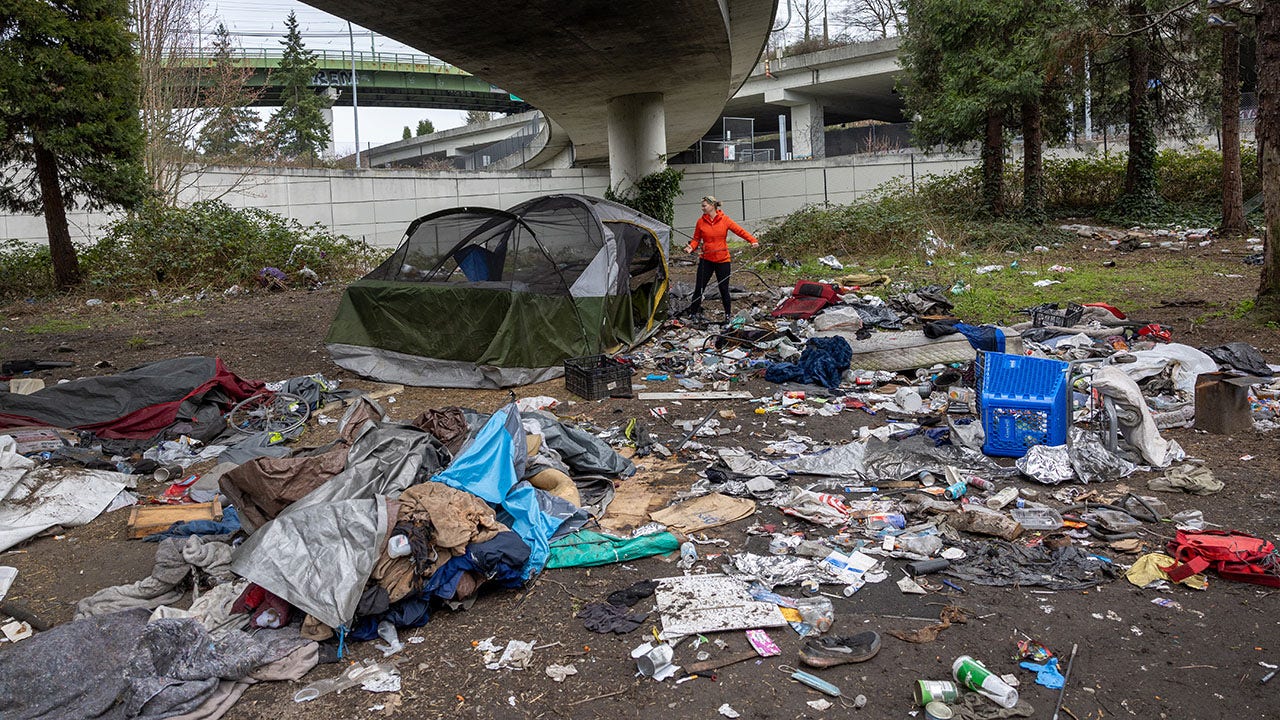
The King County, Washington, sheriff has directed her deputies to not enforce a City of Burien order outlawing homeless encampments within 500 feet of locations like schools and parks until the constitutionality of the order was resolved, without telling city officials.
Now, Burien Mayor Kevin Schilling is examining the inter-local agreement between the city and county sheriff’s office. Schilling said if he determines the agreement was broken, he would consider establishing a city-run police department.
Burien’s city council adopted a new ordinance on March 4, which prohibits people from sleeping overnight on public property from 7 p.m. to 6 a.m. the next day, if a shelter, bed or treatment facility is available.
Camping on public property is also prohibited during daytime hours under the new law.
ILLEGAL IMMIGRANT ACCUSED OF KILLING WASHINGTON STATE TROOPER WAS PREVIOUSLY ACCUSED OF DOMESTIC VIOLENCE
Orson Lee, who’s been homeless for six years, drinks water from a water bottle while outreach worker Mary Guiberson looks on at a park in Burien, Wash. Outreach teams have fanned out to provide water and other aid to the homeless. (AP Photo/Manuel Valdes)
When the new ordinance was passed, the city said on its website that it was collaborating closely with the Kings County Sheriff’s Office (KCSO) and service partners to ensure outreach and services were offered before the code is enforced. The city also said the KCSO understands that the code cannot be enforced without first verifying that a shelter, bed or treatment facility is available.
King County Sheriff Patti Cole-Tindall, on Friday, told her deputies to not enforce the ordinance, according to internal documents obtained by KTTH Radio host Jason Rantz, citing concerns over the constitutionality of the new law.
“We have strong concerns on whether the terms of this ordinance are constitutional, based on the existing legal authority,” Cole-Tindall said via Rantz’s reporting for KTTH.
FLORIDA BILL BANNING HOMELESS ENCAMPMENTS ON PUBLIC PROPERTY HEADS TO DESANTIS’ DESK
Andrea Suarez dismantles a tent as garbage lies piled at a homeless encampment on March 13, 2022 in Seattle, Washington. (John Moore/Getty Images)
“I do not want any of you to find yourself in a situation where you are asked or expected to do something that could violate legally-established rights,” the sheriff wrote in an email obtained by the station. “I am directing you that we will not enforce this particular section of the Burien Municipal Code until the constitutionality of the public camping ordinance is resolved.”
Cole-Tindall did not make Burien city officials aware of the decision, including Schilling.
The county executive and sheriff’s office did not immediately respond to inquiries from Fox News Digital on the matter.
GOV. NEWSOM: ‘PEOPLE ARE DEMANDING MORE OF US’ — CALIFORNIANS TO VOTE ON HOMELESSNESS BALLOT MEASURE
FILE – King County, Washington sheriff’s deputies were directed by its leader to not enforce a new ordinance in Burien, outlawing homeless encampments within 500 feet of locations like schools and parks. (iStock)
The sheriff was appointed by King County Executive Dow Constantine, a move granted by voters in 2021.
“This is the undemocratic situation that occurs when a higher government official gets to dictate what occurs in local governments,” Schilling told Fox News Digital. “The City of Burien pays millions of dollars to the King County Sheriff’s Office with the expectation they will enforce our city codes and laws to keep the community safe and publicly accessible for all.”
The mayor said Constantine and Cole-Tindall are prioritizing politics over public safety.
The station reported that Constantine has not been supportive of Burien’s moves to address homelessness because she does not support sweeps.
The 30-year-old mayor said he was in high school when Constantine was elected in 2009, and for years, problems have not been solved.
“Instead, King County has the highest level of homelessness ever, the highest number of overdose deaths in the country, and continuously increasing taxes for programs that do not show results or solve problems,” Schilling said. “I believe in government accountability and individual responsibility. This isn’t a liberal or conservative problem. The issue of homelessness, drug addiction, mental health issues, and criminal activity cuts across traditional partisan divides.
“We need to ensure that we are prioritizing treatment over tents, and public safety over politics so that we can get folks off the streets and into shelter and services,” he added.
KTTH reported that city council members passed the ordinance in a 5-2 vote, as members saw the legislation as an “emergency ordinance,” connected with health and public safety implications of a previous law that banned camping on public property.
Despite not enforcing the homeless encampment ordinance, Cole-Tindall told deputies to continue enforcing criminal code violations.
Read the full article from Here


Draft day in Denver ended with a yawn.
But behind the scenes, the Nuggets were pleased by their anticlimactic outcome.
On the clock Tuesday night with the 26th pick in the NBA Draft, the Nuggets chose to trade out of the first round, beginning to replenish an asset pool that was drained by the previous front office regime. San Antonio moved up to No. 26 in exchange for giving Denver the No. 35 overall pick in Wednesday’s second round and two additional future second-round picks.
Denver now controls a 2028 Minnesota second-round pick and a 2031 Sacramento second-rounder, according to league sources. The Spurs selected Connecticut big man Tarris Reed Jr. at No. 26. The Nuggets will go into Wednesday with two picks — 35th and 49th. Multiple teams had already called them to inquire about No. 35 by the end of Tuesday night, one source told The Post.
Co-general managers Jon Wallace and Ben Tenzer have less than 24 hours to decide if they want to use that pick or parlay it into more future draft capital. Part of their rationale for trading back, multiple team sources told The Post, was that they felt the 2026 draft class had a substantial drop-off in talent around No. 20.
What the Nuggets eventually do with their new picks will determine how Tuesday’s trade is evaluated. Second-rounders are often used as trade assets rather than to select playable talent, and Denver’s shortage of them has inhibited its ability to get involved in trade conversations around the league recently. Wallace and Tenzer inherited the NBA’s most depleted war chest when they took over the front office in 2025, whereas adversaries like Oklahoma City and San Antonio are practiced in the art of asset accumulation.
If one first-round pick can slowly grow into a wider swath of lower-quality picks that can subsequently be put to good use in other trades to improve the roster, then No. 26 will have been a worthy sacrifice. That could take lots of time, hard work and negotiating tact.
But the Nuggets are also faced with awkward luxury tax decisions this offseason, and they’re tied to multiple contracts that are widely perceived as having negative value, namely Christian Braun and Zeke Nnaji. If they promptly use their new picks to dump either of those salaries without bringing back any helpful players, it would be a clear indicator that team ownership is prioritizing tax savings over roster improvement.
The front office’s challenge will be to balance and accomplish both goals, which tend to be at odds with each other. At least one salary-shedding move is essentially guaranteed to occur as Denver attempts to retain Peyton Watson in restricted free agency, as The Post reported in April.
Wallace and Tenzer still have not made a draft pick yet in their tenure. For now, Denver will treat it as a win if they can stockpile future picks and right some old wrongs. A seemingly tedious trade elicited applause inside the Nuggets’ war room Tuesday, even as team president Josh Kroenke was caught on camera looking disgruntled by something. His bemusement, according to a source, was in response to some confusion on the other end of the line as Denver was trying to call in the 26th pick on behalf of the Spurs.
San Antonio walked away from the first round with two prospects secured in Reed and Jayden Quaintance. Oklahoma City snagged Aday Mara 12th and Bennett Stirtz 16th — sobering reminders that talent is going to keep on flowing into the two rosters that pose the biggest existential threats to Denver.
Nuggets recent draft history
The Nuggets haven’t drafted in the top 20 since 2018 — the cost of becoming a perennial playoff team as Nikola Jokic entered his prime. They’ve gotten mixed results from their late first-round picks since then, which is typical at that stage of the draft. Five of their six first-rounders this decade are still on the active roster, though only two of them were in the everyday rotation last season: Christian Braun (21st) and Peyton Watson (30th), both of whom were selected by former GM Calvin Booth in 2022.
Nnaji (22nd in 2020) is the third-longest tenured player on the team, but the four-year, $32 million contract extension he signed in 2023 has turned out to be a small-scale albatross on Denver’s cap sheet. Bones Hyland (26th in 2021) was shipped off to the Clippers at the 2023 trade deadline after he caused locker room frustration by walking off the bench during a game. He plays for Minnesota now.
Braun was a bench contributor during Denver’s 2023 run to the championship and signed a five-year, $125 million extension last October. Watson will be a restricted free agent and an offseason priority for Denver’s front office in the coming weeks.
Julian Strawther (29th in 2023) has been in and out of the rotation throughout the first three years of his career, and his role was scaled back last season with Tim Hardaway Jr. slotted in at backup shooting guard. Strawther is eligible to sign a rookie-scale extension before next season, or he’ll become a restricted free agent in 2027. Denver traded three second-round picks to Phoenix to move up six spots for DaRon Holmes II (22nd in 2024), who tore his right Achilles tendon in his first Summer League game and spent most of last season developing in the G League.
The Nuggets’ 2025 first-rounder belonged to Orlando as part of their trade for Aaron Gordon. Their 2027 first currently belongs to Oklahoma City as part of the trade for the pick that became Watson.
Booth’s tenure was characterized by his willingness to mortgage future draft capital for immediate gain — or immediate salary relief. Most notably, he burned through six second-round picks in a matter of weeks during the 2024 offseason to get rid of Reggie Jackson and to move up for Holmes.

LAS VEGAS (KSNV) — Las Vegas could be years away from landing an NBA expansion team, but the league’s commissioner is now offering a clearer sense of the timeline.
On Tuesday, NBA Commissioner Adam Silver told “The Dan Patrick Show” that Seattle and Las Vegas remain the cities the NBA is focused on if it expands. “If we expand, at least we’re thinking ’28-29 season,” Silver said.
Silver had previously signaled before that March meeting that Seattle and Las Vegas were at the center of the expansion discussion, while cautioning that no decision had been made.
“We will make decisions in 2026,” Silver said in February.
At the time, Silver said the league was not expected to vote in March but could emerge from those meetings ready to take the next step and begin discussions with potential ownership groups.
Las Vegas has long been viewed as Seattle’s most likely expansion partner if the NBA grows from 30 to 32 teams. Silver, however, has repeatedly said the league could expand by two teams, one team, or not at all.
The potential of an NBA Las Vegas expansion team has already drawn interest. This week, majority owner of the Vegas Golden Knights, Bill Foley, announced he is putting together a bid for the expansion team in Las Vegas.

The Padres have a serious issue in their starting rotation.
That reality brazenly slapped them in the face again Tuesday.
And then it became a side story, at least for the night.
That is how crazy things got at Petco Park.
The Padres beat the Braves 7-6 when Mason Miller worked two scoreless innings and Manny Machado grounded a walk-off single up the middle to score Jackson Merrill in the 10th inning.
“I think the most important part is just how the team fought today,” Machado said. “I think that was impressive, being down four and then coming back and winning that ball game and fighting to the end. I think that shows a lot about the team. We picked up each other. We picked Griff. Bullpen came in and did their job too.”
The game was decided eight innings after the Braves took a 4-0 lead and the Padres took a 5-4 lead.
That is correct. The craziness commenced when for the second time in five games the Padres were part of a runaway inning.
They were on the wrong side of an 11-run inning Friday in Texas when the Rangers responded with six runs in the bottom of the first inning after the Padres scored five at the start of what ended up a 9-7 loss.
On Tuesday, the Padres came out on top of a nine-run second inning.
Griffin Canning jogged in from the bullpen to start that inning after Wandy Peralta worked a scoreless first as the Padres’ opener.
Canning would get just two outs, allow four hits, hit a batter, walk another and allow three runs before he departed.
His 40th pitch completed a walk that loaded the bases. That drew more than a few boos from the seats and brought Craig Stammen from the dugout.
The game didn’t really get wild until a little bit after that.
Kyle Hart walked the next batter to make it 4-0 before ending the top of the second on a groundout.
That is how the bottom of the second began for the Padres as well.
And then six consecutive batters reached base, and they scored five runs against Braves starter JR Ritchie.
The comeback began with walks by Xander Bogaerts and Will Wagner before singles by Rodolfo Durán and Sung-Mun Song cut the Braves’ lead in half and a double by Fernando Tatis Jr. got the Padres to 4-3 and got Song to third base.
An infield single by Samad Taylor flipped the lead.
Song easily scored on Taylor’s grounder up the middle, and when Braves shortstop Mauricio Dubón bounced a throw that got past first baseman Matt Olson, Tatis raced around third and beat a throw home by Olson.
The Braves tied the game 5-5 in the fourth and retook the lead in the fifth.
Michael Harris II singled, went to second on a wild pitch by Hart and scored on Ozzie Albies’ double in the fourth. Dubón homered in the fifth off Yuki Matsui, who had come in to get the final out of the fourth and ended up working through the sixth, leaving the bases loaded in that inning.
Jackson Merrill missed a game-tying home run by a foot and instead got a double leading off the fifth inning when his fly ball to right field hit the top of the wall and bounced back to right fielder Mike Yastrzemski.
Merrill finished the inning at second after a fly ball out by Machado and strikeouts by Gavin Sheets and Bogaerts.
Tatis did not miss a home run as the first batter in the seventh, sending a sinker from Carlos Carrasco 406 feet to center field to tie the game 6-6.
David Morgan worked the seventh and Adrian Morejón the eighth before Miller threw just 11 pitches in the ninth and went back out for the 10th.
“One, we didn’t have a ton of bullpen left,” Stammen said of the decision to have Miller work a second inning . “And he’d been kind of asking me over the course of the season: ‘Hey, I got another one, come on, let me have it.’”
Austin Riley began the 10th by hitting a long fly ball to right field that moved the automatic runner from second to third before Miller struck out Rowdy Tellez and ended the inning by getting a groundout from Eli White.
“It definitely goes a long way,” Miller said, “when you empty everybody out early and you have another game tomorrow, being able to carry two innings there and keep two guys fresh for tomorrow and give us a chance to win again tomorrow as well.”
Merrill was the runner on second to start the bottom of the 10th after he made the final out in the ninth. Machado walked to the plate against Raisel Iglesias, the Braves closer, who had also worked the ninth.
“Looking for a strike,” Machado said. “He’s a strike thrower, one of the best in the game right now. So just trying to be aggressive on that first pitch, something I can drive. Don’t really need much, just just a base hit to score Jackson. So just trying to hit it hard somewhere.”
No matter the result, the Padres are left to figure out what to do about Canning, whose ERA swelled to 7.38 after he yielded his ninth multi-run inning among the 45 innings he has begun for the Padres this season.
He is but one of the flat tires on the rotation bus.
The Padres got seven shutout innings from Michael King in a 1-0 victory over the Braves on Monday. It was the first time a Padres starter went seven innings since King did it on May 18 and just the third quality start by a Padres pitcher in 24 games.
The members of the starting rotation, including the two times Canning has worked after an opener and the two times Lucas Giolito has done so, have a combined 4.76 ERA over the past 25 games.
But the Padres figured out how to win Tuesday, just the second time in a month they have won consecutive games.
“Griffin didn’t have his stuff like he wanted to,” said Taylor, who finished 3-for-4 with a walk. “But we fought. We’re going to keep fighting until the game is over. We fought. Got back in the game. Good at-bats, good pitching. And you leave it into Manny’s hands, he’s going to take over and win the game for us.”
-

 Boston, MA2 minutes ago
Woman killed in Mattapan carjacking crash honored at vigil
-

 Denver, CO7 minutes ago
Nuggets trade 26th pick in NBA Draft to Spurs, moving out of first round
-

 Seattle, WA14 minutes ago
NBA Commissioner says Las Vegas, Seattle remain expansion targets for 2028-29 season
-

 San Diego, CA17 minutes ago
Padres cap wild game against Braves with extra-innings win
-

 Milwaukee, WI22 minutes ago
Bucks draft Burries, Ament after Giannis trade: 'We're building'
-

 Atlanta, GA29 minutes ago
Sports with Sam: Hawks draft Kingston Flemmings & Zuby Ejiofor
-

 Minneapolis, MN32 minutes ago
Concerns grow over south Minneapolis homeless encampment near child care center
-

 Indianapolis, IN37 minutes ago
Karl E. Muszar Jr.

