Denver, CO
Keeler: Sean Payton has replaced Russell Wilson as face of Broncos. And he’s not done purging yet. “You have to win.”


You ask if Sean Payton is done, and Roman Harper laughs. Of the Saints the Broncos coach marched to the Super Bowl XLIV, the ones who flummoxed Peyton Manning and the Colts, only six players remained from the roster Payton inherited four years earlier.
“In New Orleans, it was the same,” offered Harper, the SEC Network analyst and ex-Alabama great who played his first eight NFL seasons under Payton in New Orleans. “But he believes in his way. Because if you’ve had success doing it one time when you’re young, you’re going to believe you can do it again.”
Big Easy football icon Deuce McAllister, who’d literally carried the Saints across the line for years, was released after 2008, Payton’s third season as coach. In 2006, Payton’s first season in Louisiana, the Saints were led by a Pro Bowl stalwart who was strong on the field and even better off it, a giving soul who’d visited fans displaced by Hurricane Katrina.
The Saints cut him the next March. Joe Horn, meet Justin Simmons.
“I’m not shocked,” Harper told me by phone Tuesday, about the time linebacker Josey Jewell joined Simmons, Russell Wilson and Jerry Jeudy in the Broncos Alumni Club. “I would say this any time a new regime comes in, that none of those things shock you.
“It should put everybody on heightened awareness. It’s about what-have-you-done-for-me-lately. I think (Payton) runs a tight ship. He’s not (just) a players’ coach, so you just have to — he wants the sustained success, so you have to win.”
Of the six Broncos named captains before Week 1 last season, three of them — Wilson, Simmons and Kareem Jackson — are now off the roster. A fourth, Courtland Sutton, recently scrubbed any references to playing for the Broncos off of his Instagram and “X” accounts.
“Then you see somebody like Russell Wilson being let go and still being owed a huge amount of money,” Harper continued. “What it tells you is that the (Broncos) ownership group chose Payton and his future over Russell Wilson.”
Payton’s replaced Big Russ as the face of Broncos Country, love it or lump it. And those who know him best say he’s just getting warmed up.
“Winning cures everything,” Harper said. “So when you don’t win, it’s changes that always happen. Nobody gets to have a non-winning season in the NFL and then change doesn’t happen.”
Harper was part of Payton’s first draft class in New Orleans 18 years ago, probably the greatest one-year haul in franchise history: tailback Reggie Bush in the first round; safety Harper in the second; guard Jahri Evans in the fourth; defensive end Rob Ninkovich in the fifth; and guard and future Broncos offensive line coach Zach Strief and wideout Marques Colston in the seventh.
To hear Harper tell it, Sunshine Sean and Big Russ were doomed from the start. Each was too stubborn, too set in their respective ways, to come around to the other guy’s vantage.
“(Wilson) was just never a natural fit,” Harper said. “Russ likes to cook. It’s more of an off-schedule, roll around a bit (style) … it’s never a 3-step-drop or a 5-step drop-and-throw.
“Although I don’t know what (the Steelers) are trying to run now, but Ben Roethlisberger was never a QB that threw on time, consistently. He was never the 5-step-drop-and-throw (type), the way Sean would would probably love his offense to be run and be coordinated.
“It was a little bit difficult for Russ. So that (breakup) never surprised me.”
As a Bill Parcells disciple, Payton has always been down on free spirits, down on me-first guys. During his first training camp with the Saints, he opened a meeting by putting the names of the 2004 U.S. Olympic men’s basketball roster up on an overhead projector, a star-studded group that included Carmelo Anthony, Allen Iverson, Dwyane Wade, Tim Duncan, and a teenaged LeBron James, all coached by Larry Brown.
“Look at these players. This is one of the greatest collections of talent ever assembled,” he reportedly said of the Olympians, who lost by 19 to Puerto Rico and wound up with the bronze. “But they didn’t win. They weren’t the best team.”
Winning cures everything. Until that corner turns, no matter how long it takes, no matter how many bodies get chucked under the bus, nobody’s truly safe.
“And so sometimes, you’ve got to go young,” Harper said. “Sometimes, you’ve got to flip a roster upside down to get the results needed.”
Four paths will get you off Broncos Parkway or Potomac Street and onto the Centura Health Training Center campus. But only two roads really count in Dove Valley anymore: Sean’s way or the highway. And ne’er the twain.
Want more Broncos news? Sign up for the Broncos Insider to get all our NFL analysis.



If you use Santa Fe Drive as a part of your daily commute, you will notice full closures this weekend on a popular section, from Florida Avenue to Evans Avenue, for the installation of a pedestrian bridge.
Once the 370-foot pedestrian bridge is completed, it will connect the east and west portions of Denver’s Overland neighborhood. This bridge will be used by pedestrians and bicyclists.
The Denver Department of Transportation and Infrastructure says this closure is needed to keep the traveling public safe. Large cranes will be used to set the two spans in place. Each one weighs about 215,000 pounds and is 180 feet long.
Once the bridge is completed in 2027, it will create a safer connection for pedestrians and bicyclists. It will link neighborhoods to trails, transit, parks, and local businesses without requiring residents to cross heavy traffic.
“Our neighborhood is quartered by transportation routes, so having a safe pedestrian bridge that can take people from one side to the other is an amazing development that neighbors have been asking for for years,” Jenn Greiving, President, Overland Park Neighborhood Association, said.
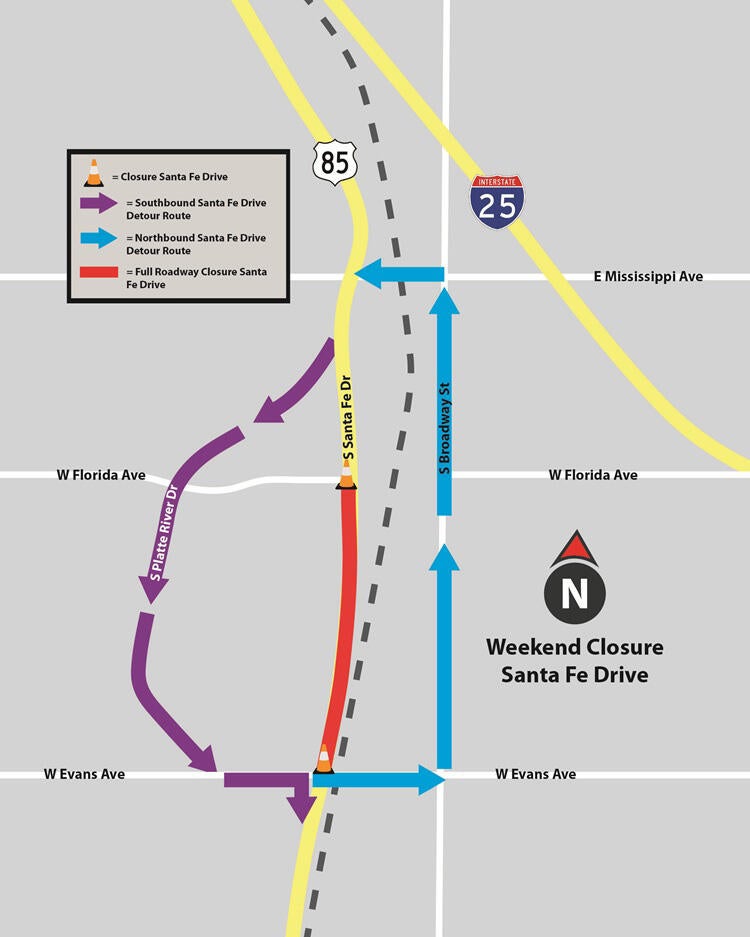
The Santa Fe Drive closure will begin at midnight on Saturday, July 11, and end on Monday, July 13, at 5 a.m. There will be detours in place. This includes:
- Southbound Santa Fe Drive Detour: Traffic will be routed to Platte River Drive to reenter southbound Santa Fe Drive at the West Evans Avenue on-ramp.
- Northbound Santa Fe Drive Detour: Access to northbound Santa Fe Drive will be at Mississippi Avenue via South Broadway Street.
- On-Ramp Closure: The West Evans Avenue on-ramp to northbound Santa Fe Drive will close at noon on Friday, July 10, to prepare for the full weekend closure and will remain closed until 5 a.m. on Monday, July 13. Traffic will be detoured to South Broadway Street to re-enter northbound Santa Fe Drive via Mississippi Avenue.
- Off-Ramp Closure: The southbound Santa Fe Drive off-ramp to West Evans Avenue will close for the full weekend period and remain closed until Friday, Sept. 11, while crews build new sidewalks and perform other concrete work at the southwest corner of the project. Detours will be posted to West Florida Avenue, West Dartmouth Avenue or West Hampden Avenue to bypass the ramp closure
During this closure, DOTI will reopen the underpass on Iowa Avenue. This is a new ADA accessible pathway that will be available between Santa Fe Drive and Acoma Street.

DENVER (KDVR) — Two officers, one now formerly of the Denver Police Department, face multiple charges relating to separate incidents in the past two months.
According to a release, now-former Denver Police Officer Gabriel Lucero was issued a citation for third-degree assault, official misconduct and false reporting, while Officer Javon Leach was cited for reckless driving and eluding.
The incident involving Lucero reportedly occurred on May 22 just before 1 a.m. in the 500 block of 16th Street. According to a release, Lucero was involved in an assault at a business, as he allegedly assaulted a person and walked away as others continued to assault the victim.
Security guards and an off-duty officer escorted him and the group out; however, Lucero reportedly identified himself as a Denver police officer and attempted to re-enter by using his police badge.
Lucero reportedly provided a false name without any other information, and further investigation verified Lucero as the person involved. Lucero was hired in 2025 and, due to his current probationary status, was fired as of Wednesday.
The incident involving Leach occurred around 1:41 a.m. on June 21, when Leach was reportedly pulling out of a parking lot on Larimer Street, attempting to drive against traffic.
Leach reportedly refused commands to stop as he left the area. Officials said he was found just seven minutes later, traveling at high speeds northbound on Park Avenue West.
He reportedly fled a traffic stop and continued to drive away, and officials deemed Leach to be the suspect following an investigation. He was placed in an off-line assignment while the case progresses, as they are considered misdemeanors.
“The Denver Police Department’s administrative review of Leach’s incident will begin once the criminal case is adjudicated, and that process includes the Denver Department of Safety and the Office of the Independent Monitor, a civilian oversight agency,” the release said.

Denver Nuggets standout forward Peyton Watson could find himself on another team before you know it.
With the Nuggets reportedly open to a sign-and-trade of Watson, could Denver really lose a core piece to their rotation?
It’s hard to imagine many teams being able to shoulder the financial weight of a Watson contract at this point because of the aprons and such, but he’s absolutely an asset to any contending team.
We’ve gone through and identified a few teams that make sense for Watson in the fall… including the one he’s already on at the moment. Hey, he might stay home, you never know!
The Clippers have been linked to Watson as a possible destination; he could help them immensely.
The Pistons have also been linked to Watson, which would help them a lot to contend for an NBA title.
Look, HYPOTHETICALLY, the Nets could move around some cap space with some player trades and such and get a deal done. They are one of the only teams in the NBA right now not in the negative with cap space.
The Grizzlies are the team with the least amount of negative cap space right now, per Spotrac. If they really wanted to pull off a Watson sign-and-trade… it would be hypothetically possible from a money standpoint.
Denver Nuggts
Look, it’s very possible Watson just stays in Denver on a brand-new deal. Who knows at this point?
-

 Florida3 minutes ago
Florida Airport Officially Renamed After Trump. Here’s What to Know
-

 Georgia10 minutes ago
West Nile infections starting to raise concerns in Georgia
-

 Hawaii13 minutes ago
First 5 Hawaii is a comprehensive online resource that helps families with young children find and connect to state and federal programs and services.
-
 Idaho19 minutes ago
Brush fire prompts GO NOW evacuations near Mesa in Adams County
-

 Illinois25 minutes ago
Illinois waives tax penalties for 11 counties hit by storms, including Stephenson and Winnebago
-

 Indiana28 minutes ago
Attempted murder suspect arrested in Indianapolis for Bloomington shooting
-

 Iowa33 minutes ago
Iowa WWII veteran approaching 100th birthday honored in Cedar Rapids
-

 Kentucky38 minutes ago
Exantus may be subject to involuntary hospitalization due to Kentucky law

