Midwest
SATs are now digital and 1 hour shorter. High school students have mixed feelings.

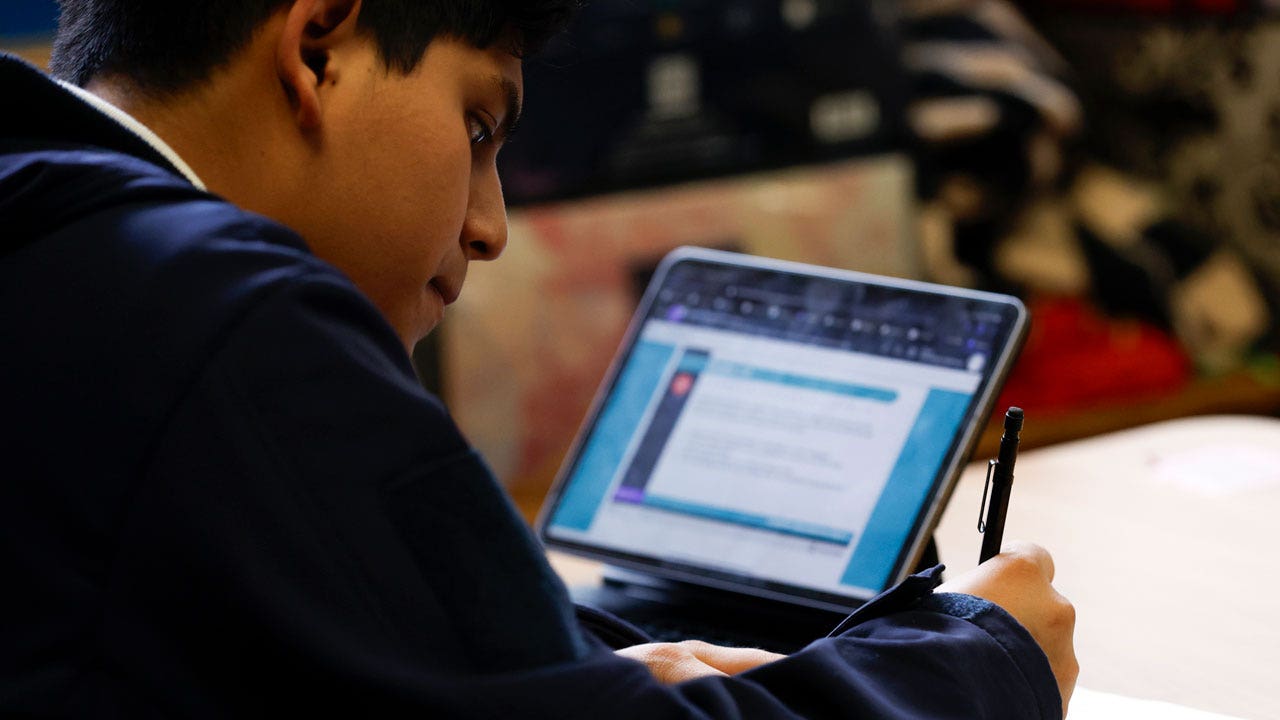
As SAT season kicks off this weekend, students across the U.S. for the first time will take it with computers and tablets — and not the pencils they’ve used since the college admissions test was introduced nearly a century ago.
It’s not unfamiliar territory for today’s digital natives, but some are still warming up to the idea.
“I’ve always been the type to do things on paper, so at first I didn’t really like it, but it’s not terrible,” said Rachel Morrow, a junior at Holy Family Cristo Rey Catholic High School in Birmingham, where students have been practicing with a digital version. She likes a timer function that keeps her on track without having to watch the clock.
SAT DEFENDED FROM ‘MISGUIDED’ ATTACKS AS TEST INCREASINGLY BECOMES OPTIONAL FOR STUDENTS
The digital SAT’s launch comes as its administrator, the College Board, and backers of standardized tests hope to win over schools and critics who are skeptical of its place in college admissions.
The COVID-19 pandemic canceled a full SAT testing season and intensified longstanding questions about whether the exams favor students from high-income families. Many colleges dropped test requirements, and today most still leave it up to students to decide whether to submit scores.
Recently, a small number of highly selective colleges including Dartmouth and Brown announced they would resume requiring SAT or ACT scores. They say the tests allow them to identify promising students who might otherwise be overlooked — students from schools that don’t offer advanced coursework and extracurriculars, and whose teachers may be stretched too thin to write glowing letters of recommendation.
Elijah Nicolas Hernandez-Valeriano studies before taking the digital SAT, on March 6, 2024, at Holy Family Cristo Rey Catholic High School in Birmingham, Ala. (AP Photo/Butch Dill)
Many students see upsides to taking the SAT, even if colleges don’t require their scores.
“A lot of people are going test-optional now but if you do put your scores in, you most likely will have an advantage,” Morrow said.
Her class has been practicing on the digital version of the SAT. The school four years ago took the unusual step of introducing a mandatory SAT prep course for juniors in partnership with CollegeSpring, a nonprofit that provides in-school preparation to help students from low-income backgrounds position themselves better for college.
The test prep teacher, S’Heelia Marks, said the SAT is especially important for students like hers who are predominantly Black and Latino and often from low-income households.
“In America, those are strikes against you,” Marks said. “You need to have all of the advantages you can in order to compete. And so for colleges, if they’re test optional, and they don’t know the school you’re coming from or trust that those grades aren’t inflated in any kind of way, they’re going to go lean on their feeder schools that they do trust, and they’re actually excluding people more than you think they are.”
The SAT also can unlock scholarships, but scoring well enough to qualify often requires intense test prep, which many low-income Americans don’t have access to.
The digital test is an hour shorter but set up and scored the same way, with two sections — one math, the other reading and writing — worth up to 800 points each. It adapts to students’ performance, with questions becoming slightly easier or harder as they go. Test-takers can use their own laptops or tablets but they still have to sit for the test at a monitored testing site or in school, not at home. To prevent cheating, students can’t work in any other program or application while the test is running.
Going digital will not resolve the debate around equity. While critics say the SAT and the alternative ACT are biased toward better-resourced, high-income students, supporters say they remain the best tool for predicting success in college and can be considered in the context of socioeconomic factors like where a student lives.
Test administrators say the digital SAT addresses what is within their control by including a built-in advanced calculator for use during the exam, and by offering free full-length practice exams. And they say the results may reflect inequities in the education system, but do not cause them.
“Claims that are made about inequities around standardized testing — that on a macro level is something that, of course we pay attention to, of course we care about,” said Priscilla Rodriguez, who leads the college readiness assessments division at the College Board. “But performance differences on tests like the SAT mirror performance differences seen in every standardized assessment given in this country, going back to tests that are given to kids in third grade.”
About 1.9 million students in the class of 2023 took the SAT at least once, up from 1.7 million in 2022, according to the College Board.
Emerson Houser, 17, is taking the test on Saturday in Columbus, Ohio. She is planning to submit her scores to colleges she applies to regardless of whether they are required. Judging from her online practice tests, she prefers the digital version.
“We didn’t have to fill in the bubble sheet so we just had to focus on our screens the entire time,” she said. “It made it easier to read the prompts and respond.”
At Holy Family Cristo Rey, Ashley Chávez-Cruz, a junior, said there are features that make the digital test feel familiar, like a highlighting option. But she said it’s harder to mark up problems and passages because you can only make notes in the digital version in a text box off to the side.
But there’s also something less nerve-wracking about taking a test digitally.
“With the paper test, especially because you’re in a quiet room with the clock ticking up there silently, it definitely brings in the sense of an exam,” she said. “With the digital SAT, I still knew it was an exam in my mind, but I was less anxious.”
Read the full article from Here


Abdul El-Sayed is leading in the polls ahead of Michigan’s Aug. 4 Senate primary. If he wins the nomination, Democrats will learn fast whether his politics can win a battleground state.

Senate hopeful Haley Stevens booed during Democratic convention
Representative Haley Stevens was met with boos while giving a speech at the Michigan Democratic Endorsement Convention in Detroit on Sunday, April 19.
In 2025, Elissa Slotkin, a Democratic U.S. senator from Michigan, observed the following about her political party: “We’re like a solar system with no sun. We don’t act as a team, and when we don’t work as a team, we turn our guns on each other, and it’s so, so, so, fruitless.”
Fast-forward to now, and the Democratic Party seems to be moving in a distinct direction: far left. Like, socialist left.
From New York to Colorado, newcomer democratic socialists have unseated sitting members of Congress.
But these victories, so far, have come in solidly leftist strongholds. What I’m watching closely is whether a far-left progressive can win in my state of Michigan, a battleground state that helped elect President Donald Trump in both 2016 and 2024.
The Democratic Senate primary here is Aug. 4, and it’s caught the attention of the country because control of the Senate could be decided in the Great Lakes State. Democratic Sen. Gary Peters isn’t running for reelection, giving Republicans a chance to win the seat back.
Democrats must flip four seats to take control of the chamber, and holding Michigan is essential to that math.
To the chagrin of more “moderate” Democrats, candidate Abdul El-Sayed – a former public health official who’s the darling of democratic socialists like Vermont Sen. Bernie Sanders – has done remarkably well in the polls, and he’s maintained a lead over more traditional opponents U.S. Rep. Haley Stevens and state Sen. Mallory McMorrow.
McMorrow suspended her campaign on July 5, first reported by The Detroit News, after weak polling numbers and likely pressure from Democratic Party insiders.
If El-Sayed pulls off a primary win, it could signal which sun the Democratic Party is heading toward.
What works in the primary may not play as well in the general
But El-Sayed may face bigger challenges if he makes it to the November election.
He’ll face off against Republican Mike Rogers, a former congressman who narrowly lost his 2024 Senate bid to Slotkin.
Michigan hasn’t elected a Republican to the Senate in more than 30 years. Yet while Slotkin is a Democrat through and through, she’s adept at appealing to independents and moderates.
That’s not true of El-Sayed, who has palled around with self-identified Marxist streamer Hasan Piker on the campaign trail, in addition to Sanders.
“El-Sayed joins the list of radical leftists running nationally that will also cause consternation amongst mainstream Democrats,” former Michigan Republican Party Chairman Saul Anuzis told me. “Slotkin has already raised the alarm bells and that probably indicates she’s hearing from her constituency, and El-Sayed will need them as well.”
Michigan could determine whether Republicans hold their Senate majority – and it’s the GOP’s best shot at flipping a seat outright.
El-Sayed may be able to rally more radical progressives and the anti-Israel base in the primary, but that message will be a tougher sell to Michigan voters as a whole. As Anuzis put it, El-Sayed’s strength in the primary is his weakness in the general.
“If he wins, then more mainstream Democrats, Reagan/Trump Democrats and culturally conservative, working-class independents will have to make a choice,” he said. “I think that greatly helps Rogers.”
Democratic leadership is shying away from El-Sayed. Will it matter?
Senate Democratic leader Chuck Schumer has openly backed Stevens, the sitting congresswoman, in the race. He and other Democrats clearly think she’s best suited to take on Rogers in November. Along those lines, ahead of McMorrow dropping out of the race, retiring Sen. Peters told associates that Democrats need to back one of the more mainstream candidates to oppose El-Sayed, according to The Wall Street Journal.
Still, El-Sayed has landed a coveted Michigan endorsement: that of the powerful United Auto Workers union, which praised the candidate for pushing forward “a strong working-class agenda with moral clarity.”
And while some believe that McMorrow exiting the race will boost Stevens, that’s far from a certainty. McMorrow notably did not throw her support behind one of the other contenders and her name will remain on the primary ballot.
Following Zohran Mamdani’s successful bid in 2025 for mayor of New York City, U.S. House Minority Leader Hakeem Jeffries said he didn’t think the democratic socialist represented the future of the Democratic Party.
With several more socialists recently winning seats in Congress, that looks a lot less certain.
Whether El-Sayed prevails in the primary, and then wins over Michigan voters in November, will be the biggest test yet of how far left Democrats are willing to go.
Ingrid Jacques is a columnist at USA TODAY. Contact her at ijacques@usatoday.com or on X, formerly Twitter: @Ingrid_Jacques

The Minnesota Lynx fell to the Connecticut Sun 90-89 on Monday night. Brittney Griner scored a season-high 29 points and grabbed 10 rebounds, and Kennedy Burke added 16 points off the bench, including two 3-pointers in the final three minutes for the Sun.
Burke made a 3-pointer with 2:53 remaining in the fourth quarter to give the Sun a five-point lead, and Griner added a shot in the lane with 1:25 left to make it 84-79.
Burke sank a wide open 3-pointer from the top of the key with 44.5 seconds left for an 87-84 lead. Then, former Lynx forward Diamond Miller made a key block for Connecticut and Griner sealed it on a layup with 18.2 seconds left for another five-point advantage.
Leila Lacan had 13 points and Olivia Nelson-Ododa added 10 points and eight rebounds for Connecticut (5-16), which won its second road game of the season.
Kayla McBride scored 28 points for Minnesota (15-6) and Courtney Williams had 23 points, nine rebounds and six assists. Natasha Howard scored 18.
Minnesota was without Napheesa Collier (left ankle) and Olivia Miles (right calf). Dorka Juhasz made her season debut and finished with three points in 25 minutes.
Griner scored 13 points in the first half to help Connecticut build a 48-44 lead.
Minnesota coach Cheryl Reeve’s second attempt to become the WNBA’s career wins leader came up just short. The next chance will come Wednesday when Minnesota plays at Connecticut. Reeve is tied with Mike Thibault at 379 regular-season victories.
Up next
The teams play again on Wednesday in Connecticut.

JEFFERSON CITY, Mo. (KY3) -Missouri teachers are criticizing Gov. Mike Kehoe’s plan to assign A-F letter grades to the state’s public and charter schools, saying the money would be better spent on classroom learning.
The Missouri Department of Elementary and Secondary Education submitted the proposed A-F School Grading Framework to the governor’s office in response to his January executive order. The order directs DESE to create yearly A-F grade cards reflecting student outcomes.
Under the framework, DESE would produce annual grade cards for districts, schools, and charter schools. Grades would be based on scores from students’ Missouri Assessment Program tests and college-readiness exams, including the ACT and SAT.
For Kindergarten through middle schools, grades would factor in student academic achievement, value-added growth, and growth toward proficiency in English Language Arts, literacy, mathematics, and science. High school grades would also include Success Ready Graduate measures and four-year graduation rates.
DESE Interim Commissioner of Education Stacey Preis, PhD, said the framework is designed to give families a clearer picture of school performance.
“The goal for the A–F school grading framework is to provide families and communities with a simple, comparable, and rigorous picture of school performance,” Preis said.DESE plans to present the proposal to the State Board of Education in August. If approved, schools could receive their first grades under the new system in the spring of 2027. The plan remains subject to change based on any revisions requested during the review process.
Setting up the program would cost $1.2 million in the first year and $715,000 each year after that. That money has not been allocated in the current state budget. That money was not allocated in the fiscal year 2027 state budget, which began July 1. The Missouri State Teachers Association said the funds should go elsewhere.
“We’re currently underfunding schools by almost $200 million, and so I think priority number one should be to make sure that we’re fully funding schools to meet the needs of those students,” said Matt Michelson of the Missouri State Teachers Association.
Michelson also questioned the emphasis on standardized testing.
“I think Missourians have wanted to move away from high-stakes testing, and to place even more emphasis on those one-time statewide tests is really concerning for a community as they look at how they can best educate their students,” Michelson said.
Kehoe said the grading system is about transparency and improvement, not punishment.
“It’s not to admonish any school; it’s to give everybody a target on how do you all get to a better level,” Kehoe said. “You have to know where you stand if you’re going to improve, and you have to have some sort of measuring tool, and that’s what A through F is.”
A bill to codify the plan into state law failed during the most recent legislative session. Kehoe said he wants to see it return.
To report a correction or typo, please email digitalnews@ky3.com. Please include the article info in the subject line of the email.
Copyright 2026 KY3. All rights reserved.
-

 Maryland1 minute ago
Maryland Lottery Powerball, Pick 3 results for July 6, 2026
-

 Michigan8 minutes ago
Michigan primary puts Democrats’ socialist strategy to the test | Opinion
-

 Massachusetts11 minutes ago
Three share lead as Massachusetts Amateur gets underway at Winchester – The Boston Globe
-

 Minnesota16 minutes ago
Minnesota Lynx bested by Connecticut Sun 90-89
-

 Mississippi23 minutes ago
Mississippi Lottery Mississippi Match 5, Cash 3 results for July 6, 2026
-
Missouri26 minutes ago
Missouri teachers push back on governor’s A-F school grading plan
-

 Montana31 minutes ago
The Record is Clear: The Wilderness Society, Greater Yellowstone Coalition, and Montana Wilderness Association have Consistently Undermined the Roadless Rule
-

 Nebraska38 minutes ago
Pine-Richland receiver Khalil Taylor pulls hat trick, picks Nebraska over Penn State


