Midwest
SATs are now digital and 1 hour shorter. High school students have mixed feelings.

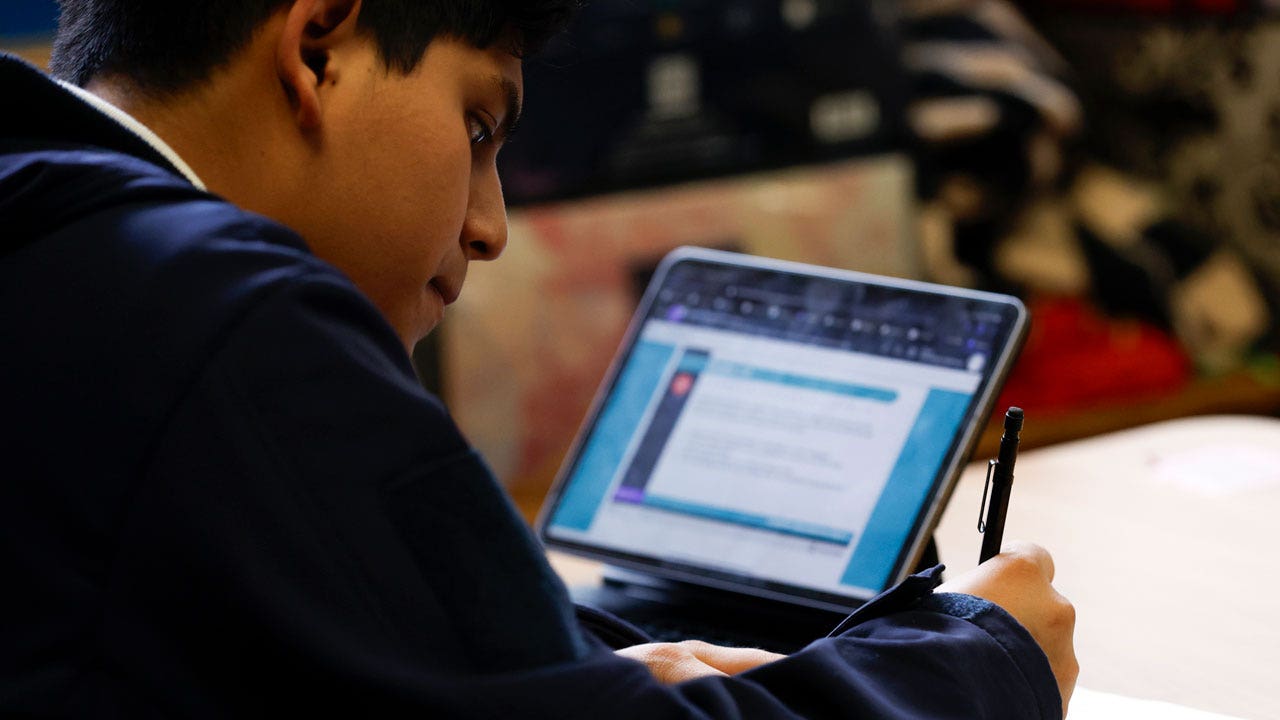
As SAT season kicks off this weekend, students across the U.S. for the first time will take it with computers and tablets — and not the pencils they’ve used since the college admissions test was introduced nearly a century ago.
It’s not unfamiliar territory for today’s digital natives, but some are still warming up to the idea.
“I’ve always been the type to do things on paper, so at first I didn’t really like it, but it’s not terrible,” said Rachel Morrow, a junior at Holy Family Cristo Rey Catholic High School in Birmingham, where students have been practicing with a digital version. She likes a timer function that keeps her on track without having to watch the clock.
SAT DEFENDED FROM ‘MISGUIDED’ ATTACKS AS TEST INCREASINGLY BECOMES OPTIONAL FOR STUDENTS
The digital SAT’s launch comes as its administrator, the College Board, and backers of standardized tests hope to win over schools and critics who are skeptical of its place in college admissions.
The COVID-19 pandemic canceled a full SAT testing season and intensified longstanding questions about whether the exams favor students from high-income families. Many colleges dropped test requirements, and today most still leave it up to students to decide whether to submit scores.
Recently, a small number of highly selective colleges including Dartmouth and Brown announced they would resume requiring SAT or ACT scores. They say the tests allow them to identify promising students who might otherwise be overlooked — students from schools that don’t offer advanced coursework and extracurriculars, and whose teachers may be stretched too thin to write glowing letters of recommendation.
Elijah Nicolas Hernandez-Valeriano studies before taking the digital SAT, on March 6, 2024, at Holy Family Cristo Rey Catholic High School in Birmingham, Ala. (AP Photo/Butch Dill)
Many students see upsides to taking the SAT, even if colleges don’t require their scores.
“A lot of people are going test-optional now but if you do put your scores in, you most likely will have an advantage,” Morrow said.
Her class has been practicing on the digital version of the SAT. The school four years ago took the unusual step of introducing a mandatory SAT prep course for juniors in partnership with CollegeSpring, a nonprofit that provides in-school preparation to help students from low-income backgrounds position themselves better for college.
The test prep teacher, S’Heelia Marks, said the SAT is especially important for students like hers who are predominantly Black and Latino and often from low-income households.
“In America, those are strikes against you,” Marks said. “You need to have all of the advantages you can in order to compete. And so for colleges, if they’re test optional, and they don’t know the school you’re coming from or trust that those grades aren’t inflated in any kind of way, they’re going to go lean on their feeder schools that they do trust, and they’re actually excluding people more than you think they are.”
The SAT also can unlock scholarships, but scoring well enough to qualify often requires intense test prep, which many low-income Americans don’t have access to.
The digital test is an hour shorter but set up and scored the same way, with two sections — one math, the other reading and writing — worth up to 800 points each. It adapts to students’ performance, with questions becoming slightly easier or harder as they go. Test-takers can use their own laptops or tablets but they still have to sit for the test at a monitored testing site or in school, not at home. To prevent cheating, students can’t work in any other program or application while the test is running.
Going digital will not resolve the debate around equity. While critics say the SAT and the alternative ACT are biased toward better-resourced, high-income students, supporters say they remain the best tool for predicting success in college and can be considered in the context of socioeconomic factors like where a student lives.
Test administrators say the digital SAT addresses what is within their control by including a built-in advanced calculator for use during the exam, and by offering free full-length practice exams. And they say the results may reflect inequities in the education system, but do not cause them.
“Claims that are made about inequities around standardized testing — that on a macro level is something that, of course we pay attention to, of course we care about,” said Priscilla Rodriguez, who leads the college readiness assessments division at the College Board. “But performance differences on tests like the SAT mirror performance differences seen in every standardized assessment given in this country, going back to tests that are given to kids in third grade.”
About 1.9 million students in the class of 2023 took the SAT at least once, up from 1.7 million in 2022, according to the College Board.
Emerson Houser, 17, is taking the test on Saturday in Columbus, Ohio. She is planning to submit her scores to colleges she applies to regardless of whether they are required. Judging from her online practice tests, she prefers the digital version.
“We didn’t have to fill in the bubble sheet so we just had to focus on our screens the entire time,” she said. “It made it easier to read the prompts and respond.”
At Holy Family Cristo Rey, Ashley Chávez-Cruz, a junior, said there are features that make the digital test feel familiar, like a highlighting option. But she said it’s harder to mark up problems and passages because you can only make notes in the digital version in a text box off to the side.
But there’s also something less nerve-wracking about taking a test digitally.
“With the paper test, especially because you’re in a quiet room with the clock ticking up there silently, it definitely brings in the sense of an exam,” she said. “With the digital SAT, I still knew it was an exam in my mind, but I was less anxious.”
Read the full article from Here


Today in History revisits the Sunday, July 7, 1940, edition of the Grand Forks Herald and highlights a story of five children being sent to Grand Forks who were fleeing the Blitzkrieg-threatened British Isles.
Five children, fleeing the blitzkrieg-threatened British Isles, will arrive in Grand Forks soon.
The five—two boys and three girls—are from Edinburgh, Scotland, and are second cousins of Rev. W. Murray Allan, minister of the Plymouth Congregational church. They will live at the Allan home.
Mr. Allan said the boys were from one family and the girls from another. Ten days ago Mr. Allan received a cable from the parents, whom he has not seen in 25 years, asking if he would care for them.
Although he has not had definite word, Mr. Allan said he presumed the children are en route to the United States now. He also has been in touch with the American Committee for European Children.
The children coming here are believed to be the first war refugees who will reach North Dakota. Several other Grand Forks families are reported considering offering their homes to British children.

Our newsroom occasionally reports stories under a byline of “staff.” Often, the “staff” byline is used when rewriting basic news briefs that originate from official sources, such as a city press release about a road closure, and which require little or no reporting. At times, this byline is used when a news story includes numerous authors or when the story is formed by aggregating previously reported news from various sources. If outside sources are used, it is noted within the story.

WARREN, Ohio (WKBN) — Police are investigating after a car crashed into a popular fitness center in Warren.
Just before 10 p.m., a car drove into the Planet Fitness on Elm Road. The car has since been removed from the building.
Bystanders tell our crew on scene that two people were taken away by ambulance.
Warren’s Police Department is investigating the cause of the crash.
Alex Sorrells contributed to this report.
The South Dakota Lottery offers multiple draw games for those aiming to win big.
Here’s a look at July 6, 2026, results for each game:
Winning Powerball numbers from July 6 drawing
17-44-63-66-67, Powerball: 04, Power Play: 2
Check Powerball payouts and previous drawings here.
Winning Lotto America numbers from July 6 drawing
12-16-19-21-23, Star Ball: 10, ASB: 03
Check Lotto America payouts and previous drawings here.
Winning Millionaire for Life numbers from July 6 drawing
02-08-32-54-56, Bonus: 03
Check Millionaire for Life payouts and previous drawings here.
Feeling lucky? Explore the latest lottery news & results
Are you a winner? Here’s how to claim your prize
- Prizes of $100 or less: Can be claimed at any South Dakota Lottery retailer.
- Prizes of $101 or more: Must be claimed from the Lottery. By mail, send a claim form and a signed winning ticket to the Lottery at 711 E. Wells Avenue, Pierre, SD 57501.
- Any jackpot-winning ticket for Dakota Cash or Lotto America, top prize-winning ticket for Lucky for Life, or for the second prizes for Powerball and Mega Millions must be presented in person at a Lottery office. A jackpot-winning Powerball or Mega Millions ticket must be presented in person at the Lottery office in Pierre.
When are the South Dakota Lottery drawings held?
- Powerball: 9:59 p.m. CT on Monday, Wednesday, and Saturday.
- Mega Millions: 10 p.m. CT on Tuesday and Friday.
- Lucky for Life: 9:38 p.m. CT daily.
- Lotto America: 9:15 p.m. CT on Monday, Wednesday and Saturday.
- Dakota Cash: 9 p.m. CT on Wednesday and Saturday.
- Millionaire for Life: 10:15 p.m. CT daily.
This results page was generated automatically using information from TinBu and a template written and reviewed by a South Dakota editor. You can send feedback using this form.
-

 North Carolina3 minutes ago
Manns Harbor Bridge repairs to be ‘most complete’ in decades | Coastal Review
-

 North Dakota10 minutes ago
Today in History: July 7, 1940 – War children routed to Grand Forks
-

 Ohio13 minutes ago
Car crashes into fitness center in Warren
-

 Oklahoma18 minutes ago
As World Cup inspires young players, Oklahoma City bets big on soccer’s future
-
Oregon25 minutes ago
Oregon Lottery Powerball, Pick 4 results for July 6
-

 Pennsylvania28 minutes ago
Boil water advisory in effect for some residents in Montgomery County
-

 Rhode Island33 minutes ago
R.I. food bank thanks Taylor Swift, Travis Kelce for pre-wedding donation
-

 South-Carolina40 minutes ago
South Carolina Lottery Powerball, Pick 3 results for July 6, 2026

