Entertainment
Summoning mothers to their power to fight climate change and inequality


On the Shelf
Lessons for Survival: Mothering Against “the Apocalypse”
By Emily Raboteau
Henry Holt: 304 pages, $30
If you buy books linked on our site, The Times may earn a commission from Bookshop.org, whose fees support independent bookstores.
As the Northern Hemisphere slowly emerges from the dark days of winter, we welcome the extra hours of daylight. In Emily Raboteau’s New York City neighborhood, a different kind of daylighting may happen; the enormous proposed civic project to daylight Tibbetts Brook, from where it was buried underground, will provide flood control and create natural beauty. (Similar projects, in which paved-over streams are brought back to the surface, are occurring in various places in California.) For Raboteau, it’s an exciting project but also a reminder that her Bronx neighborhood is living on borrowed time. In Raboteau’s book of essays, “Lessons for Survival: Mothering Against ‘the Apocalypse,’” her care for her neighborhood and her maternal care for her children are connected as she faces an uncertain climate future.
The rising sea levels that threaten the California coast will have a greater impact on New York City, submerging the areas near Raboteau’s house. Daylighting Tibbetts Brook spotlights how climate change lives in the same ecosystem as race and class and the continuing effects of colonization. During our March interview via video chat, Raboteau reminds me, “The Lenape called [Tibbett’s Creek] Mosholu.
“[The project’s] messy,” Raboteau continued. “If it comes to pass, it will be the most expensive [$130 million] green action in New York. [But] should we be spending that much money on this climate mitigation act that is in a sense an act of reparation? Or should we be spending it to think about a managed retreat for the poorest people, in the low-lying areas, who know we’re living on borrowed time now?”
In New York, anxiety about an uncertain future and economic pressure are expressed in art. One of the essays follows Raboteau’s travels to document a local artist’s warning signs about the coming catastrophe in multiple New York City locations. She journeys to see many of the city’s public art projects — including a gorgeous photo essay on murals commemorating birds likely to be extinct soon — and other calls to action to mitigate climate change. The birds, it turns out, are also a way for Raboteau to distract herself from chronic pain — both physical and metaphysical — her body’s response to the weight of our changing world.
As the result of that wandering, she comes into contact with a broad swath of people, documenting their environmental fears but also their suspicion that such art projects are signs of gentrification and additional economic disparities. Raboteau calls our attention to the ways in which environmental pressures will create even more social inequality between those who can afford to move, and those who are rooted by economic necessity and lack of access to alternatives.
Living on land that has seen multiple generations of inhabitants creates another pressing question for Raboteau, whose book of connected essays is about moving through our new 2020s reality as a mother. She is deeply conscious of a challenge posed by Jonas Salk, who insisted that our obligations to future generations should be our biggest priority — not just the ancestors of the two sons she and her husband, writer Victor LaValle, are raising.
She’s aware that many of us don’t think beyond our immediate present. “[It requires] thinking about ourselves in the past as we consider the future generations, like that edict of the Iroquois law thinking seven generations ahead. That’s very abstract and challenging for us.”
As a scion of her Black ancestors, and the mother of a new generation, Raboteau keeps photos in her workspace to remind herself that she is the result of her family’s past struggle. “It’s a story commonly told in the Black tradition, and it was told to me by my dad at some point: ‘Your great-grandfather was a slave so that his child could be a preacher so their child could be a teacher so that their child could be a politician so that you could be an artist.’ I like being reminded that you are actually the fruit or the flower of a long process of ancestry that toiled so you could do this.”
Raboteau writes poignantly about her recently deceased father, scholar Albert Raboteau, whose work on the religious traditions of slaves is seminal in the field of Black studies. He came from an area of Mississippi devastated by Hurricane Katrina, and today, Raboteau’s family has left due to its aftereffects. While environmental catastrophe has scattered her people, so too have the effects of racism and poverty.
“When [my father] was in his mother’s womb, his father, who was a grocery store clerk, was murdered by a white man. This was in 1943 and the man was never tried and certainly never prosecuted for the crime. So my grandmother fled the Jim Crow South to save the life of my dad, who was not yet born, and his older sisters and they went to Michigan.”
Her father died of dementia in 2020, in the midst of the pandemic. Her grief began before he died, as her sharp solastalgia for the man he was before illness mirrored her feelings about the changing Earth and all that has already been lost. “We see that solastalgia grafted on the landscape, but there’s also a kind of bittersweet element in parenting [in watching children grow and change].” She now sees her father’s image on the ancestor wall. “The wall reminds me to think about what’s come before, where we fall in this lineage and what we owe the next generation.”
During a research trip to the Arctic, she found herself sleeping in a tribal council office under an ancestor wall like the one in her office. It was a reminder of all that has already been lost, and just how perplexed she is by feelings of climate rage and grief.
“I was encouraged to speak to elders in that community who remembered the land, what it was like before the warming began, and I asked one elder, ‘What do we do with our anger?’ And he said, ‘That’s easy. We take care of each other.’”
Taking care of each other means moving toward collective action. It’s one way of combating the individual sense of being powerless. Raboteau is working with multiple groups across New York City that are combining social and economic justice with climate action. Tied to New York because they’re dependent on the income she and her partner earn in the city, they stay. She writes that her children, like many urban kids, suffer from the asthma associated with rising carbon levels. But the solution to stay and fight only works up to a point, Raboteau says. “I learned from my grandmother’s story the lesson of the fugitive. If something’s gonna kill you, you run when it gets to that point.”
Climate crisis is not the only variable she must parent her children through. As the mother of two Black sons, the murder of George Floyd added to her already vigilant state. During the Black Lives Matter protests, she noticed graffiti near her building: “All mothers were summoned when he called out for his mama.”
“There’s something metaphysical when it hits your heart like that,” she says. “[George Floyd] called out to his mother in the last moments of his life. It was an appeal for mercy. Not just air but mercy. It hit a lot of us, whether we’re mothers or not. You’re part of this pain and you have the power to be merciful and caring. It moved me to tears because it summons mothers to our power.”
Summoning mothers to their power is a way forward in climate survival strategies and in fighting for equality. Although Raboteau is quick to point out that you don’t have to be a mother — or a parent — to feel the same impetus and passion. “Saidiya Hartman says that ‘care is the antidote to violence.’ I don’t want to suggest that motherhood is the only doorway to which you arrive at care because certainly it isn’t. But for many of us, like me, motherhood has been a complete alteration of my experience in the world, like the shattering of your identity. There’s a loss there too; I feel a little nostalgia about myself as a person without kids and the freedom that came with it. But motherhood has been very politically activating.”
To replenish her energy, Raboteau finds great pleasure in gardening, another reminder of her family roots. Putting our hands in the dirt and bringing forth beauty is a way to acknowledge previous generations unable to access both bread and roses in the struggle to survive. Gardening has created community, and Raboteau feels a deep connection to others. She says joy and beauty are part of the struggle.
She tells me of one such moment in the South Hebron Hills. “When I was in Palestine, I spoke to one mother through a translator. She had had a hard life. She’s a Palestinian woman. Her home is more or less a tent that could be bulldozed by the IDF. But she had filled an abandoned tire with dirt and she grew roses. She found the time to do that, and I found that act really remarkable. This isn’t for sustenance. This isn’t to eat. It’s not growing olives to sell. It’s just for the pleasure of having bright pink.”
Pink connotes dawn, the promise of coming daylight. It reminds us that daylight often looks like hope.

Entertainment
Tom Sandoval’s ex Victoria Robinson accuses him of abuse; her restraining order is denied

Tom Sandoval’s former girlfriend Victoria Lee Robinson has filed a dueling restraining order against the reality TV star.
Reality TV star Tom Sandoval’s former girlfriend Victoria Lee Robinson has filed a dueling restraining order after she was arrested in June following an altercation that involved her father being pushed into a lit fire pit.
In the petition, filed Thursday in a Los Angeles court, Robinson claims that over the course of the former couple’s 2.5-year relationship, the former “Vanderpump Rules” star “routinely physically and verbally abused” her.
According to court documents reviewed by The Times, the model alleges that Sandoval shoved her down a flight of stairs in his home, pushed her to the ground at a hotel in Nashville, and attacked her and her father on June 3.
On Monday, a Los Angeles Superior Court judge denied Victoria Robinson’s request for the temporary domestic violence restraining order because Sandoval’s existing temporary restraining order requires a hearing (which was set for July 16) before Robinson’s could be granted.
Representatives for Sandoval told The Times in a statement, “It’s no surprise that Victoria’s request for a restraining order was immediately denied.”
Sandoval, known for the Scandoval cheating scandal that erupted on the hit Bravo series “Vanderpump Rules” in 2023, filed a temporary restraining order against Robinson and her father J. Will Robinson on June 25. In Sandoval’s petition, he claimed that since the two became a couple in February 2024, Victoria Robinson has been violent and attacked him physically.
Sandoval was granted a temporary restraining order which required Robinson and her father to vacate the Los Angeles rental the three had shared. According to Sandoval, he’d left the house and stayed in hotels and with friends following the June 3 incident.
“This is my home. We are both on the lease, but I paid the first month’s rent and deposit, surprised him with the keys and virtually every item in it is mine,” Victoria Robinson said in a statement shared with The Times. “I have filed my own legal action because I have my own account of what happened and it’s very different from what has been said publicly.”
Robinson said that while her father has been under media scrutiny, he was trying to protect her.
“My relationship with Tom has already controlled the past two years of my life,” she said. “I cannot allow a false narrative to control my future.”
The altercation involving Sandoval, Robinson and her father happened in the early morning hours after the couple returned home from a night out at a bar, according to both accounts.
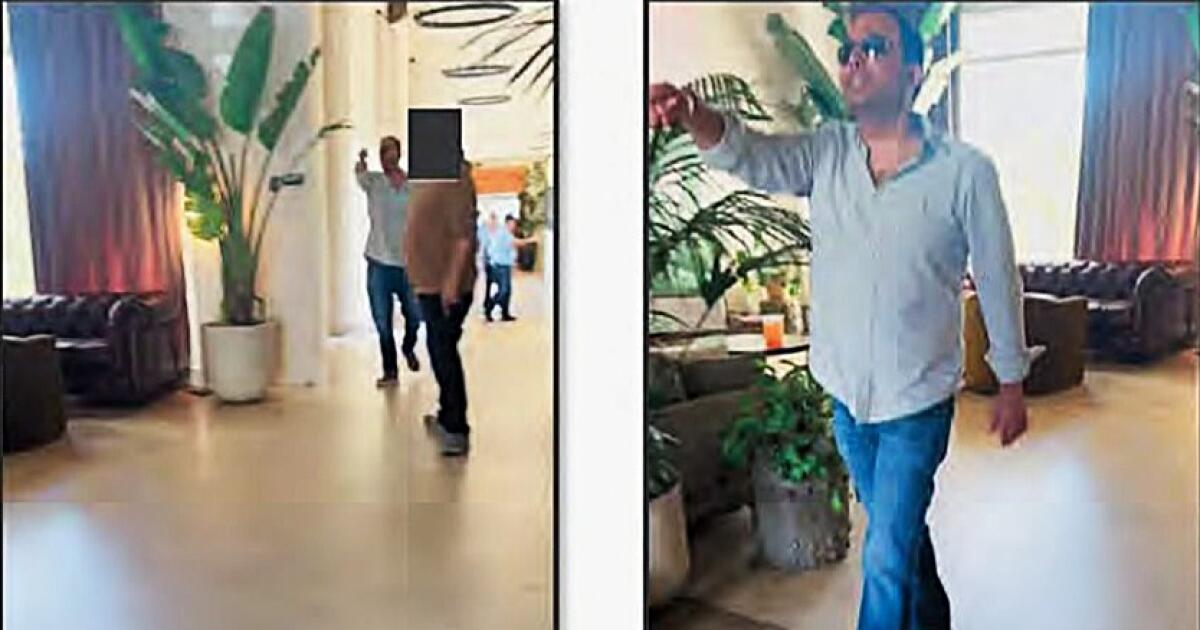
In a video of the June 3 incident, obtained by TMZ, Robinson and her father are seen sitting next to a lit fire pit on the patio when Sandoval and the elder Robinson begin arguing. Sandoval is heard yelling at Will Robinson before he asks his girlfriend if she is recording and approaches her. Will Robinson stands up and wraps his arms around Sandoval, seemingly to get him to back away from Victoria Robinson. Sandoval turns and pushes Will Robinson, who falls backward into the lit fire pit.
After Will Robinson gets back up, he rushes after Sandoval into the home while Victoria Robinson screams for the men to stop.
According to Victoria Robinson’s petition, when Sandoval noticed she was recording his exchange with her father, he twisted her arm while trying to gain control of her phone.
Will Robinson allegedly suffered a thumb fracture and elbow and back injuries.
Victoria Robinson was arrested after police responded on June 3 and released on bond the same day. On June 4, Sandoval returned to their L.A. house to collect his things and Victoria Robinson called police, who escorted Sandoval from the home, according to the filing.
The Los Angeles Police Department declined to comment on the reason for Robinson’s arrest.
Will Robinson told TMZ last month, “The DA did not file the case for a reason. I lifted Tom off of my daughter because he was overpowering and twisting her arm and trying to take her phone aggressively after yelling at us in a very aggressive and threatening manner.”
“This is my daughter’s home and we just want Tom as far away from us as possible and to keep his lies and drunken abuse away,” Robinson said.
This isn’t the first time their fights have turned physical, according to both accounts. Victoria Robinson‘s petition claims that in August 2025, Sandoval shoved her down their hardwood stairs and she suffered knee injuries. She said she reported the incident to police but ultimately recanted her statements to protect Sandoval from being arrested. “In hindsight, I deeply regret this decision,” reads the suit.
Weeks before the fire pit incident, Robinson alleges that during a trip to Nashville to visit her grandfather who was in hospice care and has since died, Sandoval pushed her to the floor of their hotel and locked her out of their shared room.
“During their 2½-year relationship, Tom has made it clear he never physically harmed Victoria,” representatives for Sandoval said. “Instead, he lived in fear of her repeated physical attacks and unpredictable behavior. He will show he was the victim of ongoing physical and emotional abuse, and has substantial evidence documenting what he endured, which will be presented through the legal process.”

It’s summer blockbuster movie season and there have been a lot of new releases from many of the biggest studios and directors. Some of the biggest titles include “Supergirl”, “Disclosure Day”, and “Toy Story 5.”
GBH’s Morning Edition guest host Tori Bedford spoke with GBH correspondent and film critic Sarah G. Vincent, along with GBH’s Callie Crossley, an avid cinephile and host of Under the Radar with Callie Crossley, for their take on some of the season’s biggest releases. What follows is a lightly edited transcript.
SUPERGIRL
Tori Bedford: So one of the biggest movies to hit theaters lately has been the next installment in James Gunn’s new DC Universe, “Supergirl”, starring Millie Alcock. Sarah, let’s start with you. What did you think?
Sarah G. Vincent: I actually loved it. It’s the first summer movie where I didn’t have any disclaimers of “I liked it but…” I was very invested in the storyline because if someone hurt my fluffy baby, I would run around the universe and try to save him. Also, I like that it was like a superhero movie with a woman where she didn’t become a surrogate mother, where she wasn’t sexualized, where she was dealing with real emotion. The real emotion really hit me. I love the backstory. It was gorgeous. I understand that it’s a lot of jokey jokes.
Bedford: What do you mean jokey jokes?
Vincent: On the present day storyline where she’s helping Ruthye, they do try to keep it light because they’re dealing with a lot of heavy issues, and so there are a lot of like flippant jokes and one-liners and everything. And I didn’t mind that because this is still a blockbuster and I think that a blockbuster does need to have some like mass appeal. I’m not going for a Bergman film, right?
Bedford: Yeah, it’s summer. Like, chill out.
Vincent: Right.
Bedford: What’d you think, Callie?
Callie Crossley: I am the “but” — I liked it except some of the themes were so heavy, even though presented in an entertaining way. So, don’t take me wrong. You should see it. It’s a popcorn movie. But I was like, “OK…”
Bedford: You wanted more jokey jokes.
Crossley: Well, it was just to me, I looked at it and I thought, “Epstein Files” because we have a plot of young girls being trafficked to an island of crazy men. So that’s what came to me. But then I thought, I guess I’m just— I live in news, so this is what I would think of. But I can understand in the moment why it was there, but I’m not sure it resolved itself for me in the best way possible that sort of made it maybe not so uncomfortable about it. Now, she is great, Millie Alcock as Supergirl, and I loved her backstory. I really enjoyed that part. And there are some cameos from Superman. So you really get to see the difference between the two of them and why there is a difference, because now you know the backstory.
Bedford: I love their relationship, where he’s like, “This is why Krypto is not well-behaved” and she’s all disorganized.
DISCLOSURE DAY
Bedford: All right, next up — I can’t wait to talk about this. Steven Spielberg is back with an alien mystery thriller, “Disclosure Day.” This man is obsessed with aliens.
Callie, let’s start with you. What’d you think?
Crossley: I went because it’s Steven Spielberg, and I wanted everything. So again, this is a popcorn movie, and out of the gate, you are really on a ride, and you’re like, “What’s happening?” So, I would say the first part of the movie, you’re just caught up in trying to understand where he’s going with it, and it’s a lot of action, and it’s Spielberg-esque in that way. And that John Williams score is fabulous. What I had a problem with was the end of it. I’m going to use the word unimaginative because I am not giving away the plot, so no spoilers here, It’s unimaginative in how he resolves it because I think it’s old-fashioned in both how he presents some of the folk, and also in the methodology of how he wants to get the word out. So that sort of threw me off and I’m thinking, “That’s not a word I use with Steven Spielberg. I should not be using unimaginative.” I still say you should see it, but those are my thoughts.
Vincent: At 2.5 hours, I would say, I warned you. So as an action movie where people are being chased, like the bad guys are chasing the good guys, it’s a great movie. As a movie where it takes an alternate sort of sci-fi approach to the idea of possession and what it would look like, terrific. Actually, a really provocative, wonderful idea. Emily Blunt does a wonderful job.
Crossley: Fabulous.
Bedford: She’s great in the movie.
Vincent: I think she owns the movie, and if the movie was just about her character, I would probably give it like closer to a 90 than where I landed, which was probably in the 70s.
Bedford: I was just going to say … I got out of this, and I thought, “Am I stupid? Or was this really dumb?” It was fun though.
Crossley: This is not a Spielberg movie you’re going to remember, I say.
Vincent: No, yeah, you’re not.
Crossley: And there’s a lot of reviewers saying it’s fabulous. And I’m like, were we at the same place?
Bedford: Am I dumb?
Crossley: But still, it’s a popcorn movie. Got some really good stuff in there you could enjoy.
TOY STORY 5
Bedford: All right, finally: Woody, Buzz, and all their friends are back again for “Toy Story 5,” and this one is taking on big tech as a teaching tablet enters the toy box. Sarah, what’d you think?
Vincent: I loved it. It’s my favorite Toy Story. And I would say that what I loved about this movie is when you go to movies, usually technology is the bad guy, period. And this movie is much more nuanced. And no one is really the bad guy. It presents the pros and cons of everything. And it’s about authentic relationships and it shows how in the past, a relationship without technology was fraught, in retrospect, with problems for Jesse, with the trauma she endured by losing her person. Now in the present with their new human basically having this crisis of “how do I make friends?” So I think it shows the universal problem of how you make authentic relationships, and the technology is only showing how that problem persists. It embodies now, but it’s always been a problem.
Crossley: I think it’s brilliantly done in this way. It doesn’t demonize all the folks that usually get demonized. The tech gets demonized. Sometimes the parents get demonized. That did not happen at all. But for me, any story about friendship that’s told authentically is going to get me. And they know how to get you. It’s a really, really important story about finding your tribe, as Sarah said. Now, having said that, it’s still not my favorite. Toy Story 3 is my favorite. And I went back just to say, “Okay, let me just go look at the end of 3 again to see if I had the same response.”
Bedford: Oh, masochist, my God.
Crossley: Well, because I just wanted to see. I looked at my computer, watched only the end, and sobbed yet again.
Bedford: I know, that’s all I’ve got to say about this franchise. How much more crying do you want me to do?
Crossley: I misted up at the end of this. I did not sob, as I scared the children in 3 before in the theater. But this time I did mist up because really, they know how to get you. It’s so worth seeing.
GBH Daily

Controversial AI actor Tilly Norwood will star in her first movie, a comedy drama called “Misaligned.”
The film portrays Tilly as an AI being with “no real body” and lived experience but with access to everyone else’s, according to Particle 6, the London-based company behind Norwood.
Norwood drew intense ire from many Hollywood actors last year, when an executive behind her creation said Norwood would soon be signed to a talent agency. Some actors worried that AI characters trained on human likenesses without permission or compensation could one day replace them in movies and shows.
Particle 6 emphasized that the movie is a “hybrid production” with film and TV professionals working with AI specialists.
“Our ambition with Tilly Norwood has always been to show the creative industry what is possible with AI at any one point in time,” said Eline van der Velden, Particle 6 chief executive in a statement. der Velden said the film will help traditional filmmakers “upskill and transition to a world where AI will play an increasingly important part.”
“We remain passionate about helping people develop AI skills that will ensure they – and the industry – continue to thrive,” der Velden said.
In “Misaligned,” the plot progresses when Tilly is later convinced by a rogue bot to ignore her guardrails and start developing ambitions of her own, which make her more human and famous, and “Tilly begins to develop shame that her very being has been built on the whole of humanity,” Particle 6 said.
“The film will absolutely be funny, chaotic and self-aware — very Tilly,” van der Velden said in a statement. “But underneath it, there’s something deeper about identity, performance, and our very human fears around AI. And yes, art will most definitely be imitating life.”
AI remains a controversial topic in Hollywood, as many people in the entertainment industry are preparing themselves for the way the technology will change jobs and the way things are done. AI companies have touted how their tools could lower the cost and the amount of time it takes to produce visual effects . Meanwhile, writers and actors have expressed worries about their work being misused to train AI models.
“They are taking our professional members’ work that has been created, sometimes over generations, without permission, without compensation and without acknowledgment, building something new,” SAG-AFTRA President Sean Astin said last year regarding the controversy surrounding Tilly Norwood.
“But the truth is, it’s not new. It manipulates something that already exists, so the conceit that it isn’t harming actors — because it is its own new thing — ignores the fundamental truth that it is taking something that doesn’t belong to them,” Astin said.
SAG-AFTRA did not immediately return a request for comment on Tilly’s first movie.
The union has been advocating for more AI protections for actors, recently approving a contract with major studios in which producers agreed to “a principle strongly favoring human performances” and that producers would only use a synthetic if it “brings significant additional value to the motion picture.” If a producer decided to use a synthetic in a role that could be done by a human, they would need to notify the union and bargain in good faith.
SAG-AFTRA is also supporting the NO FAKES Act, a federal bill that would give individuals the authorization to use their own voice and likeness in digital replicas and creates a way to hold bad actors liable.
-
 Business2 minutes ago
Orange County real estate investor pleads not guilty in $100 million bank fraud case
-
Entertainment9 minutes ago
Tom Sandoval’s ex Victoria Robinson accuses him of abuse; her restraining order is denied
-
 Politics17 minutes ago
Trump heads to NATO as tensions simmer with Europe
-
 Science24 minutes ago
New FireSat satellites promise faster wildfire detection over California and beyond
-
 Sports27 minutes ago
U.S. hopes of a historic World Cup run on home soil shattered in loss to Belgium
-

 World39 minutes ago
Cuba sees nationwide power blackout for third time in six months
-
 News1 hour ago
The U.S. men’s run at the World Cup ends with a 4-1 Round of 16 loss to Belgium
-

 Los Angeles, Ca2 hours ago
L.A. man who violently crashed into Border Patrol agents sentenced to 5 years in prison

