Science
More parents are delaying their kids’ vaccines, and it’s alarming pediatricians

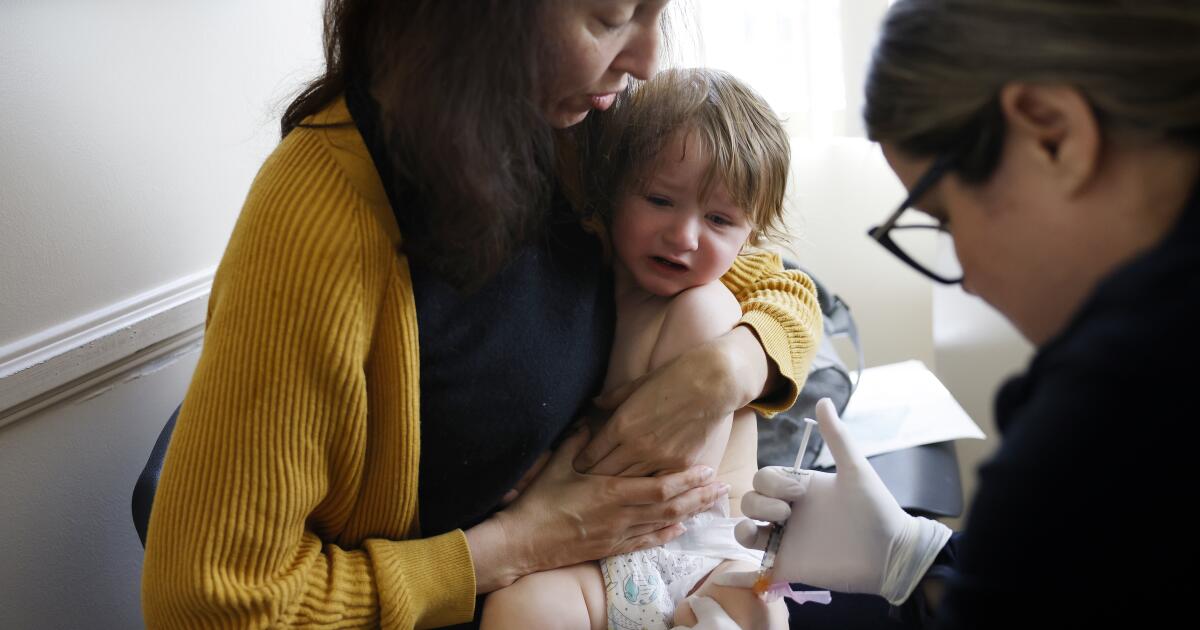
As measles cases pop up across the country this winter — including several in California — one group of children is stirring deep concerns among pediatricians: the babies and toddlers of vaccine-hesitant parents who are delaying their child’s measles-mumps-rubella shots.
Pediatricians across the state say they have seen a sharp increase recently in the number of parents with concerns about routine childhood vaccinations who are demanding their own inoculation schedules for their babies, creating a worrisome pool of very young children who may be at risk of contracting measles, a potentially deadly yet preventable disease.
“Especially early on, when a parent is already feeling really vulnerable and doesn’t want to give something to their beautiful baby who was just born if they don’t need it, it makes them think, ‘Maybe I’ll just delay it and wait and see.’” said Dr. Whitney Casares, a pediatrician and author who has written on vaccination for the American Academy of Pediatrics. “What they don’t realize is if they don’t vaccinate according to the recommended schedule, that can really set their child up for a whole lot of risks.”
It is difficult to know how widespread such delays have become. California keeps careful track of the rate of kindergartners who have been vaccinated against measles, but does not have comprehensive data for children at younger ages.
Dr. Eric Ball has seen the shift firsthand. At his Orange County pediatric practice, Ball said, he has noticed an increase in parents asking about delays since the COVID-19 pandemic, as politicization of and misinformation about that vaccine has seeped into discussions about routine childhood vaccinations, including measles-mumps-rubella, known as MMR.
Dr. Eric Ball examines 9-month-old Noah at Southern Orange County Pediatric Associates in Ladera Ranch on Feb. 28.
(Christina House / Los Angeles Times)
Rather than an outright refusal, however, these vaccine-hesitant parents express a softer kind of reluctance, asking if it’s possible to use an “alternative schedule” of vaccines, rather than sticking to the Centers for Disease Control and Prevention’s recommendations. Sometimes they seek to delay the shots by a few months, and sometimes by several years.
“I have patients who have three kids, and they vaccinated the first two kids on schedule. And then since COVID, with their third kid, they are like, ‘I don’t know if this is safe. I want to wait until the kids are older’, or ‘instead of doing two shots today, I want to do one shot,’” said Ball. “It just prolongs the time where you have a child who’s unprotected and potentially can get sick from these diseases.”
He tries his best to explain to parents the importance and safety of vaccines, including MMR. He even brings out his own children’s vaccine records to prove his point, and he is often successful. But not always.
At Children’s Hospital Los Angeles, attending pediatrician Dr. Colleen Kraft said about half of parents are questioning the CDC’s recommended vaccine schedule — a significant increase since the pandemic.
“Even my most reasonable parents ask questions. So it’s definitely in the mainstream,” she said. She also worries about her patients who are behind on vaccines because they missed so many appointments during the pandemic and are only now returning to her office.
Karla Benzl holds her son, 15-month-old Marcus, before he gets vaccinated at Southern Orange County Pediatric Associates in Ladera Ranch on Feb. 28.
(Christina House / Los Angeles Times)
In Marin County, parents’ requests to delay vaccinations have become so frequent that Dr. Nelson Branco said last month his practice decided to tighten vaccine requirements as cases of both measles and pertussis have spread. Babies seen by doctors in the practice will need to have their first set of vaccines completed by 4 months of age. The primary series of vaccines against the most serious and common diseases, including measles, must be completed by 24 months.
If parents don’t agree, they must leave the practice.
“Kids are doing a lot of things that are high risk before they’re 5 and are required to be vaccinated to attend kindergarten, said Branco. “They’re getting on international flights, they’re going to Disneyland where there are lots of kids,” leaving young children vulnerable to measles when they could be protected.
The CDC recommends that the first dose of MMR be given when a baby is 12 to 15 months old. Usually this happens at a child’s 12-month well visit. A second dose is then given at 4 to 6 years of age.
At least 95% of people in a community must be vaccinated to achieve a level of “herd immunity” that protects everyone in a community, including those who cannot get the vaccine because they are too young or are immunocompromised, according to the World Health Organization.
Low vaccination rates have led to measles outbreaks in several states over the last decade, most recently in Florida.
Nationally, the rate of kindergartners fully immunized against the measles dropped from 95% in the 2019-20 school year to 93% in 2022-23, according to the CDC.
But there is overall good news in California. Since the state’s 2015 ban on parents’ personal beliefs as a reason to skip vaccinating children before school, the measles vaccination rate for kindergartners has grown from 92% in the 2013-2014 school year to 96.5% in 2022-2023.
Are you a SoCal mom?
The L.A. Times early childhood team wants to connect with you! Find us in The Mamahood’s mom group on Facebook.
Share your perspective and ask us questions.
But those postponing vaccinations have created a potential vulnerability gap in a child’s first four years.
One in 5 unvaccinated people who get measles in the U.S. will be hospitalized. Since there is no good treatment for measles, doctors can often do little more than offer supportive care. One in 1,000 children with measles will develop brain swelling that can leave a child deaf or with an intellectual disability; 1 to 3 children in 1,000 will die, according to the CDC.
Measles is so contagious that 90% of people close to an infected person will catch it if they are not immune, according to the CDC. The virus can remain contagious in a room or on a surface for up to two hours after the infected person has left.
In the Children’s Hospital Orange County primary care network, which has more than 130 pediatricians, the share of 15-month-olds with an MMR vaccine has been dropping consistently over the past last few years, from 98% in 2019, down to 93.5% in 2023.
For years in the early 2000s, anti-vaccine sentiment was at an all-time high after the publication of a now-debunked and retracted study that falsely tied the MMR vaccine to autism. In December 2014, an unvaccinated 11-year-old was hospitalized with measles following a visit to Disneyland. Over the next few months, measles spread to 125 people across seven states.
The outbreak helped galvanize support for vaccination nationwide. A year after the Disneyland outbreak, California passed its ban on personal exemption.
“The pendulum swung back the other way, and we had a few years where vaccination rates were really high,” said Ball. But the rumors and rhetoric surrounding the COVID vaccines have caused the pendulum to swing in the other direction. “We’re back to dealing with conspiracy theories, things that people heard on the internet, or something that their cousin’s neighbor’s roommate said. It’s really hard.”
Noah, who is 9 months old, gets his measurements taken by medical assistant Shellee Rayl at Southern Orange County Pediatric Associates in Ladera Ranch on Feb. 28.
(Christina House / Los Angeles Times)
A Pew Research poll conducted in March 2023 found that 88% of Americans are confident that the benefits of an MMR vaccine outweigh the risks, a percentage that has remained fairly consistent since before the pandemic.
But support for all school-based vaccine mandates has fallen; 28% now say that parents should be able to decide not to vaccinate their children, even if it causes health risks for others, up from 16% in October 2019. Among Republicans, the share has more than doubled, from 20% in 2019 to 42% in 2023.
Support for the MMR vaccine was lower among parents with young children, the poll found. About 65% of parents with children under age 5 reported that the preventative health benefits of MMR were high — compared to 88% of all adults — and 39% said the risk of side effects was either medium or high; half said they worried about whether all childhood vaccines are necessary.
Tara Larson, a former ER nurse who lives in Santa Monica, said she became concerned about childhood vaccination when she was pregnant last year. She started watching anti-vaccine documentaries, reading vaccine safety inserts, and following several social media accounts “to make us an informed vaxxer. We’re not anti-vax,” she said.
Larson decided that she wanted to delay vaccinating her son until he was 3 months old, to limit him to just three vaccines in his first year that she felt were essential, and to spread them out so that he would only get one shot per month. “By the time he starts playing on the playground and goes to school, he’ll need to start his course of Hep B, but why overload his course of vaccines right now?” she said.
The first pediatrician she saw refused to follow her requested schedule. But, Larson said, “in my gut, I just felt like this is the right thing to be doing for our baby, and I left.” After weeks of searching, she found a holistic provider who charges a $250 monthly fee and agreed with her approach.
She said she hasn’t yet decided whether to give her son, who is now 8 months old, the MMR vaccine when he becomes eligible. “I think some doctors will say to wait until they’re 3, but that was when there wasn’t a resurgence of measles,” she said. “That’s my next thing to dive into.”
Karla Benzl of Mission Viejo comforts her 15-month-old son, Marcus, after he received his vaccinations.
(Christina House / Los Angeles Times)
But there’s no scientific basis and no known benefits to delaying vaccines except in very rare medical circumstances, said Casares, whose pediatric practice is in Oregon.
Casares said the problem is that parents have an “exposure bias.” They often consume an onslaught of information on social media about the risks, but very little about the benefits of vaccines or the enormous risks of the diseases themselves. She said in a country such as the United States, where vaccination rates are fairly high, most people don’t see the ravages that the diseases can cause if rates fall.
This article is part of The Times’ early childhood education initiative, focusing on the learning and development of California children from birth to age 5. For more information about the initiative and its philanthropic funders, go to latimes.com/earlyed.


new video loaded: NASA Announces Artemis III Crew
transcript
transcript
NASA Announces Artemis III Crew
NASA announced the crew of Artemis III mission, which will fly to low-Earth orbit to test rendezvous and docking maneuvers with one or two lunar landers.
-
“I am excited to welcome you as the next crew in the Artemis journey to successfully return to the moon — this time to stay.” “I’m honored by the role that I’ve been given. I’m also very humbled by the task in front of us. But first and foremost, I’m grateful.” “So with that, the Artemis II crew, comrade, hands you the baton. You got the controls.” “As you know, we had a significant anomaly at our Launch Complex 36A on May 28. We’ve redoubled our efforts and are moving forward.”
By Alisa Shodiyev Kaff
June 9, 2026
Science
Santa Monica Mountains’ last steelhead trout survived the Palisades fire — and even had babies

Scientists feared the Santa Monica Mountains’ last remaining steelhead trout were dead, smothered by debris flows unleashed by the Palisades fire.
But the endangered fish surprised them: A team of biologists recently spotted 30 of the rare trout — and 21 babies — in Topanga Creek.
“There was a lot of happy dancing in the creek,” said Rosi Dagit, principal conservation biologist for the Resource Conservation District of the Santa Monica Mountains, which works with public and private landowners to conserve natural resources.
That’s because the steelhead here are endangered, at both the state and federal levels. Once, they swam in most streams of the Santa Monicas, but their numbers plummeted amid overfishing and coastal development. Increasingly frequent wildfire has further stressed their habitat. Topanga Creek, a biodiversity hot spot, is home to their last known population in the mountains that stretch from the Hollywood Hills to Point Mugu in Ventura County.
The trout that were spotted, including this one, are part of a distinct Southern California population that’s listed as endangered at the state and federal levels.
(RCDSMM Stream Team)
The California Department of Fish and Wildlife spearheaded a complex mission to rescue trout threatened by the Palisades fire that sparked in January 2025.
Time was of the essence. The fire hadn’t yet been fully contained. But rain was on the way, which would sweep massive amounts of sediment from the denuded hillsides into the water. Fish are often killed this way.
Crews stunned the fish with electricity, scooped them up in buckets, trucked them to a hatchery and ultimately moved them to Arroyo Hondo Creek in Santa Barbara County.
Within days, Topanga Creek was choked with mud. Some assumed the fish left behind were goners.
But in March, the conservation district’s team found four. The following month, when water conditions were clearer, they saw more.
“These fish continue to amaze me,” said Kyle Evans, environmental program manager for the state Department of Fish and Wildlife, who had seen the damage to the creek. “I had seen populations get wiped out in similar situations. So when I heard, I was thrilled.”
Evans surmises the fish that survived were in an area of the creek where less charred material and sediment were swept in.
“These fish likely hunkered down, were hiding under some rocks or places to try to get away from the main concentration of flow,” he said. “And luckily they weren’t buried.”
The ones that were spotted were fairly small, around 6 to 14 inches. Rainbow trout and steelhead trout are the same species, but with different lifestyles. If the fish remain in freshwater, they’ll be considered rainbows. However, they can migrate to the ocean and become steelhead, where they typically grow larger before returning to their natal waters to spawn.
Topanga Creek hasn’t fully recovered from the damage it sustained, but scientists say it’s looking better. Surveys last year were “so depressing,” Dagit said, with very few animals, and stretches that were essentially transformed into flat roads from all the sediment buildup. Some of the riparian canopy burned right down to the creek.
Then came 32 inches of rain over the last nine months, scouring out and moving sediment, creating deeper pools. Dagit said they recently found newt egg masses for the first time in years, as well as a few adult newts and many frogs. Plants that provide cover are starting to recover.
She provided photos comparing certain pools last year and this year, some dramatically transformed. In September 2025, the Shrine Pool could have been an overgrown hiking trail. This April, it was filled with shallow water.

The Shrine Pool in September 2025, left, and the same location in April 2026, right, with RCDSMM’s Isaac Yelchin donning a wetsuit.
(RCDSMM Stream Team)
Topanga Creek is home to another endangered fish, the small but hardy northern tidewater goby, often described as cute. Not long before the trout operation, Dagit led a rescue of hundreds of these fish too. Many were repatriated to the lagoon at the mouth of the creek in a moving ceremony last June.
There’s still the matter of what to do with the trout that were moved to Santa Barbara County last year. Evans would like to bring them home to the Santa Monicas at some point, but isn’t sure if it will happen. On one hand, they could bolster the small, genetically isolated surviving population. On the other, they might inadvertently bring in a disease or bacteria. There is some time to decide. Evans estimates the creek still needs to recover for two to three more years.
For now, the fish are functioning fine in their adopted creek. Experts worried the trauma wrought by the move would disrupt their spawning process, but they had babies that spring. This year, they spawned again.

The Pacifica Municipal Pier was shut down and taped off Thursday after city workers noticed cracks running through the landmark structure and concrete chunks falling into the ocean.
It’s just one of many coastal California structures that have recently crumbled under pressure from a rising and relentless ocean.
Officials from the small, beach city south of San Francisco said the pier was closed due to “cracking, separation, and displacement of the concrete walkway and structural elements.”
It will stay closed while structural engineers asses its safety.
Photos taken by city employees show a wide crack that runs from top to bottom and across the structure as well. Other photos show a large horizontal crack under the foundation of a small restaurant on the pier, the Chit Chat Cafe.
The cafe was also shut down.
This is not the first time the 53-year-old pier has shown signs of stress. In 2021, part of it was shut down after handrails along the edge collapsed. And in 2023, after a series of storms pummeled the Central California coast, damaging parts of the pier, the structure was partially closed for more than year.
Those same storms caused extensive damage in Aptos and Capitola, 70 miles south, where piers and waterfront infrastructure were swept away or damaged.
In 2024, a 150- to 180- foot section of the Santa Cruz wharf was ripped off by powerful waves.
At least 10 of the state’s dozens of coastal public piers were closed for part or all of 2024 due to structural damage sustained in winter storms since 2022. At least five others have longer-term upgrades planned to address structural issues.
“These things are costly to maintain,” said Zach Plopper, senior environmental director at Surfrider. “They are a part of our California coastal culture in many ways, but we’re going to need to reckon with, one, the state that they’re in, and two, the continuous and worsening threats they’re going to experience,”
He said most of the piers were constructed in the early 1900s, and they weren’t built to withstand decades of rough seas, storms and rising sea level.
“With this incoming El Niño, which is forecasted to be significant, and this marine heat wave we’re in the midst of, we’re kind of in uncharted waters as far as what this winter could bring in terms of storms and swells to the California coast, and we’re likely going to see a lot more damage,” he said. “Not just piers, but roads and other coastal infrastructure up and down the state.”
There was no storm in Pacifica earlier this week, so no single event could be blamed for the destruction.
However, a 2025 report from an outside engineering firm, GHD, found that several sections of the pier were in “poor” or “serious” condition, and they recommended closure before anticipated storms or events that could “subject the piles to high winds, swells and large waves.”
The firm found several areas of the pier where concrete was missing and rebar was exposed and corroding.
“The pier has continued to experience high winds and large waves in a harsh marine environment,” the engineers wrote in the report, noting that continuous exposure to seawater or marine spray was “detrimental” to the structure.
A 2023 city report estimated it would cost $19 million to repair.
That same year, a state law was enacted to require local governments along the California coast to plan for sea level rise in the coming decades.
Sea level has risen some 8 inches, on average, along the coast in the past 150 years, Plopper said, and researchers anticipate another foot in the next 25 years.
“We’re going to see profound shifts on our coastline, none that we have ever experienced before, and building static structures on the coast just doesn’t work all that well,” he said. “We’re going to have to make some really hard decisions.”
-
 Politics2 minutes ago
Supporters of L.A. County healthcare sales tax declare victory
-
 Sports14 minutes ago
USC freshman linebacker Talanoa Ili joins lawsuit seeking to upend new NIL system
-

 World22 minutes ago
Who has the most and fewest judges in the EU?
-
 News42 minutes ago
In Nevada, Trump’s policies are making things tough for Republican Gov. Joe Lombardo
-

 New York2 hours ago
This Parking Spot Is Free. Should It Be?
-

 Los Angeles, Ca2 hours ago
O.C. Uber customer says driver asleep in Tesla on 405 Freeway
-

 Detroit, MI2 hours ago
One person dead, another in custody following shooting in Detroit, police say
-

 San Francisco, CA3 hours ago
Bay Area artists celebrate Wong Kim Ark’s legacy in San Francisco’s Chinatown

