Sports
The hockey brawl that changed the NHL forever, told by those who lived it


It looked for a while that the game between the Philadelphia Flyers and Ottawa Senators on March 5, 2004, might come and go without incident.
That was a bit surprising because eight days earlier, Ottawa’s Martin Havlat whacked the Flyers’ Mark Recchi in the face with his stick and afterward, heated words and insinuations flew. The Flyers were irate about the play and Havlat was suspended two games.
“Someday someone’s going to make (Havlat) eat his lunch,” Flyers coach Ken Hitchcock said.
“It might not come from our team,” Recchi said, “but he better protect himself.”
In the rematch, though, the first 58 minutes passed quietly as the Flyers built a multi-goal lead on the way to a 5-3 victory. But those last minutes were anything but quiet. And when it was over, officials tallied up a record number for penalty minutes in an NHL game (419) that still stands.
Another lasting outcome from that night: New league rules were implemented for the start of the 2005-06 season, the first after a lockout killed the 2004-05 season. Players who instigated a fight with fewer than five minutes to go were given a one-game suspension and the coaches of those players would be fined $10,000.
Twenty years later, fights in the waning minutes of games are almost non-existent. Here’s how it all went down.
Senators forward Martin Havlat, speaking about the previous game that started it all: I had a forearm into Mark Recchi. I don’t think I hit his face, but I hit him for sure. I kind of lost it a little bit, so I got suspended for two games. My first game back after the suspension was of course in Philly. (Hitchcock) said someone would make me eat my lunch, right? I remember that quote.
Flyers forward John LeClair: That’s what started it, obviously. Nobody forgets that kind of stuff.
Flyers forward Mark Recchi: I remember Havlat got suspended, and they suspended him (two) games and we played them the (third). (League disciplinarian) Colin Campbell did a good job there.
Flyers goalie Robert Esche: There was bad blood going in.
Senators forward Daniel Alfredsson: We talked about it, but we didn’t think anything was going to escalate to that extent. Would something happen? Probably.
Havlat: I remember being in Philly the day before and I was sick. I wasn’t feeling well. I was like, “If I call in sick and don’t show up, everyone is going to think that I’m a loser and I’m scared.” I wasn’t feeling well, but I knew I had to play.
The first fight takes place at 18:15 of the third period, when respective tough guys Donald Brashear of the Flyers and Rob Ray of the Senators drop the gloves. Other fights broke out during the stoppage, including goalies Robert Esche (Flyers) and Patrick Lalime (Senators).
Esche: Brash had it made up in his head how that night was going to go. He went up and down the ice and then he started fighting (Rob Ray). It was a good fight. Brash was doing a great job. Everybody is kind of watching the fight … and then all hell broke loose.
Flyers forward Donald Brashear: Like any other game where guys’ emotions run up, you want to make something happen or you want to get respect back. Something had to be done. I fought Ray a few times. He was a good fighter. He was doing his job and I was doing mine, and we both tried to do the best we can. Sometimes it gets ugly, but that’s the name of the game.
Flyers coach Ken Hitchcock: Everybody knew how tough Brash was but I always thought that Brash was a way better player than people thought. Way better. … I thought he was really a dependable player that could manage the puck and manage the game properly. I had a lot of trust in Donald.
Senators forward Rob Ray: If I remember correctly it was just us battling in front of the net. And then it just escalated into a fight. It was just two guys looking to get their teams fired up. Then everybody jumped in. It seemed like that sparked everything. It was just an emotional roller coaster from that point on.
Senators forward Shaun Van Allen: I couldn’t believe Brian Pothier jumped in and went after Donald Brashear after he fought Ray. I don’t know what set him off. It got out of control fast.
Flyers forward Patrick Sharp: I was on the ice just kind of chillin’, and found myself in a 6-on-6 brawl. I was in the first wave of the brawls. I actually got pounded pretty good. Todd Simpson grabbed me. There’s a fight between Brash and Rob Ray, and another one escalated. That’s when Eschey and Patty Lalime went at it.
Esche: I remember Danny Markov laying on the ice and there was a scrum going on, I went over to go pick somebody up, and I turn around and Patrick Lalime is right there — no helmet, no nothing. I was like, “What are you doing here?”
Senators goalie Patrick Lalime: Esche was in the middle of it all. That’s when I said, ‘I’m going down there.’ And I didn’t care. I knew he was a tough guy. But I got rid of all my stuff because I didn’t want to be weighed down by my glove, blocker and mask. And I knew I had to get his mask off.
Senators forward Chris Neil: Patty Lalime was awesome. For him to come down and do what he did, he’s just a great team guy. For him, he had a big smile on his face.
Lalime: After we were done fighting each other, we were just along the boards. I was just exhausted. I said to Esche, “I’m dead.” He said, “Me too.” So we made an agreement. No cheap shots. Nothing dirty. And I think that was a sign of respect. And every time I passed him after that, we always said hi to each other.

After play resumed came another series of fights. In a 6-second span on the game clock, six players were issued fighting majors: Chris Neil, Zdeno Chara and Mike Fisher from Ottawa, and Radovan Somik, Mattias Timander and Michal Handzus from the Flyers.
Esche: Once it got to a tipping point, which it clearly did the next shift, it was just going to continue to unravel.
Hitchcock: It was an emotional time, they were emotional games. Two really good teams. But I was really angry (because) the players that were being attacked, they weren’t scrappers or fighters or anything.
Flyers GM Bob Clarke: I was watching from the press box obviously as the manager. For me, Jacques Martin premeditated that. He had all tough players on the ice and the Flyers had four Europeans. As it turned out, our Europeans got beat up.
Senators coach Jacques Martin: I’ve never sent a guy out to fight in my entire career. I don’t believe in sending a guy over. When there are fights in hockey, I think that’s fine. But I don’t think I’ve ever been a proponent of going after people.
Van Allen: That would have been out of Jacques’ character to do that. I played for him for about six years. And he never asked anybody to fight – ever.
Neil: We made that decision as players. I said to Martin Prusek (the Senators backup goalie, who entered the game after the first fight), “As soon as the puck is dropped, skate down and grab their goalie. Because we’re all going.” We all knew what we were doing. Then after my fight I looked down the ice and I see Prusek still standing at his net and his arm over the crossbar. He didn’t understand a word I said because he didn’t fight.
Lalime: I think Prusek was being smart. Sean Burke was their other goalie. And I think Burkie was ready to go.
Another wave of fights came at 18:45 of the third. Recchi fought with Ottawa’s Brian Smolinski, while LeClair and Wade Redden paired off.
LeClair: Some of it was guys picking the wrong guys to dance with. So, all right, you’re going to do that, and the next shift up we’re going to do this.
Recchi: I saw Johnny (LeClair) all of a sudden was fighting somebody and I just turned around and grabbed the first guy, and, let’s go. And everybody else was going, as well. It’s what you do as teammates, and we were a team, and we wanted to show that.
Havlat: Zdeno Chara got an instigator penalty and Jacques saved my life that night. He sent me to the penalty box to serve that instigator. And that way I was safe. So that was my participation in the fight. Smolinski fought Recchi right in front of the penalty box and I thought, that could have been me. And I don’t think I would have done as well as Smoke.
Lalime: I think they really wanted to get at Marty. But he was inside the box.
Flyers defenseman Chris Therien: It’s one of those things where it gets crazy, but it gets to a point where it ends up being more like a WWE event than an actual hockey game, and that’s what happened.
Alfredsson: Well, I didn’t have a fight in that game. And the last minute and a half probably took about a half hour to actually play. I remember looking up during one of the faceoffs and we have four coaches and three players on the bench.
Neil: Guys were coming off and high-fiving each other inside the locker room. The adrenaline was going. Behind the scenes, it was really intense.
The final fight happened on the ensuing face-off, at 18:47 of the third, when Patrick Sharp and Jason Spezza dropped the gloves.
Senators forward Jason Spezza: I was thinking, ‘Who am I going to fight? When am I going to fight? And I better make sure I fight because in a game like that, you don’t want to be the only guy who doesn’t fight.
Sharp: The building was rocking. They’re sorting out the penalties, and Hitch came over and tapped me on the shoulder and said, “When 39 gets on the ice, you’re up.” And I’m thinking, who the heck is 39? Is that Dominik Hasek? Then I looked over and it’s Jason Spezza. … It’s one thing to fight when you’re in the NHL when it’s spur of the moment, but when you have time to sit there and think about what’s coming, you get little butterflies in the stomach. I looked over and saw Simon Gagne and he just gave me a look, like, good luck man.
Spezza: Jacques was much quieter. He didn’t say anything about it, but I remember the refs coming to our bench and saying, “That’s it. No more fights.” And I’m thinking to myself, “No way am I done. I have to fight in this game.” When I got out to that draw, Sharpie said to me, “We’re going.” And I felt like we were the two young guys who didn’t want to get left out.
Hitchcock: (Martin’s) bench was shorter than mine. I just said to myself, screw it. … I’m going to try to run him out of players.
Clarke: Patrick Sharp was going against Jason Spezza. He’s a Canadian, he could fight. Jason Spezza got the short end of that one. He was the only one we won.
Neil: Spezz getting 35 minutes in penalties, we use that as a trivia question sometimes. But he got all those minutes because he had no tie down (as required by league rules to prevent the jersey from coming off), he was the instigator and he fought with a visor. I wish I had that on my card, but I didn’t wear a visor.
Spezza: I used to joke with Neiler about it. I think he has every other fighting record in team history. I don’t think I have any other Sens records, but I got that one.
After the game, Clarke was so upset that he attempted to find Martin in the visitors’ dressing room.
Clarke: Foolishly, I was so mad at what Jacques Martin did, because he had planned it. … I was pissed and I went down (to the visiting dressing room). I said to their PR guy, could I see Jacques Martin? He said, “I don’t work for you.” And he was right. So, I left.
Martin: I guess they wouldn’t let him in. I think our coaches office at that time was actually part of the visiting dressing room. Just a little office. And someone told me afterwards that Bobby was trying to get in. And he was trying to get at me.
Ray: I heard about him coming down and being pissed off and blaming our side for everything. But you know what? Bobby Clarke has done some things over the years. I remember playing against the Flyers in the playoffs one year with Buffalo. And he wouldn’t turn the lights on in the arena for our practice. Another time, we broke a cheap fan in our dressing room and he sent us a bill for like $2,500 to replace it. I appreciate him, but he always took things to extremes. So I think this was him just trying to be a part of it.
Recchi: To me, fighting is fighting, but the way we handled it as a team and the way Ottawa handled it, I think it hurt Ottawa. They kind of went one direction and we went the other because of the way we handled it, and the way everybody was involved. Everybody. Every top skilled guy, to our role guys. They didn’t do that, and I think it kind of divided their dressing room a little bit and brought us even closer. I really feel that way.
Alfredsson: We stood our own ground and pushed back. I think it was something that helped us as a team for sure.
Ray: There was only one person pissed off and I think that was Jacques. He hated that stuff. I could see in his face, he didn’t like that stuff. I think he was the only one in the group who didn’t like it. I think for so long that group was pushed around. And that night, the players learned they could push back. And that did a lot for them.
Esche: We thought it was comical, we thought it was awesome, entertaining. Fun to be a part of.
Lalime: I don’t like fighting, but that whole night was a great hockey moment.
Clarke: It was just foolishness. They all laughed about it after. But I didn’t think it was much fun.
Neil: At the end of the day, we had four guys getting stitched up. They had six, so I think we won the war.
(Illustration: Daniel Goldfarb / The Athletic. Photos: George Widman, H. Rumph Jr. / Associated Press; Dave Sandford / Getty)



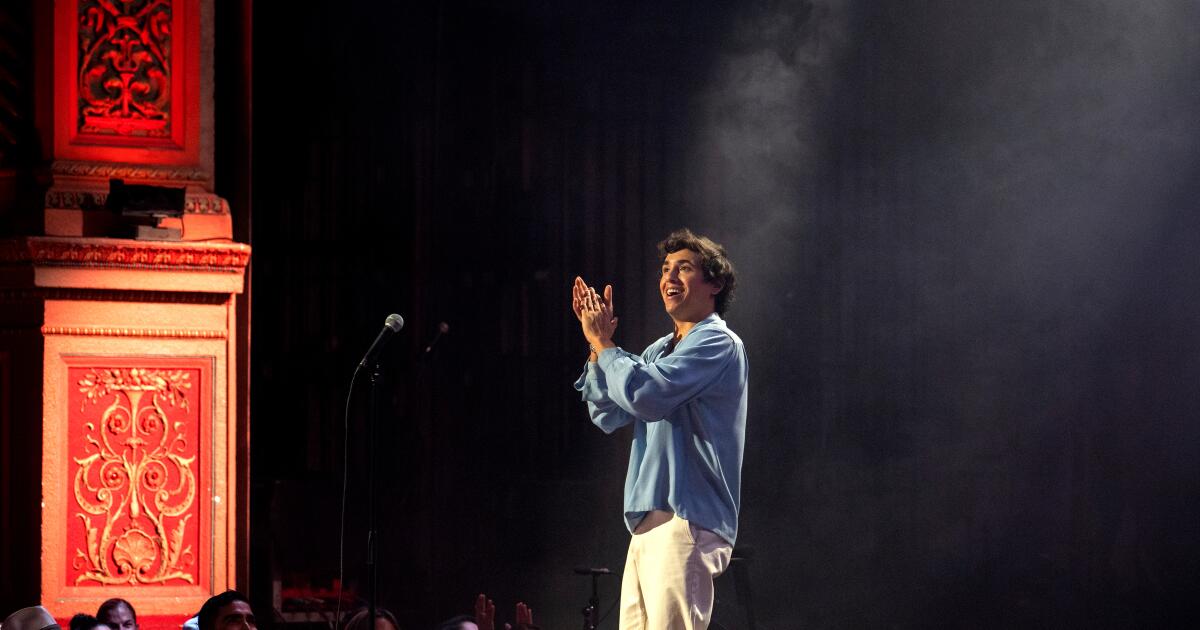
Comedian and “Saturday Night Live” standout Marcello Hernández will host this year’s ESPY Awards, ESPN announced Wednesday.
The event, honoring excellence in sports performance, will be broadcast live on ABC and the ESPN app from the David H. Koch Theater at Lincoln Center on July 15, making it the first ESPYs in New York City since 1999. For the last 25 years, the awards ceremony was held in Los Angeles.
“I started doing comedy 10 years ago, in Cleveland, Ohio, and I would take the train 12 hours to New York to sell comedy tickets on the street in Greenwich Village in exchange for stage time,” Hernández said in a statement. “It is an honor, and frankly feels crazy to be hosting the ESPYs this year in New York. I’m sure the energy is going to be great.”
Hernández recently headlined the biggest Spanish-language comedy show ever at the Hollywood Bowl as part of the Netflix Is a Joke Festival in May, and wrapped up his fourth season of “SNL” soon after. His first stand-up special, “American Boy,” premiered on Netflix in January.
He’s also a sports enthusiast, having grown up playing soccer and competing at the collegiate level during his time at John Carroll University in Ohio.
“Marcello is one of the most electric, young comedians today. His genuine enthusiasm for sports and his ties to New York City make him a natural fit to host this year’s ESPYs,” Craig Lazarus, ESPN vice president and executive producer of the ESPYs, said in a statement.
Hernández succeeds last year’s emcee, comedian Shane Gillis, as well as past hosts that include Jimmy Kimmel, John Cena, LeBron James and Peyton Manning.
In January, Puck reported that the change in venue is an effort to capitalize on the popularity of Fanatics Fest, the massive sports festival taking place in New York’s Javits Center from July 16-19, which also coincides with the World Cup final on July 19 at MetLife Stadium in New Jersey.
“This return to the heart of Manhattan brings the celebration of sports back to its roots for an unforgettable night at an iconic cultural landmark,” an ESPN spokesperson said in a statement.
Sports
AJ Brown trade outcome: Dianna Russini paid a heavy price while Mike Vrabel emerged unscathed

NEWYou can now listen to Fox News articles!
Mike Vrabel and A.J. Brown were winning on Tuesday because the long-rumored trade that reunited them was finally complete. Brown was free of his recent unhappiness with the Philadelphia Eagles, while Vrabel spoke easily and smartly about how his Super Bowl team was getting better.
It was one lovely victory lap for everybody.
Except for Dianna Russini.
New England Patriots head coach Mike Vrabel celebrates after the AFC championship game against the Denver Broncos at Empower Field At Mile High in Denver, Colo., on Jan. 25, 2026. (Cooper Neill/Getty Images)
MIKE VRABEL BREAKS HIS SILENCE ON DIANNA RUSSINI CONTROVERSY
Yes, this is about her as much as Vrabel and Brown. Those three names will be linked for a long time in NFL circles based on what happened going back as far as September of 2025, and then definitely through this offseason that was about, well, the relationship between the coach and the reporter.
If you aren’t up to speed on that relationship, you’ve got homework. And you will probably catch up easily because the reference material is everywhere — the photos of Russini and Vrabel together, the denials of anything untoward between two married people, the collapse of the professional friendship narrative, and everything after.
So, to the uninitiated, you’re excused. Go now and read the soap opera’s opening chapters. Because this might be the saga’s end, barring a major surprise.
And let me cut to that end:
Philadelphia Eagles wide receiver A.J. Brown walks on the field during an NFL training camp in Philadelphia on July 29, 2025. (Matt Rourke/AP Photo)
Brown wins. He’s wholly unscathed, in fact, and happy as a clam with a new team he grew up adoring.
Vrabel wins, too. Yes, he took some lumps, suffered some humiliating moments in front of reporters and had some family conversations he termed “very difficult,” but he’s ultimately none the worse for wear.
And then there’s Russini. She lost. Big time.
FORMER NFL REPORTER MICHELE TAFOYA WEIGHS IN ON WHY RUSSINI’S CREDIBILITY IS GONE
It was saddening to watch Vrabel’s presser because it was Russini who first reported teams were calling the Eagles about Brown back in September of 2025. She first reported the Eagles weren’t interested in trading Brown.
Russini called it when she told everyone the Patriots were interested (so were the Los Angeles Rams, by the way). And she was right again when she said earlier this year that Brown wouldn’t be traded around the start of the league year in March but watch out for June.
She was dead-on accurate with practically all of it.
Dianna Russini, left, and Mike Vrabel, right, are shown in a split composite image featuring Russini with an ESPN microphone and Vrabel on the Titans sideline wearing a headset. (Imagn Images)
But everyone has surmised all that information came out of her relationship with Vrabel. All that insider work came from other alleged inside work.
Russini’s information was great but how she seemingly attained it eventually led to her resigning from The Athletic. And sullying her professional reputation.
Losses.
MIKE VRABEL STEPS AWAY INDEFINITELY TO SEEK COUNSELING
Vrabel? He seemed just fine on Tuesday.
About the hardest thing he had to do was answer a question about Brown’s obvious displeasure last year in Philly.
“I don’t know what happened,” Vrabel said. “I’m not trying to figure out what happened in Philadelphia. I’m trying to focus on what’s going to happen here and trying to get him acclimated to what we do and how we do it.”
Vrabel, during this press conference, congratulated a reporter for winning a marathon. He thanked Executive Vice President for Player Personnel Eliot Wolf for making the trade happen. And he took a bunch of football questions.
Dianna Russini attends the 2026 Fanatics Super Bowl Party at Pier 48 in San Francisco, California, on Feb. 7, 2026. (Cindy Ord/Getty Images)
CLICK HERE TO DOWNLOAD THE FOX NEWS APP
There was not one question about whether he indeed for months leaked to Russini details of where the Patriots and Eagles talks were. Not one question about how his family “counseling” sessions are going or if his marriage is certain to survive.
There was nothing uncomfortable because it seems the local media lost interest or its curiosity on a day the story that Russini beat them on for months was laid bare before them.
And, the thing is, if Vrabel didn’t have to sweat this occasion, he’s probably in the clear. He’s not likely to get tough questions about the whole affair (pardon the pun) again unless more facts come out that raise the issue from the grave.
So, yeah, Mike Vrabel has survived. He’s won.
FOLLOW ARMANDO SALGUERO ON X: @ARMANDOSALGUERO

Reaching the summit is a dream. But staying there? That’s an altogether different challenge.
Maja Stark has a special appreciation for that now, a year after winning the U.S. Women’s Open at Erin Hills and feeling the hefty weight of expectation that came along with it.
For her, the aftermath of that victory brought heightened anxiety, and searing criticism from outsiders when the Swedish professional’s play took a dip.
“You get comments and stuff saying, ‘What happened? You just won a major; why do you suck all of a sudden?‘” Stark said at the Chevron Championship in April. “That does take some energy and just makes you focus on the wrong things. Then I got even more stressed and anxious.”
Maja Stark plays a shot from a bunker on the 17th hole during the third round of the Chevron Championship on April 25.
(Alex Slitz / Getty Images)
Stark said she sought professional help in the form of a mental coach, sports psychologist and therapist and now believes she’s better able to withstand the scrutiny that comes with winning at the highest tier.
That career-shaping pressure will be on display again this week when the USGA brings the U.S. Women’s Open to Riviera Country Club for the first time, merging the game’s most prestigious women’s championship with a historic venue celebrating its centennial year. The tournament takes place Thursday through Sunday.
Riviera is a theater, sitting low beneath high hillsides that almost serve as balconies. Players have described the course as a stage because it can feel as if you’re being watched even when you’re alone.
“I think there’s something very nostalgic about the facility,” said Jim Richerson, Riviera’s general manager. “The golf course has never had any major renovations or changes. The clubhouse is the exact same footprint today as it was when it was built in the 1920s.”
The U.S. Women’s Open is the oldest of the LPGA Tour’s five majors, and has long served as the standard by which women’s golf measures itself. It’s open to professionals and elite amateurs through a qualifying process, and the tournament is known for identifying the player who can withstand the most pressure under the most demanding conditions.
NBC will televise the championship and although Mike Tirico will not call the event, he knows the significance of holding it at Riviera.
“Without there being a Masters for women’s golf, that tournament really is the crown jewel of the sport,” Tirico said. “It has become the event people dream of winning. … It’s just appropriate that it’s contested at a place like Riviera that for so many generations has come to define a great championship test of golf.”
A look at some of the players to watch:
Nelly Korda
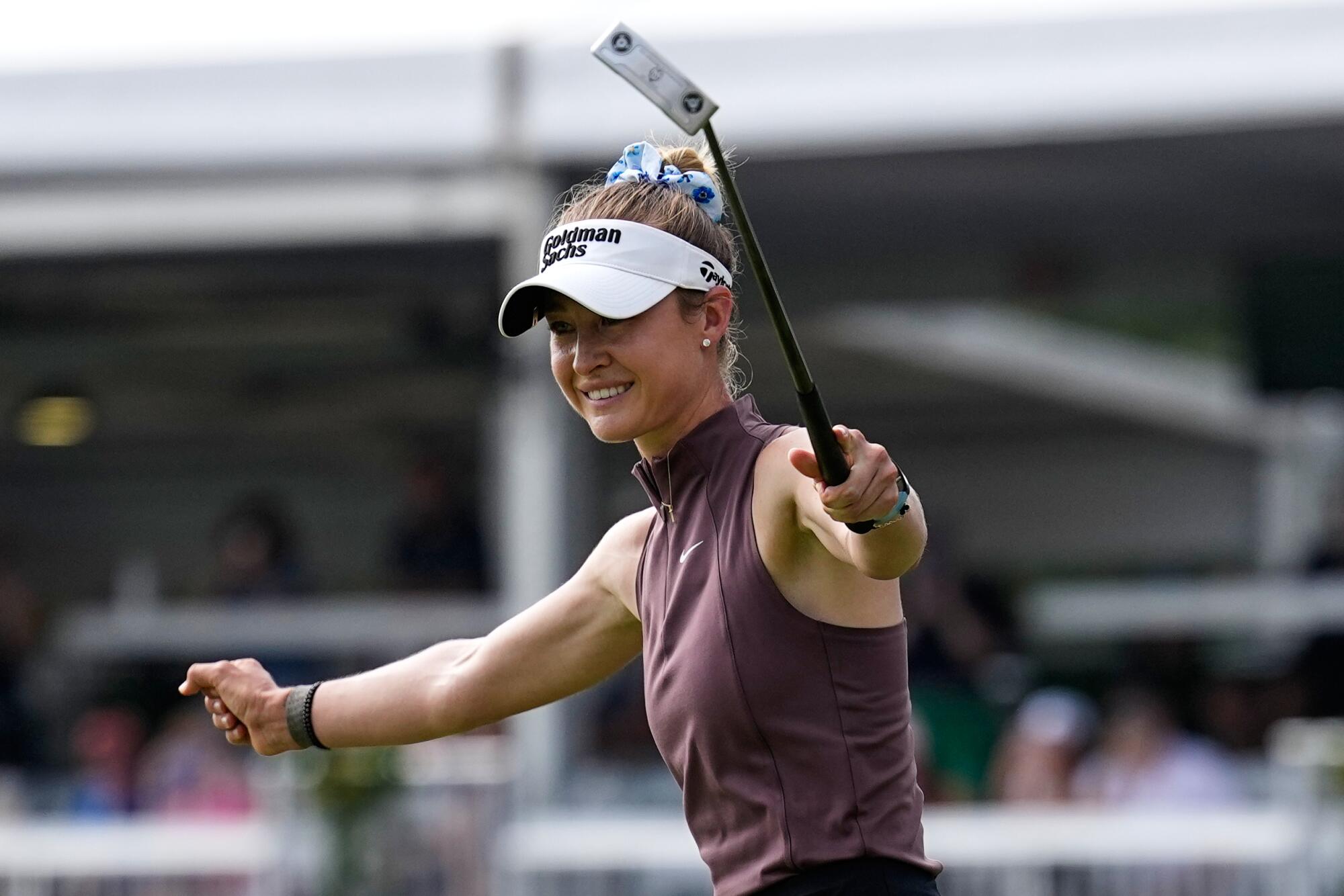
Nelly Korda celebrates after winning the Chevron Championship on April 26.
(David J. Phillip / Associated Press)
The world’s No. 1 player is a major needle mover for women’s golf and is a significant source of ratings when she’s in contention. She had a record five consecutive victories last season and seven overall. Her missing major is the U.S. Women’s Open. She finished in a runner-up spot last year and left Erin Hills firmly believing a win was within reach.
Jeeno Thitikul

Jeeno Thitikul plays a shot from the fairway during the first round of the Queen City Championship on May 14.
(Jeff Dean / Associated Press)
The former World No. 1 is still in pursuit of her first major championship. She’s a big question mark in the field.
Lydia Ko

Lydia Ko hits from the fairway during the second round of the LPGA Honda Thailand on Feb. 22.
(Kittinun Rodsupan / Associated Press)
This Hall of Fame player is the only golfer in modern Olympic history to win a complete set of medals — gold, silver and bronze — across three different Olympic Games. She’s still looking for her first U.S. Women’s Open win.
Charley Hull

Charley Hull hits off the 16th tee during the first round of the Mizuho Americas Open on May 7.
(Seth Wenig / Associated Press)
A colorful character who went viral during the 2024 Open for smoking a cigarette while signing autographs and playing. She was among a cluster who finished second in that tournament. She has three victories on the LPGA Tour but has yet to win a major.
Rose Zhang

Rose Zhang hits from the ninth tee during the final round of the Queen City Championship on May 17.
(Dylan Buell / Getty Images)
Zhang, who has been splitting time between Stanford and the LPGA, amassed a remarkable collection of victories as an amateur and three years ago, became the first player in 72 years to win an LPGA Tour event in her professional debut.
Minjee Lee

Minjee Lee prepares to putt during the third round of the Chevron Championship on April 25.
(Sarah Stier / Getty Images)
Lee, an Australian star, has won three majors including the U.S. Women’s Open in 2022. Her younger brother, Min Woo, won the 2016 U.S. Junior Amateur, making them the first brother-sister tandem to win the USGA’s junior championships.
Yuka Saso

Yuka Saso lines up a putt during the first round of the Mizuho Americas Open on May 7.
(Seth Wenig / Associated Press)
She is the anomaly of anomalies, with zero wins on the LPGA Tour with the exception of two U.S. Women’s Open victories. She won the first of those at 19 years, 11 months and seven days — astoundingly tying her for the youngest player to win the Open with Inbee Park, who was precisely that old when she won in 2008.
Lilia Vu

Lilia Vu watches her shot from the seventh tee during the third round of the Queen City Championship on May 16.
(Dylan Buell / Getty Images)
Vu grew up in Fountain Valley and was a standout at UCLA. She won two majors in 2023 but lately has been battling back problems.
Michelle Wie West

Michelle Wie West of the United States hits from the third tee during the first round of the Mizuho Americas Open on May 7.
(Sarah Stier / Getty Images)
Wie West retired three years ago after the Open at Pebble Beach, but is coming out of retirement to use her last year of exemption to play at Riviera. Her husband, Jonnie West, son of late NBA icon Jerry West, will be caddying for her.
-
 Entertainment2 minutes ago
Review: Muscling past a flat script, a big-screen ‘Masters of the Universe’ embraces its own silliness
-
 Politics14 minutes ago
Hilton and Becerra lead California’s unsettled governor’s race; Steyer faces elimination
-
Sports22 minutes ago
‘SNL’ star Marcello Hernández to host 2026 ESPYs as show leaves L.A. for New York
-

 World32 minutes ago
US House passes Iran war powers resolution in rare moment of Trump backlash
-

 News59 minutes ago
House votes to rein in Trump on Iran as war loses GOP support
-

 Los Angeles, Ca2 hours ago
Police investigate deadly stabbing in Tarzana; suspect in custody
-

 Detroit, MI3 hours ago
Detroit Tigers sweep Tampa Bay Rays in win as Dillon Dingler stays hot
-

 San Francisco, CA3 hours ago
Retired San Francisco firefighter dies from lung cancer after Blue Shield denies treatment claims

