Politics
Supreme Court rules Trump will stay on Colorado ballot despite Jan. 6 attack

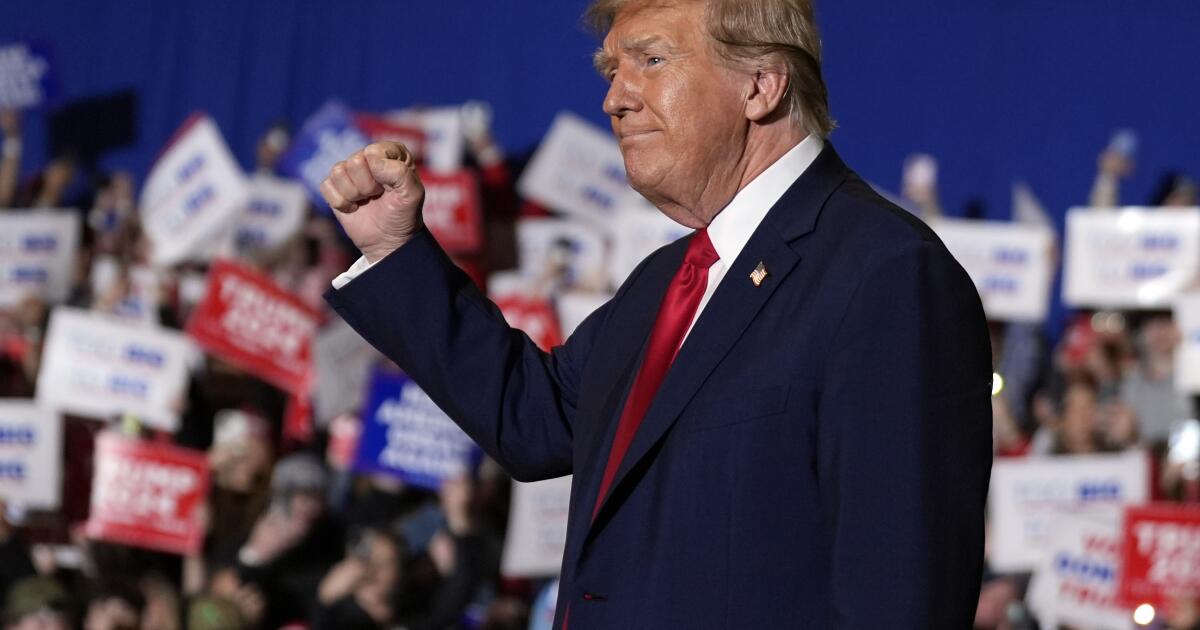
The Supreme Court ruled Monday that former President Trump may not be disqualified from appearing on state ballots despite allegations he “engaged in insurrection” after losing the 2020 election and thereby should be barred under the Constitution from holding office.
Reversing a ruling by Colorado judges, the high court said states do not have the authority to interpret the post-Civil War 14th Amendment or use it to remove a presidential candidate from the state ballot.
It was an unsigned, unanimous decision.
In December, the Colorado Supreme Court decided that Trump was disqualified from running for president because he violated Section 3 of the 14th Amendment. It says no person may “hold any office, civil or military” who took an oath to support the Constitution and then engaged in “insurrection or rebellion” against the United States.
Legal scholars and historians told the court in friend-of-the-court briefs that the Reconstruction Congress sought to prevent “insurrectionists” from gaining power and subverting American democracy.
The justices did not dispute that reading of history, but they appeared more concerned about allowing state judges to remove from the ballot a candidate who is the overwhelming choice of Republican voters.
“Because the Constitution makes Congress, rather than the states, responsible for enforcing Section 3 against federal officeholders and candidates, we reverse,’’ Monday’s ruling stated.
All nine justices said they agreed that Colorado or any state may not disqualify a presidential candidate based on the 14th Amendment.
But Justices Sonia Sotomayor, Elena Kagan, Ketanji Brown Jackson and Amy Coney Barrett objected to part of the court’s opinion that said Congress must enact a law to enforce this provision in the 14th Amendment.
“Today, the majority goes beyond the necessities of this case to limit how Section 3 can bar an oath-breaking insurrectionist from becoming president. Although we agree that Colorado cannot enforce Section 3, we protest the majority’s effort to use this case to define the limits of federal enforcement of that provision. Because we would decide only the issue before us, we concur only in the judgment,” the court’s three liberals wrote.
Barrett filed a similar concurrence.
“I agree that states lack the power to enforce Section 3 against presidential candidates. That principle is sufficient to resolve this case, and I would decide no more than that. … In my judgment, this is not the time to amplify disagreement with stridency. The court has settled a politically charged issue in the volatile season of a presidential election. Particularly in this circumstance, writings on the court should turn the national temperature down, not up. For present purposes, our differences are far less important than our unanimity: All nine Justices agree on the outcome of this case. That is the message Americans should take home. “
The court moved with uncommon speed to hear Trump’s appeal and to rule for him. His lawyers asked the court to review the Colorado case Jan. 3. Two days later, the appeal was granted, and arguments were held Feb. 8.
The justices ruled for Trump in less than a month and in time for his votes to be counted in Colorado’s primary election on Tuesday.
The court has moved less quickly to resolve Trump’s separate claim of presidential immunity from prosecution. As a result, the criminal trial over his role on Jan. 6 may not be held until after the November election.
Last week, the court announced it would hear Trump’s immunity claim, setting arguments for the week of April 22. Under that schedule, the justices are not likely to rule before June.
By then, it may be too late for the trial to be held before the November election.
The court’s Monday opinion does not discuss or decide whether Trump engaged in insurrection after losing the election in November 2020.
The lawyers who brought the suit in Colorado called that a victory of sorts.
“While the Supreme Court allowed Donald Trump back on the ballot on technical legal grounds, this was in no way a win for Trump. The Supreme Court had the opportunity in this case to exonerate Trump, and they chose not to do so,” said Noah Bookbinder, president of Citizens for Responsibility and Ethics in Washington or CREW.
Election law experts also noted the Colorado decision does not prevent members of Congress from objecting to Trump’s election if he wins in November.
“This decision does not resolve the contentious insurrection issues, which will remain live and disputed in the public domain in the months ahead,” said Derek Muller, a Notre Dame law professor. “But it shuts the door on any exclusion of Trump from the ballot in any state, either in the primary or the general.”

Politics
Expert who fled Cuba warns of ‘vicious cycle’ that will lead to ‘communists in double digits’ in Congress

NEWYou can now listen to Fox News articles!
A national security expert who fled to the U.S. from Cuba is warning that one “vicious cycle” currently dominating American politics could lead to “communists in double digits” serving in Congress.
Mike Gonzalez, a senior fellow at the Heritage Foundation who fled communist Cuba in the 1970s, said in an interview with Fox News Digital that the socialist “threat is real now.”
Gonzalez likened this trend to a “takeover of a host body, the Democratic Party,” saying, “It’s being taken over by body snatchers and they’re not able to mount any defense of it whatsoever even if they wanted to.”
Under the current political environment, Gonzalez predicted, “We’re going to get communists in double digits in the House of Representatives at least, there’s no doubt of that.”
BILL MAHER’S DIRE MIDTERM ELECTION WARNING TO DEMS AFTER ‘REALLY CRAZY’ SOCIALISTS WIN PRIMARIES
Members of the Democratic Socialists of America gather outside of a Trump owned building during a May Day rally in New York City in 2019. (Spencer Platt/Getty Images)
Over the course of a year, New York City elected a socialist mayor, Zohran Mamdani, while three of his endorsed socialist congressional candidates — Brad Lander, Claire Valdez and Darializa Avila Chevalier — defeated establishment Democrats, including two incumbents. On the other side of the country, Seattle elected a socialist mayor, Katie Wilson. Just this week, Colorado congressional candidate Melat Kiros defeated 15-term Democratic incumbent Rep. Diana DeGette, further illustrating socialists’ ability to topple entrenched party figures.
While these politicians identify as socialist, Gonzalez pointed out that to the authors of the communist manifesto, Karl Marx and Friedrich Engels, “there was no difference between socialism and communism, they were interchangeable.”
“These people are communists, and when you catch them unawares, they actually say, ‘Oh, yeah, I know we want communism,’” he said.
According to Gonzalez, the widespread success of socialist candidates in races across the U.S. is due to several factors, including the breakdown of immigrants assimilating to American culture, increased hatred of the U.S. and even White guilt combined with a real affordability crisis in cities like New York.
“A very important component of this and one that conservatives sometimes forget is that a lot of these votes are White votes, White young kids who have come in from the suburbs, who feel guilty about a number of things,” he explained.
SOCIALISM GOES WEST AS DSA-BACKED CHALLENGER OUSTS LONGTIME DEMOCRAT
New York City Mayor Zohran Mamdani speaks during a primary-night watch party for NYC Congressional candidate Claire Valdez at 99 Scott Studio on June 23, 2026 in the East Williamsburg neighborhood of the Brooklyn borough in New York City. (Michael M. Santiago/Getty Images)
“They have gone to very expensive Ivy League schools and they’re trying to make a living in New York City without being a banker. And you can’t make a living in New York City if you’re not a banker, sorry, you’re going to have an affordability crisis.”
This, Gonzalez said, makes socialist promises of handouts, such as free tuition, free bus fares and public-run grocery stores, an easy sell.
“So, they end up voting for this. This is a very bad vicious cycle that is taking place and that is going to produce communism in this country if we’re not careful.”
Meanwhile, Neetu Arnold, a young immigrant to the U.S. who now works as a policy analyst for the Manhattan Institute, emphasized that the socialist trend is not just isolated to cities like New York but becoming increasingly prevalent in cities across the U.S.
“The rise in the socialism in America, it’s going to shape our politics. I think it’s going to make things more extreme,” Arnold said in an interview with Fox News Digital.
DSA CO-CHAIR PUSHES BACK ON SOVIET UNION COMPARISONS, WANTS PRISONS TO BE ‘LESS NECESSARY’
Members of the Party for Socialism and Liberation filmed children supporting the regime in Iran, during a protest on Saturday, March 7, 2026, in Washington, D.C. (Asra Q. Nomani/Fox News Digital)
“What the socialist candidates have tapped into are real frustrations and grievances, but the solutions that they’re offering is essentially more government involvement rather than trying to address the underlying problems,” she explained. “What a lot of younger people are finding out is that it’s not that easy to get housing. They’re in student debt, they are struggling to find stable jobs, and so the things that they were promised are not necessarily coming true.”
SIGN UP TO GET THE POLITICS NEWSLETTER
As a naturalized U.S. citizen, Arnold said she hopes both sides of the political aisle recognize that “socialist policies are a threat to the American way of life.”
CLICK HERE TO DOWNLOAD THE FOX NEWS APP
“In this country we value merit, we value wealth, and the ability to move upward in this society,” she said. “I’ve seen my life change before my eyes by being here in this county, by having the opportunities that I did, and that I saw for my family, and I think that was only possible because of free markets and the opportunities that we had in this country.”
“Socialist policies essentially restrict what we are able to do,” Arnold continued. “So, I do take it seriously and I hope that Democrats, Republicans, they all take the rise of socialism seriously.”

Happy Birthday, America!
You turned 250 on Saturday and, honestly, you don’t look a day over 249. (Ha ha.)
Seriously, it’s perfectly understandable why there’s more gray on your scalp and deeper worry lines on your face. This last year has been another challenging one, to say the least. (And we thought the one cataloged 12 months ago in this space was rough.)
The country is caught up in an unpopular, on-again, off-again war with Iran that was recklessly launched by President Trump with far more swagger than foresight. In an utterly predictable move, Iran choked off the the Strait of Hormuz, a vital passageway for the world’s oil, sending gasoline prices skyrocketing. Though they’ve fallen since the announcement of a shaky ceasefire agreement, the cost of filling up is still significantly higher than a year ago.
Of course, costlier oil means virtually everything else has become more expensive. Trump was reelected in good part because he vowed to tame inflation on his very first day in office. Instead, it’s reached a three-year high.
The ground beef served up at many July 4 cookouts costs 75 cents a pound more than it did a year ago. A package of hamburger buns is up 15 cents. The price of hot dogs and other picnic staples have also increased, along with just about every other item at the grocery store.
Chew that over with your corn on the cob. (Up roughly 2.5% from July 2025.)
Meanwhile, Trump enriched himself to the tune of $2.2 billion during his first year in office alone. Treating the U.S. treasury like his personal cash cow, the president has lavished hundreds of millions of taxpayer dollars on vanity projects such as a personally kitted out Air Force One — a “gift” from Qatar that Trump plans to keep after retirement — and a gilded White House ballroom, rising where the demolished East Wing used to stand. Plans are underway for a grand, marble arch in Washington celebrating, well, you know who.
At the same time, Trump has squandered money and resources pursuing political vendettas, persecution of his enemies and fruitless investigations like the one probing “theft” of the 2020 election and “vandalism” at the algae-clogged Reflecting Pool he promised and failed to rehab.
All this while millions of Americans have lost healthcare coverage and/or federal food assistance, all thanks to the One Big Billionaire Bounty bill that Trump signed into law a year ago.
It’s all a bit unnerving isn’t it, America? You’re on edge in a way you haven’t been in at least a generation.
In Minnesota, in the dead of winter, two of your citizens were gunned down by federal officers as they engaged in that most American of exercises, registering dissent against the policies of their government. From sea to shining sea, innocent Americans have been arrested — and sometimes shipped abroad — and immigrant communities cower in fear of federal agents who often seem bent more on meeting deportation quotas than meting out justice.
You’re divided, America, in ways no one alive has ever seen.
It starts at the very top. Trump acts as though he’s president of a favored rump group — his political supporters — rather than the nation as a whole. He’s used your 250th birthday not to celebrate those many grand and glorious things that hold us together as Americans but to bask in the tanning-bed glow of his immeasurable self-regard.
But, heck, if it’s any consolation on this star-spangled holiday weekend, the country has been through worse. Much worse. And you, America, have not only survived but in many ways grown stronger by surmounting obstacles, facing down your flaws and overcoming some knee-buckling, soul-crushing challenges.
Slavery. Civil war. Racist exclusionary laws. Genocide against indigenous peoples. Two worldwide conflicts. Depression. Financial crises. And too many deadly natural disasters — fire, floods, earthquakes, hurricanes — to enumerate.
Your treatment of some Americans, it should be said, hasn’t always been fair and just. It still isn’t.
People are despairing over the Supreme Court and its genuflecting deference to the president. The justices of its conservative majority have done just about everything short of handing Trump a crown and scepter to reign as a virtually untouchable, imperial president.
But it’s worth noting that earlier court majorities held that Black Americans — “beings of an inferior order,” in the words of the wretched Dred Scott decision — could be denied citizenship, that racial segregation was constitutional and that compulsory sterilization based on eugenics was perfectly fine from a legal standpoint.
That ugly, sordid history won’t necessarily make anyone feel better about the current state of affairs, nor should it. But it does offer some perspective and, with it, hope.
This weekend is best celebrated honoring the country’s many good things and the bright, shining place that America aspires to be, with liberty and justice for all. So chin up! Have another slice of birthday cake, America, and don’t worry about the calories — you really do look terrific for 250!
Going forward it’s up to us, your citizens, to keep working toward that more perfect union mentioned in the preamble to the Constitution. Whatever ails you, America, the remedy resides with we the people and the power we hold, particularly at the ballot box.
Unhappy with the wrecking crew that’s heedlessly chain-sawed federal programs and allowed Trump to money-grub with both fists, defile the White House and undermine our rule of law? Send a message and vote ‘em out, starting in November’s midterm election. And bear in mind the damage that’s been wrought come the 2028 presidential race.
Don’t stop believing that, as dark and difficult as things may seem right now, better days lie ahead.
That undimmed and abiding faith is what makes America great.

NEWYou can now listen to Fox News articles!
President Donald Trump is set to deliver what the White House is calling a “historic” speech Saturday night before a massive fireworks display celebrating America’s 250th anniversary.
Trump is still expected to take the stage at 10 p.m. at the conclusion of the Salute to America celebration on the National Mall, though timing of events may fluctuate due to adverse weather, per a senior White House official.
The president’s address is expected to look back on America’s history since its founding 250 years ago, a senior White House official told Fox News.
THE LESSON WE CAN LEARN FROM BICENTENNIAL HISTORY IS TO PARTY LIKE IT’S 1976
President Donald Trump speaks during a rally at Mount Rushmore National Memorial on July 3, 2026 in Keystone, South Dakota. (Chip Somodevilla/Getty Images)
Trump will deliver a “unique” speech featuring the stories of American heroes.
“It will be a unique speech unlike any other he’s given before,” the official added.
Earlier Saturday, Trump celebrated what he described as a “stronger than ever” America in a Truth Social post, praising the “incredible” crowds gathered in Washington despite the heat and storms.
FOURTH OF JULY APP GUIDES SPECTATORS THROUGH NINE-HOUR AIR SHOW FROM NASA JETS TO B-1 BOMBERS
The grand finale lasted over two minutes to cap a 23-minute light and fireworks display over Mount Rushmore after President Donald Trump’s 28-minute speech, brief by his lengthy standards. (Matt Gade)
The president also highlighted the air shows over the nation’s capital, saying the pilots and aircraft were “at a level never seen before.”
Trump also addressed recent vandalism at the Reflecting Pool, calling those responsible “Vandal Thugs” and promising the pool would be drained and repaired after the holiday weekend.
The president’s remarks come one day after he delivered a patriotic speech at Mount Rushmore, where he called the United States the “most exceptional nation ever to exist” and warned that communism posed the nation’s greatest threat.
TRUMP HAILS AMERICA AS ‘MOST EXCEPTIONAL NATION EVER TO EXIST’ IN MOUNT RUSHMORE SPEECH
The U.S. Air Force Thunderbirds perform a flyover during “Salute to America 250” Fourth of July celebrations on the National Mall on July 4, 2026, in Washington, DC. (Finn Gomez/Getty Images)
“Communism is the exact opposite of life, liberty and the pursuit of happiness — it is death, tyranny and the pursuit of evil.
A severe thunderstorm swept through Washington on Saturday evening, prompting emergency officials to urge people on the National Mall to seek shelter.
CLICK HERE TO DOWNLOAD THE FOX NEWS APP
Freedom 250, the event organizer, said it would provide updates on the evening’s schedule as weather conditions developed.
-

 World6 minutes ago
Thousands gather in Tirana in major ‘Pink Flamingo’ protests
-

 News31 minutes ago
At least 25 people die in US as record heatwave scorches swaths of country
-

 Los Angeles, Ca2 hours ago
Huntington Park announces street closures ahead of Mexico World Cup match
-

 Detroit, MI2 hours ago
Mallory McMorrow drops out of Michigan’s US Senate race
-

 San Francisco, CA2 hours ago
Waymo Vehicle Catches Fire in San Francisco
-

 Dallas, TX2 hours ago
Dallas police and fire teams seize of nearly a ton of illegal fireworks
-

 Miami, FL2 hours ago
Triple shooting, crash sends adults to hospital, Miramar police say
-

 Boston, MA3 hours ago
After monthlong break, Boston Legacy FC battles back to earn a draw with Bay FC – The Boston Globe

