Connecticut
Attorney General Tong Seeks to Ban Predatory Real Estate Listing Agreements Following Investigation


Press Releases
02/29/2024
Attorney General Tong Seeks to Ban Predatory and Deceptive Real Estate Listing Agreements Following Connecticut Investigation
(Hartford, CT) – Following an investigation that uncovered nearly 400 deceptive real estate agreements in Connecticut through the company MV Realty, Attorney General William Tong today urged legislators to pass legislation banning the multi-year predatory listing deals and nullifying all existing unfair contracts.
MV Realty is a Florida-based company with two licensed realtors in Connecticut. An investigation conducted by the Office of the Attorney General revealed that the company has targeted hundreds of lower-income homeowners in Connecticut, offering residential exclusive listing agreements, which MV calls “Homeowner Benefit Agreements.” Through these agreements, MV provides a small cash payment of a few hundred dollars in exchange for the exclusive right to list their homes for sale for a period of 40 years. If a homeowner chooses to sell their home during that period, MV merely posts the home to the Multiple Listing Service (MLS). They do not serve as a real estate agent. If the homeowner seeks to cancel the exclusive listing agreement or lists their home without using MV, they are subject to a draconian penalty of 3 percent of the market price of their home—often worth several thousand dollars. Moreover, the exclusive listing agreements are entered on the land records as a lien.
“MV Realty preyed on hundreds of Connecticut homeowners with scam deals. Their agreements offered small amounts of up-front cash in exchange for decades-long contracts that few people understood or even had the chance to review. Connecticut law should leave no doubt—these contracts must be banned and voided,” said Attorney General Tong.
There are approximately 400 MV Homeowner Benefit Agreements recorded on residential land records in Connecticut. The Office of the Attorney General sent surveys to all 400 homeowners and has received responses from more than 100 people to date.
Many homeowners reported that they did not understand the terms of the agreement when it was offered, were not given time to review the paperwork presented and reviewed and signed the exclusive listing agreements on cracked iPads without a notary present. Some were not afforded the opportunity to read the agreement at all and had it read to them, while others were not given copies of the agreements after execution. Many homeowners did not learn of the terms of the exclusive listing agreement until they were preparing to close on the sale of their home or refinancing and the lien was discovered following a title search, forcing them to pay exorbitant amounts to have it removed.
After a handful of states sued MV, the company filed for Chapter 11 bankruptcy and sought to enjoin the states’ actions. MV was unsuccessful in preventing the suits from going forward and states including Connecticut continue to pursue all available remedies for removing the exclusive listing agreements from homeowners’ land records and seek restitution for consumers who were forced to pay MV.
Legislation proposed by the Office of the Attorney General would make clear that such unconscionably long exclusive listing agreements are unenforceable and would provide mechanisms for removing existing agreements from land records. The legislation would limit such agreements to one year and prohibit recording such agreements on land records. The proposal would further nullify all existing unfair excusive listing agreements and give homeowners and the Attorney General authority to seek removal of these agreements from land records.
Click here for the full testimony.
Assistant Attorneys General Addison Keilty and Rebecca Quinn and Deputy Associate Attorney General Michael Wertheimer, Chief of the Consumer Protection section, assisted the Attorney General in this matter.
- Twitter: @AGWilliamTong
- Facebook: CT Attorney General
Media Contact:
Elizabeth Benton
elizabeth.benton@ct.gov
Consumer Inquiries:
860-808-5318
attorney.general@ct.gov


Connecticut
Florida High School State Bronze Medalist Dajah German Verbals To Connecticut For Fall 2027

Fitter and Faster Swim Camps is the proud sponsor of SwimSwam’s College Recruiting Channel and all commitment news. For many, swimming in college is a lifelong dream that is pursued with dedication and determination. Fitter and Faster is proud to honor these athletes and those who supported them on their journey.
Florida high school state bronze medalist Dajah German has announced her verbal commitment to swim and study at the University of Connecticut beginning in the fall of 2027. She publicized the news on SwimCloud, writing:
I am so excited to announce my verbal commitment to continue my academic and athletic career at the University of Connecticut! I’m incredibly grateful for everyone who has supported me throughout this journey, my family, coaches, teammates, and friends who have pushed me to be my best throughout the years. And a very special thank you to Coach Chris and Coach Nicole for believing in me and giving me this opportunity. I’m so excited for what’s ahead. GO HUSKIES!
A rising senior at Fort Lauderdale High School in Florida, German trains year-round with Swim Fort Lauderdale and primarily specializes in the sprint and middle-distance freestyle events.
German has improved each year of her high school career, most recently dropping from 23.78, 51.39, and 1:50.56 in the 50/100/200 free to 23.54, 51.35, and 1:49.69 during the 2025-26 short course season.
German’s top meet of the season was the Florida Senior Championships in March, where she recorded her current PBs in both the 50 and 200 free. She finished second in the 500 free (4:55.94) and 1650 free (17:02.78), third in both the 50 free and 200 free, and fifth in the 100 free (51.43). She set her current 100 free PB at a smaller holiday meet in December. In the 500 free, she clocked a season-best 4:55.21 at the Speedo Cup in January, with her lifetime best of 4:53.19 coming at the 2025 Florida Senior Championships.
German has qualified for the FHSAA (Florida High School Athletic Association) State Championships for the past three years, with her top performance coming at the 2025 iteration in November. She placed third in the 50 free (23.96), fifth in the 500 free (5:01.12), and helped Fort Lauderdale to fourth place in both the 200 free relay (24.64 leadoff) and 400 free relay (53.08 anchor).
Top SCY Times:
- 50 Freestyle: 23.54
- 100 Freestyle: 51.35
- 200 Freestyle: 1:49.69
- 500 Freestyle: 4:53.19
A Division I Mid-Major program, Connecticut competes in the Big East, with the women’s team placing second out of seven teams at this past season’s conference championships. German’s current lifetime bests would have placed third in the 200 free, fourth in the 500 free, eighth in the 50 free, and ninth in the 100 free, setting her up as an immediate contributor with two full seasons of training still ahead before her first conference meet.
German joins Anna Mumford, Lyla Devlin, Lena Brown, and Louisa Holda in committing to the Huskies’ class of 2031 so far.
If you have a commitment to report, please send an email with a photo (landscape, or horizontal, looks best) and a quote to [email protected].
About the Fitter and Faster Swim Tour
Fitter & Faster Swim Camps feature the most innovative teaching platforms for competitive swimmers of all levels. Camps are produced year-round throughout the USA and Canada. All camps are led by elite swimmers and coaches. Visit fitterandfaster.com to find or request a swim camp near you.

FFT SOCIAL
Instagram – @fitterandfasterswimtour
Facebook – @fitterandfastertour
Twitter – @fitterandfaster
FFT is a SwimSwam partner.

Here are the forecast details for northern Connecticut via the National Weather Service:
Today: Sunny, with a high near 80. Light west wind increasing to 6 to 11 mph in the morning.
Tonight: Partly cloudy, with a low around 56. Northwest wind around 6 mph becoming calm in the evening.
Monday: A chance of showers before 2pm, then a chance of showers and thunderstorms between 2pm and 4pm, then showers likely and possibly a thunderstorm after 4pm. Increasing clouds, with a high near 76. Calm wind becoming southeast around 6 mph in the afternoon. Chance of precipitation is 60%. New rainfall amounts between a quarter and half of an inch possible.
Monday Night: Showers and possibly a thunderstorm. Some of the storms could produce heavy rainfall. Low around 59. Southeast wind around 8 mph becoming southwest after midnight. Chance of precipitation is 90%. New precipitation amounts between three quarters and one inch possible.
-
 Sports4 minutes ago
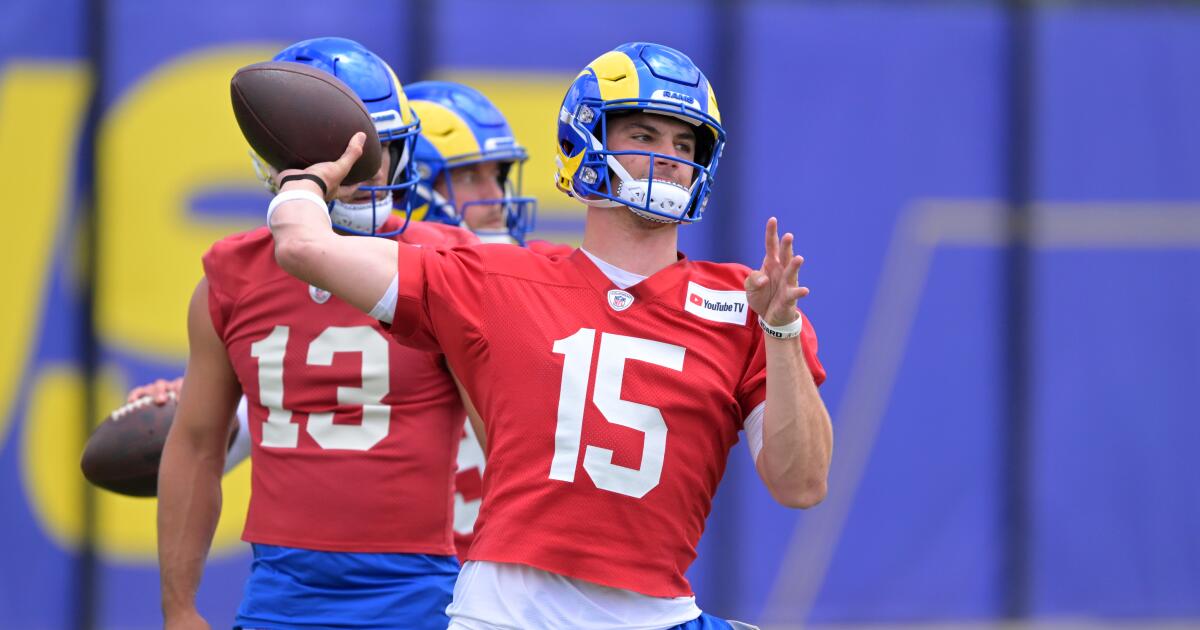
Rams QB Ty Simpson embracing an unusual bedtime routine to spur his development
-

 World14 minutes ago
Lebanon Latest: Israeli attacks surge despite ceasefire efforts
-
 News41 minutes ago
Supreme Court allows a ruling that ends a tool to protect minority voters in 7 states
-

 New York2 hours ago
How a Security Guard Lives on $46,000 a Year in the East Bronx
-

 Los Angeles, Ca2 hours ago
L.A. Tenants Union trying to save business owner given eviction notice ‘without reason or discussion’
-

 Detroit, MI2 hours ago
Grace Hanke crowned Miss Michigan 2026
-

 San Francisco, CA2 hours ago
The U.S. Government Secretly Tested Biological Weapons. The Citizens of San Francisco Paid the Price.
-

 Dallas, TX2 hours ago
3 Cowboys Entering Training Camp With Plummeting Stock

