Southwest
Supreme Court to decide if tech companies can censor what you post on the internet

NEWYou can now listen to Fox News articles!
The Supreme Court is set to hear arguments in the most significant free speech case since the 1960s on Monday, Feb. 26. The dispute comes down to one question: Do Big Tech companies have a constitutional right to censor other people?
The court will hear two connected free speech cases. The broader of the two, NetChoice v Paxton, stems from a challenge of the Texas law which protects its residents from Big Tech censorship. The other important case, Moody v NetChoice, was also brought by Big Tech to challenge a Florida law which prohibits Big Tech censorship of political figures.
The Media Research Center has now documented more than 6,400 cases of censorship by firms such as Amazon, Google/YouTube, and Meta — including the egregious suppression of the New York Post Biden laptop story ahead of the 2020 election. To protect Texans from Big Tech’s abuses of power, Texas enacted a new “common carrier law.”
JOHN OLIVER OFFERS JUSTICE THOMAS MILLIONS TO ‘GET THE F— OFF THE SUPREME COURT’
Common carriership is a longstanding legal concept for private companies which hold themselves out as “open to the public” and also control access to other markets. Common carrier laws have existed for centuries, covering utilities, telecommunications firms and railroads.
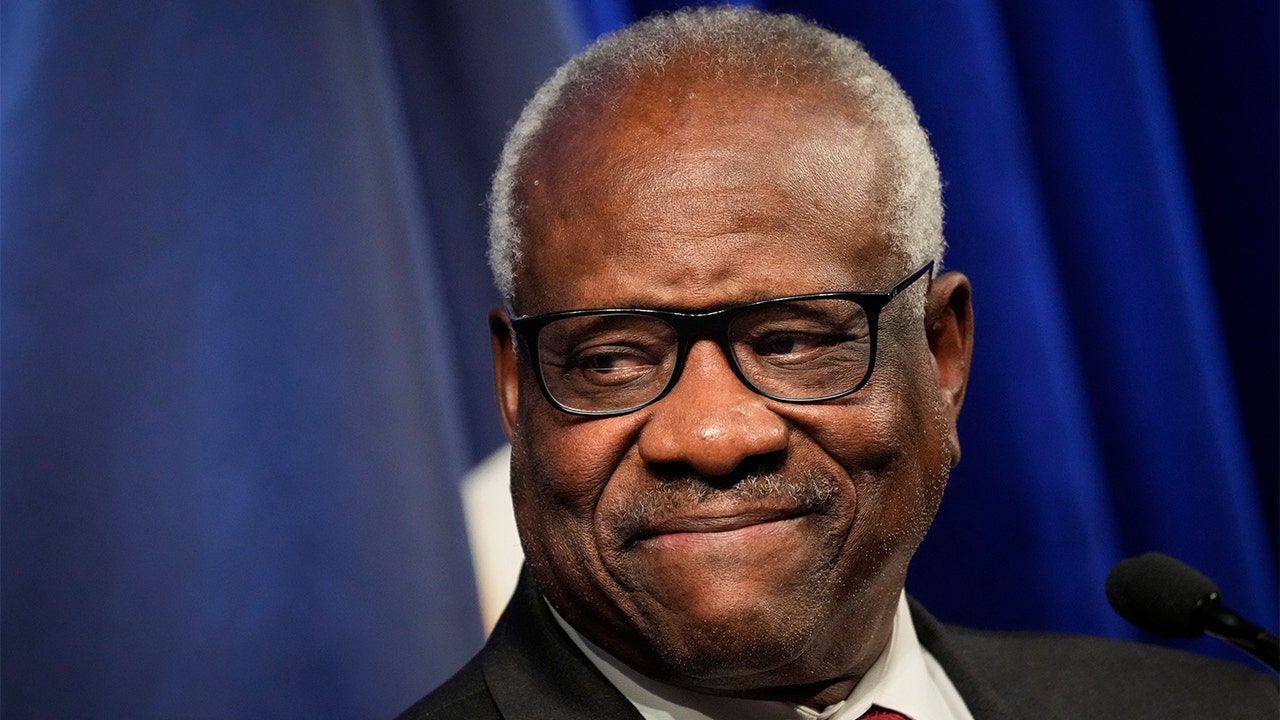
Many believe Supreme Court Justice Clarence Thomas helped set in motion the challenge to Big Tech censorship with comments he made. (Drew Angerer/Getty Images)
A common carrier is forbidden from denying service to or discriminating against its customers. While it was already broadly understood this category included large social media platforms, Texas eliminated any doubt by explicitly classifying them as such.
Under its trade association NetChoice, Big Tech has advanced a profoundly silly argument for why courts should block the Texas law. Big Tech claims that, by barring social media platforms from subjectively banning users, Texas is compelling the platforms “to speak” against their will.
Big Tech now begs the court to create a constitutional right to censor, immunizing discrimination —- a right that would apply even if a platform’s stated goal was to manipulate elections or target people by race and religion.
If courts accept Big Tech’s arguments, it would mean that notoriously anti-Israel Google could have an unlimited constitutional right to ban Jewish Americans from posting videos on YouTube. If this sounds far-fetched, keep in mind that Facebook has already banned several Punjabi-American Sikhs from the platform specifically because of their racial and religious identity.
To be clear, any of the Big Tech firms covered by the Texas law can choose to stop being common carriers whenever they like. All they would have to do is say that they are publishers, no different than newspaper or book editors and entirely protected by the First Amendment. Being a publisher, though, means accepting liability for the content on their sites.
Of course, platforms like YouTube and Facebook know many of their users are uploading defamatory, fraudulent and even violent content, and they do not want to face any responsibility for that. Therefore, instead of choosing to be publishers, they are asking activist judges to let them enjoy all the benefits of being a common carrier (total immunity for customers’ conduct) while avoiding any of the responsibility (the obligation not to discriminate).
The Fifth Circuit rightly rejected Big Tech’s laughable argument, saying that it was “staggering” for “platforms [to] argue that buried somewhere in the person’s enumerated right to free speech lies a corporation’s unenumerated right to muzzle speech.” Nevertheless, there is a genuine danger that the Supreme Court will side with Big Tech and rewrite the Constitution to enshrine censorship.
CLICK HERE FOR MORE FOX NEWS OPINION
One justice who is unlikely to join in such an effort is Justice Clarence Thomas. Many believe the Texas law was, in part, inspired by an opinion he wrote in 2021, where he remarked that “[i]n many ways, digital platforms that hold themselves out to the public resemble traditional common carriers” because they “are at bottom communications networks, and they ‘carry’ information from one user to another.”
The New York Post’s bombshell reporting during the 2020 presidential election was one of many topics heavily censored by Big Tech. (Getty images | New York Post)
Justice Elena Kagan, an appointee of then-President Barack Obama, joined Thomas in contending (unsuccessfully) that the Texas law should have remained in place while the court decides its fate. A justice is unlikely to allow a law to go into effect if she believes that, on appeal, it will be ruled unconstitutional.
While Kagan may surprise court observers by siding with Texans’ free speech rights, Justice Brett Kavanaugh remains an enigma. When he was a circuit court judge, Kavanaugh claimed some common carriers possess “editorial discretion” to censor in violation of federal law. If Kavanaugh still believes in this invisible “editorial discretion” loophole to duly enacted civil rights statutes, then he could well side with Big Tech against free speech.
If Kavanaugh and four other justices take this drastic step, the ramifications for America will be devastating. Only once in history has the Supreme Court limited a common carrier law. That was in the now discredited Plessy v. Ferguson case, where the Supreme Court allowed a railroad to deny service to a Black man.
Choosing to uphold Texas’s free speech law ought not to be difficult for the Supreme Court. Centuries of precedent reiterate that Americans’ fundamental liberties can be protected with common carrier laws. It would be much better for the justices to follow these rulings rather than create a new constitutional right for the world’s largest corporations to discriminate.
CLICK HERE TO READ MORE FROM DAN SCHNEIDER
Tim Kilcullen is counsel for investigations at the Media Research Center.
Read the full article from Here


A man wanted for a deadly road rage shooting in Los Angeles was arrested and extradited from Mexico after fleeing the U.S. in 2024.
The suspect was identified as Christian Rojas, 21, of Bellflower, according to the California Highway Patrol.
Authorities had been searching for him since the deadly incident on October 10, 2024.
Rojas and a second suspect, Joshua Rojas Sr., 47, of Downey, were driving on the northbound 5 Freeway in Boyle Heights around 4 p.m. when they became involved in an altercation with another driver that escalated into a shooting.
-

Video obtained exclusively by KTLA shows the terrifying moment a road rage suspect opened fire the driver of another car on the 5 Freeway in Los Angeles, fatally wounding him and seriously injuring a passenger, on Oct. 10, 2024. (Credit: @hugoboss01) -
Video obtained exclusively by KTLA shows the terrifying moment a road rage suspect opened fire the driver of another car on the 5 Freeway in Los Angeles, fatally wounding him and seriously injuring a passenger, on Oct. 10, 2024. (Credit: @hugoboss01) -
Video obtained exclusively by KTLA shows the terrifying moment a road rage suspect opened fire the driver of another car on the 5 Freeway in Los Angeles, fatally wounding him and seriously injuring a passenger, on Oct. 10, 2024. The alleged gunman is circled. (Credit: @hugoboss01) -
Video obtained exclusively by KTLA shows the terrifying moment a road rage suspect opened fire the driver of another car on the 5 Freeway in Los Angeles, fatally wounding him and seriously injuring a passenger, on Oct. 10, 2024. (Credit: @hugoboss01) -
Video obtained exclusively by KTLA shows the terrifying moment a road rage suspect opened fire the driver of another car on the 5 Freeway in Los Angeles, fatally wounding him and seriously injuring a passenger, on Oct. 10, 2024. (Credit: @hugoboss01) -
Christian Rojas, 21, of Bellflower, was arrested and extradited to the U.S. from Mexico on June 2, 2026, in connection with a deadly road rage shooting in Los Angeles. (California Highway Patrol)


Video of the tense confrontation showed the suspects, who were driving a Dodge Durango SUV, opening fire on two men in a Cadillac sedan.
The shooting forced the victim to pull over abruptly. That’s when a suspect ran up to the Cadillac, opened the passenger-side door and fired several shots at close range.
In a panic, the Cadillac driver tried to escape by making a sudden U-turn and driving against oncoming traffic. He eventually crashed head-on into several vehicles.
The suspects ditched their SUV and fled toward a freeway exit on foot. The Cadillac driver was left with serious injuries and his passenger was killed. Their identities were not released.
The incident caused a miles-long backup that left thousands of motorists stranded on the freeway for hours and authorities worked to clear the scene.
Following an extensive investigation, detectives identified the two men as the suspects involved.
Joshua Rojas Sr. was arrested in San Bernardino on October 22, 2024, on a murder charge. He remains in custody awaiting trial.
Meanwhile, Christian Rojas had fled the U.S. and was hiding in Mexico, detectives said. A $4.3 million bail warrant was issued for his arrest.
“Through a coordinated international effort, investigators determined that Rojas was living in Palomo de Arriba, Mexico,” CHP officials said. “The U.S. Marshals Service worked with Mexican state police to locate and arrest him on the outstanding warrant.”
On June 2, 2026, Christian was arrested and extradited to the U.S. to face a murder charge.
“This arrest demonstrates that time and distance will not shield violent offenders from justice,” said CHP Southern Division Chief Chris Margaris. “For nearly two years, our detectives remained relentless in their pursuit of those responsible for this senseless act of violence. Through exceptional collaboration with the United States Marshals Service and our law enforcement partners in Mexico, we located and apprehended this suspect and brought him back to face the charges. We remain committed to protecting the public, supporting victims and their families, and holding violent criminals accountable wherever they may try to hide.”

The northbound 405 Freeway will remain closed for several hours near Los Angeles International Airport after a police pursuit ended with officers opening fire Friday morning. Unconfirmed reports indicated the incident began with a robbery at a 7-Eleven store, which ended with Los Angeles Police Department officers pursuing the suspect in a Kia. The chase […]

The victim in a bizarre and deadly stabbing in Tarzana has been identified as 81-year-old character actor James Handy, best known for a recent role in Tom Cruise’s “Top Gun: Maverick.” The stabbing happened around 9:30 a.m. Wednesday in the 19200 block of Erwin Street in the West Valley area. Officers responded after receiving a […]
-

 Oklahoma24 seconds ago
New Oklahoma fireworks law brings back bottle rockets, leaves local bans intact
-

 Oregon3 minutes ago
CAN YOU HELP? Oregon State Police’s new Fish & Wildlife K-9 needs a name
-

 Pennsylvania8 minutes ago
Sweet Summer: 59 creameries unite dairy lovers with Pennsylvania farms on Ice Cream Trail
-
Rhode Island15 minutes ago
RI Lottery Mega Millions, Numbers Midday winning numbers for June 5, 2026
-

 South-Carolina18 minutes ago
South Carolina Lottery Mega Millions, Pick 3 results for June 5, 2026
-

 South Dakota23 minutes ago
Hot weekend ahead with severe storm threat across region
-

 Tennessee30 minutes ago
Life360 crash alert helps Madison family respond after Tennessee wreck
-
Texas33 minutes ago
NCAA denies Texas Tech’s appeal regarding Brendan Sorsby’s eligibility


