Business
The Inland Empire's once-unstoppable warehousing industry falls into a slump

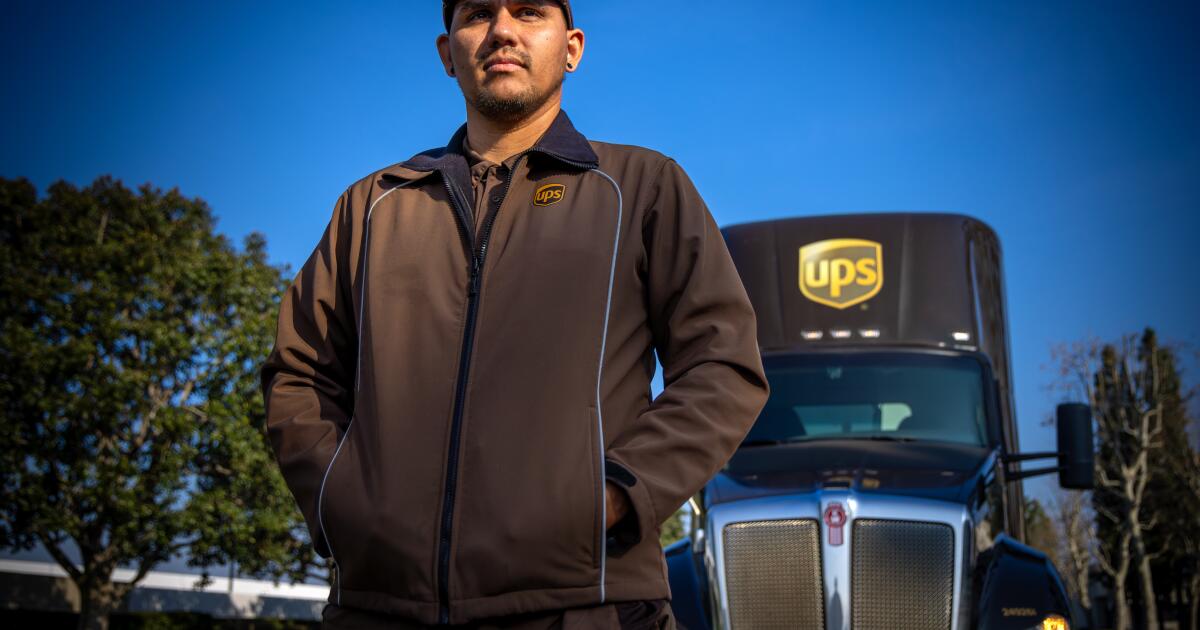
For years the growth of warehousing in the Inland Empire was relentless. At the confluence of port-bound freeways and rail spurs along the eastern edge of Los Angeles’ sprawl, box-like fulfillment centers popped up in business parks by the millions of square feet. They were an economic engine, a bringer of jobs, a shortener of commutes, and a workhorse during the pandemic.
But now that’s come to a halt — bringing uncertainty for thousands of workers and an industry that has been an economic bellwether for the region.
After the COVID-19 pandemic slammed the nation in spring 2020, the Inland Empire recovered all of the jobs it lost by the summer of 2021 — more than a year ahead of Orange County and almost two years earlier than Los Angeles County. Despite pandemic restrictions, the area’s machinery of storing and transporting goods kicked into high gear, outpacing better-paying and more glamorous sectors in the state, such as entertainment and tech.
But the tables have turned in the last year. Warehousing and storage jobs in the Inland Empire shrank for the first time in more than two decades. Once-booming truck transportation has been down since early in the summer, and the area’s wholesale trade employment is dropping fast, according to year-over-year data from the U.S. Bureau of Labor Statistics. Industrial building vacancies are up and rents are down.
Logistics businesses nationally are cutting back amid declines in freight volume. United Parcel Service said it would shed 12,000 jobs worldwide over the next several months after more than a $9-billion drop in revenue last year. A company spokesman said it didn’t have a breakdown of where those layoffs would hit, but UPS employs tens of thousands of workers in California.
“Everything is different,” said Victor Ramirez, a Pomona resident who’s worked in warehousing for about 20 years. Speaking in Spanish, he remembered when times were better — much better.
The 59-year-old recalled not only getting full 40-hour workweeks in the past but bonuses during the pandemic. These days, things have slowed so much at his current place of employment, a warehouse that builds pallets, that he has taken on additional work as an Uber driver and canvasser for nonprofits.
“One job isn’t nearly enough,” Ramirez said.
With related business services and real estate also down, the Inland Empire’s overall job growth last year averaged just 1.2%, about half the rate for Southern California and the state as a whole. “We could be the weak link,” said John Husing, the region’s longtime economist based in Redlands.
The pandemic-induced surge of consumer purchases, transportation gridlock and prolonged labor negotiations at the ports all played a role in disrupting the flow of goods and exacerbating an oversupply of warehouses. But even before COVID, the industry was feeling increasing strains from environmental regulations, disputes over independent trucking and rising operating costs that have pushed more businesses to leave the state.
The Inland Empire’s troubles come as the U.S. economy faces an expected slowdown and the tech sector continues to shed jobs. California’s tourism industry, another big economic engine, hasn’t fully recovered, and high interest rates have taken a bite out of the housing market. All of that has left the state trailing the nation in job growth. The latest unemployment rate statewide, as well as for the Inland Empire, was 5.1% in December, well above the U.S. figure of 3.7%.
“Right now I am not an optimist on this economy,” Husing said.
The long shadow of logistics
Thanks to lower housing costs than in Los Angeles and Orange counties, the Inland Empire’s population has been growing for decades. Over the years, many residents found work in a logistics industry that has surged along with the region. Since 2000, the Inland Empire’s population has increased by 45% to 4.7 million last year. And jobs during that period have jumped even faster, up 68% to 1.7 million. That’s about as many as in all of Orange County.
A lot of that came on the back of the logistics industry, which got a big boost from soaring trade with China. Today, about 40% of all containers entering the U.S. from Asia are handled by the ports of L.A. and Long Beach. More than 37,000 heavy and tractor-trailer truck drivers based in the Inland Empire haul that cargo to rails and some 4,000 warehouses that are scattered across Riverside and San Bernardino counties’ 27,000 square miles, double the land area of the next largest metropolitan area, Phoenix-Scottsdale in Arizona.
The growing number of jobs brought the promise of greater economic security and quality of life as more residents were able to get jobs closer to home. But the growth of the logistics industry has exacerbated environmental concerns in communities with some of the least-healthful air in the United States. And analysts say too many households in the area are struggling to make ends meet as earnings have not kept up with rising costs.
Sheheryar Kaoosji, executive director of the nonprofit advocacy group Warehouse Worker Resource Center in Ontario, said many logistics jobs are still too close to minimum wage, are temporary or seasonal and are often quick to disappear when the economy softens.
“The average worker is always in a position of uncertainty,” he said.
For all occupations, Inland Empire workers made $27.96 an hour on average in 2022, the latest according to the Bureau of Labor Statistics. That is compared with $33.43 for L.A. and Orange counties combined, and $45.37 for the San Francisco Bay Area.
More than 270,000 people in the Inland Empire work in transportation and material moving occupations. Their median hourly pay in 2022: $21.13. Stockers and order fillers made even less — $19.01 an hour, on average.
California’s statewide minimum wage for larger employers was $15 an hour in 2022. It went up to $16 this year, and for fast-food workers it’ll go to $20 an hour in April.
“It’s a good starter job, but as far as long-term, a lot of people think they’re going to do it for life,” said Byron Williams, 48, of Moreno Valley, referring to logistics jobs at Amazon.
Williams once worked at Amazon, though on the finance side of logistics. The e-commerce behemoth operates more than a dozen distribution facilities in the Inland Empire. Williams said he left because of the pay. “It’s not a for-life position.”
The new boom and bust
Going through boom and bust cycles has been part and parcel of life in the Inland Empire. The area tumbled during the early 1990s downturn that was marked by defense cuts and overbuilding. And it was one of the hardest hit by the subprime mortgage crisis that brought the Great Recession in 2007-09.
The pandemic, at first, seemed to be an exception. The Inland Empire’s economy quickly rebounded thanks to surging orders for all kinds of stuff from people stuck in their homes. Rounds of government stimulus checks added fuel to consumer spending.
But in the last year the industry suddenly fell back, in part as consumer spending shifted more to services, such as travel and entertainment , and less on things such as cars and groceries. High inflation also was a factor, as was the unusual situation at the ports.
Early in the pandemic, dozens of ships were lined up at sea waiting to berth in L.A. and Long Beach ports. When the logjam eased, merchandise flooded into the region, prompting wholesalers and distributors to double down on warehouses and workers.
“We couldn’t hire fast enough,” said Jeff Baldassari, who until August was president of U.S. Rubber Recycling in Colton, which got a burst of pandemic orders of rubber mats for in-home gyms and other uses. “Now the party ended, and it’s the hangover the next day,” he said.
Drawn-out labor talks with longshoremen that lasted more than a year prompted some companies to divert cargo to the East and Gulf Coast ports.
In the last few months, warehouses and distribution centers have shut down in Rialto, Fontana, Jurupa Valley, Perris and Chino, among other cities, according to WARN Act filings with the state. During the summer, the bankrupt trucking firm Yellow Corp. shuttered several terminals in the Inland Empire that eliminated about 1,000 jobs.
The downturn in logistics has spread to other industries too, including finance and real estate. San Francisco-based Prologis, the world’s biggest warehouse developer and a major player in the Inland Empire, reported a 7% drop in rents in the fourth quarter for Southern California. The company said its construction pipeline in the region was half of what it was at year-end 2022.
During a recent conference call with analysts, Prologis’ chief executive, Hamid Moghadam, said it’s always been difficult for retailers and wholesalers to correctly forecast demand and manage inventories. “They’re schizophrenic. They always have too much or too little. You can never get it right.”
Still, he and other developers said they are bullish on the future. The logistics business in Southern California is getting back on its feet after the pandemic, they said. And key drivers of growth remain intact — e-commerce, global trade, demand for larger, more efficient distribution centers, said Iddo Benzeevi, chief executive of Highland Fairview, a developer working on a massive logistics center in Moreno Valley.
But that will also bring more consolidation, he said. Older, smaller facilities will get phased out, and payrolls aren’t likely to grow as fast as before. In the long term, logistics jobs may require higher skills and pay better as facilities become more automated and employ technologies such as driverless trucks — but they could employ fewer workers.
Mauricio Perez, 33, a UPS truck driver who has been at the company for 15 years. (Irfan Khan / Los Angeles Times)
(Irfan Khan/Los Angeles Times)
For truck driver Mauricio Perez, a 15-year veteran at UPS who lives in Rancho Cucamonga, it’s the near term that worries him.
Work usually slows after the busy Christmas season, but he said this year looks different. During the holidays, Perez saw 53-foot trailers stacked to the brim with items and packages to be delivered. Nowadays, 28-foot trailers have barely two or three pallets inside.
What’s more, he said that the work-bidding process at UPS suggests that a lot more truckers in the Inland Empire are likely to be on a more flexible schedule that can vary week to week or shunted to the package hub, where they’d work fewer hours. That means drivers who don’t get assigned work may end up taking a “layoff week,” in which they won’t get paid unless they cash out vacation time or accrue pension benefits.
“It’s not looking like the economy is going to get any better in the next few months,” Perez said. “We just gotta brace ourselves for the worst.”


The race to bring air travel to the sky is heating up as Santa Cruz-based Joby Aviation and Toyota launch a joint venture to commercially produce air taxis.
The companies said in a news release Tuesday that they will work together on productivity, quality and costs and move toward mass production of Joby’s electric vertical takeoff aircraft. Joby and Toyota were first linked when Toyota made a nearly $400-million investment in the company in 2020. It has since increased its backing of the company to $900 million.
“It’s really meaningful for us to take on this challenge together with Joby, a partner that shares the same vision,” Toyota Chair Akio Toyoda said. “We believe this strengthened relationship is an important step forward in realizing the future mobility society.”
Joby‘s all-electric vertical takeoff vehicles are designed to hold four passengers and a pilot and can travel at up to 200 mph. The vehicle uses six tilting propellers to achieve vertical takeoff before switching to forward flight.
In February, Joby announced a partnership with Uber to start service in the United Arab Emirates this year, bringing on-demand air taxi rides to the country. It plans to expand to the U.S. after the completion of its final stage of Federal Aviation Administration testing.
Prior to its full FAA certification, Joby is hoping to launch early flight operations later this year as part of a White House program that will bring flights to several states, including New York, Texas and Arizona. Flights in California will not begin until after obtaining FAA certification.
Joby has been in a fierce battle to be the first with taxis in the sky with its Northern California competitor Archer Aviation. The two companies are involved in overlapping lawsuits, with Joby alleging corporate espionage against Archer, and Archer filing a suit alleging dubious ties to China that sparked an investigation into Joby by the U.S. International Trade Commission.
“Toyota has been by Joby’s side for nearly a decade, providing invaluable guidance and support as we built the foundation for manufacturing our aircraft,” JoeBen Bevirt, Joby’s chief executive and founder, said in the news release. “Together, we share a vision of making aerial mobility an everyday reality, and we look forward to delivering on that promise together.”
Joby Aviation’s shares, which have fallen more than 30% this year, climbed 3% on Tuesday to $8.92.
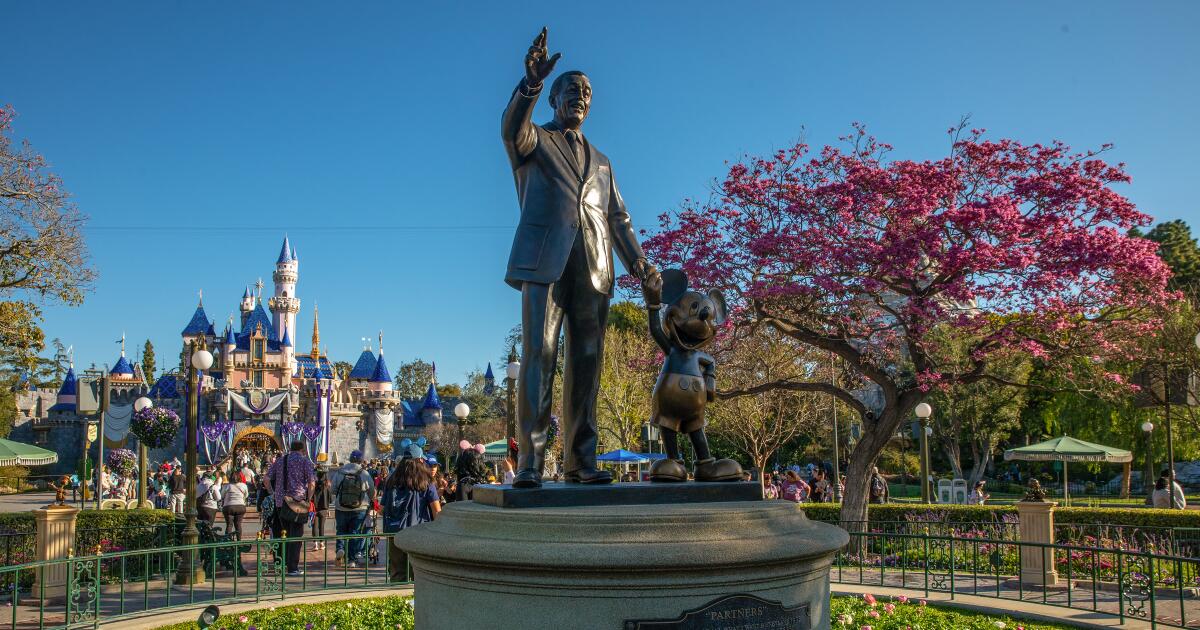
Disneyland Resort in Anaheim will offer $59 tickets for select evening admission to either theme park as part of a new promotion.
The one-day, one-park evening ticket offer will allow attendees to enter Disney California Adventure at 5 p.m. or Disneyland at 7 p.m. Park reservations are still required, as has been the case since the COVID-19 pandemic.
The offer only applies for admission from July 12 through Aug. 5 on Sundays to Wednesdays.
Disneyland Resort is commemorating its 70th anniversary through Aug. 9, and has introduced new shows and additions to rides as part of the occasion.
Walt Disney Co.’s theme parks and experiences business are a crucial boost to its finances, making up about 56% of the company’s operating income last fiscal year.
During the Burbank-based company’s most recent earnings call in May, Disney executives said attendance at its U.S.-based parks was down 1% compared with the prior year, a shift they attributed to “continued softness” in international visitations. However, the company said at the time that it was starting to move past those issues.
Disney’s experiences division reported $9.5 billion in revenue in that fiscal second quarter, up 7% compared with the same period a year ago, something executives said was due to higher guest spending domestically and more capacity on its cruise line.

An aging downtown office complex will be converted into apartments as part of an ambitious plan by local real estate companies to create 4,000 affordable housing units in Los Angeles.
The first project will be a $200-million makeover of the L.A. World Trade Center, a sprawling white elephant of an office complex on Figueroa Street built in the 1970s that will be turned into 512 apartments in one of the largest affordable housing conversions to date downtown.
Future projects being planned in the central city for delivery over the next five years will include other office-to-apartment conversions and new housing built from the ground up.
The 10-story World Trade Center, right, at Figueroa and Fourth streets in downtown Los Angeles, was built in the mid-1970s.
(Myung J. Chun / Los Angeles Times)
Behind the building campaign unveiled Monday are two of the region’s largest real estate companies, Jamison and Kennedy Wilson. Jamison is the city’s most prolific converter of offices to market-rate apartments and currently has a major makeover of a downtown office skyscraper underway for tenants who can pay top rents.
Kennedy Wilson, a real estate investment company based in Beverly Hills, owns Vintage Housing, which builds and operates affordable housing using tax credits and other state and federal financing to help fund it.
Vintage Housing and Jamison’s new affordable housing division, Arden Residential, will take on the campaign to build the housing where qualified tenants will pay rents below market rates.
Rents in the World Trade Center — which will be renamed Sky Castle when it opens in early 2028 — are expected to start at $937 for a one-bedroom unit. Some two- and three-bedroom units would rent for $1,100 and $1,300 per month, respectively, developers said.
Sky Castle will have shared amenities found in more expensive modern apartments, the developers said, such as a fitness center, resident lounge and co-working space. It already has six tennis courts on the roof, which may be converted to pickleball courts, Jamison Chief Executive Garrett Lee said.
The goal is to build higher quality affordable housing by using efficient construction methods Jamison has learned through building more than 8,000 market-rate apartments in the past, Lee said. The makeover of the World Trade Center will mark Jamison’s 15th conversion of an office building to housing.
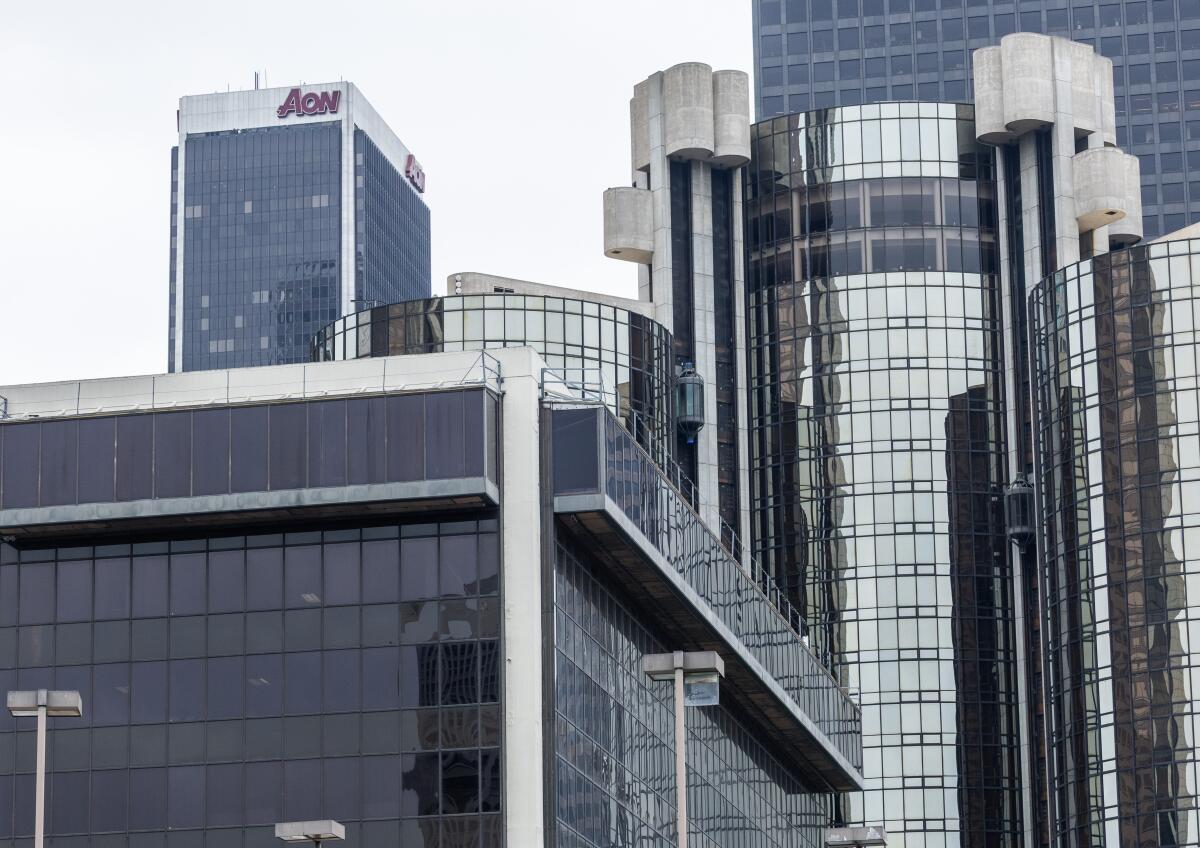
The plan to redevelop the L.A. World Trade Center, bottom left, is one of the largest affordable housing conversions to date downtown.
(Myung J. Chun / Los Angeles Times)
The 10-story World Trade Center was built in the mid-1970s to fanfare saying it would be home to international companies. In 1976, The Times described the center as a place to prepare for an overseas trip where visitors could get passports and visas, as well as exchange dollars for francs, marks, rubles and other currency. There was a language school and branches of U.S., Swiss and Japanese banks.
By the mid-1980s, the 400,000-square-foot office complex covering a city block at Figueroa and Fourth streets had lost its international flavor and was falling out of favor with corporate tenants who were moving into glossy new skyscrapers on Bunker Hill and in other locations.
The building has been cleared of remaining office tenants to allow work to begin in August, Lee said.
Kennedy Wilson is a nationwide operator of market-rate apartments that has also moved into building affordable housing in the last decade, said Nicholas Bridges, global head of capital markets at the company.
Building affordable, workforce housing “in almost all cases requires public subsidies,” Bridges said, and Kennedy Wilson has developed expertise in assembling “a cocktail of public financing sources” that includes low-income housing tax credits and tax-exempt bonds.
In the past, many housing developers have shied away from building affordable housing because assembling the subsidies needed to make construction profitable is challenging.

An artist’s rendering shows what the L.A. World Trade Center could look like after being redeveloped into affordable housing. The new complex is to be called Sky Castle.
(Ian Camarillo)
“It’s complicated,” Bridges said, “and not for the faint of heart.”
Eligible tenants must earn between 30% and 80% of the median income in the area where the housing is built.
Jamison and Kennedy Wilson will develop about 15 affordable housing projects between downtown and the 405 Freeway, Bridges said, many of them in aging office buildings such as the World Trade Center that are already owned by Jamison and are close to public transit.
Substantial potential for affordable housing lies in L.A.’s underused office buildings, he said.
“In this post-COVID world, the way people are utilizing office buildings, particularly older office buildings, has just fundamentally changed,” he said.
It makes sense for developers of conventional multifamily housing to move to building affordable housing, Lee said, because the government supports it through subsidies, zoning reform and the fast-tracking of construction permits. The city of Los Angeles also recently streamlined its adaptive reuse rules to make it easier to convert office buildings to housing.
“There are a lot of incentives pushing us in this direction,” Lee said.
-

 Los Angeles, Ca1 hour ago
Knife-wielding man rushes at LAPD officers in tense body cam video
-

 Detroit, MI2 hours ago
5 Potential Landing Spots For Former Detroit Lions CB Terrion Arnold
-

 San Francisco, CA2 hours ago
May 17 officially declared
-

 Dallas, TX2 hours ago
Dallas City Hall named to World Monuments Fund’s ‘Irreplaceable America’ list – Lake Highlands
-

 Miami, FL2 hours ago
Ex-con lists $138M in luxury penthouses, including Miami trophy condo
-

 Boston, MA2 hours ago
Celtics reportedly trading Jaylen Brown to 76ers for Paul George, picks
-

 Denver, CO2 hours ago
LeBron James to the Nuggets? Latest reports and betting odds
-

 Seattle, WA2 hours ago
Residents and activists clash over plan to curb SEPA appeals at Seattle hearing

