Northeast
Facing community pushback, NYC mayor reverses plan to house migrants in luxury building

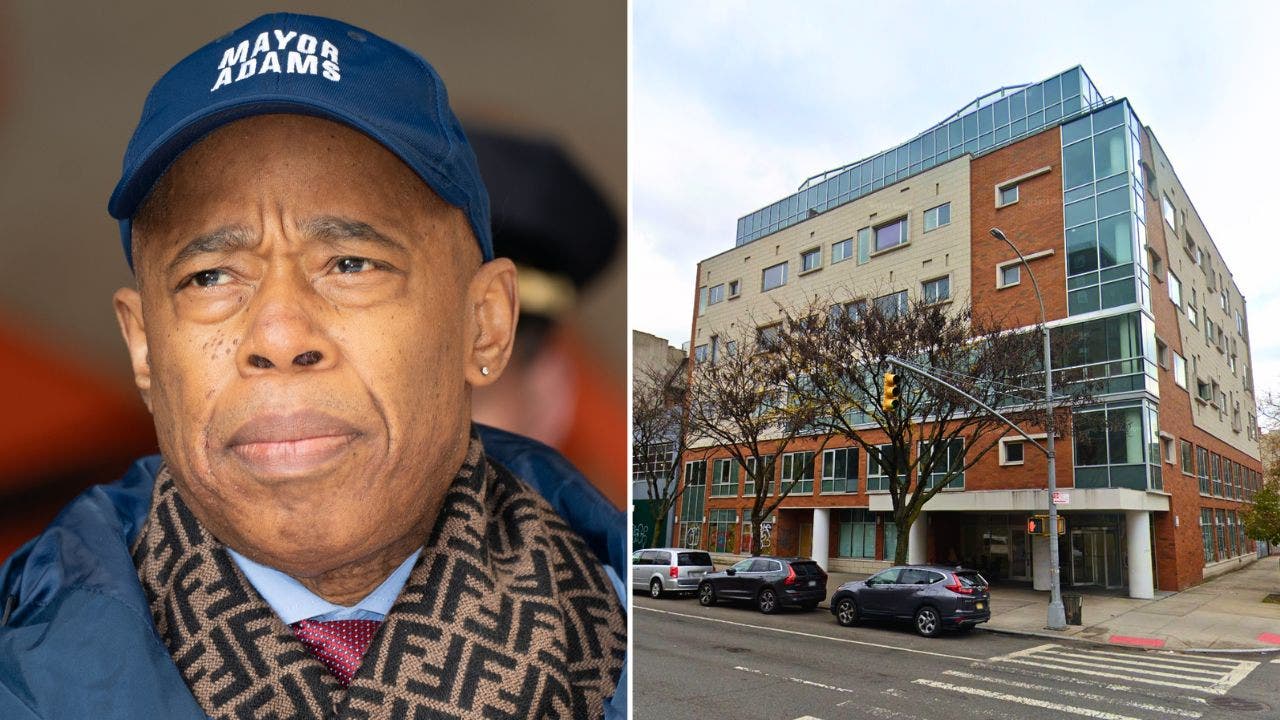
New York City Mayor Eric Adams has done a U-turn on plans to convert an abandoned luxury apartment complex into a shelter for illegal migrants after the community in Harlem opposed the proposal.
Adams turned up unannounced at a community meeting in the Upper Manhattan neighborhood Thursday where locals were gathering to discuss rumors the building on the corner of 130th Street and Adam Clayton Powell Jr. Blvd. was quietly being prepared for immigrants, according to CBS News.
The building was first advertised as luxury housing with a swimming pool, but it has been empty for around a decade after its developers defaulted on loans, the outlet reports. It was built in 2007 and has 35 units, city records show.
New York City Mayor Eric Adams has reversed plans to convert an abandoned luxury apartment complex into a shelter for illegal migrants after the community in Harlem opposed the proposal. (Theodore Parisienne for New York Daily News/Tribune News Service via Getty Images and Google Maps)
NYC MAYOR ERIC ADAMS BEGS STATE TO COVER 50% OF CITY’S MIGRANT CRISIS COSTS
It was then leased to a nonprofit that had been working with the city Department of Social Services/Homeless Services to use it as a shelter for either migrants or the city’s native homeless population, the New York Post reports.
Residents saw boxes of bunk beds being loaded into the building. So, when they weren’t getting answers, they convened a meeting. They said they were angry over the lack of communication and about being kept in the dark.
“No, I don’t agree with it turning into a sanctuary for asylum seekers knowing we have people right here that need the space,” said Tiffany Fulton, executive director of Silent Voices United Inc., a local nonprofit that helps underserved communities.
Central Harlem, where about 44 % of residents are Black, is generally a low-income neighborhood with a 28.4% poverty rate compared to 18.0% citywide, according to the 2020 census.
Asylum seekers line up in front of the historic Roosevelt Hotel, which was converted into a city-run shelter for newly arrived migrant families in New York City Sept. 27, 2023. (Selcuk Acar/Anadolu Agency via Getty Images)
A sign at the meeting said, “Millions on migrants, what about youth programs?” Adams has said the illegal migrant crisis could cost the city as much as $12 billion through 2025. At least 170,000 illegal migrants have arrived in New York since the spring of 2022.
As the meeting took place, Adams turned up and answered questions from residents.
“You are the mayor. We do not want to hear excuses,” one Harlem resident said.
ERIC ADAMS WARNS NYC IS ‘OUT OF ROOM’ AMID SANCTUARY STRUGGLE: PEOPLE WILL SOON BE ‘SLEEPING ON THE STREETS’
But the mayor said that illegal migrants wouldn’t be placed inside the building and that it instead would house local homeless New Yorkers.
“I told the team, ‘Find out what’s going on here,’” Adams said. “We’re not moving folks into a brand new building when you have long-term needs in a community. That’s not going to happen.
“You will not have migrants and asylum seekers in that property.”
Single migrant men, mostly from West Africa, congregate in Tompkins Square Park as volunteers give away food and clothing Jan. 27, 2024, in the East Village neighborhood of New York City. (Andrew Lichtenstein/Corbis via Getty Images)
CLICK TO GET THE FOX NEWS APP
The mayor’s office did not respond to a Fox News Digital request for comment on the matter.
Harlem resident Regina Smith told CBS the neighborhood felt disrespected and that there are already too many homeless shelters in the community.
“We’re being priced out of the community,” she said.
Meanwhile, resident Leslie Johnson said the units should be used instead for affordable housing.
“These apartments could be used for us to go into,” Johnson told CBS.
Read the full article from Here


Have you ever wanted to meet the people who work every day to help keep your community safe? Now you and your family have the perfect opportunity!
One of my favorite things about living in New Hampshire is how the community genuinely makes the effort to know one another. Whether its neighbors lending a helping hand, local businesses supporting fundraisers, or first responders showing up for community events, there’s a real sense that we’re all in this together.
Events like Coffee with a Cop are a perfect example of that Granite State spirit!
Coffee with a Cop gives residents the chance to sit down with the dedicated men and women of the Bedford Police Department in a casual setting. Just real conversations over coffee and pastries.
This is a wonderful opportunity for children to meet police officers outside of an emergency situation. Instead of only seeing officers during stressful moments or traffic stops, they get to laugh, ask questions, and learn about the people behind the badge.
As a newer mom, I don’t take for granted the people who work every day to protect the community my child is growing up in.
If you’re looking for a simple way to connect with your neighbors while supporting your local law enforcement, stop by Simply Delicious Bakery on Wednesday, July 15, from 8:30 a.m. to 9:30 a.m. Grab a cold drink, enjoy a pastry, and spend a few minutes getting to know the people who work tirelessly to help keep Bedford a safe place to call home.
READ MORE: The Next Great Filmmaker Could Be Premiering Their Work Right Here In New Hampshire
I love highlighting stories like this because they remind us what makes New Hampshire special. It’s not just the beautiful scenery, it’s the people who continue to show up for one another.
These Are 15 of the Best Coffee Shops in New Hampshire
Gallery Credit: Megan Murphy
35 Community Meals for New Hampshire and Maine
Thank you to Lynne DeMelio-Rafferty for creating this.
New Jersey
Exclusive | NJ’s suburbs are in a full-blown bidding war frenzy — with houses going 33% above asking

New Jersey’s suburban gold rush has no ceiling in sight, and buyers are paying whatever it takes.
Forty-two Euclid Ave in Maplewood hit the market at $1,795,000. It sold for $2,279,000, a staggering 27% above ask. Down the road in South Orange, 376 Melrose Pl listed for $998,999 and closed at $1,332,200, a 33% premium.
These aren’t outliers. They’re the new normal across a stretch of Essex and Union County suburbs where inventory has all but evaporated and buyers are throwing caution, and hundreds of thousands of dollars, to the wind.
Maplewood, South Orange and Montclair are leading the charge, with homes across the region averaging double digit percentages over asking price and spending under two weeks on the market before going under contract.
The numbers, according to weekly market data compiled by Mark Slade of Keller Williams Midtown Direct Realty, tell the story clearly.
Maplewood’s average sale price sits at $1.34 million as of late June, with buyers paying 15.6% over ask. South Orange isn’t far behind at 16.2% over asking with an average sale price topping $1.27 million. Montclair, meanwhile, is running the hottest of the bunch, with buyers paying nearly 25% over list.
Slade, who has tracked these markets since becoming a realtor in 2009, says the upward march has been remarkably steady.
“I don’t think I’ve ever seen a down-trending year in Maplewood, South Orange or Montclair,” he told The Post, adding that the last several years in particular have brought “dramatic changes in the performance of the market.”
The pandemic supercharged an existing trend, according to Slade, who traces the appeal of these towns back to 1997, two years after Midtown Direct train service began running straight into Penn Station without a transfer in Hoboken.
“That’s when we started to see some movement, some significant movement and attraction to the area,” he said.
Slade has a name for what’s happening now. He calls it “value convergence equilibrium” — a theory built on the idea that Northern New Jersey buyers are catching up to what Westchester and Long Island commuters have paid for decades.
“What we now see is that more and more people as buyers, are recognizing that with their economics, they can afford more house for less money in Northern New Jersey,” he said.
The buyers driving this frenzy aren’t only fleeing Manhattan. Slade says most are also coming from Brooklyn, Hoboken and Queens, current apartment dwellers looking to trade up.
“Northern New Jersey offers some of the best values as much as it may seem crazy for someone like me watching these prices grow by leaps and bounds,” he said. “It’s still a better value if you’re looking for a 45 minute and under commute to the city.”
Basic economics explains the rest. Supply simply hasn’t kept pace. Slade points to Maplewood specifically, a town of 25,000 residents with more than 5,500 single family homes, yet only a couple dozen actively listed at any given time.
“I mean, that’s just ridiculous,” he said. He tracks a metric he calls a “hypermarket,” where the number of homes under contract nearly doubles the number of active listings, a ratio he considers more telling than the traditional six month absorption rate used across the industry.
The demand has changed the character of these towns, longtime residents complain.
Slade says he’s heard grumbling that the small town feel is being “supplanted by more New York, impatient, higher end buyers.”
He offered an only half joking anecdote about downtown Maplewood’s diagonal parking spots, where illegal U-turns into spaces happen constantly despite signage every 30 feet.
“I think that today’s buyers are much more affluent,” he said. “They’re even more time pressed, so to speak, which is why they’re choosing these areas to live for the more manageable commutes.”
Township meetings haven’t been immune to the anxiety. After a record breaking sale in Maplewood’s Hilton neighborhood last year, Slade recalls committee members raising concerns at the next public meeting about what runaway prices mean for longtime residents. Still, he sees the appreciation as a feature, not a bug, of homeownership.
“This is real estate,” he said. “This is what real estate is all about.”
Momentum tends to soften slightly as the year goes on, Slade says, a seasonal pattern he attributes half jokingly to what he calls “bonus baby syndrome,” when buyers flush with year end bonuses resolve to finally buy a house “so we don’t have to trip over the stroller.”
When buyers get priced out of one town, they simply move to the next rung down.
Montclair shoppers frustrated by bidding wars often land in Maplewood. Maplewood buyers priced out end up in West Orange, where the year to date average sits at $763,000 with a 10.7% premium over ask, or Union, averaging around $600,000.
Bidding wars, meanwhile, have become simply expected.
“Bidding wars are very much part of the current market scenario, given the limited number of homes for sale and the fact that the amount of buyers far outweighs the supply,” Slade said.
“Buyer’s should generally expect some type of bidding war.”
He uses an ice cream metaphor to describe buyer psychology, borrowed from a Cold Stone Creamery portion chart.
“There are three sizes of ice cream at Cold Stone Creamary, Like It, Love it and Gotta Have It!,” he said. “So, if a buyer is in the Gotta Have It mode, their offer could likely blow everyone else away.”
Homes that have recently traded well above ask include 8 Colony Dr in West Orange, which sold for $1,178,000 against an $865,000 list, a 36% jump, and 35 Porter Pl in Montclair, which closed at $1,525,000 on a $1,395,000 ask, pricing out at 30% higher per square foot than the town average.
Whether this run has a natural endpoint is another matter. Slade doesn’t see one coming, short of the state “building a wall around Manhattan.”
New Jersey remains the most densely populated state in the country, meaning new construction is largely limited to developers subdividing larger lots rather than building fresh inventory from scratch.
Relief in the form of significantly lower mortgage rates also seems unlikely anytime soon, Slade says, leaving buyers to keep competing for a shrinking pool of homes in towns that offer what he still considers, even amid the chaos, the better deal.
Pennsylvania
From Chocolate Avenue to the World Cup, how Hershey, Pennsylvania, shaped Christian Pulisic

HERSHEY, Pa. (AP) — Hershey may be known as the “Sweetest Place on Earth,” thanks to its chocolate-drenched origins, but the Pennsylvania community is also home to Christian Pulisic — the most accomplished and famous player on a U.S. national team that’s dreaming big as it co-hosts the World Cup.
“Hershey to me is everything — it’s where my family is from, it’s where I grew up,” Pulisic recently said on his Instagram account as he promoted limited-edition Pulisic’s Milk Chocolate Bars by the Hershey Company that feature custom wrappers with his signature. “It’s where I learned how to play. It’s just home.”
A billboard featuring U.S. soccer player Christian Pulisic is pictured on the side of the Hotel Figueroa, Monday, June 29, 2026, in Los Angeles. (AP Photo/Chris Pizzello)
Pulisic grew up in this south-central Pennsylvania community surrounded by farms and rolling countryside, where even the streetlights along Chocolate Avenue are shaped like Hershey’s Kisses. The community was founded in 1903 by Milton S. Hershey, the American businessman and philanthropist who also built homes for workers, a hotel and a theme park that Pulisic often visited with family.
More than 120 years later, the Hershey Company is still the economic engine of Chocolatetown, USA. But the “Man Behind the Chocolate Bar” now shares the hometown hero honor with the soccer player nicknamed “Captain America.”
Pulisic inspires young soccer players in Hershey
Pulisic’s hometown roots run deep, and during the World Cup, his community has rallied around him as the U.S. plays some of its most exciting soccer ever.
“It’s pretty amazing that he came from Hershey and played for my club,” said Hershey High School rising freshman Cecelia Stefanelli who, on a recent afternoon, kicked a ball to score a goal on her father at a field where Pulisic played.
The Americans will attempt to win their first World Cup elimination game in 24 years on Wednesday evening, when they face Bosnia-Herzegovina in the round of 32 in Santa Clara, California. They should have a healthy Pulisic after the star missed the second group-stage game with a calf injury and played only 33 minutes as a sub in the final group match against Turkey.
“I’d love if USA won the World Cup; it’d make me happy,” said Stefanelli, a center back who also plays for the Pennsylvania Classics soccer club. Pulisic often credits the structure and coaches at PA Classics, where he played for eight years, with helping develop his skills. In 2021, he returned to the club for a ribbon-cutting ceremony for new fields that he financed and helped design. It’s now known as the Pulisic Stomping Grounds.
The club is located in Lancaster County, surrounded by chicken and dairy farms that give off a pungent odor of fermenting feed and manure.
On a recent day, Liam Gustafson and Moussa Oumarou juggled a soccer ball and passed it back and forth as they warmed up for training in front of a huge collage of photos of Pulisic that trace from his childhood training to starring for the U.S. at the World Cup.
“It’s really special to see someone from around here, where we live, playing in the World Cup,” said Gustafson, a 17-year-old forward who dreams of playing pro soccer and calls Pulisic his role model. “It’s really inspiring to see someone who paved the way, so that we can do that someday.”
Pulisic’s path to USMNT stardom ran through Hershey
The road to soccer was paved early as Pulisic followed in the footsteps of his parents. He was born in Hershey on Sept. 18, 1998, to Kelley and Mark Pulisic, both former collegiate soccer players at George Mason University. His father went on to play pro indoor soccer for the Harrisburg Heat. The family moved to England for a year while Pulisic’s mother completed a Fulbright Program teacher exchange and their 7-year-old rising star played for the Brackley Town youth team.


“Mark and Kelley could write a playbook on how to raise a humble, smart, kind superstar, while maintaining family relationships,” said Tara Seymour, a family friend and retired health and physical education teacher at Hershey Middle School. She met the family at a soccer camp and became close friends with Pulisic’s mother.
“She just quietly said to me one time, ‘We have never seen anything like this.’ This is a kid who could juggle the soccer ball hundreds of times when he was in elementary school,” Seymour said. Pulisic, she said, would practice in his backyard for hours, trying to emulate the moves of pros he saw on TV.
“He has an intensity that couldn’t be taught,” she recalled. “I think he had the opportunity to go pro earlier or go to Europe earlier and they held back just to make sure emotionally and maturity-wise he was ready.”
When the family returned to Hershey, Pulisic joined PA Classics at the age of 10. The club’s president and co-founder Doug Harris said Pulisic’s talent allowed him to play with older age groups, and he was often the smallest player on the field.
“I think if you were to pull kids in the world who want to achieve the level of Christian Pulisic, you’d have millions that would step up, raise their hand. They’re all gifted; they all can play,” Harris said. “But there’s something fundamental about what Christian has been able to do and I’d credit Mark and Kelley Pulisic with a lot of that.”
Looking forward to the future of American soccer
The Americans’ only World Cup knockout win came on June 17, 2002, when they defeated Mexico 2-0 in the round of 16 in South Korea. Pulisic has said the team’s approach won’t change in this round and the mood remains light despite the high stakes.
“It’s just special to be here,” he said. “You just don’t want it to end.”
Pennsylvania Classic coaches, Brittney Jakobson, left, and Nick Jakobson, right, look at a banner of U.S. national team soccer player Christian Pulisic with their children, Declan Jakobson, who wears an Argentina jersey, and Camden Jakobson, wearing a Portugal jersey, at the club were Pulisic honed his skills in Manheim, Pa., on Monday, June 29, 2026. (AP Photo/Luis Andres Henao)

Ahead of the game against Bosnia-Herzegovina, PA Classics coaches Brittney Jakobson and Nick Jakobson took their children, Declan and Camden, to kick a ball at Pulisic’s former club. The Americans, they said, have a shot at winning the tournament. But their legacy goes beyond the trophy.
“Their goal is to inspire a generation and it’s really fun to see that happening in real time … to hear people going out and watching the games, to see people buying the jerseys,” Brittney Jakobson said.
“Pulisic, obviously, in the short term is a great kind of figure to follow,” said Nick Jakobson. “But he does very much encourage that it’s not just about him. It’s not about just these four years. It’s about the next eight, 12, 16. It’s forward-thinking, and they’re laying a good foundation for what we can build on.”
___
See more of AP’s World Cup coverage here
-

 New Hampshire6 minutes ago
Have You Ever Actually Talked to a New Hampshire Police Officer? Here’s Your Chance
-

 New Jersey9 minutes ago
Exclusive | NJ’s suburbs are in a full-blown bidding war frenzy — with houses going 33% above asking
-

 New Mexico14 minutes ago
Dispatches from Route 66: Finding queer hope in New Mexico and Arizona
-

 North Dakota24 minutes ago
WATCH LIVE: Trump speaks in North Dakota ahead of July Fourth
-
Ohio29 minutes ago
Children found in ‘deplorable’ Ohio home were part of same family
-

 Oklahoma36 minutes ago
Oklahoma opens Taiwan Regional Trade Office at State Capitol
-

 Oregon38 minutes ago
Strict fire restrictions in effect on BLM lands in Washington, Oregon ahead of July 4
-
Pennsylvania44 minutes ago
From Chocolate Avenue to the World Cup, how Hershey, Pennsylvania, shaped Christian Pulisic


