San Diego, CA
How much should San Diego charge for trash pickup? City moves toward a $4.5 million study to decide


The city of San Diego took a key step this week toward charging single-family homeowners for trash and recycling services after decades of not doing so.
The City Council’s Environment Committee voted 3-0 on Feb. 15 to approve paying a consultant $4.5 million to study how much to charge customers, whether to add new services and what discounts customers should get for producing less trash.
The proposed deal with consultant HDR Engineering must be approved by the full council, possibly next month.
But some council members raised concerns about plans to handle trash billing in-house, the higher-than-expected price tag for the consultant’s study and plans to adjust trash services based on a series of neighborhood forums.
The proposed deal comes 15 months after city voters approved Measure B, which amended a 1919 law called the People’s Ordinance that had prohibited the city from charging for trash pickup at single-family homes.
Measure B’s supporters say it is expected to create a roughly $80 million windfall in new annual revenue for the city once nearly 300,000 single-family customers start paying monthly trash and recycling fees in summer 2026.
But now that the city is allowed to begin charging those customers, it must figure out which services they want while making sure it doesn’t violate state law by charging more than it costs to deliver those services.
That complex process is why the contract with the consultant costs so much more than the roughly $1 million that council members were expecting, according to Renee Robertson, who oversees trash collection as the city’s environmental services director.
“What’s unique about this process is that this is the first time we are evaluating services and setting rates,” Robertson said. “This is a significant change that requires time, thoughtfulness and a continuous focus on customer experience.”
Councilman Joe LaCava, whose District 1 includes La Jolla, agreed, saying: “We’re really looking at the whole spectrum of what we could do. You really have to button it down from every direction.”
Councilwoman Jennifer Campbell criticized plans to gather feedback on trash and recycling services at forums in each of the city’s nine council districts. That effort is the centerpiece of a $1.7 million outreach campaign the consultant is planning.
“Very few people come to these meetings,” Campbell said. “It’s a waste of staff time and money.”
She suggested it would be more cost-effective to conduct a poll of residents.
But Randy Wilde, an aide to Mayor Todd Gloria, said a thorough process is necessary to avoid lawsuits accusing the city of violating Proposition 218, which says government agencies can’t charge more for a service than it costs.
“This is brand-new territory for the city,” Wilde said. “It’s very likely this will be litigated. There will be a lot of questions about ‘Is the city being as efficient as possible?’ before we levy these new fees.”
He contended the $4.5 million will be well-spent.
Issues for the consultant to consider are whether the city should add new services, such as regular pickups for bulky trash and hazardous waste, or shift recycling pickups from every two weeks to every week.
A potentially larger challenge will be designing a “pay-as-you-throw” program that would mean lower bills for people who produce less trash and higher bills for those who produce the most trash. City officials say such a program would help achieve San Diego’s goal of net-zero waste by 2035.
The city’s independent budget analyst said in fall 2022 that a rough estimate of monthly bills for single-family homes would fall between $23 and $29 if all of the 285,000 households that had been getting no-fee service were charged equally.
But bills almost certainly will be higher because of inflation since then and because the IBA’s analysis didn’t account for increased service levels and the need to create a new city billing bureaucracy.
City leaders, however, say there is no guarantee they will charge residents the full cost of the service. They’ve also said monthly charges might be slowly raised up to full cost recovery and that low-income residents and senior citizens may get subsidies.
Councilwoman Marni von Wilpert said San Diego should outsource trash billing based on years of complaints about billing problems in the city’s water and sewer divisions.
“It’s been a huge mess and it’s not going to get better any time soon,” von Wilpert said. She noted that the Fire-Rescue Department chose to outsource billing last year when it took over city ambulance service.
If the proposed deal with the consultant is approved by the full council, it calls for HDR Engineering to hold community forums during the second half of this year, create a proposal for a rate structure in early 2025 and present that structure to the council for approval in summer 2025.
Campbell said she wants the city to stop providing no-fee trash pickup to single-family homes as soon as possible.
“There are other things we can’t fund because of it, whereas other cities don’t have this burden on their budget,” she said.
— La Jolla Light staff contributed to this report. ◆


A California yoga instructor known as “Namasteve” is leveling up his warrior pose as he battles San Diego’s efforts to end his popular beachfront classes.
Steven Hubbard recently filed his third lawsuit over a 2024 city ordinance that prohibits teaching yoga to four or more people at local beaches and parks.
Hubbard, who’s been teaching yoga by the Pacific Ocean shoreline for 17 years, contends the local law violates his right to free speech because he doesn’t charge his students and instead accepts voluntary donations.
“It does set a dangerous precedent for government to be passing bans on specific types of speech that, for whatever reason, it doesn’t like,” Hubbard’s lawyer, Bryan Pease, told The Independent. “We don’t know why they decided yoga is something they want to target. They’ve never explained it, but it is concerning from a First Amendment perspective.”
Neither the San Diego mayor’s office nor the city attorney’s office replied to inquiries from The Independent.

The yoga ban is buried in a subsection of the San Diego Municipal Code that defines the “services” that are regulated at beaches and parks.
“Examples include massage, yoga, dog training, fitness classes, equipment rental, and staging for picnics, bonfires or other activities,” it says, marking the only time yoga is mentioned.
At the time the ordinance was introduced, Pease said, it was “put on the city council agenda as a sidewalk vending ordinance.”
“There was no public notice that they would be targeting the free and donation-based teaching of yoga in parks and beaches,” the lawyer said. “ I don’t even know that the city council members themselves knew what they were voting on.”
Videos posted on Hubbard’s “Namasteve Yoga” page on YouTube show scores of students following his instructions as they face the water in the Southern California sunshine.
San Diego park rangers issued Hubbard a total of 10 citations under the 2024 law, Pease said.
Some were for leading classes from his backyard while livestreaming on YouTube as students apparently watched on their devices by the beach, Pease said.
After Hubbard first challenged the 2024 ordinance in federal court, the judge overseeing the case denied a motion to block its enforcement, saying the First Amendment didn’t protect the teaching of yoga.
But that decision was reversed last year by the U.S. Court of Appeals for the Ninth Circuit, which ruled that Hubbard and fellow yoga teacher Amy Baack were “likely to succeed” in challenging the legality of San Diego’s public yoga ban.

“Teaching yoga is protected speech. The City’s prohibition on teaching yoga in shoreline parks is content-based and fails strict scrutiny,” according to the unanimous decision written by U.S. Circuit Judge Holly Thomas.
Hubbard has also filed two lawsuits in state court, with the most recent on June 22. It was first reported by the Times of San Diego.
It seeks unspecified damages for three tickets he received in May 2025, all of which charged him with giving a lecture without a permit.
The accusation came despite a ruling in the federal case that said requiring a permit to give a lecture “substantially overburdens” the right to free speech, according to Hubbard’s lawsuit.
All the citations issued against Hubbard were dismissed in April when the city attorney’s office didn’t appear in court to prosecute, Pease said.
Meanwhile, city lawyers have issued a series of subpoenas that seek “detailed GPS tracking information, all social media posts from all time and complete financial records for all financial transactions” involving Hubbard and Baack, Pease said.
Pease characterized the move as “pure harassment,” saying it seemed “calculated to have a chilling effect on people’s participation if they think their personal information is going to be obtained through these channels.”
“All that the city attorney has said to me about it is that it’s to prove that this is commercial activity, and they’re going to hire a financial expert to go through all these records,” he said.
A hearing on a motion to quash the subpoenas is scheduled for July 17 in state court, and pretrial discovery in the federal case is pending, with a deadline of August 28.
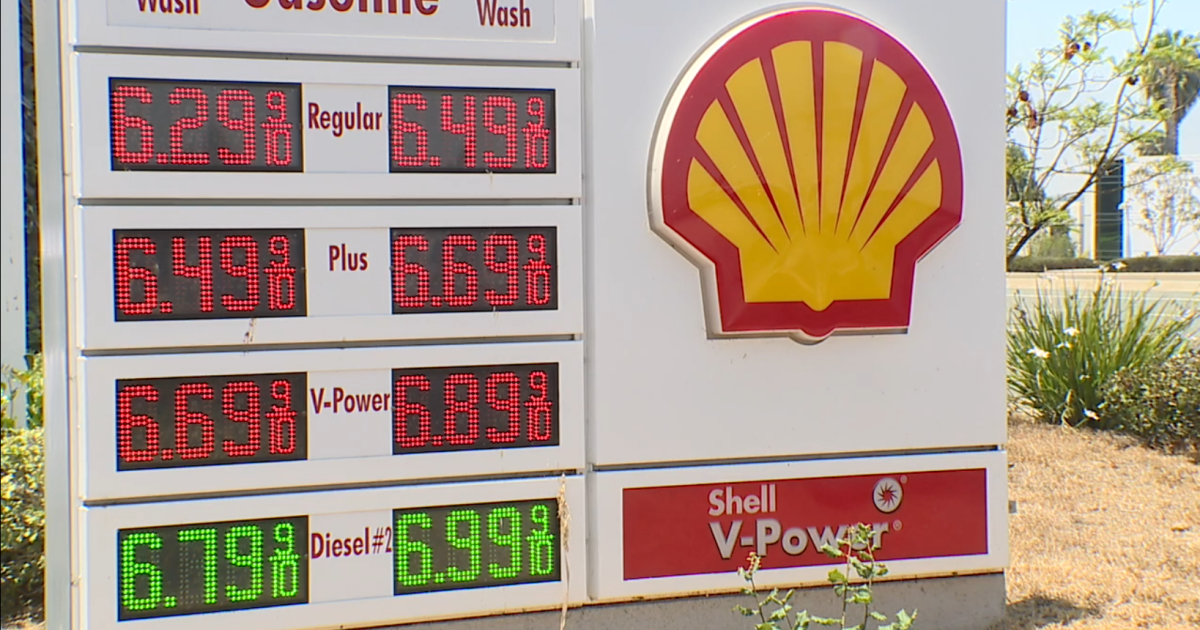
SAN DIEGO (CNS) — The average price of a gallon of self-serve regular gasoline in San Diego County dropped for the 44th time in 45 days today, falling eight-tenths of a cent to $5.42, its lowest amount since March 12. The average price has fallen 74.9 cents over the past 45 days, including eight-tenths of a cent Saturday, according to figures from the AAA and Oil Price Information Service. It is 9.8 cents less than one week ago and 53.2 cents less than one month ago, but 80 cents more than one year ago. The national average price dropped for the 43rd time in 45 days, falling six-tenths of a cent to $3.804, its lowest amount since March 17.
It has decreased 76 cents over the past 45 days, including 1.3 cents Saturday. The national average price is 6.3 cents less than one week ago and 41.6 cents less than one month ago, but 65.6 cents more than one year ago. “Crude oil prices have fallen to their lowest levels in months, dropping to the $60 a barrel range,” the AAA said Thursday. “Overall, gas prices remain the highest they’ve been in 4 years, but the downward trend since late May is welcome news during the busy summer driving season.”
Copyright 2026, City News Service, Inc.

-

 New York2 hours ago
How a Museum Security Guard and Artist Lives on $51,000 in Parkchester
-

 Los Angeles, Ca2 hours ago
Heat advisory issued as Southern California temps near triple digits this week
-

 Detroit, MI2 hours ago
Detroit Battery Safety Provider Reaches to the Skies with Med Hawk
-

 San Francisco, CA2 hours ago
A Locals-Approved Modern Guide to Fisherman’s Wharf: Seafood, Beer Gardens + Iconic Bay Views
-

 Dallas, TX2 hours ago
New glitzy Houston steakhouse Juliet opens next to Delilah this summer
-

 Miami, FL2 hours ago
Allapattah man faces charges over armed robbery after crash in Miami’s Liberty City
-

 Boston, MA2 hours ago
Somehow, This is a Fitting, Confusing End to Jaylen Brown’s Boston Celtics Career
-

 Denver, CO2 hours ago
Denver Broncos 2026 schedule

