Entertainment
Dakota Johnson returns to host 'SNL' with an assist from Justin Timberlake

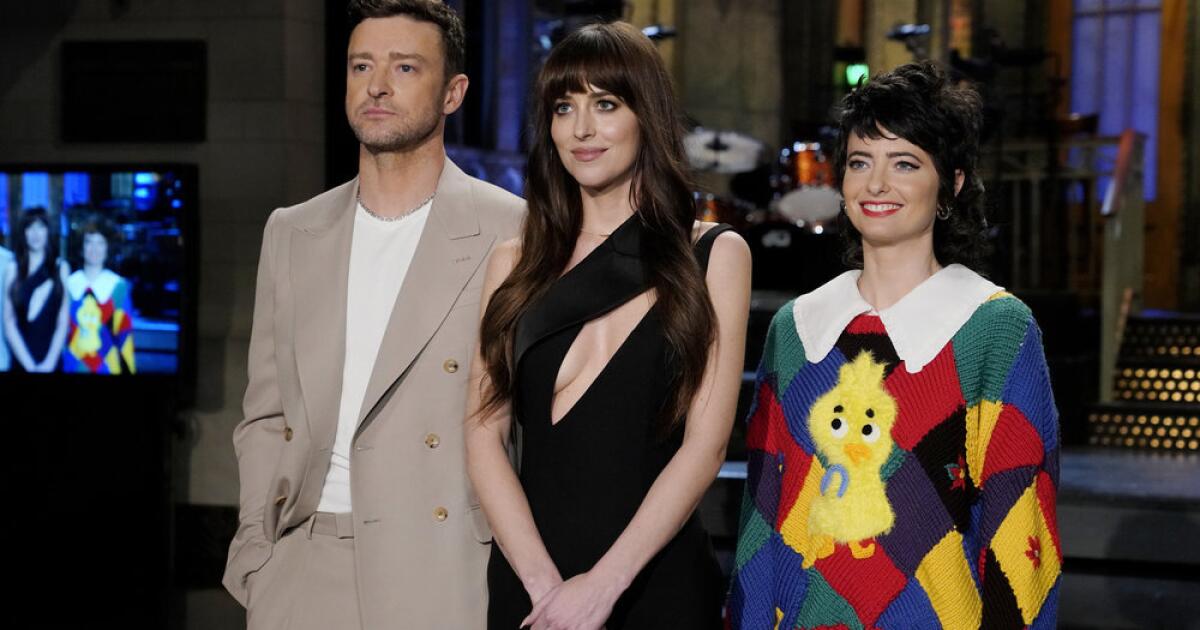
Even if Dakota Johnson, the star of “Madame Web” and this week’s “Saturday Night Live” guest host, was in on the monologue joke that musical guest and previous five-time host Justin Timberlake was there to upstage her, it must have seemed a lot less funny to her by the end of the show.
It was an episode that felt undernourished on the performance side while being overstuffed with guest stars. They included “Tonight Show” host Jimmy Fallon, there to bring back “The Barry Gibb Talk Show” sketch with Timberlake; two cast members from “Shark Tank,” Mark Cuban and Barbara Corcoran, for a sketch about a woman (Johnson) debuting a bad T-shirt idea at her book club; and Dave Chappelle, who appeared in no sketches, but could be spotted on stage next to Fallon during the final goodnight at the end of the show. Like last week’s host, Jacob Elordi, Johnson couldn’t seem to pick up the rhythms of the sketches, losing her place in the cue cards multiple times and breaking character often when cast members fired off funny lines next to her. It wasn’t first-time nerves: She hosted previously in 2015 to promote “50 Shades of Grey.”
The episode also included a sketch about a family having trouble ordering a meal at a restaurant called Buccacino’s, one about an overly enthusiastic Delta airport counter employee (Devon Walker) blocking Johnson’s character from retrieving her lost bag, and a sketch about the Stanley cups craze called “Big Dumb Cups” that had funny lines, but suffered from dropped lines and scattershot performances. Befitting of someone who might be more comfortable off of live television, Johnson shined in two pre-taped pieces, one about a family watching old VHS tapes (more on that in a bit), and a “Please Don’t Destroy” video in which Johnson and the three writers get into a beef and exchange very personal insults.
Timberlake performed “Sanctified” with featured performer Toby Nwigwe, and “Selfish,” introduced by Falon. Both songs are from his upcoming new album.
This week’s cold open parodied CBS’s NFL playoff coverage, with sports analysts including Jim Nantz (James Austin Johnson), Tony Romo (Andrew Dismukes) and James Brown (Kenan Thompson) lamenting “the last real day of football” because the Super Bowl is just a bunch of commercials and nobody watches the Pro Bowl. The melancholy crew, also consisting of Phil Simms (Michael Longfellow), Bill Cowher (Mikey Day) and Nate Burleson (Walker), clapped back at criticisms of Ryan Gosling’s Oscar nomination for “Barbie,” saying that the character of Ken was the first time they felt seen, and asked sadly, “What are men supposed to do on Sundays? Just go to their friends’ houses for no reason?” The existential crisis concluded with an autotuned song that promised better times, “When there’s football again.”
In the monologue, Dakota Johnson showed a prescient photo from when she appeared at an “SNL” 40th-anniversary event. A photo shows her standing up amid a crowd of celebrities including Steven Spielberg, Donald Trump before he was president and someone who Johnson says would become the most powerful person in the country — Taylor Swift. The host said she’s always had trouble handling interviews and press, leading to a clip of her as a child, on stage with her father, Don Johnson. As her dad speaks at the People’s Choice Awards, she’s next to him rolling her eyes and making faces.
With the Dakota Johnson part of the Dakota Johnson monologue dispensed with, Timberlake appeared on the stage to steal the spotlight, and Fallon, already dressed in his Barry Gibb costume, joined. Timberlake offered to fill in when needed because he’s hosted five times. It felt all the more crass given that Timberlake has been telling the press that he “flirted with the idea of hosting” but decided not to, making it seem as if Johnson wouldn’t have been producer Lorne Michaels’ first choice. Yikes. Maybe “Selfish” was an apt song choice.
Best sketch of the night: Home videos full of secrets
A son (Dismukes) comes across old VHS tapes at his aging parents’ home (played by Day and Johnson) and asks to view them. One of the tapes reveals that his parents were disgusting guests on a Maury Povich-style ‘90s talk show segment, “Is He the Father?” The son learns that his parents were in a dysfunctional relationship that involved lots of cheating and fighting. The pre-taped sketch goes on a little too long, but Day and Johnson, along with fellow cast members Sarah Sherman, Marcello Hernandez and James Austin Johnson, lean into the craziness.
Also good: ‘The Barry Gibb Talk Show’ still works
The first “Barry Gibb Talk Show” sketch with Timberlake and Fallon was in October 2003, and whatever you think of Fallon and Timberlake more than 20 years later, the shtick still works. Even if the guests on the made-up show, including Johnson, have nothing to do, Fallon’s Barry Gibb impression is still killer, the random harmonized lyrics are still funny, and Timberlake admirably doesn’t break as the quiet, unopinionated Robin Gibb. If that doesn’t win you over, there’s Fallon-as-Gibb warbling, “If you don’t cry at [Australian animated show] ‘Bluey,’ you’re not a real man!” Hard agree.
‘Weekend Update’ winner: Give Ethan all the Oscars
There’s something about Bowen Yang and award shows, as we’ve mentioned before. For this guest segment, Yang plays Ethan, a 15-year-old in a tux who makes up his own Oscar categories including “Best Performance That Reminded Ethan of Moments From Ethan’s Past” such as having an eye problem like Paul Giamatti’s character in “The Leftovers.” “Been there,” Ethan says and sighs. Ethan’s Academy of Motion Pictures membership is 100% Asian, leading him to share a hashtag for his one-person ceremony, #EthansSoAsian! He concludes the segment by stealing Niecy Nash-Betts’ Emmy speech and revealing that his last name is Oscars. Here’s hoping Ethan makes a return appearance before the Academy Awards in March.



James Gunn isn’t exactly crushing it.
Named co-chairman and chief executive officer of the newly formed DC Studios in 2022, the “Guardians of the Galaxy” filmmaker wrote and directed the division of Warner Bros. Discovery’s largely disappointing “Superman,” released last year.
This week, DC Studios’ second big-screen affair, “Supergirl,” lands in theaters with similarly underwhelming results.
‘Superman’ review: James Gunn gets DCU off to rocky, overstuffed start
Starring Milly Alcock as the movie’s namesake Kryptonian heroine — who also goes by Kara Zor-El and is the cousin of David Corenswet’s Superman/Clark Kent/Kal-El — “Supergirl” isn’t distractingly zany the way its 2025 sister film was. Instead, it’s tonally boring, a chore of a movie chock full of thinly drawn characters and increasingly bombastic and violent.
To be clear, Gunn isn’t at the helm for “Supergirl.” Instead, it’s the typically dependable Craig Gillespie (“I, Tonya,” “Cruella”), working from a script by Ana Nogueira, making her less-than-impressive feature-writing debut.
This planet-hopping adventure in the new DC Universe isn’t a complete space wreck, however, thanks largely to the spunky performance by Aussie Alcock, best known for portraying the younger Rhaenyra Targaryen in the early episodes of HBO’s “House of the Dragon.”
When we catch up with Kara, she’s basically as we left her late in “Superman”: a super-sized mess. She’s out with her beloved, rambunctious dog, Krypto — the peppy and powerful pup having already been a major player in “Superman” — and enjoying a 23rd-birthday pub crawl among planets under a red sun. (Quick reminder: Supergirl, like Superman, draws her incredible powers from a yellow sun, like Earth’s, so she’s at least vaguely normal under a red sun and, importantly, can become intoxicated. The color of suns is a major factor throughout “Supergirl,” and it’s the movie’s most inventive narrative element.)
It is on such a world where a drunken Kara encounters 13-year-old Ruthye Marye Knoll of the Danastia Clan (Eve Ridley), whose family has just been brutally slain by the ruthless Krem of the Yellow Hills (Matthias Schoenaerts). Understandably, Ruthye wants revenge against Krem — leader of the Brigants, a band of male pirates and traffickers — and can think of little else.
She’s offering anyone who will help a sword made by her family of skilled weapons makers. The beyond-buzzed Kara isn’t interested, but she gets involved when a scumbag type tries to take the sword. She continues to do her best to fend off Ruthye’s subsequent pleas for assistance in her quest to kill Krem, but when the baddie — in the process of stealing her floating RV of a spaceship — shoots a charging Krypto with a poison dart, Kara has designs on punishing him, too. In fact, she needs to retrieve the specific antidote Krem carries with him to save her four-legged bud.
And so the gals are off to other worlds, initially traveling via the space equivalent of a beat-up Greyhound bus, on which they run into a trio of pillaging Sklarian Raiders. The sequence in which Kara retrieves stolen possessions and extracts information from them is as zany as “Supergirl” gets.
As their trek through the stars warps on, Kara and Ruthye encounter Lobo (Jason Momoa, seemingly leaving his Aquaman character back in the defunct DC Extended Universe), a rough-and-tumble, motorcycle-riding bounty hunter. They team up — sort of, eventually — but their alliance of convenience is one of the flick’s myriad plot threads that fail to tie into a sturdy knot.
The screenplay by Nogueira — an actor who’s penned a pair of plays — attempts to explore why Kara is so jaded by taking us back to her childhood in the Kryptonian city Argo, protected by her father’s tech after the planet’s demise. Of course, that protection proved to be temporary, or she wouldn’t have eventually been sent to Earth like her cousin before her. It’s lukewarm fare, with Kara eventually learning the familiar Spider-Man lesson — with great power comes great responsibility.
Gillespie adds a few nice touches from the director’s chair throughout the movie, but they’re too little to elevate the proceedings.
Again, Alcock — whose credits also include the recent Netflix limited series “Sirens” — does what she can with the material. It’s a demanding role, as she is on screen for most of the movie, and is spirited in it.
Unfortunately, the lesser-known Ridley — making her feature debut following a few television appearances — is given even less to work with. We never learn much about the one-note Ruthye beyond that her family was killed in her presence and that she is really upset about it.
If you’re expecting the always-lively Momoa to save the day, he brings his larger-than-life presence to Lobo, but the demon-like figure isn’t very interesting. A mix between Aquaman and his Khal Drogo from “Game of Thrones,” the longtime DC Comics character isn’t anything you wouldn’t expect here.

If there’s another bright spot in the cast, it’s Schoenaerts (“Rust and Bone,” “The Old Guard”), who brings a touch of nuance to the villainous Krem. You may have expected a bigger name to play the big bad in this second DC Universe big-screen effort, but some of the acting choices the Belgian makes keep things vaguely engaging when he’s within the frame.

Sadly, vaguely engaging is the best “Supergirl” can manage.
We’ll see if Gunn can turn things around, starting with the HBO series “Lanterns” in August and the horror-tinged film “Clayface” in October, before he returns to direct Corenswet, Alcock and the rest of the “Superman” gang in “Man of Tomorrow,” arriving a little more than a year from now.
We’re hoping for super results, but, at this point, it’s tough to say we’re expecting them.
‘Supergirl’
Where: Theaters.
When: June 26.
Rated: PG-13 for sequences of strong violence, action, language, and smoking.
Runtime: 1 hour, 48 minutes.
Stars (of four): 2.

Richard Montoya of Culture Clash doesn’t mince words when it comes to politics, current events or the state of mainstream Hollywood. But he does sugarcoat his technological limitations as a 67-year-old comic in the dreaded age of video calls with a punchy Chicano twist.
“I’m a low-tech Aztec,” he writes via email when requesting a Zoom link to our Monday interview.
Culture Clash — which includes members Montoya, Ric Salinas and Herbert Sigüenza — arrived on the scene as a guerrilla sketch theater group from the San Francisco Mission District in 1984. By that time, the Chicano movement had reached its peak, thanks to the United Farm Workers labor movement, as well as student activist organizations like Movimiento Estudiantil Chicano de Aztlán (MEChA), which advocated for Chicano unity, political empowerment and educational access.
Luis Valdez, founder of El Teatro Campesino — who began putting on social justice-oriented plays for the striking Delano farmworkers in 1965 — backed the slapstick satire troupe, considering the trio “the cutting edge of fresh, new Latino comic genius.”
Culture Clash stood out in a time when Chicanos became more vocal and visible — and its members challenged an entertainment industry that has historically lacked Latino representation. Between 1993 and 1996, Culture Clash hosted its own self-titled TV show on the syndicated Fox network. The show, which was filmed at the Mayan Theater in downtown Los Angeles, is widely considered the first Latino sketch comedy to air on American television.
Throughout the last four decades, Culture Clash has parodied nearly every prominent Latino figure in history, including Che Guevara, Frida Kahlo, Ritchie Valens, Rita Moreno, Edward James Olmos and others. Its members have mocked hard-shell cholos and gangsters, often by placing them in funny scenarios. For instance, take this clip, in which the trio take on cholo characters and reimagine what it would be like to surf on the Southern California shore.
But they’ve also taken on more serious topics in their classic “Chavez Ravine” play, which looks into one of the darkest chapters in L.A. history: the forceful removal and displacement of families, mostly Mexican, in the 1950s under eminent domain. Recently Montoya attended a live reading adapted by Somos El Teatro, led by Xolo Maridueña, Mariana da Silva and Angel Villalobos at Elysian Park.
“It gives us so much life that people are finding the issues of swindlers, whether it’s gentrification, the taking over of settlements,” says Montoya. “The generational trauma of losing your home in L.A. has never gone away.”
But not every Culture Clash joke or skit has been safe from criticism. Montoya still remembers how a conservative pundit chastised the group for using light humor to discuss the 1992 riots, when LAPD officers were acquitted for using excessive force in the arrest and beating of Rodney King.
“By looking at it and treating it as dynamite, exploding it and then by bringing some levity and a whole lot of seriousness to the Rodney King matter allows us a moment, a fraction of time to look at the issues a little bit differently,” says Montoya. “That laugh allows us a moment to examine it differently.”
On June 27, Culture Clash will return to Grand Performances, a free summer concert series at California Plaza in downtown L.A., with comedic sketches colored by political and social satire. The show, titled “American Payasos! Culture Clash’s End Times Cabaret” will be co-presented with De Los.
While their 40-year-plus legacy might merit a show reminiscent of old goofball skits — like their early 1989 show “The Mission” that poked fun at the problematic Spanish Franciscan missionary Junipero Serra — this will not be an “oldies but goodies show,” as Montoya put it. “We are highly pissed off about a lot of stuff right now.”
“ We’re thinking a lot about the Mexican American patriarchy, Cesar Chavez, Dolores Huerta and it’s time to address some of these things,” says Montoya. “ We want to look at the service workers of Los Angeles, the people that sell cotton candy in MacArthur Park, the people that sell ice cream in Echo Park and the people working the World Cup.”
For the veteran comic, son of the late Chicano poet Jose Montoya, it is also impossible to ignore the immigration enforcement raids that have rattled Los Angeles communities in recent years.
“This is a very strange moment for satirists,” says Montoya. “We have a responsibility to use those tools to say what’s going on in our city and country and provide these moments where we can do a little bit closer examination because the people in power aren’t telling us what’s going on.”
In the last five years, Montoya has fiddled around with digital media, creating sporadic videos featuring old clips of the troupe, as well as videos of Latino media, to connect with technologically diverse audiences of all ages. (One example is a video calling on people to get out the vote, that features clips of Speedy Gonzales and honors political figures like Huerta.)
Although Montoya believes Culture Clash is nearing the end of its career, there’s a question lingering inside his mind: What does a graceful exit look like for a group like Culture Clash, which has never been fully integrated into mainstream Hollywood and still left such a profound legacy in the world of Latino entertainment?
The answer to that might still be unknown, but like any Culture Clash project, it will likely be wickedly satirical and punchy. Says Montoya: “We’re ready to go out with a huge, loud bang that can say something against the power structure.”
Culture Clash will take center stage on June 27 at Grand Performances, in partnership with De Los. Also performing is the retro cumbia-quebradita musician É Arenas (bassist of Chicano Batman), the cumbia-fusion, luchador-masked cumbia group La Nueva Ola de Cumbia, as well as DJ Dali.

In the Hand of Dante, 2025.
Directed by Julian Schnabel.
Starring Oscar Isaac, Gal Gadot, Gerard Butler, John Malkovich, Louis Cancelmi, Sabrina Impacciatore, Benjamin Clementine, Martin Scorsese, Al Pacino, Franco Nero, Jason Momoa.
SYNOPSIS:
A handwritten manuscript of Dante Alighieri’s poem “The Divine Comedy” makes its way from a priest to a mob boss in New York City, where it is taken by Nick Tosches after he’s asked to verify its authenticity.

Outrageously ambitious with an absurd narrative that veers between slick scuzzy fun and philosophically snoozy, the key issue with co-writer/director Julian Schnabel’s excessively long In the Hand of Dante is that it’s more engaging as a dopey early 2000s crime thriller about mobsters employing the services of novelist Nick Tosches (also the writer of the novel the film is based on, inserting himself into it as a fictional character, here played by Oscar Isaac in the adaptation by Schnabel and Louise Kugelberg) and Dante Alighieri specialist to steal the recently unearthed original manuscript of his 14th-century masterwork The Divine Comedy from Italian priests than it does as its other side to that coin, a flashback story about the creation of that story complete with actors portraying secondary characters to eventually get at some points about reincarnation.
This means that the film mostly begins with Oscar Isaac entangled in a web of crime alongside slur-slinging, trigger-finger-happy Louie (in what might be the best performance of Gerard Butler’s career, despite the steep drop in quality in the second half), John Malkovich as a mob boss seeing nothing but dollar signs if they can get a hold of the original manuscript, authenticate it, and sell it on the black market, and even Al Pacino popping up for a scene and stealing it set during Nick’s childhood following a violent incident that is so bonkers readers might not believe it even if I typed it out here, to something close enough to a mess culminating in a confrontation between the excellent Oscar Isaac and the shudderingly bad Gal Gadot and Jason Momoa in important roles, the former a lover placed in danger to the mob by her proximity to Nick, and the latter a greedy killer in a relationship with literary historian Dr. Susanna Pulice (Sabrina Impacciatore).

Martin Scorsese also appears in the 14th-century section (for someone who loves to assert what real cinema is vs cinematic theme park rides, he has now appeared in 3 mediocre-to-terrible movies this year), offering sage-like advice to Dante (also Oscar Isaac) in a hilariously over-the-top beard piece. Much of this is a mental journey, but also has something to do with Pope Boniface VIII (also Gerard Butler) placing the Mark of Cain on Dante following a falling out, the writer’s inability to find inspiration in his current lover Gemma Donati (also Gal Gadot) compared to his first love Beatrice, executed in stark contrast from the much more accessible and palatable modern day crime story. A blunter way to put it is that any time the film shifts to these flashbacks, it’s quite boring and never finds a sense of rhythm, drive, or purpose.
Unquestionably, some of this is by design and baked into other elements of the presentation, which includes flashbacks only receiving color as a means of implying that they were more enriching days for artistic freedom and integrity, compared to the black-and-white 2000s material that further homes in on greed and only financial gain for a manuscript no one even knows how to price if it turns out to be authenticated. Expanding on that thought, there are certainly no qualms to be had with the striking cinematography from Roman Vasyanov.

The other encroaching thought here is that, for as carefully considered as the film looks and as captivating as about half the performances are (we truly do not need to talk anymore about Gal Gadot and Jason Momoa, neither of whom can deliver convincing accents without eliciting laughs), it’s not going anywhere interesting, especially once the mobsters exit the narrative. Technically, they are replaced by a hitman, although a lengthy amount of time is spent watching Nick fly around the world for different aspects of the identification process, sometimes involving technology that even he doesn’t understand and tunes out of. In the novel, there appears to be a greater emphasis on Nick’s inner thoughts about the current state of the art world and on finding flaws in classic works or restrictive prose, which is alluded to here but not interrogated enough to emerge as a compelling element. It’s enough to make one wonder what else was lost in translation from the book.
The filmmakers seem to think the romantic subplot will sustain intrigue for the second half, but it’s devoid of emotion and comes across as aimless in the 14th-century portion. At a certain point, one simply longs for a more focused movie about mobsters stealing recently discovered historic manuscripts for profit; it’s far more fun and amusing than the rest of the sluggish, artfully tedious In the Hand of Dante. No one here seems to realize that this should be a comedic crime caper, and it works that way until it takes itself far too seriously, with flashbacks that bore rather than provide insight or meaningful context.
Flickering Myth Rating – Film: ★ ★ / Movie: ★ ★ ★
Robert Kojder
https://www.youtube.com/watch?v=embed/playlist
-

 Finance1 minute ago
G7 Recommits to Development, Investment Finance to Drive Shared Prosperity
-

 Fitness1 minute ago
Social Fitness: Why Independent Living Communities Are Vital for Healthy Aging
-

 Movie Reviews16 minutes ago
‘Supergirl’ review: DC Studios serves up a second less-than-super movie
-
World28 minutes ago
FACT FOCUS: Norway brought its own food to the World Cup. But not because it distrusts US products
-

 Health51 minutes ago
Does Metformin Help With Weight Loss? How To Maximize Your Results
-
 Lifestyle1 hour ago
A judge says the Kennedy Center must update him on its plans — and address that tarp
-

 Technology1 hour ago
A new paper argues Microsoft exaggerated its quantum claims a year ago
-

 World1 hour ago
Colombia’s ‘El Tigre’ secures presidency as leftist rival finally concedes defeat

