Sign up for the Today newsletter
Get everything you need to know to start your day, delivered right to your inbox every morning.

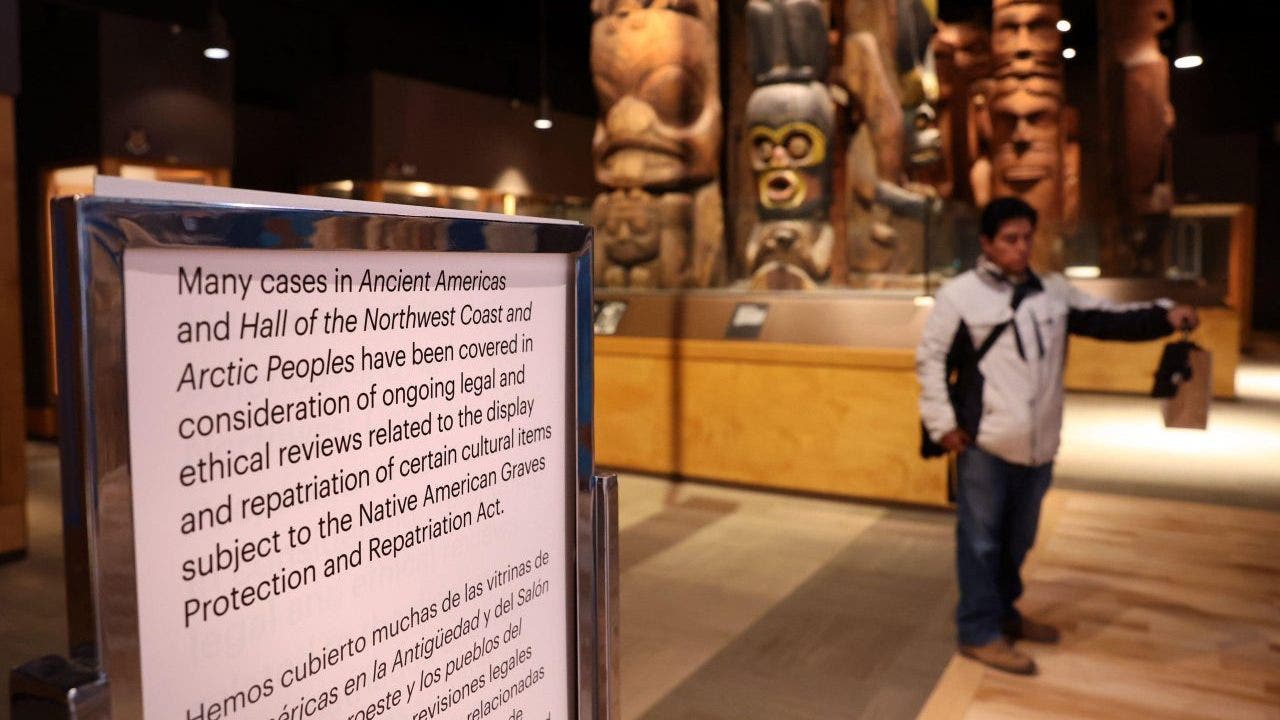
The American Museum of Natural History announced the closure of two Native American exhibits on Friday, citing concerns over tribal consent.
The Manhattan museum, one of the most famous in the country, made the decision after the federal government passed regulations requiring museums receive assent from tribes before displaying cultural artifacts to the public.
“The halls we are closing are artifacts of an era when museums such as ours did not respect the values, perspectives and indeed shared humanity of Indigenous peoples,” museum president Sean Decatur said in a Friday letter, according to The New York Times.
UK MUSEUMS RETURN LOOTED ARTIFACTS TO GHANA UNDER LONG-TERM LOAN ARRANGEMENT
The skeletal remains of a warrior discovered in Outer Mongolia in 1925 are displayed before their removal from public viewing at the American Museum of Natural History. (AP Photo/Bebeto Matthews)
He added, “Actions that may feel sudden to some may seem long overdue to others.”
The two canceled exhibits showcased Native American cultural items from the Eastern Woodlands and Great Plains.
President Biden’s administration has attempted to hasten the repatriation of Native American remains and cultural objects.
‘DOCTORS AGAINST GENOCIDE’ SCRAPS EVENT AT HOLOCAUST MUSEUM, APOLOGIZES AFTER UPROAR: ‘MISUNDERSTANDING’
New federal regulations were put into effect this month that expedite the processes outlined in the 1990 Native American Graves Protection and Repatriation Act.
Museums, universities, and other institutions are now required to begin repatriation of human remains or relevant cultural items within five years.
Messages for the public greet people upon arrival in the Halls of the Ancient Americas and the Hall of Northwest Coast and Arctic Peoples at the Field Museum in Chicago. (Chicago Tribune)
A major change is the sweeping power given to tribal leaders and representatives in making claims on museum property and requesting repatriation.
The federal regulations rolled out earlier this month greatly loosen the burden of proof for tribes to make claims on objects or remains.
Institutional curators are required to “defer to the Native American traditional knowledge of lineal descendants, Indian Tribes and Native Hawaiian organizations” in lieu of missing historical documentation.
Read the full article from Here


Local News
An East Boston father is suing ICE, alleging immigration agents unlawfully stopped, arrested, and detained him because of his race and national origin despite having his legal status, his lawyers said.
Lawyers for Civil Rights filed the lawsuit Thursday on behalf of Jose Pineda, a 62-year-old Salvadoran immigrant who has lived in the U.S. for more than three decades and is authorized to remain and work through humanitarian relief, the nonprofit legal organization said in a press release.
The suit is seeking damages under the Federal Tort Claims Act, alleging false arrest, false imprisonment, assault, and severe emotional distress.
“I came to the United States to escape the civil war that devastated El Salvador. I worked hard, started a family, and built a life here,” said Pineda, who works as a landscaper and lives with his wife and 13-year-old daughter. “I never expected to feel that kind of fear again, much less in the United States.”
According to the 30-page complaint, written by LCR senior attorneys Victoria Miranda and Mirian Albert, Pineda has been a recipient of Temporary Protected Status, which allows certain foreign nationals from designated countries to live and work legally in the U.S.
Pineda also had a pending asylum petition and had been granted a T visa, which provides immigration protections to trafficking victims, the complaint states.
“We will not stand idly by as ICE wreaks havoc on immigrant families. Through racial profiling, ICE agents are carrying out an unquestionably discriminatory agenda,” Miranda said in the release. “The law exists to protect people like Mr. Pineda, and it must be enforced against ICE.”
The lawsuit stems from a May 2025 encounter in Weymouth, where Pineda was driving a landscaping truck to a job site when agents in unmarked ICE vehicles surrounded him, according to the complaint.
“The aggressive nature of the questioning made it clear to Mr. Pineda that he was not being judged based on any evidence of unlawful conduct, but rather on his identity, race, ethnicity, and/or national origin,” Pineda’s attorneys wrote.
The lawsuit alleges ICE officers then “forcibly” handcuffed and shackled Pineda before taking him to the agency’s field office in Burlington.
Officers searched Pineda’s belongings during the stop and again at the field office, allegedly confiscating $600 in cash that he intended to use to pay his family’s rent. The money has not been returned, according to the complaint.
Pineda spent two days in ICE custody under what the lawsuit describes as “cruel and inhumane conditions.”
“After what ICE did to me, and after everything my family has endured, I don’t know if I will ever truly feel safe again,” Pineda said.
According to the complaint, he was held in severely overcrowded cells containing more than 40 people — at times as many as 60 — leaving little room to sit and forcing him to remain standing for much of his detention. Detainees also allegedly shared a single toilet and sink without soap or toilet paper and were not provided toothbrushes, clean clothes, or showers.
Fluorescent lights remained on around the clock, making it difficult to sleep, while temperatures became “extremely cold” overnight and some detainees received only aluminum blanekts for warmth, the complaint states.
Pineda was given only a two-minute phone call during his detention and received two bottles of water each day, along with “inadequate and limited” food and water, according to the complaint.
“Mr. Pineda has suffered devastating and ongoing physical and emotional harm that has impacted all aspects of his life,” his attorneys wrote. “Mr. Pineda brings this action to seek accountability for these violent and traumatizing tortious acts of the ICE officers and to address the harms inflicted upon him.”
According to LCR, Pineda was released following advocacy by Centro Presente, a Massachusetts immigrant rights organization.
After his release, ICE initiated removal proceedings against him depsite his humanitarian protections, the organization said. Those proceedings were ultimately dismissed.
“ICE targeted Mr. Pineda based on nothing more than his perceived national origin and the nature of his work,” Albert said in the press release. “Our laws prohibit this kind of arbitrary and discriminatory enforcement. Through this lawsuit, we seek to hold the federal government accountable for the violence and harm inflicted on Mr. Pineda.”
ICE referred questions about the lawsuit to the Department of Homeland Security. DHS did not immediately respond to a request for comment Thursday evening.
Get everything you need to know to start your day, delivered right to your inbox every morning.

Last year, Americans received nearly 30 billion scam robocalls and text messages. Now, leaders in Pennsylvania are taking a new approach to try to crack down on them.
“It’s not just certain audiences that are targeted in this space. It’s really everybody,” said Kate Sullivan, CEO of Better Business Bureau of Western Pennsylvania. “Robocalling is just faster and more aggressive than it’s ever been,” Sullivan said.
The prevalence, exacerbated by artificial intelligence, is why 49 attorneys general across the country sent a letter to the Federal Communications Commission to strengthen its rules to prevent scammers from accessing legitimate phone numbers.
“You have individuals that will purchase maybe 100,000 different phone numbers,” Pennsylvania Attorney General Dave Sunday said. “Those numbers will land somewhere where you have a nefarious actor who will use those numbers to do the robocalls.”
Sunday is part of the Anti-Robocall Task Force, along with West Virginia Attorney General JB McCuskey. Last year, the coalition sent warning letters to major phone service providers to stop allowing illegal robocalls to reach consumers. Now they’re building on this by going directly to the FCC.
“The consumer matters, and we want to make sure that our constituents, the consumers that are in our states’ voices, are being heard at the highest level as loudly as they can be,” McCuskey said.
Sunday said they want to put more onus on companies to not sell these numbers, and if they do, to have documentation that can be provided to law enforcement so they can trace back and hold the scammers accountable.
KDKA-TV reached out to the FCC for comment. A spokesperson said in part that they “welcome this input from state leaders.” They also mentioned, “The Commission proposed expanding certification and disclosure requirements to all providers that receive telephone numbering resources… to stop scammers from exploiting gaps in the system.”
“Getting ahead of it and more protections for the consumers, I think, does have quite a bit of value,” Sullivan said.
As for what you can do, the BBB and AGs said it’s better to let a robocall go to voicemail. If you decline it, that indicates you’re a real person and may get more calls. Also, make sure to report robocalls to the BBB or the Federal Trade Commission.

New data is shedding light on the state of Connecticut’s economy and labor force.
On this episode of the CBIA BizCast, CBIA Foundation director Dustin Nord joins host Amanda Marlow to talk about new Connecticut Department of Labor data that highlights the mismatch between increased job openings and a shrinking labor force.
Connecticut job openings jumped 2.6% in May to 87,356—however, since May 2025, 37,700 people have left Connecticut’s labor force.
Nord breaks down some of the reasons for this mismatch and what needs to be done to address Connecticut’s economic challenges.
He also shares insights into a U.S. Bureau of Economic Analysis report showing Connecticut’s economy expanded 1.8% in the first quarter of 2026.
The CBIA BizCast is made possible through the generous support of Google. Subscribe to the BizCast wherever you get your podcasts. Please rate the podcast and leave us a review—we appreciate your support! And be sure to give us your feedback and share guests you’d like to hear.


California teen e-biker baiting police to chase tracked by drone, arrested


Our picks for state\nSenate from Wayne Co. | Endorsements


Man reported missing in San Francisco


How to buy France World Cup semifinal soccer tickets in Dallas


Miami-Dade Schools names six semifinalists for superintendent


Lawsuit: ICE detained East Boston father despite legal status


Victor Marx wins GOP primary for Colorado governor, defeating veteran lawmaker after unorthodox campaign


Widower of pregnant woman who was shot to death in Seattle sues homelessness authority

