West
University of California board delays vote on allowing illegal immigrant students to work on campus

- The University of California has decided to postpone a decision on allowing immigrant students without legal status to apply for jobs on its campuses.
- The vote to delay the plan until 2025 was passed with a 9-6 majority, leading to some audience protests.
- The policy aimed to provide work opportunities for immigrant students, potentially benefiting up to 4,000 previously allowed to work under DACA.
The University of California’s governing board on Thursday punted a decision of whether to allow immigrant students without legal status to apply for jobs on its 10 campuses, with the system’s president warning doing so would carry “significant risk” for the institution and students, including possible criminal prosecution.
The Board of Regents voted 9-6 to delay considering the plan until 2025 amid shouts of “Cowards!” from some in the audience.
Before the vote, University of California President Michael Drake told the board that the proposed legal pathway for the student work plan was “not viable right now” and said implementing such a plan would carry “significant risk for the institution and for those we serve.”
UNIVERSITY OF CALIFORNIA BOARD TO VOTE ON ALLOWING ILLEGAL IMMIGRANT STUDENTS TO WORK ON CAMPUS
Drake said the policy could put immigrant students at risk of criminal prosecution and then deportation for working while lacking legal status. That, in turn, would put the university system at risk of fines and criminal penalties for employing them, and pose a potential threat to grants and other funding. He said the university system will continue to explore its options.
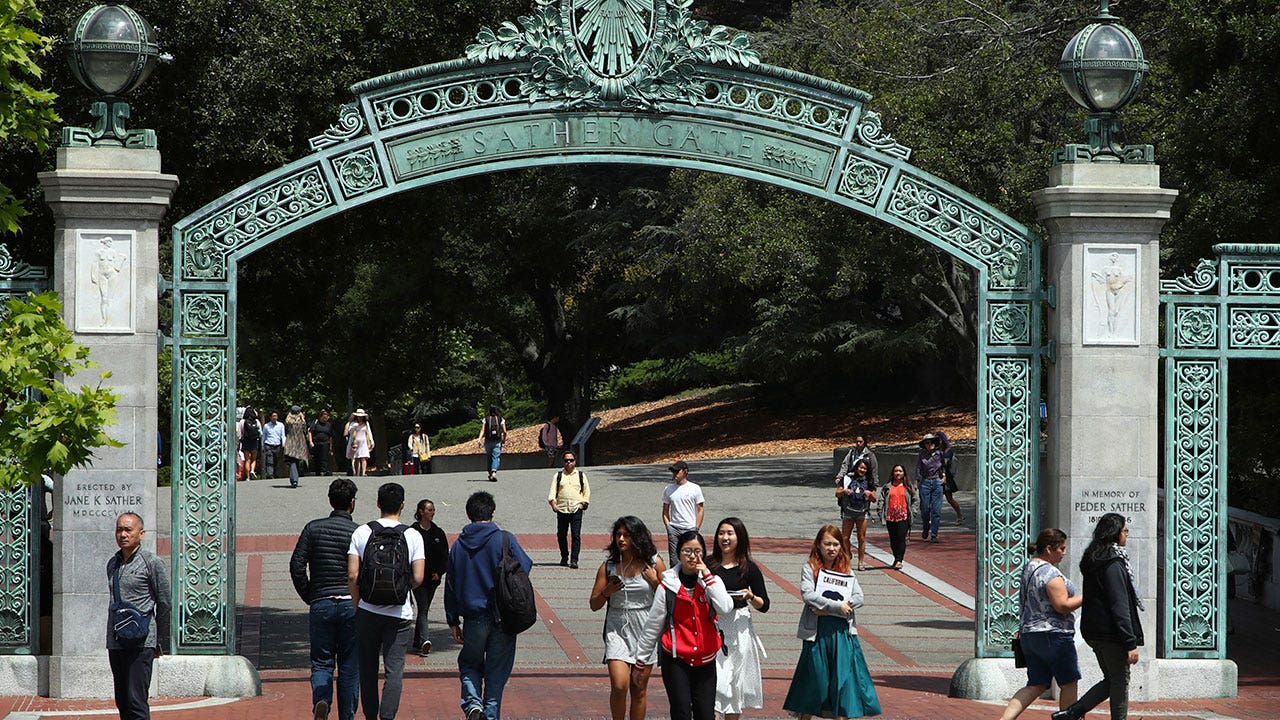
Students walk past Sather Gate on the University of California at Berkeley campus in Berkeley, Calif. The University of California’s governing board has postponed for a year a vote on a plan to allow immigrant students who lack legal status to apply for university jobs. (AP Photo/Ben Margot, File)
Regents who opposed delaying the plan shared their disappointment and called it a missed opportunity for the university system to lead in the fight for the rights of immigrant students who don’t have legal status.
“We are taking a pause at a crucial moment on an issue that requires our commitment,” said California Assembly Speaker Emeritus and UC Regent John A. Pérez. “If you stand and say this is the time for us to actually be bold, and take individual and institutional risks then you speak to a different sense of moral authority.”
The prestigious university system has more than 295,000 students. The policy could benefit as many as 4,000 immigrant students who would previously have been allowed to work under the Deferred Action for Childhood Arrivals, or DACA.
The federal policy implemented by former President Barack Obama prevents the deportation of hundreds of thousands of immigrants brought to the U.S. as children. It was declared illegal by a federal judge in Texas in September. The judge’s ruling is ultimately expected to be appealed to the U.S. Supreme Court, sending the program’s fate before the high court for a third time.
UC’s policy would also challenge a 1986 federal law prohibiting people without immigration status from legally working.
For years, students without legal immigration status have attended University of California schools while paying in-state tuition.
Department of Homeland Security officials did not respond to a request for comment on the proposal considered by the board of regents.
UNIVERSITY OF CALIFORNIA BOARD OF REGENTS MOVES TOWARD ALLOWING HIRING OF ILLEGAL IMMIGRANT STUDENTS
“I’m deeply disappointed that the UC Regents and President Drake shirked their duties to the students they are supposed to protect and support,” Jeffry Umaña Muñoz, UCLA student and leader at Undocumented Student-Led Network, said in a statement.
Ahilan Arulanantham, faculty co-director at the Center for Immigration Law and Policy at the University of California Los Angeles School of Law called it “deeply shameful” that the regents refused to adopt the policy now.
“Our legal theory, which we presented to the regents in October 2022, makes clear: the University of California has the legal right to authorize the hiring of undocumented students today,” Arulanantham said. “I have had the immense privilege of working with these students for the past couple of years, and I’ve seen firsthand how challenging it is to simultaneously pursue their studies and fight for their right to survive at the UC.”
Read the full article from Here


Officials with the University of Alaska have tapped the commander of the U.S. Army 11th Airborne Division’s Arctic Aviation Command as the new permanent chancellor of the University of Alaska Fairbanks.
Col. Russell “Russ” Vander Lugt was selected from four finalists after an eight-month search process. He will be the top executive of Alaska’s leading research institution, which describes itself as “America’s Arctic university.” He will replace interim chancellor, and former U.S. Ambassador to the Arctic, Mike Sfraga, who succeeded former chancellor Dan White who announced his retirement in May of last year.
Vander Lugt is a senior U.S. Army officer, an Arctic scholar and UAF alumni, with over two decades of executive leadership experience, according to a university announcement on May 27. He has served as commander of the 11th Airborne Division’s Arctic Aviation Command at Fort Wainwright in Fairbanks since Aug. 2024.
“I’m humbled to be selected to lead the University of Alaska Fairbanks during this pivotal time,” Vander Lugt said in a statement with the announcement.
“I look forward to leading through trust, transparency, and teamwork as we see Alaska and the Arctic transformed through education, research, and public service. I’m committed to building on the strong foundation Chancellors Sfraga and White have established, and working closely with university leadership and governance to support and advance UAF’s mission,” he said.

Vander Lugt will step into the permanent chancellor role on Sept. 8. Sfraga’s last day was Friday, and university officials have selected Larry Hinzman, director of the UA Arctic Leadership Initiative, to serve as interim chancellor through the summer.
Vander Lugt has had a long career with the U.S. Army in various roles in Alaska, where he is stationed in Fairbanks, and across the U.S. His resume lists deployments to Europe and the Middle East.
He served in executive leadership roles that include the Alaskan Command, a division of the U.S. Northern Command, the 601st Aviation Support Battalion, and the 1st Stryker Brigade Combat team. He also taught history and military leadership as an assistant professor at the U.S. Military Academy at West Point and was a professor of military science and department chair at Embry-Riddle Aeronautical University in Prescott, Arizona.
He holds a master’s degree and doctoral degree in Arctic and Northern Studies, which he completed in 2022 at the University of Alaska Fairbanks.
Vander Lugt’s hire is the latest in major leadership changes in the University of Alaska system — former UA President Pat Pitney retired last month and former university attorney Matt Cooper was named as her successor. Cooper will begin as university president in early August, and Michelle Rizk, vice president of university relations and chief strategy, planning and budget officer, is serving as interim president. Cheryl Siemers was appointed permanent chancellor of the University of Alaska Anchorage in March, after serving as interim chancellor since the retirement of former chancellor Sean Parnell last year.
Vander Lugt’s base salary will be $309,000, according to the university’s announcement.
The University of Alaska Fairbanks serves roughly 7,500 students. It employs more than 800 faculty and nearly 2,000 staff across urban and rural campuses in Fairbanks, Kotzebue, Nome, Bethel and Dillingham.
Originally published by the Alaska Beacon, an independent, nonpartisan news organization that covers Alaska state government.

Believe it or not, the 2026 All-Star Game voting process has already begun, as of Wednesday. Fans who want to see their favorite members of the Arizona Diamondbacks take the field in the midsummer classic this season can begin voting for their stars.
There are certainly some deserving players on this Diamondbacks club, which is currently 32-28 and occupying the third Wild Card sport in the National League.
Here’s how and where you can vote for your hometown heroes:
How to vote for Diamondbacks players to make All-Star Game
Fans can utilize the following link to vote for members of their team on dbacks.com. Fans are permitted to fill out and submit as many as five ballots per day, selecting as many or as few players as they choose.
This period of the fan vote constitutes Phase 1 of All-Star voting, which will run from Wednesday, June 3 through Thursday, June 25 at 9:00 a.m. Arizona time (12:00 p.m. Eastern time).
Following Phase 1, the two overall top vote-getters will receive automatic berths into the All-Star lineups. If those two are not Shohei Ohtani and Aaron Judge once again, that would be an upset.
When and where is the 2026 All-Star Game?
The 2026 All-Star Game will take place at Citizens Bank Park, home of the Phillies in Philadelphia. All-Star week begins on June 10, with a full slate of activities, before the game is played on Tuesday, July 14 at 8:00 p.m. Eastern time (5:00 p.m. Arizona time).
The full schedule of events are as follows:
- Friday, July 10: HBCU Swingman Classic
- Saturday, July 11: 2026 MLB Draft
- Sunday, July 12: All-Star Sunday, MLB Futures Game, MLBx All-Star 3-on-3
- Monday, July 13: T-Mobile Home Run Derby (8:00 p.m. ET)
- Tuesday, July 14: All-Star Red Carpet, All-Star Game
Which Diamondbacks are deserving All-Stars?
| Mark J. Rebilas-Imagn Images
So, who should Diamondbacks fans vote for? Obviously, you may fill out the ballot however you choose. That can include a full roster of Diamondbacks, regardless of their stats or notoriety this season.
Still, here are some of the top performing D-backs who might have a leg up on an All-Star berth:
OF Corbin Carroll
Corbin Carroll is having another All-Star worthy season. He’s hitting .289/.380/.545 with a .925 OPS and eight home runs, while playing good right field defense. He has the eighth-most bWAR (2.7) among position players, fifth-most in the National League, and third-most among all pure outfielders.
2B Ketel Marte
If Marte wins the NL second base fan vote, it will be his third straight season starting the All-Star game. Despite such a slow start to the year, that feels possible again. Marte is hitting .259/.315/.456 with 10 homers and is playing the best defense of his career.
3B Nolan Arenado
Nolan Arenado is quietly putting together one of his better seasons of the 2020s, slashing .269/.351/.467 with eight homers and flashing his elite third base glove at nearly as good a pace as ever. His name still carries a lot of weight in third base conversations; he’ll get some votes, no matter what.
1B Ildemaro Vargas
Vargas’ bat has cooled down quite a bit since his historic start to 2026. He’s still hitting a sturdy .290/.318/.454, but feels more likely to be considered as a reserve selection than a leading vote-getter.
Honorable Mention: LHP Eduardo Rodriguez
Pitchers are not selected by the fan vote. They are selected by player ballots and the All-Star Game managers. The National League’s manager will be Dave Roberts of the Dodgers, again.
The National League has quite a few talented pitchers, but Eduardo Rodriguez currently holds the fifth-best starting pitcher ERA (2.24) among NL hurlers. It’s going to be difficult to dethrone Christopher Sanchez or Jacob Misiorowski, but Rodriguez could find his way into the pitching pool, especially after his WBC heroics for Team Venezuela.
 Add us as a preferred source on Google
Follow

Hilton, Becerra lead California governor primary results
Vote counting continued after California’s primary election for governor with just over half of the results in.
Although results from California’s primary election began rolling in on Tuesday, June 2, it could take days or even weeks before the final counts are certified.
“This is normal … We have a process that by law ensures both voting rights and the integrity of elections, so I would call on all Californians to be patient,” Secretary of State Shirley N. Weber said in a June 2 news release.
The Golden State’s lengthy vote-counting process has “become a national narrative about California elections,” according to Thad Kousser, a professor of political science at the University of California, San Diego.
“In California, it takes a long time to certify votes, to verify the signatures, to then count the ballots; all of that process takes a while,” Kousser said in an interview last week. “It may take a while for us to learn who the top candidates who emerge are.”
Here are some factors behind California’s lengthy vote-counting process.
Mail-in ballots come with added verification step
With each mail-in ballot cast, elections officials must compare the signature on a returned vote-by-mail envelope to the voter’s signature on their voter registration card. Various factors go into determining whether the signatures match, including the slant of the signature, whether it is printed or written in cursive, and the size, proportions, or scale.
Vote-by-mail ballots were Californians’ preferred voting method in both the 2024 primary and general elections, with drop-off locations — such as ballot drop boxes and voting centers — the most popular way to return mail-in ballots.
During California’s 2024 primary, more than 7.7 million votes were cast statewide, and 90 percent of those were mail-in ballots. This means election officials had to verify the signatures on more than 6.8 million ballots before they could be counted. For the November 2024 general election, 80% of cast ballots, or about 13 million, were vote-by-mail.
Reviewing conditional voter and provisional ballots
California also allows for same-day voter registration, also known as conditional voter registration. Voters who need to register, or re-register, within 14 days of an election can do so at their county elections office, polling place, or vote center. These ballots will be processed and counted after the county elections office has completed the voter registration process.
In addition to conditional voter ballots, there are provisional ballots that must be verified before they are counted. Voters cast provisional ballots for a wide array of reasons, including if their name does not appear at a polling place or if they’ve made a mistake on their ballot. After a voter casts a provisional ballot, it will not be counted until election officials have confirmed that the voter is registered to vote in that county and has not already voted in that election.
Vote-by-mail ballots can be sent on Election Day
Though state officials recommend voters mail their ballots sooner rather than later, state law allows vote-by-mail ballots postmarked by Election Day to be counted if they arrive within a specified window afterward, thereby extending the tallying process.
For the primary, ballots needed to be postmarked on or before June 2 and received by county elections office no later than June 10.
California is, well, big
California is the most populous state in the nation. And, as of May 18, a record total of 23,155,447 Californians were registered to vote.
While not all registered voters are expected to have voted, county election officials estimate that more than 5 million ballots were cast statewide.
When to expect final results
Under state law, county elections officials are required to report the results for most ballots by June 15, or 13 days after the election, according to Weber. However, some ballots can take counties up to 30 days to count every ballot and then conduct a post-election audit.
State law requires county elections officials to report final official results to state officials July 3. State officials then have until July 10 to certify the results of the election.
-

 Austin, TX37 seconds ago
Highly pathogenic virus found in herd of Texas dairy cows
-

 Alabama6 minutes ago
Is Tommy Tuberville an Alabama resident? GOP candidate challenges status
-

 Alaska13 minutes ago
University of Alaska names U.S. Army commander as new UAF chancellor
-

 Arizona16 minutes ago
Diamondbacks Fans Can Now Vote for Arizona’s All-Stars
-

 Arkansas21 minutes ago
Arkansas DFA Agents seize illegal products in Corning
-

 California28 minutes ago
California may take weeks to finalize primary results. ‘This is normal’
-

 Colorado31 minutes ago
Colorado governor vetoes block on surveillance pricing as other states push for bans
-

 Connecticut36 minutes ago
Afternoon forecast for June 3

