Politics
Column: The only thing voters liked less than Ron DeSantis' anti-woke crusade was Ron DeSantis

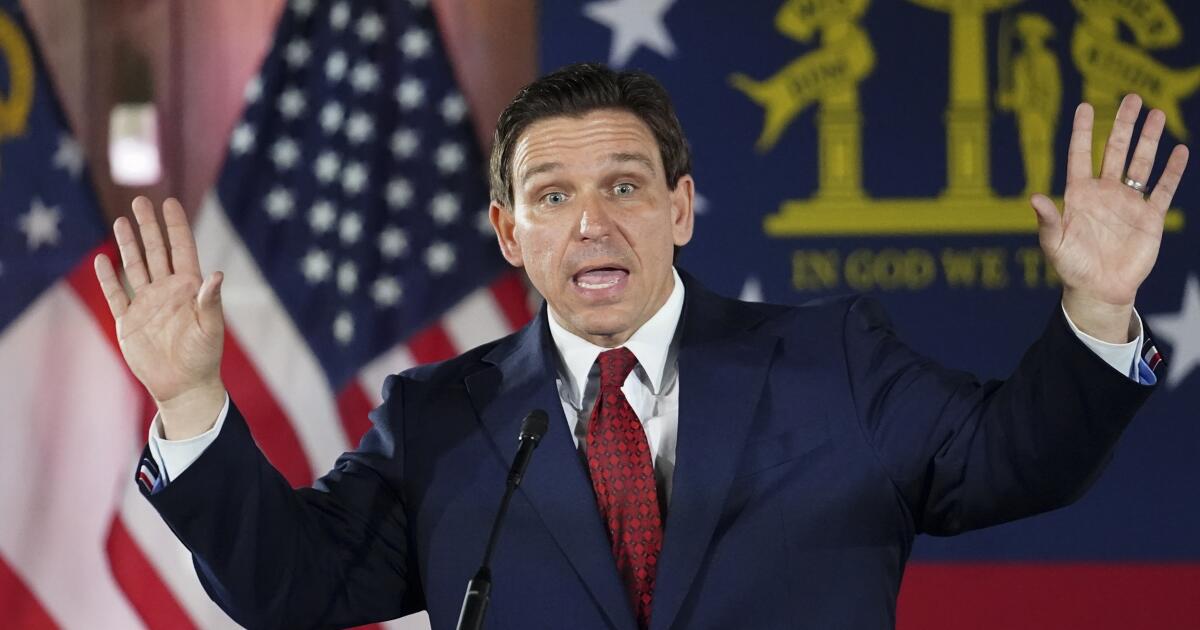
Sunday was a tough day for those, like me, who get their entertainment jollies by watching losers try to redeem themselves. I’m not talking only about the Buffalo Bills, the only NFL team I care even two cents for, whose effort to erase their four consecutive Super Bowl losses (1990-1993) was defeated by the Kansas City Chiefs.
Even more crushing, I am forced to bid farewell to the Ron DeSantis for President campaign.
The theme of the postmortems that started appearing in the political press almost instantaneously after DeSantis’ announcement that he was withdrawing from the quest for the Republican nomination was that his campaign’s recklessness was matched by its fecklessness.
The damage of the laws [DeSantis] pushed through in Florida … will live on.
— Miami Herald editorial
That’s true enough, as far as it goes, but it doesn’t go nearly far enough. The DeSantis campaign exposed the vacuum at the heart of Republican policymaking, which is that it doesn’t involve policymaking at all, only the ceaseless repetition of grievances against fabricated enemies — teachers, librarians, doctors, transgender individuals, advocates of social inclusion-equity-diversity — accompanied by performative viciousness.
The campaign also exposed the vacuum in our political press corps, which tried valiantly to prop up the Florida governor as a doughty maverick who shouldn’t be underestimated. (Pamela Paul, New York Times, Feb. 9, 2023: “His policies land better with voters than with progressive critics.”)
The elevation of DeSantis into some sort of political virtuoso with frighteningly occult skills began midway through his first gubernatorial term, when Politico ran an article headlined, “How Ron DeSantis won the pandemic.” This oustandingly ignorant piece underscored the folly of calling the game before the final whistle blows — indeed, even before the game has begun.
The truth was that the pandemic was defeating DeSantis even then, since 32,000 Floridians already had died of COVID-19; by the time the pandemic was declared over, Florida would have one of the worst records against COVID of any state in the union, due mostly to DeSantis’ resistance to sensible social policies and his demonization of the COVID vaccines.
DeSantis continued to snow the press with disinformation about his COVID response, citing Florida’s relatively high median age to explain away the state’s wretched performance against COVID. The problem there is that three of the four states with higher median ages than Florida (Maine, New Hampshire and Vermont) had significantly lower death rates than Florida.
There are two chief methods of assessing the DeSantis presidential campaign. One is to examine its nuts and bolts and assess DeSantis’ ability at retail campaigning; that’s the method of the political press corps, which prefers horse-race coverage to writing about things as dull as policies. The other is to examine the implications of a DeSantis presidency for voters and their families, which is where the rubber meets the road.
In both respects, DeSantis was a disaster. Let’s take them in order.
DeSantis’ campaign began with the audacious tactic of announcing his candidacy May 24 on Twitter Spaces, an online audio feature that Twitter (now X) owner Elon Musk thought would raise the social media platform to a new level of user appeal. Didn’t work that way.
Musk couldn’t get the thing to function, plying the audience with feedback, weird musical interludes and long stretches of silence instead of with DeSantis. Scheduled to start at 3 p.m. Pacific time, it finally got going about 18 minutes late.
Musk and the moderator, a Musk acolyte named David Sacks, kept trying to assert that the technical screw-ups amounted to a triumph brought about by a large audience. “We are melting the servers, which is a good sign,” Sacks said early on.
This sounded like the claim by SpaceX, another Musk venture, that its April 20 launch of a prototype rocket, which ended with the vehicle exploding in flight four minutes after liftoff, was a success. Never mind that the launch destroyed the launchpad and showered a neighboring community with debris, which sounds like a convenient metaphor for the DeSantis launch.
On the stump, DeSantis proved singularly maladroit. Coverage of his personal appearances focused on his obvious discomfort in meeting with strangers and his fruitless efforts to laugh or even crack a smile, which tended to produce only a hideous facial rictus.
He sat down for interviews only with right-wing sources such as Fox News, where he could be assured of receiving questions as solid as balls of yarn. After I wrote that DeSantis had “all the charisma of a linoleum floor,” The Times received an indignant letter from an architect objecting to the unwarranted affront to linoleum.
The end of the campaign was as slipshod as its beginning. In his withdrawal speech, DeSantis quoted Winston Churchill as stating, “Success is not final, failure is not fatal; it is the courage to continue that counts.”
Um, no. After checking Churchill’s ample canon for this quote and another line purporting to define “success,” the International Churchill Society reported that it could “find no attribution for either one,” and that an almost equal number of online sources credit them to Abraham Lincoln — but the society couldn’t find them in the Lincoln archives either. At least one dedicated sleuth found the same quote in a Budweiser beer ad from 1938.
That brings us to the more important ramifications of the DeSantis candidacy, for the residents of Florida today and potentially for Americans who might have lived under a DeSantis presidency.
Whether or not he and his sedulous sycophants in the Florida Legislature specifically tailored their in-state policies to his desire to pose as the most extremist culture warrior in America, the consequences for Floridians have been dire.
Start with the pandemic. After bragging about being personally on hand to welcome the first shipments of the COVID vaccine into Florida — he called it a “historic day” — DeSantis staged an about-face.
Evidently calculating that throwing in his lot with the anti-science, anti-vaccination right wing was a surer path to electoral success than protecting his constituents from harm, DeSantis demonized the vaccines and joined the far right in trying to turn Anthony Fauci, the most respected immunological authority in America, into the chief pandemic villain.
He hawked campaign swag like beer can cozies and T-shirts emblazoned with the slogan, “Don’t Fauci My Florida,” a reference to Fauci’s advocacy of vaccination and social distancing — policies that Fauci actually had no authority to enforce. This while COVID cases were exploding in Florida and nationwide.
In September 2021, DeSantis appointed as his state’s surgeon general the COVID crank Joseph Ladapo, an advocate of the useless anti-COVID nostrums hydroxychloroquine and ivermectin and a persistent anti-vaccine advocate.
Supporting his advice to all Americans to avoid the mRNA vaccines from Moderna and Pfizer with fabricated research papers and long-debunked claims about the hazards of the vaccines — which have protected millions from death and hospitalization from COVID — Ladapo has used his position as a state public health official to undermine public health nationwide. As I described him, “the most dangerous quack in America.”
Ladapo’s ideological and ignorant pronouncements against the vaccines prompted the Food and Drug Administration and Centers for Disease Control and Prevention to upbraid him jointly, in a letter notifying him that his claims are “incorrect, misleading and could be harmful to the American public” and warning that his activity “puts people at risk of death or serious illness that could have been prevented by timely vaccination.”
But there’s more. In April, DeSantis signed one of the most restrictive abortion bans in the nation, barring the procedure after six weeks of pregnancy — before many women even know they’re pregnant. He was so proud of his decision that he signed the measure late one night.
In September 2022, minions acting in DeSantis’ name deceived nearly 50 immigrant asylum seekers in Texas into boarding flights to Martha’s Vineyard, Mass.
The immigrants, who were in the U.S. legally, were told that they were being taken to Boston or Washington, D.C., where they would be given jobs and receive a host of immigrant services. Instead, they were dropped off on the island, which is reachable only by air or sea and where no one capable of providing such services had been warned of their arrival.
This stunt may have been designed to show up the islanders as heartless liberals who talk a good game but don’t walk the walk. Instead, the islanders met their humane responsibilities, providing succor to the deceived innocent victims and arranging the services they had been promised. All this was paid for by Floridians’ taxes. DeSantis hasn’t yet paid the price for his contemptible behavior.
Then there’s DeSantis’ impersonation of a champion of election integrity, shown by the arrests of 19 people, 14 of whom are Black, for alleged voter fraud in 2022. Most believed they were entitled to vote because that’s what they were told by state elections officials. The first cases to go to trial ended with dismissals or acquittals, and all the rest are probably destined to go the same way.
The most significant and far-reaching DeSantis policy is his assault on education. DeSantis eviscerated New College of Florida, a state college that has long been considered a beacon of liberal arts education; he fired its board and replaced it with a passel of right-wing ideologues including the egregious Christopher Rufo (last seen as an advocate of firing Harvard President Claudine Gay). The board fired the school’s president and replaced her with another GOP time-server who has presided over plummeting academic standards.
DeSantis’ notorious so-called Don’t Say Gay law and other policy initiatives aimed at banning books from school libraries have turned teaching in Florida schools into a potentially career-ending minefield. The harvest has been one of the most severe teacher shortages in Florida history, which the Florida Education Assn. attributed to the deliberate creation of “sustained chaos in public schools” designed to “undermine parents’ trust in their child’s neighborhood school with the ultimate goal of having a fully privatized education system.”
Remarkably, major institutions kowtowed to DeSantis’ basest instincts. The College Board rewrote the syllabus for its advanced placement course in African American studies to meet his objection that it made slavery look too mean. The National Hockey League refashioned a conference aimed at recruiting diverse candidates into its management ranks when DeSantis henchpersons objected that it was too “woke.” The Special Olympics rescinded a COVID vaccine mandate for a meet in Florida when DeSantis threatened it with a massive fine. He was the meet’s honorary chairman at the time.
All those institutions deserve to be shamed for failing to stand up to a bully.
The truth is that most voters appear to be repulsed by extreme right politics of this sort. In every state where they’ve had their say on abortion, including red states, they’ve favored expanded abortion rights. School board candidates who advocated book bans lost their elections in November coast to coast. The voters see through the “parents’ rights” flapdoodle when it’s used to narrow the educational opportunities for their children.
DeSantis’ failure to appeal to even Republican primary voters — who tend to be the most right-leaning among Republicans generally — should raise questions about whether the GOP has any appeal to American voters at all, outside Trump’s strongman personality cult.
But his impact on his home state will last far longer than his campaign. “The damage of the laws he pushed through in Florida,” the Miami Herald lamented in an editorial on Sunday, “will live on. Without his political ambitions, there likely wouldn’t be ‘Don’t say gay,’ woke wars and the waste of state resources to fight meaningless battles against drag queen bars.
DeSantis ended by endorsing the candidate he had been attacking in the final stages of his campaign, Donald Trump. That’s the most vivid manifestation of the condition of Republican electioneering in this presidential cycle. Shakespeare described it best: “A tale told by an idiot, full of sound and fury, signifying nothing.”

Politics
Jared Kushner’s overseas luxury resort project faces anti-corruption investigation amid violent protests

NEWYou can now listen to Fox News articles!
Albanian anti-corruption prosecutors are investigating changes to the protected status of a coastal wetland where a luxury resort project linked to Jared Kushner, the son-in-law of U.S. President Donald Trump, has drawn environmental opposition and protests, according to Politico.
SPAK, Albania’s special anti-corruption prosecution office, has opened a probe into changes made to the status of the Vjosa-Narta protected landscape in Zvërnec, Politico reported. The coastal wetland area is home to flamingos, Mediterranean monk seals, and sea turtle nesting sites, Politico reported.
IVANKA TRUMP BREAKS DOWN IN EMOTIONAL INTERVIEW TALKING ABOUT HER MOTHER IVANA’S DEATH, OTHER CHALLENGES
Jared Kushner and Steve Witkoff participate in a charter announcement for President Donald Trump’s Board of Peace initiative in Davos, Switzerland, on Jan. 22, 2026. (Denis Balibouse/Reuters)
In 2024, Kushner publicly discussed plans for his firm, Affinity Partners, to develop luxury tourism projects in Albania, including in the Zvërnec area. Earlier this year, he visited the area with his wife, Ivanka Trump.
Albanian Prime Minister Edi Rama recently confirmed to Politico that talks were ongoing between the government and Kushner over the deal, which is expected to include roughly 10,000 hotel rooms and villas.
EUROPEAN CAPITAL ROCKED BY VIOLENT PROTESTS AS GOVERNMENT CORRUPTION PROBE FUELS UNREST
Albanian Prime Minister Edi Rama speaks during a press conference following the EU-Albania Intergovernmental Conference in Brussels, Belgium, on May 26, 2026. (Daniel Gnap/NurPhoto)
“I want to make Albania a country that is a destination to be envied in the region, and this project is part of this effort,” Rama said Monday.
Fox News Digital has reached out to Affinity Partners and SPAK for comment.
Protests by Albanian citizens and nonprofit groups began in May when large, barbed-wire-topped fences were erected at the proposed site, preventing locals and tourists from accessing the beach. On Sunday, protesters assembled outside government offices to demand an end to the project as well as Rama’s resignation.
Jared Kushner speaks during the inaugural meeting of the Board of Peace at the Donald J. Trump Institute of Peace in Washington, D.C., on Feb. 19, 2026. Kushner is facing pushback in Albania over a luxury development project. (Chip Somodevilla/Getty Images)
CLICK HERE TO DOWNLOAD THE FOX NEWS APP
Following Sunday’s protests, footage emerged showing private security guards appearing to assault and drag a protester along a cliff. Some guards allegedly threatened other demonstrators who were attempting to remove fences and halt construction.
The licenses of two private security companies were revoked following the incident. Meanwhile, around 15 protesters have been charged, and the local police chief has been stripped of his duties.

After the polls close in California on Tuesday, NBC News chief data analyst Steve Kornacki will just be getting started.
Since December, the khaki-clad vote-counting guru has been going live and uninterrupted on streaming platforms to provide results and analysis of every special election and even some state Senate contests.
The stream — called the Kornacki Cam — provides unadulterated number crunching without any pundits weighing in. Rather than getting updates that last a few minutes, Kornacki provides continuous real-time results until the last available total is counted.
“This all happens in full view,” Kornacki said Monday in a phone interview. “The audience gets to see the whole thing. They get to see the buildup, the anticipation, the payoff.”
In the 10 Kornacki Cam sessions streamed by NBC News so far, 19 million viewers have sampled them across all platforms. The coverage — consisting of Kornacki, his Big Board, his producer and a Stedicam operator — is available on YouTube, NBCNews.com, the NBC News app and the division’s social media accounts on Instagram, Facebook and TikTok.
The Kornacki Cam will focus on the primaries for Los Angeles mayor, California and several congressional districts, shortly after the state’s polls close at 8 p.m. Pacific. NBC News has its own decision desk, which the network said has called the results of 70% of the 2026 elections ahead of the Associated Press.
In a Monday chat with The Times, here are the trends Kornacki says he’ll be looking for on the night.
Polling in mayoral races is typically pretty unreliable. What do you make of the contest based on what you’ve seen?
You don’t always have super-competitive mayoral elections and they’re not all created equal. It’s not quite like a presidential election so you just don’t have a wealth of data to draw on for expectations either.
I’ve seen the polling you’ve seen. It suggests that of the three candidates (Mayor Karen Bass, reality TV star Spencer Pratt and City Council member Nithya Raman), Bass is in the best position to get into the runoff. It also suggests that Spencer Pratt has had the most positive movement in the last month or so of the campaign. But we go in knowing there will be volatility and I’m open to any and all possibilities.
Spencer Pratt is an unusual candidate who has been able to take up a lot of oxygen in the race. Is there a hidden vote for him that people might not be eager to admit to pollsters?
You can look at the city and know where to look for whether Pratt is having a big night. The San Fernando Valley is gonna be more than a third of the vote, probably close to 40%. If he gets in the general election, he wants to be winning there by a big margin. If it’s not happening there for Pratt, I don’t think it’s happening anywhere else. Karen Bass is going to rely on central and South L.A., with probably a third of the vote coming out of those two places. Those should be her bulwarks. The Westside, I think could be more of a toss-up. There’s a fair chunk of the vote there.
We don’t do a ton of mayoral races around the country. So we’re still trying to figure out exactly how detailed we’re going to be able to zoom in, at the neighborhood level and the precinct level.
Turnouts usually are low for Los Angeles mayoral races. Will this year be different?
This mayoral race has received a lot more national attention than 2022. So my thought is that the turnout would be higher, just based on that. But this is something that is resonating nationally because Pratt has that celebrity factor. The number was 646,000 (total votes) for 2022. So that’s something we’ll be following — are we trending over or under that?
And what will be the best indicators for the gubernatorial race?
The place that I kind of got circled here is Orange County. In the last two sort of major statewide elections, it was the first to report out (its) vote. At 8:06 p.m local time in California, in 2024, Orange County reported out half of its vote, right? So you’re getting, you know, you’re getting hundreds of thousands of votes, potentially, from this enormous county within, potentially within 10 minutes of polls closing. There were a couple others — the Central Valley, and we got a good chunk of Merced and Fresno quickly.
So how long are we going to have to wait for a result on Tuesday night?
One of the other things that just surrounds everything in California, whether it’s the mayor’s race, or governor’s race, or anything else, is nothing is definitive in the first hour or so after the polls close. We’re probably realistically looking at a days or even weeks-long process of getting all the vote counted.
I know it drives many people nuts. Without editorializing on that, it’s just a fact that they can get out of about two-thirds of their vote on election night, and if the races aren’t clear and definitive, then you’re generally in for a pretty long haul.
We do know in California that they’re not going (to count) nonstop until they get a result. They’re going to then start doing updates as they process and count the remaining vote by mail, which is usually a considerable pile in a lot of these places. The vote by mail in California can continue coming in for seven days after the election.
So do you think your coverage reflects a shift in what the consumer wants? We already know how fragmented the audience is. Are there now enough political junkies who want the pure uncut stuff?
I’ve been doing this about 20 years, and when I would tell people that I reported on politics for a living, they either moved away from me or changed the subject. And now, you know, I found the last, you know, 10 years or something, has just totally changed. People come up to me, even if they don’t know I work in politics, and they want to talk politics. Everybody seems into it whatever side they’re on.

new video loaded: Judge Decides to Keep Charlie Kirk Hearings Open to Public
transcript
transcript
Judge Decides to Keep Charlie Kirk Hearings Open to Public
Utah district judge, Tony Graf, rejected the defense’s bid to close the hearings in the Charlie Kirk murder case. The defendant, Tyler J. Robinson, is accused of fatally shooting Mr. Kirk, the conservative activist.
-
A party seeking to close a preliminary hearing must show that adverse publicity traceable to the opening hearing poses a realistic likelihood of prejudice to a fair trial. Public access to the judicial — to judicial proceedings also serve in an important role in maintaining confidence in the fairness and transparency of the judicial process. This court finds these showings have not been made here.
By Meg Felling
June 1, 2026
-

 Pennsylvania1 minute ago
A gap in Pennsylvania law has put fire companies and county treasurers at odds over online raffles
-

 Rhode Island8 minutes ago
RI Day of Portugal parade names 2026 grand marshals
-

 South-Carolina11 minutes ago
Anderson County voters to weigh in on Statehouse races. Who’s on ballot?
-

 South Dakota16 minutes ago
South Dakota Community Foundation encourages nonprofits to apply for funding
-

 Tennessee23 minutes ago
Gov. Bill Lee wraps up America 250 tour after visiting all 95 Tennessee counties
-

 Texas26 minutes ago
Women’s College World Series championship series set: Texas to rematch Texas Tech
-
 Utah31 minutes ago
Adoptee shares gratitude as Utah’s Safe Haven law turns 25 years old
-

 Vermont38 minutes ago
Burlington Trout Parade celebrates kids raising fish, learning nature

