Sports
Remembering the Zambia air disaster – 'The boys would say: 'This plane will kill us''


“The spirit of the 1993 team will always be there for Zambia.”
Kalusha Bwalya, Zambia’s former football captain, is reflecting on the day that changed his life forever.
On April 27, 1993, a military aircraft taking 18 of his team-mates and their coach to a World Cup qualifier against Senegal crashed shortly after refuelling in Gabon. All 30 people aboard died.
Bwalya would have been on the plane, too, but for the fact that he was playing for PSV Eindhoven at the time. Being based in the Netherlands meant he made his own way to the match from Europe and ultimately saved his life — although it did not spare him from crushing, numbing grief.
“You couldn’t imagine the whole team you play with are not there anymore,” Bwalya tells The Athletic. “It didn’t feel real.”
Zambian football could have been broken by the dreadful events of that day nearly 31 years ago. Instead, in the year that followed, a new national team — captained by Bwalya — came within one match of reaching the 1994 World Cup and also made the Africa Cup of Nations (AFCON) final.
Against all the odds, an unfancied Zambia team went one better and won the 2012 AFCON final in Libreville — the city in Gabon where the doomed flight carrying the 1993 team had crashed minutes after taking off. A tragic story had come full circle.
Now, as the team known as The Copper Bullets prepare for their first game at an AFCON since 2015 tomorrow (Wednesday), this is the story of that plane crash and the team’s enduring legacy in their homeland and beyond.
It has been slightly forgotten now, amid the trauma of how their story ended, but that 1993 Zambia squad was widely hailed as one of the best the country had ever produced.
They harboured genuine hopes of reaching the World Cup finals for the first time and also lifting the AFCON trophy. Just two days before the plane crash, the team had travelled to Mauritius for an AFCON qualifier, thrashing their hosts 3-0 with Kelvin Mutale, a talented young striker, scoring a hat-trick.
Bwalya missed that match but planned to link up with the squad for their next game, an important World Cup qualifier against Senegal in Dakar, that county’s capital city.
That meeting never happened.
The squad had boarded a De Havilland Canada DHC-5D Buffalo twin-engined military aircraft, and the plan was for them to travel to Senegal, in west Africa, via stop-offs in Congo, Gabon and Ivory Coast.
After its second stop to refuel in Libreville, Gabon’s capital, it took off from Leon-Mba International Airport. Two minutes later, it crashed just 2km (a little over a mile) from the coast, killing all five crew and the 25 passengers. According to the accident report, which was finally released in 2003, the right engine caught fire but the pilot shut down the still-functioning left engine, meaning the plane plunged into the Atlantic Ocean.
Gabon scrambled soldiers to lead the search for bodies but only 24 of the 30 were recovered, and just 13 positively identified — a grim task handed to Patrick Kangwa, vice-chairman of the Zambian Football Association’s technical committee.
Gabonese soldiers and rescuers search for bodies in 1993 (AFP via Getty Images)
Following the tragedy, Zambia’s President Frederick Chiluba, who was on a state visit to Uganda when he learnt the news, announced a week-long period of national mourning and a state funeral for the players, who were all later buried in ‘Heroes Acre’ close to the Independence Stadium, in capital city Lusaka. It was not until May 2002, after a lengthy court battle, that families were awarded compensation of $4million (£3.1m).
Bwalya was one of four Zambia players with clubs in Europe — along with Charles Musonda, Johnson Bwalya (no relation) and Bennett Mulwanda Simfukwe — who were making their own way to the match in Senegal. He was on a morning jog at PSV’s training ground in Eindhoven when he received a call from the Zambia FA treasurer.
“He told me, ‘You have to delay your flight tomorrow’. I said ‘Why?’. He said, ‘Because there’s been an accident’. He said he thought there were some casualties.”
Bwalya then recalled turning on the news and watching a BBC report saying his Senegal-bound team-mates had all died in a plane crash and that there were no survivors. “In that moment, you don’t think that much,” he said. “You just think it should be a mistake. There was a lot of denial on the first day.”
He spent the rest of that day on the phone frantically trying to piece together what exactly had happened while worried family and friends called to find out if he was on the flight.
Back at PSV’s training ground the following day, he remembered his club colleagues trying to protect him by hiding the newspapers, with stories of the crash.
The next day, a Friday, Bwalya flew to Zambia via the UK. He said: “When we were taking off from London, the pilot said I should go to the front of the plane in the cockpit, so I could see the take-off and landing because he thought I would be very nervous to fly. I was in the cockpit in London when we took off.
“When I got to Zambia, every time people saw you, they would cry. On Saturday, the plane that had gone to Gabon to collect all the bodies returned — the 30 people who died. When that plane came and landed, that was the first time it hit me and I realised I would never see the boys again.”
Musonda was also playing in Europe, for Anderlecht in Belgium’s capital Brussels. He was desperate to play in that World Cup qualifier against Senegal but had a longstanding right knee injury and was told he couldn’t join up with the national team by the club’s owner.
His son, Charles Jnr, who starred for Chelsea’s youth team before a knee injury ruled him out of the game for three years, said: “My dad was furious (he wasn’t allowed play in the game). Two days later, the plane crashed. If he was on the plane, I wouldn’t be here.”

Kalusha Bwalya at the graves of his Zambia team-mates in 1993 (Simon Bruty/Getty Images)
Some players had even more fortunate escapes.
Martin Mwamba, the third-choice goalkeeper, had been in the squad for the game against Mauritius only to be dropped for the trip to Senegal. He had eaten breakfast with the Zambia squad before they began the long journey north west. It was his sobbing wife who broke the news.
“I switched on the radio and it was everywhere,” he said. “I was very shocked.” His family had assumed he had died and opened their home to mourners.
“It was very hard for me to recover from that tragedy. It took me two months to start recovering.”
Others were not so lucky. David ‘Efford’ Chabala, the first-choice goalkeeper, was one of the 30 who perished, leaving behind four children and a wife, Joyce, who was pregnant with twins.
One of his sons, Freeman — who was seven when his father was killed, and subsequently became a professional footballer — told FIFA.com: “I didn’t understand what it was. And anybody that I asked what it meant… I was only told, ‘Your dad is not coming back’. And I kept on wondering why Dad would decide not to come back. It was something I had to wrestle with for a very long time.”
Zambia mourned not just the tragic loss of those young lives taken far too soon, but also of gifted footballers who seemed on the verge of creating history.
The country had occasionally threatened its more powerful regional rivals at the Africa Cup of Nations, getting to the final in 1974 — when they lost to Zaire after a replay — but had never won the tournament or qualified for a World Cup.
This group, however, were seen as special, a blend of exciting young talents such as Mutale, a Manchester United fan who had brought his international tally to 14 goals in 13 games with that hat-trick against Mauritius, and older players who had big tournament experience, having competed together at the 1988 Olympic Games in South Korea.
They were led by their new coach, Godfrey Chitalu, who was widely recognised as one of the country’s greatest-ever players. Chitalu, who had only replaced Samuel ‘Zoom’ Ndhlovu five months earlier, also died in the crash.
“The team was built on strong foundations,” Bwalya said. “David Chabala was a fantastic goalkeeper, one of the best that has ever come out of Zambia and very influential. Wisdom Chansa was a very good friend, another very important player, who played in the No 8 position. We won one of the first tournaments in Zambia with the under-20 team.
“Derby Makinka was a midfielder of the highest calibre: he could defend and shoot with his left and right foot. Eston Mulenga was a very solid centre-half. We had young players that came in, like Patrick Banda and Mutale, who were lethal up front. They didn’t play many games but were brilliant talents.”

Patrick Banda was a highly-rated striker for Zambia (Neal Simpson/EMPICS via Getty Images)
A chilling part of the story is that, before the crash, Zambia’s players had frequently raised concerns about the unreliable green-camouflaged Buffalo military planes.
“There was always a problem,” Bwalya said. “The boys would say ‘This plane will kill us’. The association didn’t have a lot of money to fly the team on a commercial flight, so the easiest way was to try and get a plane from the air force.”
For a previous match, a World Cup qualifier they lost 2-0 away to Madagascar in December 1992, they had stopped for refuelling in Malawi. After hours stuck on the runway because of a pay dispute, their plane took off again.
On the four-hour journey over the Indian Ocean from the African mainland, the pilot insisted the players wear life jackets.
If the shattering events of April 1993 seem remarkable three decades on, what happened next truly defied belief: a new Zambia team rallied.
“When I came to Zambia for the funeral and I saw all the bodies, I didn’t think that Zambia would be able to compete at a decent level, because you just feel you can’t lose a generation of players and then start over,” Bwalya said. “But it was credit to the coaches, Roald Poulsen and Ian Porterfield, and everyone else involved. It was incredible when you think about it that the team could start from nowhere.”
To start with, the players met for a six-week training camp in Denmark under Poulsen, a 44-year-old whose main claim to fame had been winning the Danish title with Odense five years before and whose services had been offered to Zambia by the country’s football association.
Zambia played games against teams at different levels of the Danish league system before a World Cup qualifier against Morocco for a place at the 1994 World Cup finals in the United States.
“Approximately three weeks after the disaster, I got calls from the Ministry of Foreign Affairs and the Danish Football Association,” Poulsen said, “to ask if I could help over a period of six weeks in Denmark. I could see this was going to be a big job.”
Bwalya was persuaded to join up with the new squad in Denmark by President Chiluba.
“The president called me and said, ‘Skipper, we have to go on, otherwise the death of our heroes will be in vain. We can’t allow our country to go down like this. You have to be there so you can inspire the guys. If people see you, they will feel inspired to continue’. So I said, ‘OK, I will do my best’.”
Just 67 days after the plane disaster, on July 4, this new Zambia team came from behind to beat Morocco 2-1 in Lusaka, with Bwalya scoring a free kick. Poulsen said afterwards it had been “It was most emotional game I ever experienced.”
However, after a draw and a win in back-to-back matches with Senegal, they missed out on USA ’94 following a 1-0 loss in their final qualifying game, the return fixture away against Morocco in the October.
But, again, this team were not finished: the next year, Zambia reached the AFCON final in Tunisia under Porterfield, a Scottish former manager of clubs including Chelsea, Sheffield United and Aberdeen.

Ian Porterfield talks to his Zambia players (Simon Bruty/Allsport)
They scored that final’s opening goal but lost 2-1 to a Nigeria side including the likes of Jay-Jay Okocha, Sunday Oliseh and Finidi George. Porterfield, who died of cancer in 2007, was subsequently awarded the freedom of Zambia.
Bwalya said: “When you look behind you (at the rest of your team) and you only see new faces, not the ones you have been seeing behind you for 10 years, it’s a difficult feeling. It hits you. But you have to give credit to the guys who stepped into the shoes of the fallen heroes.”
Against the odds, Zambia went one better and were crowned African champions in 2012, under Frenchman Herve Renard.
Fittingly, that final against Ivory Coast was held in Libreville to complete a story, with the squad laying flowers on Sabliere Beach, close to the site of the crash, in memory of those who had died there 19 years before.
In a previous interview with The Athletic, Renard said: “It was maybe the best Zambia team ever that died in that crash in 1993. We wanted to do it for the players Zambia lost, but also for Kalusha Bwalya and for all the Zambian people. It was an obligation to play for the memory of the people.
“Emotionally, it was something very important for us. The spirit of those players was something I don’t think I will find anywhere else. I remember when I went back to Zambia later, people said to me, ‘You put us on the map’. They are so proud of that 2012 team. It was something very special. That’s the right word: special.”

Zambia’s AFCON 2012 players pay tribute to the victims of the 1993 air crash in Libreville (Franck Fife/AFP via Getty Images)
Bwalya, who was by then president of the Zambia FA, recalled: “It was a sunny day but the clouds turned dark and there was lightning, so everybody was moved by the whole ceremony.
“It felt like there was an encounter between the old team and the new. You could just feel in the air that Zambia was a different team between visiting Sabliere Beach and going back to the hotel. The old team was with the team in presence when we played (the final) against Ivory Coast. The rest is history.”
There was certainly an air of destiny about the manner of Zambia’s triumph in the final. Chelsea striker Didier Drogba missed a penalty in the second half with the score still 0-0, before the game went to penalties.
After a combined 18 spot kicks, and with a nation’s nerves at breaking point, Zambia prevailed to claim their first AFCON title — one not even their opponents could begrudge.
“In Africa, we are big believers in stuff like this in religion and culture and, for us, it was written in the stars for them,” said Sol Bamba, a member of the Ivorian squad that day who has played in the UK for Leeds United, Cardiff City and others. “After the disappointment and the sadness between ourselves, we talked about it and said, ‘Maybe it’s not a bad thing Zambia won it in the end’.”

Zambia’s players mark their 2012 AFCON triumph (Franck Fife/AFP via Getty Images)
It is now over to the 2024 team, who count Leicester City’s Patson Daka as their star player, to write their own script.
They begin their group schedule against DR Congo tomorrow (Wednesday) and while expectations are hardly high, the events of 1993 ensure any Zambia team that takes to the field in a major tournament will not lack motivation.
“We were an exciting team and it was just the beginning,” Musonda Snr said. “The legacy of that team will forever be remembered. I hope the new squad can challenge and bring honours to Zambia again.”
(Top photos: Simon Bruty/Allsport, Neal Simpson/EMPICS, both via Getty Images; design: Eamonn Dalton)



NEWYou can now listen to Fox News articles!
With the largest World Cup field in the history of the tournament, 32 of the 48 teams will be fighting for a spot in the knockout stage.
66.6% of nations will advance out of the group stage this summer, which is a massive upgrade from 50% in past World Cups. Because of this, sportsbooks have adjusted with less favorable odds.
Prior to the start of the tournament, Spain, Argentina, Brazil, England, and Germany entered with the strongest odds to advance from the group stage, supported by recent major-tournament success and talent-rich rosters.
All five nations are heavily favored at -10000 to advance to the knockout round.
The Spaniards are the defending European Champions while the Argentinians are looking to win back-to-back titles. Germany has not made it out of the group stage in the last two World Cups, but has always been a perennial contender— having won four titles in its history. And then of course there’s Brazil, which has more titles than any country with five.
Now, after the conclusion of the first day of the World Cup, Mexico has joined the group at the top. El Tri has surged to -10000 to advance to the knockout stage after initially being just -1400. Mexico’s huge leap up the oddsboard is a direct result of its dominating 2-0 win over South Africa.
With that in mind, let’s dive into the odds for each team to advance to the knockout stage of the 2026 FIFA World Cup as of June 12.
This page may contain affiliate links to legal sports betting partners. If you sign up or place a wager, FOX Sports may be compensated. Read more about Sports Betting on FOX Sports.
Odds to Advance to Knockout Stage
Spain: -10000 (bet $10 to win $10.10 total)
Argentina: -10000 (bet $10 to win $10.10 total)
Brazil: -10000 (bet $10 to win $10.10 total)
England: -10000 (bet $10 to win $10.10 total)
Mexico: -10000 (bet $10 to win $10.10 total)
Germany: -10000 (bet $10 to win $10.10 total)
Portugal: -5000 (bet $10 to win $10.20 total)
France: -5000 (bet $10 to win $10.20 total)
Belgium:-3500 (bet $10 to win $10.29 total)
South Korea: -2500 (bet $10 to win $10.40 total)
Switzerland: -1800 (bet $10 to win $10.56 total)
Netherlands: -1400 (bet $10 to win $10.71 total)
Morocco: -1000 (bet $10 to win $11 total)
Colombia: -1000 (bet $10 to win $11 total)
Uruguay: -1000 (bet $10 to win $11 total)
Canada: -1000 (bet $10 to win $11 total)
Ecuador: -900 (bet $10 to win $11.11 total)
Norway: -900 (bet $10 to win $11.11 total)
United States: -750 (bet $10 to win $11.33 total)
The U.S. men’s national team is currently -750 to advance from Group D (Photo by Omar Vega/USSF/Getty Images).
Croatia: -500 (bet $10 to win $12 total)
Austria: -500 (bet $10 to win $12 total)
Türkiye: -500 (bet $10 to win $12 total)
Ivory Coast: -500 (bet $10 to win $12 total)
Japan: -500 (bet $10 to win $12 total)
Egypt: -340 (bet $10 to win $12.94 total)
Algeria: -310 (bet $10 to win $13.23 total)
Scotland: -310 (bet $10 to win $13.23 total)
Senegal: -230 (bet $10 to win $14.35 total)
Sweden: -230 (bet $10 to win $1435 total)
Bosnia and Herzegovina: -220 (bet $10 to win $14.55 total)
Paraguay: -205 (bet $10 to win $14.88 total)
Iran: -200 (bet $10 to win $15 total)
Czechia: -165 (bet $10 to win $16.06 total)
Ghana: -140 (bet $10 to win $17.14 total)
Australia: -110 (bet $10 to win $19.09 total)
DR Congo: +100 (bet $10 to win $20 total)
Raúl Jiménez helped propel Mexico to a 2-0 win over South Africa in the opening match of the 2026 FIFA World Cup (Photo by Yair Gonzalez/Jam Media/Getty Images).
Saudi Arabia: +105 (bet $10 to win $20.50 total)
Tunisia: +140 (bet $10 to win $24 total)
New Zealand: +150 (bet $10 to win $25 total)
Uzbekistan: +180 (bet $10 to win $28 total)
Cape Verde: +200 (bet $10 to win $30 total)
Panama: +200 (bet $10 to win $30 total)
Qatar: +275 (bet $10 to win $37.50 total)
South Africa: +320 (bet $10 to win $42 total)
Jordan +350 (bet $10 to win $45 total)
Iraq: +450 (bet $10 to win $55 total)
Haiti: +800 (bet $10 to win $90 total)
Curaçao: +1000 (bet $10 to win $110 total)
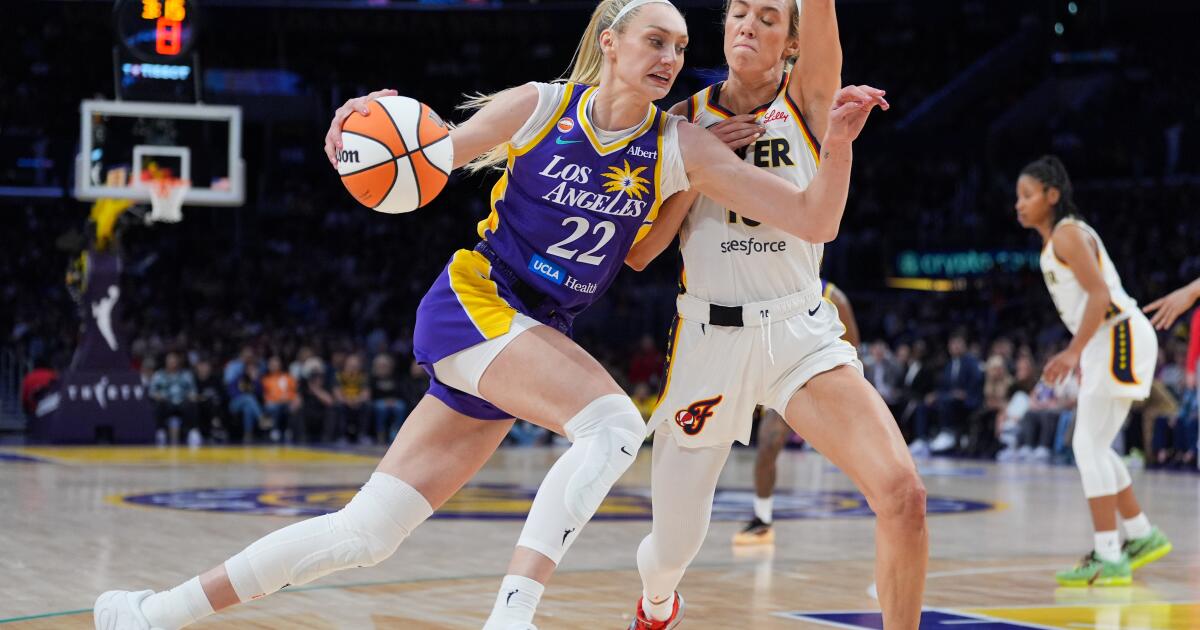
Cameron Brink said she’d appreciate some grace. She really would.
Sparks fans should give her some, because where else is she going to get it?
Certainly not from WNBA refs. Not from opponents with more to play for than ever. Certainly not from the game itself; basketball moves fast, and a bummer can become a bust in a blink.
But Brink, 24, is not on the brink of bust territory, no. Block that thought. Technically, it’s Year 3, but after a torn ACL derailed her as a rookie two summers ago, it’s practically like Year 2 for the former Stanford star. And by design, the WNBA is testing her confidence, her decision-making and her patience as she tries to reestablish herself as one of the WNBA’s best young players.
So, grace.
The recognizable 6-foot-4 forward — she’s the long-blond-haired hooper in the New Balance ads — was the No. 2 overall pick in 2024.
Now she’s her team’s No. 3 option in the post. She’s coming off the bench behind Nneka Ogwumike and Dearica Hamby for the Sparks, who are a modest 6-6 after wins this week over the expansion Portland Fire and the struggling Seattle Storm.
Against the Fire, Brink scored two points and picked up four fouls in nine minutes. Then she went to Seattle and had 15 points in 18 minutes but was pulled with more than five minutes left in the fourth quarter after getting her third, fourth and fifth fouls in 86 seconds. (WNBA players get six fouls before being disqualified.)
For the season, Brink has been called for 49 fouls in 208 minutes. A foul about every four minutes!
They’re silly fouls and they’re phantom calls. Egregious and ticky-tack. Costly and common. A real fouled-up buffet. She sets screens that get scrutinized as if by the most vigilant TSA agent. And sometimes, yes, she’s doing the accidental tripping. Other times, the officials are.
Her reputation precedes her, so everyone gets a superstar’s whistle when being defended by Brink. Opponents bake it into their game plans.
That can’t continue.
All that fouling is hindering Brink’s development because it’s robbing her of important in-game reps — which she needs, foremost, to figure out how to stop fouling.
Sparks forward Cameron Brink, left, blocks the shot of the Tempo’s Laura Juskaite during a game last month.
(Jeff Lewis / Associated Press)
“At the pro level,” said Tara VanDerveer, Brink’s coach at Stanford, “every young player always has a lot of work to do. And I saw her make a three. I see her block shots. She rebounds, she can handle the ball, she’s unselfish, she’s a terrific talent. But there’s always things players need to work on.”
We know what Brink’s thing is.
“She has to be disciplined,” VanDerveer said. “And if you want something so badly, if you want to be an All-Star someday or make the Olympic team, you’ve got to be dependable … and I think anyone can change, if it’s behavior they recognize is not in their best interests or not in their team’s best interests. It’s hard, but it’s something I think people can do.
“That’s what Cam is working on.”
And, VanDerveer added, “I’m really so excited that Nneka is there, because she will give her such great guidance and mentorship.”
And grace. Brink is getting that from Ogwumike — also a former Stanford star, the Sparks legend returned to L.A. this season after two seasons in Seattle — and her other teammates.
“I just do my best to lead by example,” Ogwumike, 35, said. “But then also let [Brink] know that she’s very capable, that she’s more than capable, which is exactly why she’s here with us and it’s exactly why we need her on this team.”

Sparks forward Cameron Brink, wearing a facemask, controls the ball while defended by Sun forward Raegan Beers.
(Joe Buglewicz / Getty Images)
But how long will Brink get grace from the Sparks in the what-have-you-done-for-me-lately business of basketball?
The foul trouble tells us why a win-now team wouldn’t trust her, why the Sparks would give meaningful minutes to two veteran post players ahead of her. Why they wouldn’t prioritize Brink’s development alongside winning as they strive to snap a previously unthinkable five-year playoff drought.
And what about fans? How patient will you all be with a player who was drafted immediately after Caitlin Clark and five spots in front of Angel Reese?
These days, that might depend on what the parlay calls for.
Or, preferably, whether you remember Brink’s first 15 WNBA games. All starts, all signs pointing to stardom. She showed up in 2024 throwing lavish block parties. Her 2.3 blocks per game were message-sending spikes, like what Lisa Leslie used to enthrall Sparks crowds with.
From the jump, she had guys coming to games at Crypto.com Arena wearing her No. 22 jersey and little girls arriving in groups with No. 22 painted on their cheeks and “I love Cam Brink” signs in hand.
And then the torn ACL cost her 25 games of her rookie season and another 25 last season, plus her spot on the United States’ Olympic 3×3 women’s basketball team in Paris in 2024.
She had to start over. Lost a lot of ground. But you see that masked woman stuck on the Sparks’ bench for all but 17 minutes per game?
You can’t miss her. She’s looking uncomfortable in protective facial gear that either hinders her breathing or her peripheral vision, her only options to protect the torn septum she suffered in a victory over the Las Vegas Aces last month.
She’s the one with the 6-8 wingspan who’s averaging 9.2 points, 4.3 rebounds and 1.5 blocks while shooting 52.1% from the field in her limited minutes.
She’s still Cameron Brink. Between fouls, she’s fluid and fast and covers more of the court than almost anyone in the WNBA, able to leap from defending guards to centers in a single bound.
“It’s just looking at every day as a new opportunity to learn and grow and not getting too bogged down when things don’t go exactly as you planned,” Brink told me. “Because more times than not, things are not going to go how you want them to. And that’s life. So I just want to be able to put my best effort out there every single night.
She knows what the Sparks need from her: “To perform, just come on the floor and compete.”
To prove she can stay on the floor to compete.

NEWYou can now listen to Fox News articles!
When will Team USA lose in the 2026 FIFA World Cup? Or, will it not lose at all?
Let’s check out the odds for the Americans’ stage of elimination at FanDuel Sportsbook, as of June 11.
Team USA — Stage of elimination odds
Last 32: +170 (bet $10 to win $27 total)
Last 16: +220 (bet $10 to win $32 total)
Group stage: +500 (bet $10 to win $60 total)
Quarterfinals: +500 (bet $10 to win $60 total)
Semifinals: +1200 (bet $10 to win $130 total)
Runner-up: +2800 (bet $10 to win $290 total)
Outright winner: +6000 (bet $10 to win $610 total)
This page may contain affiliate links to legal sports betting partners. If you sign up or place a wager, FOX Sports may be compensated. Read more about Sports Betting on FOX Sports.
The outlook appears to be … ho-hum?
If the odds ring true, the Americans are expected to make it out of the group stage but fall in the first knockout stage game.
How would that result stack up against previous results? Well, at the 2022 World Cup, Team USA made it to the Round of 16, which was viewed as a stellar accomplishment.
The U.S. men’s national team currently has 60-1 odds to lift the 2026 FIFA World Cup trophy this summer (Photo by Omar Vega/USSF/Getty Images).
In 2018, the USA did not qualify for the World Cup, and in 2014 and 2010, the Americans also made it to the Round of 16. Their best result this century occurred in 2002, when the Americans made it all the way to the quarterfinals before being eliminated.
In 1998, Team USA lost in the group stage, in 1994, it fell in the Round of 16, and in 1990, it also fell in the group stage.
With the expanded World Cup format, 32 teams will advance to the knockout stage (out of 48), giving teams a much better chance of getting out of the group stage than in previous tournaments. In past years, only 50% of the field advanced to the knockout round, but now 66.6% of teams will move on.
With that being said, anything less than a knockout round appearance on home soil would be viewed as a major failure this summer for Team USA.
The second result on the oddsboard is the “Last 16,” meaning the USA would make it out of the group stage and win one knockout stage game, before falling in the second knockout stage game. The third result is that the Americans failed to make it out of the group stage, and the fourth is that they made it to the quarterfinals, meaning they won two knockout stage games.
Making the semis, losing in the championship game and winning the championship are the three results with the longest odds.
The U.S. begins its World Cup journey on Friday as the Stars and Stripes face Paraguay at Los Angeles Stadium. Getting off to a fast start in the group is crucial for the team’s World Cup dreams of making a deep run this summer.
-

 Los Angeles, Ca22 minutes ago
MLB to screen Hollywood classic at drive-ins nationwide
-

 Detroit, MI42 minutes ago
Detroit at Le Mans: Cadillac favorite, Ford poised for 2027
-

 San Francisco, CA52 minutes ago
Hudson Pacific lands SF’s biggest office lease in nearly a decade
-

 Dallas, TX57 minutes ago
NFL Brazil tickets are available: Shop Cowboys vs. Ravens NFL Brazil tickets now
-

 Miami, FL1 hour ago
North Miami man accused of stabbing victim 7 times
-

 Boston, MA1 hour ago
Everything you need to know about Sail Boston 2026
-
Denver, CO1 hour ago
Broncos’ Jonathon Cooper arrested again on four charges, including harassment, violation of protection order
-

 Seattle, WA1 hour ago
Ribbon-cutting marks completion of mixed-income condos in Seattle’s Phinney Ridge


