Lifestyle
Big cats, little cats, weird cats collide at this purrfect L.A. experience

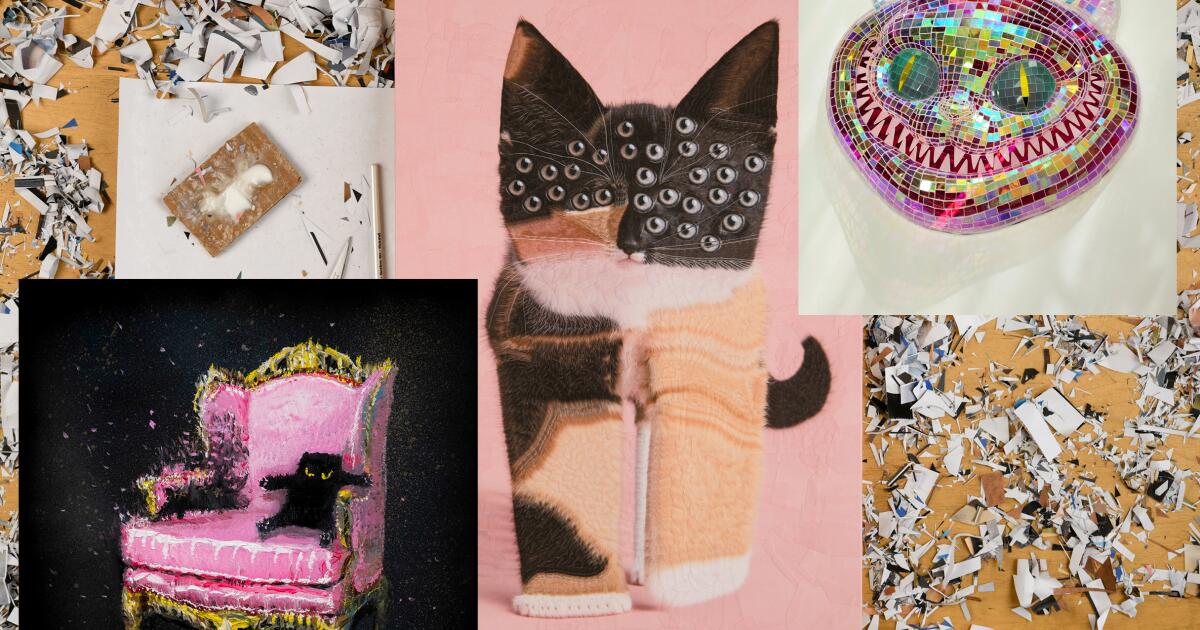
Since 2014, a recurring art show dedicated to cats has captured common feline actions (commandeering a pet parent’s lap, unflinchingly staring down an onlooker, shredding upholstered furniture and sweetly nuzzling) and just as many fantastical ones.
The Cat Art Show returns this week to celebrate a milestone. Starting Friday, the “Cat Art Show: The Tenth Anniversary” event will bring works from about 50 artists to Wallis Annenberg PetSpace in Playa Vista. From oil paintings to sculptures and tile mosaics, cats in all of their glory will have the run of the walls for three days. Also, for the first time, there will be a live pet adoption running concurrently with the show — paws and whiskers upstairs, cat-inspired art downstairs.
For the record:
4:42 p.m. Jan. 16, 2024A previous version of this story described L.A. artist Rabi’s multimedia artwork as photographic.
During the last decade, this group exhibition has become a must-see for gallery hoppers who have flocked to view the works of such boldface art-world names as Mark Ryden, Tracey Emin and Jill Greenberg. Likewise, cat lovers have often lined up at the art event, donning all manner of cat-covered paraphernalia to show their devotion to the animals of the hour. The Cat Art Show delivers just the right amount of camp but holds enough cool-kid appeal (think graphic artists Yusuke Hanai and Eric Haze) to attract those who don’t consider themselves furball fans.
“It’s grown to be a bit of everything — a lot more big collectors but a lot more of the general population too,” said Susan Michals, the Cat Art Show’s founder and head curator.
‘Miss Pitch and Furl,’ by Annie Montgomerie, and ‘Une Chat,’ by Léo Forest. (Annie Montgomerie; Léo Forest)
Creating an event that celebrates Michals’ two great loves was a no-brainer. She’s had cat companions her whole life, and she grew up with gallerist parents and has covered visual art extensively as a freelance journalist.
“I wanted to do a show that focused on emerging and established artists,” Michals said, “so I needed some great names to give validity … that this was a serious art show.”
To start, she approached artists she’d interviewed professionally or knew personally. The prompt she gave them was: “Cats as muse.” Shepard Fairey was among the first artists tapped for the inaugural show along with Gary Baseman and Tim Biskup.
Multimedia artist Britt Ehringer was another Angeleno who Michals approached back in 2014 and he eagerly agreed, enticed by the opportunity to raise funds for different animal charities. (Proceeds from the art sales benefit animal charities; this year’s is Wallis Annenberg PetSpace’s Extraordinary Care Fund.) Each year since, he’s submitted pieces that pair pop culture figures such as Scarface, Frida Kahlo and Tupac Shakur with clusters of cats.
“My other work’s not so pop art-y, so this is my space to play,” Ehringer said, speaking of his cat-related contributions.
‘Kobe Entering the Kingdom of Kittens,’ by Britt Ehringer.
(Britt Ehringer)
This year’s entry, “Kobe Entering the Kingdom of Kittens,” depicts Kobe Bryant soaring through the heavens as a coterie of cuties gaze at him (though, of course, a few appear aloof). The Lakers legend is joined by one of the artist’s two cats, Tofu, seen floating in the piece’s upper right-hand corner.
“There’s lots of different subcultures in the art world. I like how [the show] mashes up all those subcultures,” Ehringer said, noting that, over the years, the Cat Art Show has enabled him to establish friendships with artists he wouldn’t have otherwise met.
“Almost all of the art that I got in the first year was domestic. It’s definitely become more global in scope,” said Michals.
The 2024 collection of art is expected to include a comically disfigured painting by Vienna-based artist Eva Beresin, motion-filled sketches by Parisian Léo Forest, work by Korean Australian graphic artist YeahYeahChloe, and from the U.K., Annie Montgomerie’s handcrafted vintage toy-style kitties dressed in darling play clothes made from upcycled fabrics.
“News of the Cat Art Show has traveled around the world and was known to me here in Scotland,” said collage artist Lola Dupre, who’s based outside of Glasgow and is participating for the second time. “These shows include some of the greatest artists making work today, so it is an honor and privilege to include my work.”
‘Squits,’ by Lola Dupre.
(Lola Dupre)
Feline portraiture is a common part of her distortion-heavy cut-paper practice, and she frequently takes inspiration from her own companion, Charlie. This year’s entry, “Squits,” was inspired by a specimen she encountered while visiting a cat colony in Granada, Spain.
“Since I was young, I have known many cats, each one an individual,” Dupre said. “Their independence, energy and wildness I find fascinating.”
What makes the Cat Art Show compelling is that each artist views the muse in their own personal way, from impish to serene. Whatever way an attendee feels about cats, they’re likely to see that emotion reflected in various forms including glass sculpture, wooden figurine or porcelain candy dish.
“They are evil but they’re also awesome. And people have held that contradiction about cats since the dawn of time,” said L.A. street artist Rabi whose “Good Luck” artwork will be featured in the Cat Art Show. “People have thought cats were their gods and then demons and devils.”
L.A. street artist Rabi’s artwork, ‘Good Luck,’ was inspired by the duality and contradictions surrounding cats. ‘People have thought cats were their gods and then demons and devils,’ Rabi says. In one photo, his black cat, Sea Beast, looks at a mirrored section of Rabi’s artwork. (Rabi)
Drawn to exploring the concepts of duality and contradiction, he feels that cats are the perfect case study. His artwork for the show — two multimedia triptychs — combines images of broken mirrors, black cats and the number 13. “I loved the idea of challenging these bad luck archetypes and then calling it good luck,” he said.
Rabi tipped his hat to Michals for capturing and amplifying the dopamine rush a person gets from watching, and re-watching, the perfect cat video on social media.
“I think Susan does a really good job of bringing that culture to a tangible environment where we can all see things in real time, in real life, together,” he said.
In addition to showing all the ways in which cats are “an art form in themselves,” Michals aims for the Cat Art Show to dash stereotypes about what it means to fancy cats.
“What I saw with the first show was that the people that came did not fit the model of the hoarder, spinster, crazy cat lady,” she said. “I saw that audience and I was like, ‘These people are severely underrepresented and underserved as consumers and art appreciators.’
“Really, part of what these shows are about is to showcase my audience and say: ‘Look at these people. They love their animals and they love art,’” she said. “They do not represent the negative connotations associated at all.”



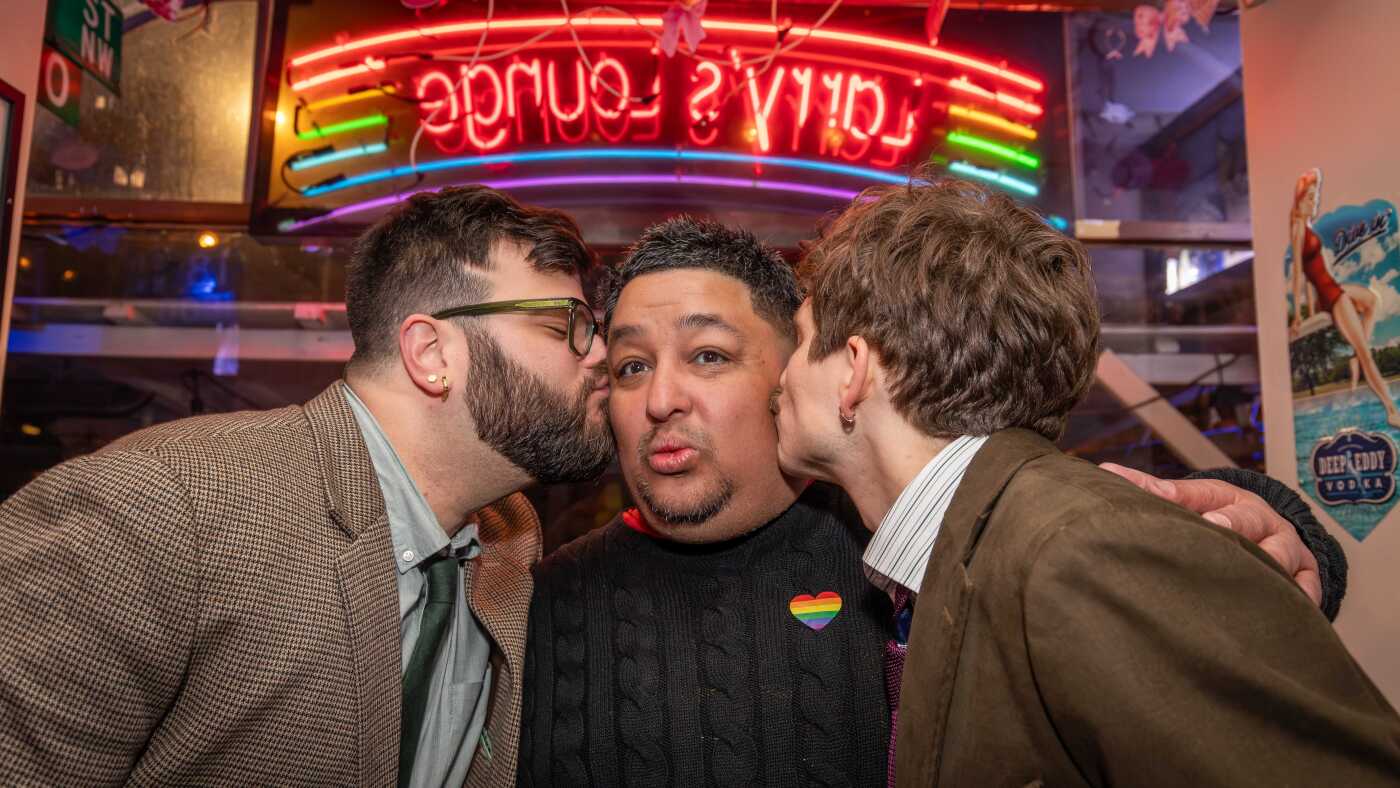
Ryan Benk and Ryan Ricciardi are married by their friend Cesar Garcia this year.
Christopher Di Ruggiero
hide caption
toggle caption
Christopher Di Ruggiero
Gone is the traditional wedding officiated only by a rabbi, a priest, an imam, a pastor or an archbishop.
In a recent survey by the wedding website The Knot, 67% of couples are getting married by a friend. The share has skyrocketed since 2009, when The Knot started tracking who officiates weddings. That year, 27% of couples used a friend for their ceremony.
“Gen Z culture is really infiltrating the wedding industry, and they just do not do things in a standard, traditional way,” said Esther Lee, The Knot’s editorial director.
“They are scrutinizing every aspect of the wedding day in a sense of ‘How do I make this speak to my story?’” she said.
As people swap traditional vows for more personalized weddings, friends and family are filling many more roles beyond just bridesmaids and groomsmen. The wedding officiant is a really big one.
If you’re asked to perform a wedding for a couple, “take the role seriously,” Lee suggested. “Put a lot of hours and thought into how the ceremony will go.”
An officiant with a close tie to a marrying couple can bring a beautiful intimacy to the ceremony. But Lee warned, “Don’t wing it. You can’t wing it.”
First of all, weddings have a lot of stage directions. And the officiant is in charge of telling everyone in the congregation what to do.
“Part of the proceedings is having everyone be seated at a certain time,” said Shelby Wax, a contributing weddings editor at Vogue. She would know. “I’ve been at a wedding where we have stood up too long because an officiant forgot to say that.”
Wax suggested that officiants keep the proceedings moving without making too many jokes or doing anything to draw attention to themselves and away from the couple.
Ask the couple ahead of time for their vision of the ceremony, and find out some of the special things that draw them together and make them want to commit to marriage. And be sure to find out how long they want the ceremony to last.
You’ll also need to get any necessary credentials for legally officiating a wedding. Some jurisdictions require that wedding officiants be ordained ministers. That can be just a few clicks and is often free. The Universal Life Church ordains ministers online and boasts that it has ordained 20 million people.
“Sometimes you have to register with the state and the county and have all the forms ready to go for them to sign afterwards and mail them afterwards,” Wax said.
If the hassles and the responsibility of planning a ceremony and conducting a wedding are too much, bow out right now. The sooner the better.
But Wax suggested that you consider the invitation carefully. It’s an honor that your loved ones want you to marry them. “You know, if I was asked, I would absolutely make the time to do it,” she said.
Even if weddings have become less traditional, the event is still a joyous milestone and evokes a certain dreaminess in the people who get to witness it.
“I do feel that magic and that hope, similar to a child being born,” said Alisa Allred Mercer, a school board member in Davis County, Utah. She has officiated the weddings of a brother, two nieces, a nephew and many, many others.
If people are willing to give love a try, she said, she is happy to help.
“Each time that I am able to perform a wedding, I think the greatest thing that I’m able to give is to pour out my hope and my faith in their relationship to them,” she said.
Mercer had one final piece of advice: After you pronounce the couple married and tell them to kiss, get out of the picture.
“They do not want you in that photo — they want a photo of the two of them,” she said. “So step out of the way.”
The Knot estimates that more than 2 million couples will get married this year, and we’re not even halfway through wedding season. So if you find yourself sitting at a wedding this summer, maybe offer your silent wishes and prayers not just for the couple, but for the officiant too.
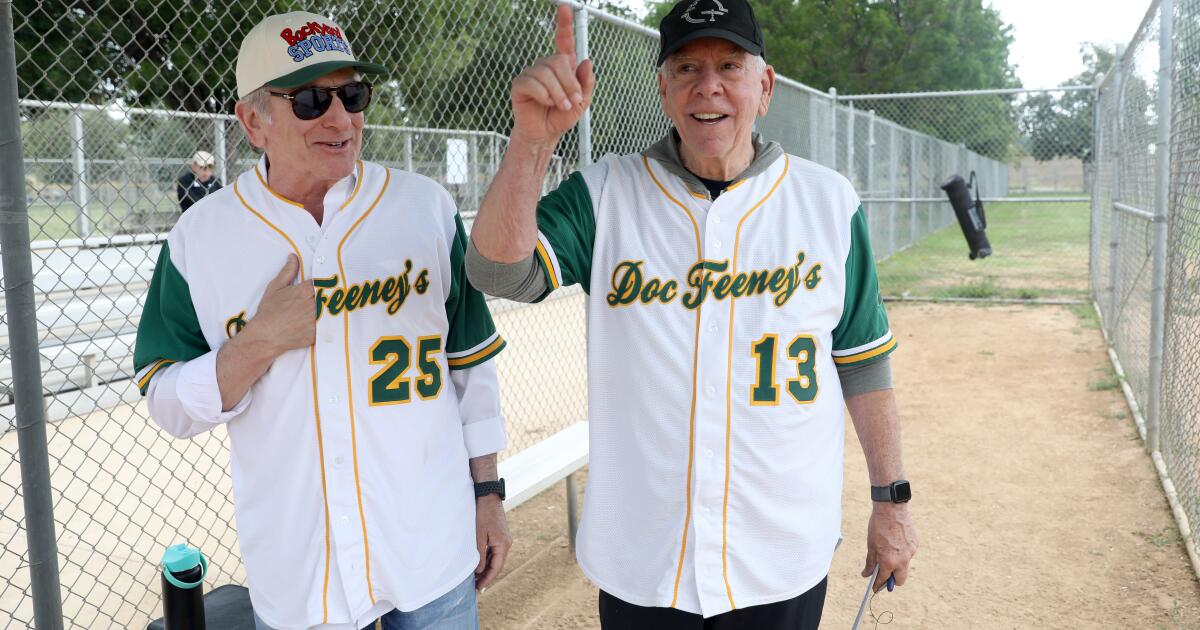
As Al Michel and Mike Sugerman tell it, the first rendition of their L.A. softball team was overflowing with “geeks,” “nerds” and “goofs.”
So they took a name straight out of National Lampoon, a humor magazine that featured “Doc Feeney’s Scrapbook of Sports Oddities,” showing outfielders making catches 40 feet in the air and providing tips to swimmers on proper drowning maneuvers.
“I’m thinking, we’re not a bunch of athletes — we’re a bunch of geeks,” said Michel, the team’s co-founder, current coach and catcher, reflecting on the loose band of UCLA law students, aspiring actors, accountants and other semi-athletic misfits. “Sports oddities? I thought, well, that’s not going to work… Let’s go with ‘All Stars.’”
And thus, in the spring of 1976, Doc Feeney’s All Stars was born. Fifty years and thousands of runs later, six of the original players still take to the diamond nearly every Sunday, swinging for the fences. And if out-of-towners are visiting, the ranks of the older timers swells a few more.
On a recent humid Sunday afternoon, the score was 16-16 going into the final inning. A booming home run at the bottom of the sixth by Aaron Krug — at 36, a youngster by Doc Feeney standards — had tied the game against the Six Pack at the Sepulveda Basin Sports Complex in Encino, one of the many fields across L.A. the Feeneys have graced in the last half-century. The cohort of mostly 70-something players in the dugout rejoiced, waving their caps and hollering.
This wasn’t any old Sunday matchup in the L.A. Municipal Softball League: The Feeneys’ jerseys featured black patches embroidered with “JBK” for Jamie Bailey Krug, the first of the original founders to make it back to home base in the sky.
This game was a memorial dedicated to Krug, the patch a reminder that being a Feeney has never really been about sport anyway.
“Jamie taught me what a best friend was,” said second baseman Richie Greenberg, another Feeney progenitor. “I never knew a best friend was someone you’d never get tired of, or never stopped missing.”
Jeff Koppelman, 72, 48 years on the team, delivers a pitch during a slowpitch softball game against Six Pack at the Sepulveda Basin Sports Complex in Encino.
(Gary Coronado / For The Times)
Jamie’s son, Aaron, belongs to a new generation of All Stars — some of whom grew up watching their fathers’ games from kiddie strollers or their mothers’ arms.
“Every city in this country has a group of morons who get together every Sunday and who have done it for a lifetime, who love each other and love each other’s kids, and who, for some miraculous reason, believe that this will continue with the next generation,” Greenberg said. “We are bound to this thing… It sustains us.”
Feeney history, as told by the founders
The first season of Feeney ball was a resounding success, despite all the strikeouts and bobbled catches in between. The championship game was a struggle of lawfare: Michel, then an attorney in training, noticed that one of the opposing team’s hitters was using a baseball bat instead of the regulation softball bat with a smaller barrel. He kept this fact close to his chest, until the other team went up in the seventh, the last inning.
“The other team is celebrating, thinking they won the championship, high-fives all around,” Michel said. “We call a time out, point out the bat, and the ump comes over and says, ‘Oh yeah, that’s illegal’… It counts as an out and we win the game.”
“The only way to win like a Feeney,” Sugerman added.

Doc Feeney’s All Stars pose for a team photo, circa late 1970s.
(From Doc Feeney’s All-Stars )
Another season, outfielder Craig Simon, knowing he was weak at the plate, intentionally struck out so he could avoid an impending double play, much to the dismay of the opposing team.
“Another Feeney classic,” Greenberg said.
Nobody expected that the Feeneys would go on for half a century, but every winter and spring that passed, the team would be back on the diamond, albeit with a rotating cast.
Krug, Michel and Greenberg were near Sunday constants; Sugerman moved to San Francisco to become an award-winning correspondent on Bay Area radio, but always got a spot when he visited; Howard Lesner and Matt Kaplan became regulars in the 1980s; and other Feeneys faded to time, stuck as a memory of whichever decade they called it quits.
In L.A. Municipal Softball, there is a grading system to facilitate fair competition. The Feeneys oscillated between C and B over the years, a plus or minus coming depending on how much time had passed since the founding. A decade or so back, the team was blown out by a B-minus team in their first game after being upgraded, realizing that the elder’s eyes could no longer keep up with the heat coming off the B-minus bats.
“Couldn’t even see it coming,” Michel said.

Doc Feeney’s All Stars players, from left, Jonny Ehrich, 36, Richie Greenberg, 72, Joel Gerson, 37, and Aaron Krug, 36, warm up before a slowpitch softball game. Greenberg has been a mainstay on the team for 49 years.
(Gary Coronado / For The Times)
Because the team has survived so long, every Feeney has had their day: double plays, home runs and batting averages — think .450 — that would make Shohei Ohtani look like a Triple-A backup. But that’s not what kept players coming back.
“I’ve had a great life and an enjoyable life, but no sense of bond and family,” Kaplan said between innings as dust from home plate lingered about, tears welling up from who-knows-what. “This became my family… This gave me what I was missing.”
The legends surrounding the team can, at times, become muddled. On a recent day outside of the Apple Pan burger joint — a Krug favorite — Michel, Greenberg and Sugerman, all nearly halfway into their 70s, litigated Feeney history:
“Who was it that got kicked off the team for being too competitive?”
“Did he marry the girl in this picture?”
“He never hit a home run in his life.”
“That guy was kind of a jerk.”
“You think so? I thought he was nice.”
But all of these questions led to the same, inevitable conclusion.
“Who cares, he was a Feeney.”
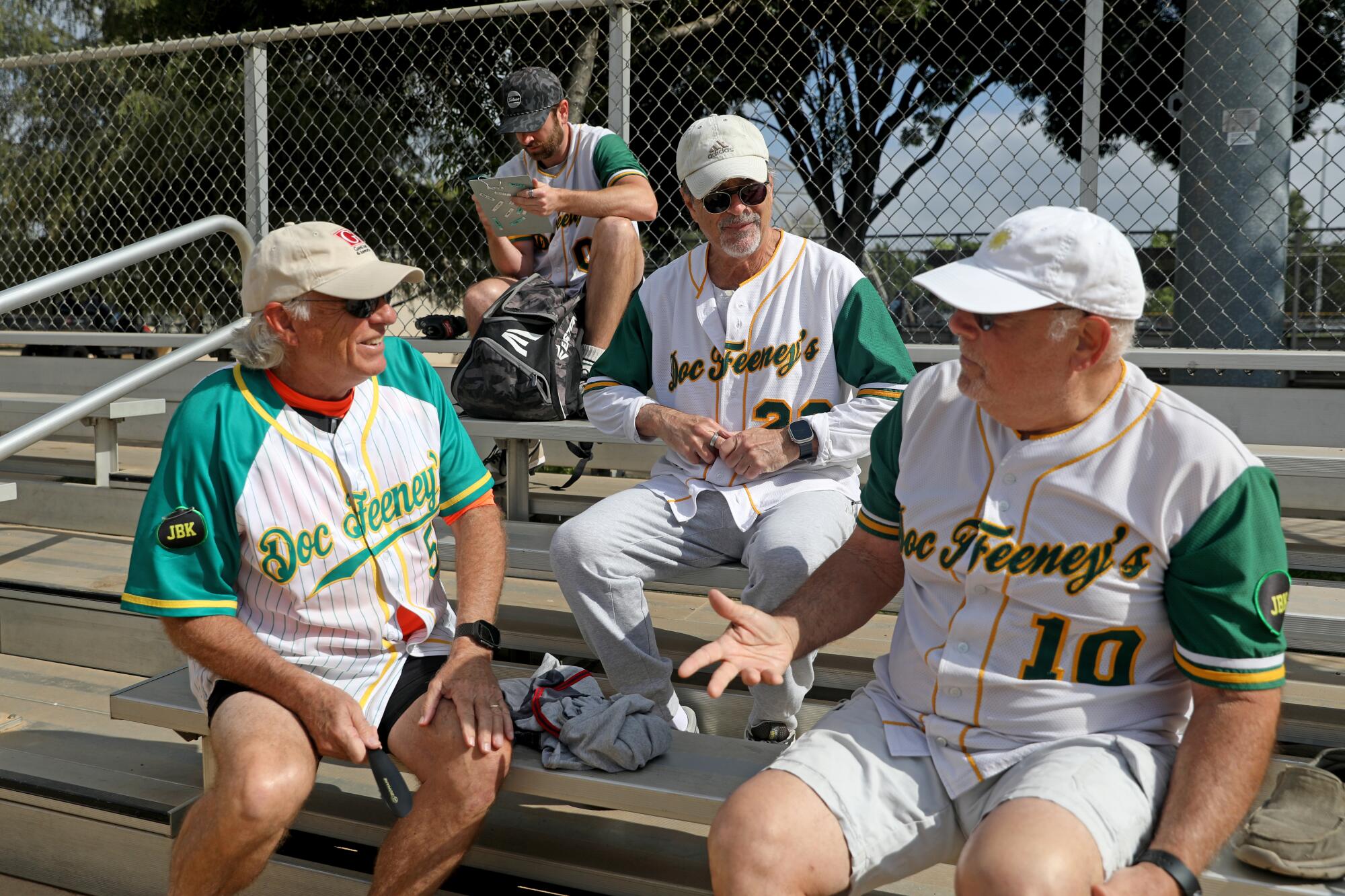
Doc Feeney’s All Stars veterans, Richie Greenberg, from left, Todd Lesner and Jeff Koppelman, all 72, sit together as team rookie Matt Michel, 33, works on the lineup. The trio has played on the team for nearly 50 years.
(Gary Coronado / For The Times)
The new generation of All Stars
The weekend he died last May, Jamie Krug had planned to play Sunday after attending his grandson’s musical performance Friday and going out to dinner with his wife, Simone, and friends Saturday. Krug heard the music and enjoyed a lovely night out, but he never made it to Sunday’s game.
The All Stars won, but learned Monday that Krug had gone to sleep and never woken up. Heart complications.
Family and friends remember Krug as many things: a reliable laugh, a saint of a father, a hell of a second baseman, a competitive but altruistic coach. At his funeral, his wife recalled, almost every speaker called him their “best friend.”
While some of the wives wouldn’t bother coming to games every Sunday, Michel said, many of the children saw the Feeney fathers as proper heroes. When she finally turned 14, Krug’s daughter, Ali, broke Municipal League barriers when she became the first woman to make an appearance as an All Star.
“My whole childhood was centered around baseball,” Ali said, recalling playing with her dad. “He’d set up these scenarios that were like, two outs, bottom of the ninth, World Series, bases loaded; he’d hit a huge fly ball and I’d catch it.”
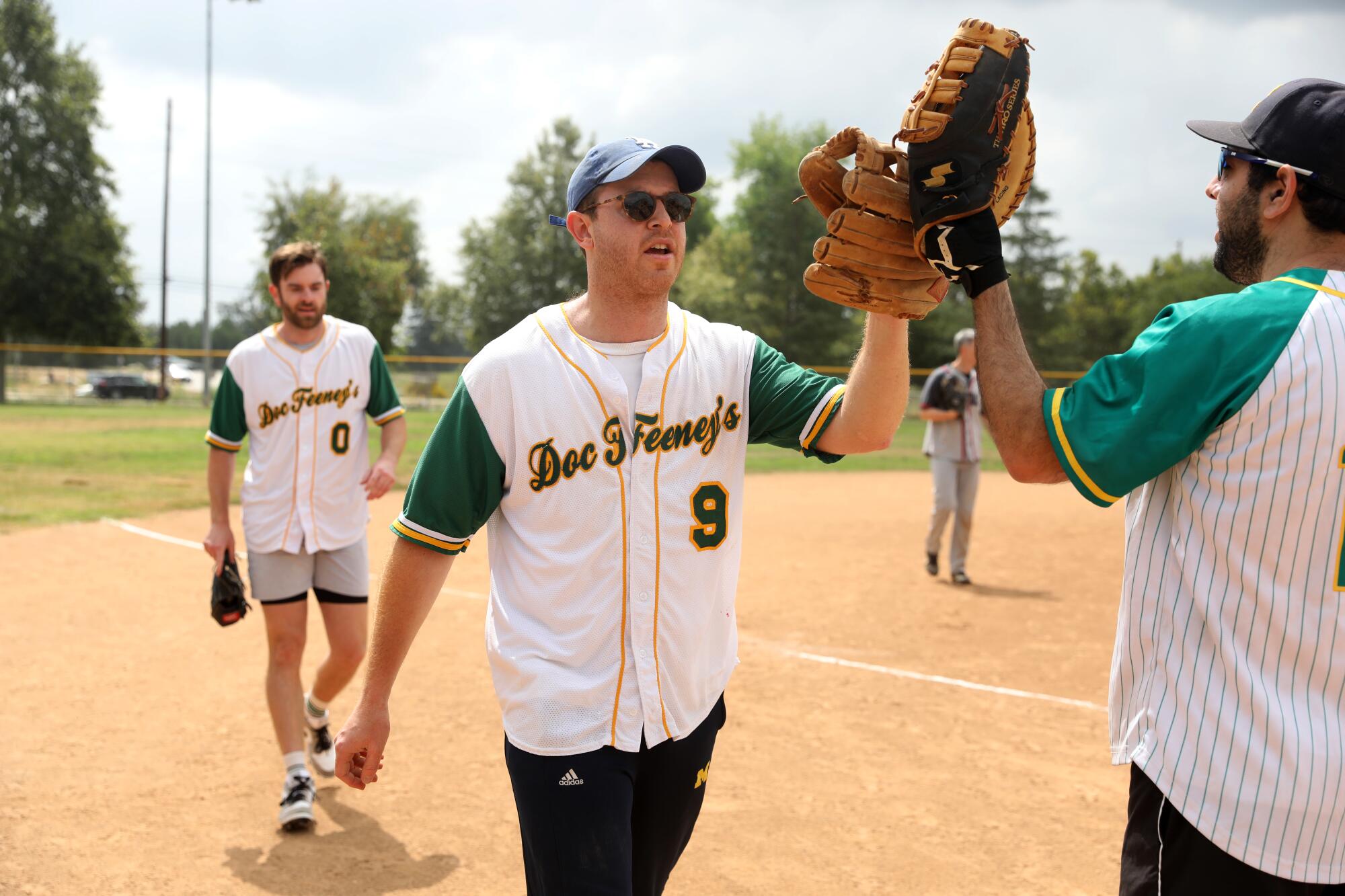
From left, Matt Michel, 33, Aaron Krug, 36, and Joel Gerson, 37, high-five after a Doc Feeney’s slowpitch softball game. Michel’s father, Al, and Krug’s late father, Jamie, are both original members of the team.
(Gary Coronado / For The Times)
Aaron — whose homer brought the Feeneys back into the memorial game — also joined the team at 14, playing alongside his father whenever he wasn’t too busy with his own sports schedule.
“Playing with your dad,” he said. “It’s hard to not get romantic about it.”
Michel’s son, Matt, has sought to modernize the team with a score-keeping app that has proved more reliable than Michel’s antiquated paper method.
“They used to pay me $20 to keep score,” Matt said. “I don’t have to pretend anymore, though.”
The game plan in a modern Feeney game revolves around strategically placing the elders in the batting lineup to avoid having two quick strikeouts or slow runners on base. Even though the Feeneys have gotten more competitive under the junior Michel’s management, the rascal-on-the-field ethos of the original team still prevails.
“The combined age of every Feeney in the infield could be 350 at any given time,” Lesner said before heading to the infield.
Winning like a Feeney
Due to some sloppy defensive errors from the silver-haired infield, the Feeneys allowed more runs in the top of the seventh. The Six Pack led, 18-16.
The Feeneys were in precarious waters as Greenberg stepped up to the plate with two outs. For the memorial game, the Feeneys had reverted to their old batting order, so after Greenberg, the lineup would be wholly composed of Feeney elders.
For the first time the whole game, all the players glued their eyes to the plate, conversations and catch-ups stopped mid-sentence.
Greenberg tried his best to ignore an irritating ankle injury that had plagued him the last couple of weeks and grimaced under the hazy sunlight as the pitcher, probably 20 or more years his junior, stared him down.
The high-arc pitch went up.

Jeff Koppelman, 72, drives a single during a slowpitch softball game. He has been a member of Doc Feeney’s All Stars for 48 years.
(Gary Coronado / For The Times)
Greenberg yanked his bat back, looking like a young Ken Griffey Jr. He struck the ball hard, but sent a one-hopper straight toward a third baseman no older than 40. Greenberg made it only about halfway up the basepath.
Out at first.
The Jamie Krug memorial game ended in a loss.
But instead of kicking up dust, breaking bats or throwing fits, the Feeneys coalesced in a green-and-yellow mass behind the dugout. They all high-fived, asked about each other’s families and went to dote on Ali’s 1-year-old daughter — Krug’s granddaughter, Eloise — who wore a shirt that traversed 50 years of family and friendship. It reads: “Littlest Feeney.”

Since leaving office, former Vice President Mike Pence founded the policy and advocacy organization Advancing American Freedom.
Drew Angerer/Getty Images
hide caption
toggle caption
Drew Angerer/Getty Images

Since leaving office, former Vice President Mike Pence founded the policy and advocacy organization Advancing American Freedom.
Drew Angerer/Getty Images
Former Vice President Mike Pence played a key role in bringing President Trump to power in 2016. By putting his name on the Republican ticket, he helped reassure the Republican establishment and evangelical voters who were wary of Trump’s brash brand of populism.
Pence’s departure from Trump’s leadership of the Republican party began when Trump called on Pence to refuse to certify the results of the 2020 election — pressure Pence rejected.
“For four years, we had a close working relationship. It did not end well,” Pence wrote in his memoir So Help Me God, which was released in 2022.
In the years since leaving office, Pence has been advocating for an ideological restructure of the Republican party, and founded the policy and advocacy organization Advancing American Freedom. Pence builds on the theme of reimagining the Republican party in his new book What Conservatives Want, which provides a critique of the second Trump administration and what he terms the “populist right.”
In an interview with Morning Edition, Pence detailed to NPR’s Steve Inskeep his critique of the second Trump administration, shared his perspective on civil rights legislation and challenged Trump’s tariffs and other interventions in the economy.
Listen to the full interview by clicking on the blue play button above; and read highlights from the conversation below.
‘The populist right’ does not represent conservative beliefs
Pence believes that Trump has embraced “the populist right” over traditional conservatives in the Republican party.
The sale of economic American company U.S. Steel to Nippon Steel in Japan exemplifies this shift, Pence said.
In his first term, President Trump opposed the sale. But in his second term, he approved the sale and took a golden share — a class of shares in which a government can own a very small percentage of the company but has outsized voting rights.
Pence said that he was taken aback by Trump’s decision to take a golden share.
Free trade is essential to American conservatism
Pence takes umbrage with his former boss’ tariff-laden economic policy.
Pence said it violates conservatism’s bedrock belief in the power of free trade, and Trump has gone about granting exceptions to tariffs in an unfair way.
Granting waivers to large corporations from certain tariffs is “one of the lesser reported aspects of the tariff regime that’s been imposed by the administration,” Pence added.
Trump and Pence ran in 2020 on a mission to “drain the swamp,” rooting out government corruption and wasteful spending. However, Pence said Trump appears to have shifted from those goals.
“There’s maybe nothing more swampy than the battle over getting tariff waivers for big business,” Pence said.
Women’s rights on the right
There is a debate among the ultraconservative right about the role of women in civic life.
The concept of “household voting,” has become a familiar talking point for ultra-right-wing communities online. Supporters of “household voting” advocate that every American household should get one vote, the vote being that of the husband’s. This concept has been promoted by figures such as Abby Johnson, a prominent anti-abortion activist who spoke at the 2020 Republican National Convention. When asked about whether he supported household voting, Pence said he is not aligned
“It’s one person, one vote in this country. And people have bled and died for that principle throughout the years of our history,” Pence said.
He added that American families don’t need to be propped up by government programs to boost childbirth. “What American families need is an application of the kind of principles that will create higher wages, more opportunities, more jobs,” Pence said.
Should conservatives stand for civil rights?
Pence said he was an admirer of senator and one-time presidential candidate Barry Goldwater.
Notably, Goldwater voted against the Civil Rights Act of 1964.
“Should conservatives stand for civil rights?” asked Inskeep.
Pence responded that civil rights are important to conservatives, but that equality of opportunity is what legislation ought to enshrine, not equality of outcome.
Pence added that he stood by the Supreme Court’s decision to ban partisan gerrymandering on the basis of race, rendering ineffective a key provision of the Voting Rights Act of 1965.
-

 Finance2 minutes ago
Your Savings Account Is Failing: 3 Shifts to Reclaim Your Wealth
-

 Fitness7 minutes ago
Steffie Bryant, Alistair Brownlee to Share AI, Performance Insights at European Congress – Health & Fitness Association
-

 Movie Reviews17 minutes ago
Movie Review: SUPERGIRL – Assignment X
-
World29 minutes ago
Cape Verde’s dream run continues, becoming smallest country into World Cup knockout round
-
Lifestyle1 hour ago
Amateurs now conduct most weddings. Here is some basic advice
-

 Technology1 hour ago
It’s the last day of Prime Day — here are over 140 great deals to choose from
-

 World1 hour ago
Rubio announces framework deal between Israel and Lebanon as experts warn Iran will fight to sabotage it
-

 Politics1 hour ago
Lawyer who beat Hawaii gun law calls state’s reliance on Black Code ‘disgraceful’

