Business
Sweet Lady Jane bakery faced class-action lawsuit for wage theft before sudden closure

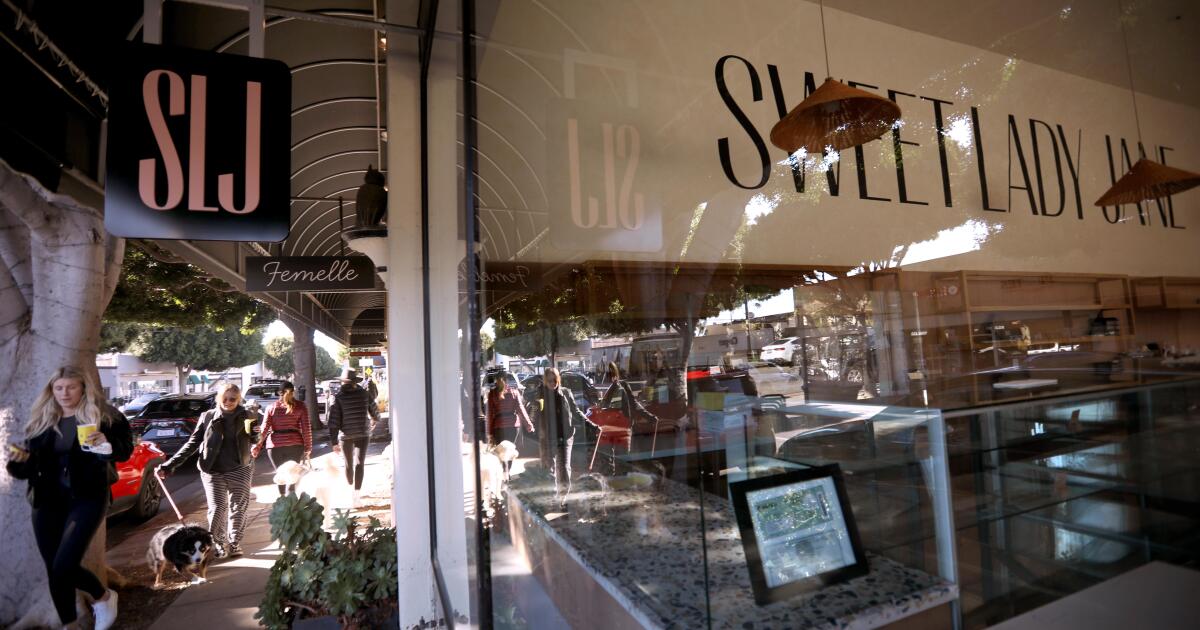
Sweet Lady Jane, a bakery beloved by Angelenos and a celebrity clientele, unexpectedly shuttered six locations on New Year’s Day, citing a lack of sales that prevented it from paying its “treasured employees.”
But for some former workers at the dessert chain, the message rang hollow.
For nearly seven months, the companies behind Sweet Lady Jane have been embroiled in a class-action lawsuit filed by an employee who alleged wage theft, according to court documents reviewed by The Times. Employees also said the company suffered from mismanagement.
Blanca Juarez, who worked at the bakery for about two months in 2022, alleged that Sweet Lady Jane LLC and SLJ Wholesale LLC did not compensate her for all hours worked, including overtime, as well as for missed meal periods and rest breaks, according to a complaint filed June 30 in Los Angeles County Superior Court.
“Defendants engaged in a pattern and practice of wage abuse against their hourly-paid or non-exempt employees,” the lawsuit reads.
A note from the owners of Sweet Lady Jane tells customers they had decided to close their business.
(Genaro Molina / Los Angeles Times)
Juarez also accused the bakery of not keeping accurate payroll records and of failing to provide “reimbursement for necessary business-related expenses,” according to the lawsuit.
The lawsuit alleged that Sweet Lady Jane had the ability to pay but “willfully, knowingly, and intentionally failed to do so” in an effort to “increase Defendants’ profits.”
Attorneys for Juarez and Sweet Lady Jane did not respond to requests for comment.
In court filings, the bakery chain denied Juarez’s allegations and called the complaint “unverified.” Lawyers wrote that Juarez and other employees who could join the lawsuit have been paid “all sums earned by them that are due.”
In a court document filed Tuesday, lawyers said the companies intend to file for a state alternative to bankruptcy, which could allow creditors, including former employees, to try to recover what they are owed.
Some former workers have been offered severance packages, according to documents obtained by The Times. The documents say that if employees sign the deal, they must agree not to join lawsuits “seeking any additional amounts of money or to participate in any class, collective or representative actions.”
Tables are piled up against the front counter.
(Genaro Molina / Los Angeles Times)
On Dec. 31, Sweet Lady Jane uploaded an Instagram post announcing the closure of all stores. The post was taken down, and the next day employees received word that “the company was closing permanently.”
“However, we want to tell you that we are very grateful for your loyal service and will be paying you your regular wages through January 5th,” said the email, which was obtained by The Times.
In a public statement, the company said it “did not come to this decision lightly nor quickly.”
“While the support and loyalty of our customers and our employees has been strong, sales have not been high enough to continue doing business in the state of California, allowing us to service our lease obligations and pay our treasured employees a living wage,” the email said. “We hope the sweet memories of the joy we had been able to share throughout L.A. will stay with you, as it will for us.”
At the West Hollywood outpost of Sweet Lady Jane, which opened in 1988 on Melrose Avenue, an outdated sign hung on the door five days after the closure announcement: “We will be closed for renovations beginning Monday, September 18th.” Customers were advised to shop at stores in Santa Monica, Calabasas or Manhattan Beach; the latter location had closed toward the end of 2023.
Concerns over finances predated the companywide closure.
Phoebe Davidson, who was employed from summer 2021 to summer 2022, said Sweet Lady Jane had been cutting back on its menu and hitching up prices.
When a 9-inch cake had cost about $90, Davidson said, customers would often round up to $100 for a tip. But the company raised the price to $100.
“Then people wouldn’t tip us,” Davidson said. “And we started asking for raises, and they were like, ‘Well, there’s no money for raises.’ How’s that possible when we’re selling thousands of dollars worth of cake a day?”
Two recent workers, who requested anonymity because they feared retaliation from the company and difficulty finding jobs, told The Times that the business had been undergoing change prior to the shutdown — such as expanding into new neighborhoods and temporarily closing popular sites for remodeling.
The closure, both said, caught them by surprise.
“I did get the feeling that there was a lot happening behind the scenes,” said one. “They closed Melrose. They closed Encino. They tried to open Larchmont, and all of this was at the same time.”
The abrupt closure of all stores left some customers — among those who sought out the bakery’s beloved Triple Berry Cake and other desserts were Taylor Swift, Blake Lively and Sophia Bush — scratching their heads.
Longtime customer Meagan Mayo said she was “totally shocked” to hear the news. The company had a strong presence in the film and television industry, said Mayo, who works as an assistant for a streaming video service.
“It’s L.A.,” she said. “A lot of places, a lot of restaurants, a lot of bakeries just don’t make it. We’ll be sad for a while, and someone else will come and take their place, but it is extremely unfortunate.”
Courtney Cowan, whose bakery Milk Jar Cookies announced its closure in the new year, reiterated how challenging it has been running a food business in L.A.
“It has never been an easy industry — food and, specifically, baking,” Cowan said. “It is extremely labor-intensive, and the hours are crazy, and there are a lot of moving parts.”
Syeda Fathima visited Sweet Lady Jane’s Encino location on Dec. 31, what would be its last day of operation.
She was impressed by how beautiful the store was, she said, adding that she talked with a few cheerful employees about potential job openings.
Five days later, there were signs on the doors announcing the closure. Passersby peered into windows, muttering their disbelief.
All that was left was empty seats, the display shelves void of cake.
Times staff writer Sarah Mosqueda contributed to this report.


Nearly a year after the expiration of a $7,500 federal tax incentive for new electric vehicles, California is stepping in to try to motivate buyers to go electric.
Gov. Gavin Newsom allocated $135 million in his new state budget to provide incentives for new and used EVs. Participating automakers will match the funds.
California leads the nation in EV adoption, though the market has taken a hit under the Trump administration.
The state budget — a more than $350-billion spending plan — went into effect Wednesday. The EV incentives will take effect in the coming weeks as the California Air Resources Board irons out agreements with dealerships.
Here’s what you need to know.
What are the incentives worth?
Senate Bill 168 tasked the California Air Resources Board with setting incentive amounts for new and used electric vehicles sold in California.
Eligible buyers will receive $3,500 off for new EVs and $1,750 off for used ones. Unlike the federal tax credits that expired in September, these incentives offer an instant discount and don’t require buyers to apply for credit later.
State funds will cover half of the incentive amount, and auto manufacturers will cover the other half.
The rebates will mean that most eligible buyers will effectively get between 4% and 7% of their money back.
For used EVs, “this incentive helps what’s already a good deal become an even better deal,” said auto analyst Brian Moody. “I think that’s the perfect use of these kinds of dollars.”
What are the rules and exceptions?
The new incentives can’t be used on all electric vehicles — they apply only to new EVs with a manufacturer’s suggested retail price of $50,000 or less, and used EVs with a sale price of $25,000 or less.
The $50,000 maximum rules out many options on the market, but legislation outlining the incentive program makes a special exception for California-based companies. Buyers purchasing a new or used EV from a company with headquarters in California can claim the discount regardless of the vehicle price.
That’s good news for Lucid, with headquarters in Newark, Calif., and for Irvine-based Rivian. Neither company currently offers new vehicles for less than $50,000. Rivian said it plans to launch a $44,990 SUV in 2027.
Who is eligible?
California’s new EV discounts are available only to first-time EV buyers, according to the legislation.
SB 168 says the buyer’s eligibility will be “confirmed by a buyer attestation” that they have not previously owned a zero-emission vehicle.
The new EV incentive is less than half of the federal incentive that expired nine months ago. Whereas the federal incentive may have been enough to spark interest in a range of buyers, Moody said the lesser amount will probably appeal mainly to people who already have their eye on an EV.
“I think you have to already be considering it, or in the market,” Moody said. “I think that the amount is just right for that.”
What are California’s clean car goals?
The incentives are intended to help California reach its electric vehicle and air quality goals as those targets have been under fire from President Trump.
Shortly after taking office, Trump signed an executive order that revoked California’s authority to set its own EV regulations, which included a goal of having 100% of new vehicle sales in the state be zero-emission by 2035.
California sued the administration in response. The state also has goals, including some that have been in place since 2012, that set declining limits on smog-causing pollutants and required automakers to sell increasing percentages of electric and hybrid vehicles through 2025.
In March, the administration filed a new lawsuit again trying to block California’s ability to set stricter-than-federal emissions standards for cars.
Early this year, California announced that more than 2.5 million zero-emission vehicles had been sold in the state since 2010, surpassing a target to put 1.5 million zero-emission vehicles on the road by 2025.
Business
Want an AI-proof job? New research says you may be safer at companies embracing the technology

While AI is often cited as one of the reasons for mass layoffs, particularly in the tech sector, for fast-growing companies it also seems to be creating new jobs in many companies, according to a study published Tuesday from financial services company Ramp and employment database Revelio Labs.
“Our early result is that it looks like firms are starting to look for more entry-level hires, likely people who are more AI native,” said Ara Kharazian, the lead economist at Ramp, a financial services company that found a rise in early-career hiring by companies in the period they started spending heavily on AI.
The study tracked AI spending and the workforce records of nearly 22,000 U.S. companies between January 2021 and February 2026.
It found that firms that spent more on AI ended up increasing their workforce headcount by an average of 10% over the two years after rolling out the technology. Companies that made the largest AI investment expanded entry-level job hiring by 12%.
“If you are a job seeker, or you are graduating from college, and you’re choosing between two different firms that are otherwise similar, I would choose the one that’s using AI,” Kharazian said. “Our paper shows that that firm is going to grow faster.”
The early and intense AI adopters spent more than $100 per month per employee on AI and had their employees using advanced AI, such as coding subscriptions, as opposed to simple ChatGPT subscriptions.
The low-intensity, casual AI adopters didn’t see any hiring gains and reduced headcount.
The Ramp study showed a positive effect on employment from AI because it focused on firms adopting AI, many of them fast-growing, venture-backed companies hiring AI-native junior employees.
It reached a different conclusion than a November 2025 Stanford University study, which examined payroll data across the entire labor market and found that employment among young software developers had declined by nearly 20% from its late-2022 peak.
The two findings can both be true, Kharazian said, because the Stanford study was broader and didn’t focus just on the firms that use AI.
“While there may be overall weak hiring for young people, what we found is that hiring is actually strong at the firms that use AI, and the firms that use AI intensely,” he said.
In another recent study on the impact of AI on jobs, the California AI-unemployment tracker examined the state across industries, education levels and region and highlighted some worrying trends.
It seemed to disprove the understanding that AI has been hurting mostly younger employees and those in entry-level jobs.
It found that unemployment insurance claims among college-educated workers in high-AI-exposed jobs, such as customer service and software development, increased after ChatGPT’s release in 2022 and remained elevated through May 2026.
Unemployment insurance claims among master’s and PhD holders in highly AI-exposed occupations have also risen, moving from a baseline average of 13,000 claims per month in November 2022 to between 16,000 and 22,000 claims per month since mid-2023, the study found.
The study also categorized unemployment claims by age and found that a significant portion of claims were from those aged 36 to 65, signaling that AI’s effect doesn’t only affect early-career jobs.
It also found a higher rate of insurance claims in the San Francisco Bay Area compared with the rest of California, and that job loss claims were concentrated in the technology sector.
In 2026, tech companies have let go of more than 160,000 workers, according to trueup.io, a website tracking industry layoffs.
Many companies have said AI was one of the main reasons for layoffs. Meta, Oracle, Microsoft and other big tech companies have laid off tens of thousands of employees, while simultaneously investing billions in AI data centers.
Ramp’s findings that heavy AI adoption can lead to increased hiring suggests that some of the companies announcing large layoffs may be guilty of blaming regular cost cutting on AI, a practice dubbed “AI washing.”
“When you hear CEOs talk about layoffs and they attribute it to AI, I would be skeptical,” Kharazian said.
Business
Commentary: It’s not just vaccines — from infancy to adolescence, Republicans are waging war on children’s health
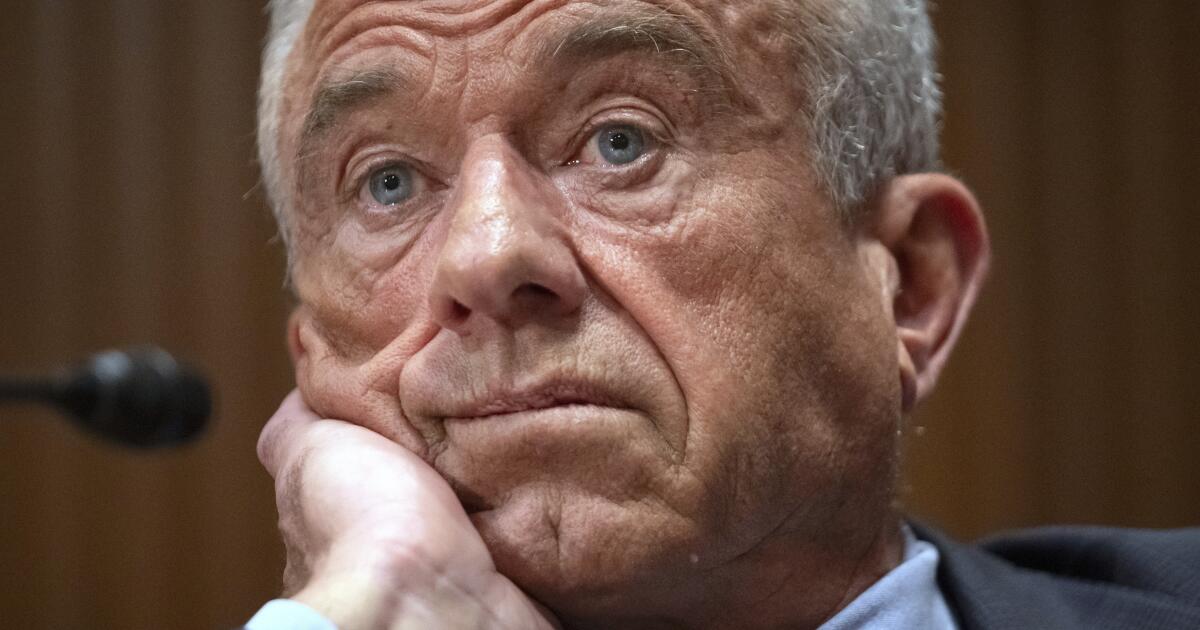
The conservative assault on child health starts with the anti-vaccine campaign and proceeds to cutbacks in nutrition assistance and narrowed access to healthcare.
In the old days, before accepted medical protocols came under partisan assault, infants typically received a vitamin K shot to enhance blood-clotting capability and a few drops of an antibiotic to stave off eye infections before leaving the hospital, followed by a thorough round of vaccines against life-threatening diseases.
Americans assumed that “whatever a family could afford, the country had already decided this child was worth protecting,” Robert B. Shpiner, a critical care expert at UCLA medical school, wrote recently. “I have seen children harmed by disease, poverty, by bad luck. I had not, until now, seen them harmed so methodically by their own government.”
Shpiner’s targets were the changes in healthcare policies instituted by the Trump administration generally and Health and Human Services Secretary Robert F. Kennedy Jr., as well as the mistrust in medical authority that Kennedy and his followers have helped to foment.
We’re going to be paying this bill for years to come, because the lack of proper nutrition has profound effects on learning and disability.
— Robert B. Shpiner, UCLA
As Shpiner wrote in the Guardian, the administration’s assault on child health begins with its anti-vaccination policies. In January, Kennedy’s agency reduced the list of recommended childhood immunizations to 11 from 17, removing shots for COVID-19, hepatitis and meningitis, among other diseases. The agency made the changes without the customary professional consultations, KFF has reported.
But that’s only the tip of the iceberg. “It’s just one thing after another,” Shpiner told me.
What triggered him into writing his Guardian essay, he says, was learning that congressional Republicans had advanced an agriculture appropriations bill that would cut the fruit and vegetable benefit for children in WIC, the supplemental nutritional program for women, infants and children to $10 a month from $26.
“That got me to looking at this as a sequence,” he says, starting with the reduction of child immunizations, followed by the proposed cuts in WIC and the cuts in food stamps enacted as part of the Republican budget bill that Trump signed one year ago Saturday (i.e., the Fourth of July, 2025).
“The image of us taking food away from kids and not giving them enough money to buy some apples and berries—the short-term response is outrage,” he says, “but the medium- and long-term effect is that we’re going to be paying this bill for years to come, because the lack of proper nutrition has profound effects on learning, and disability and anemia. A number of measures of health and success match with nutrition.”
At almost every stage of childhood development, he notes, programs aimed at preserving or enhancing children’s health have gone on the chopping block.
“A vaccine rule one week, a food program the next,” he wrote. “Each change arrives wrapped in a reasonable rationale: fiscal discipline, local control, parental choice. But arrange them in the order a child actually grows, and the rationales stop mattering.”
Judging from their rhetoric, one would think that Republicans would move heaven and earth to foster child immunizations, nutritional assistance and access to medical care.
In “Communion,” his recent book about his conversion to Catholicism, for example, Vice President JD Vance writes: “We want more children in our society because children are profoundly good — the greatest value add we can create.”
Yet the programmatic cutbacks advocated for and implemented by the Republican Congress and Trump give the lie to that sentiment. Let’s examine chapter and verse.
Measles is the canary in the coal mine for vaccination and public health, and at this moment, the canary is singing a doleful tune. The Centers for Disease Control and Prevention count 2,134 cases in the U.S. as of June 25. That’s poised to exceed the 2,288 cases in all of 2025, which was the worst outbreak since 1991.
There’s no question why this is happening. It’s because of a decline in measles vaccinations below the 95% generally considered to provide “herd immunity,” in which the disease is so rare that even unvaccinated individuals are protected from exposure.
Kennedy may not deserve all the blame for the immunization decline, but as pseudoscience debunker Steven Novella has pointed out, as secretary he has “done everything possible to undermine vaccine science and confidence in health institutions.”
Kennedy has paid lip service to the value of the MMR vaccine, which combines immunizations for measles, mumps and rubella. But he has claimed without evidence that the vaccine causes deaths “every year” and that the vaccine hasn’t been safety-tested, which isn’t so. He has asserted that it shouldn’t be subject to a government mandate. He also has promoted treatments for measles that aren’t known to be effective.
(The Department of Health and Human Services didn’t respond to my request for comment on the vaccine initiatives.)
As children grow, the crisis of malnutrition kicks in. The House GOP’s cuts to WIC are still only on the drawing board. But the Republican budget bill incorporated cuts to food stamps — the Supplemental Nutrition Assistance Program, or SNAP — that have driven some 4 million people off the program. In 13 states that have published data, according to the Center on Budget and Policy Priorities, child enrollment fell by more than 800,000, or 16%, between July 2025 and May of this year.
“This is where the nutrition cuts become a medical, not merely a moral, story,” Shpiner says. “Iron-deficiency anemia in infancy is associated with poorer cognitive, motor, and behavioral outcomes that persist more than 10 years after the deficiency itself has been corrected — the deficit does not fully reverse even with later treatment. Withdrawing produce and protein from WIC and SNAP at the peak window of brain growth is not a budget line that resets the following year; it is a developmental exposure with a long tail.”
The combination of reduced immunization and poor nutrition build on each other. “Unvaccinated kids are going to get sicker,” he told me. “If they’re malnourished, they’re going to get sicker. If their parents don’t get affordable care, they’re going to be strapped. It becomes a synergistic and multiplicative cascade.”
Indeed, the administration’s assault on Medicaid and the Affordable Care Act intensifies the damage. Enrollment in Medicaid and the Children’s Health Insurance Program, which is part of Medicaid, fell by 4.8 million people, or 6%, from March 2025 through March 2026, according to government data. The enrollment decline for children alone came to more than 1.9 million, or 5%.
White House spokesperson Kush Desai challenged the latter figure when I asked for comment. But it came from KFF, which sourced it to the government’s Centers for Medicare and Medicaid Services, or CMS.
“Nothing has been done to alter insurance or Medicaid coverage of any vaccination,” Desai told me by email, “and parents are encouraged to seek out the counsel of their pediatrician to make the best decisions for their children.”
The prospects are for further declines. That’s because new work requirements for enrollees in Medicaid expansion under the Affordable Care Act are almost certain to drive enrollment down, due to obstacles including paperwork burdens and administrative snafus, resulting in even some eligible enrollees losing their coverage.
(These problems became so pronounced in Arkansas, which implemented work requirements during the first Trump term, that a federal judge axed the program.)
The work rules enacted last year as part of the Republican budget bill aren’t scheduled to start until Jan. 1, but three states are starting early — Nebraska (May 1), Montana (Wednesday) and Iowa (Dec. 1). The impact on enrollment isn’t yet clear.
Whatever the effect of these changes, the public is going to know less about them than before. The reason is that the administration has shrunk the requirements for reports of immunization from states, changing the reports from mandated to voluntary. The affected data include childhood immunization rates against diphtheria, tetanus, pertussis, polio, measles, mumps and rubella, hepatitis, chicken pox and flu; and rates for 13 year olds and expectant mothers.
“While seemingly a small, technical change, the removal of vaccine reporting in Medicaid and CHIP may make it more difficult to monitor and understand vaccination trends for a large share of children in the U.S.,” KFF noted.
I asked the Department of Health and Human Services to explain the rationale for these changes, and specifically whether they were aimed at obscuring the effect of the narrowing of vaccine recommendations, but didn’t hear back.
-

 Ohio6 minutes ago
Water main break closes part of Glenwood Avenue
-

 Oklahoma9 minutes ago
Widespread outages hit Norman and Oklahoma City as crews begin power restoration
-

 Oregon14 minutes ago
Wildfire Fact Sheet – (Incident #0383) | Central Oregon Fire Information
-

 Pennsylvania21 minutes ago
PHOTOS: Storm damage across central Pennsylvania
-

 Rhode Island24 minutes ago
Will Taylor Swift hold a post-wedding bash in Rhode Island?
-

 South-Carolina29 minutes ago
Summer offer leads to EDGE Jayden Broadie’s commitment to South Carolina
-
South Dakota36 minutes ago
SD Lottery Powerball, Lotto America winning numbers for July 4, 2026
-

 Tennessee39 minutes ago
Tennessee troopers investigating deadly crash involving UTV, train

