Lifestyle
Paintings on paper reveal another side of Rothko


Mark Rothko, Untitled (seated figure in interior), c. 1938, watercolor on construction paper sheet.
ShootArt Mobile 1/Copyright © 2023 Kate Rothko Prizel and Christopher Rothko
hide caption
toggle caption
ShootArt Mobile 1/Copyright © 2023 Kate Rothko Prizel and Christopher Rothko

Mark Rothko, Untitled (seated figure in interior), c. 1938, watercolor on construction paper sheet.
ShootArt Mobile 1/Copyright © 2023 Kate Rothko Prizel and Christopher Rothko
It’s easy to interpret the large, dark paintings of Mark Rothko’s final months as bleak, the work of an artist whose long struggle with ill health and depression ended when he took his own life in 1970. Too easy, as it turns out. A series of lesser known pieces on paper in dreamy pastel hues from that same period counter an enduring narrative of gloom.
The intimate paintings are the pièce de résistance in a show at the National Gallery of Art in Washington running through March 31 that features more than 100 works on paper of an artist best known for towering color fields painted on canvas in the last two decades of his life. It will travel in May to the National Museum in Oslo for the artist’s retrospective in Scandinavia.
Mark Rothko, Untitled, 1969, acrylic on wove paper mounted on linen overall.
ShootArt Mobile 1/Copyright © 2023 Kate Rothko Prizel and Christopher Rothko
hide caption
toggle caption
ShootArt Mobile 1/Copyright © 2023 Kate Rothko Prizel and Christopher Rothko
Mark Rothko, Untitled, 1969, acrylic on wove paper mounted on linen overall.
ShootArt Mobile 1/Copyright © 2023 Kate Rothko Prizel and Christopher Rothko
“I find them incredibly optimistic,” said Pace Gallery founder Arne Glimcher, a friend of Rothko’s who was his neighbor in New York. “There’s this immediate freshness and minimalist touch to those pictures where he lays the brush down in each color only one time or a couple times, and they’re not worked over like the oil paintings are.”
‘The interpretation is yours’
To conclude that the dark paintings are depressing and the light ones are happy is simply “mindless,” according to Glimcher.
Once, he recalls Rothko telling him, a woman came to the studio for a purchase. Rothko liked to pick himself the work he would sell to individual buyers, in an effort to match the painting to the person who would live with it. This time, he chose a piece redolent with burgundy, dark blue and rust. The woman was not pleased, asking instead for a bright red, yellow and orange painting, which she thought would be more cheerful.
“And he said to the woman, ‘Red, yellow and orange, isn’t that the color of an inferno?’” Glimcher said. “So you see, the interpretation is yours, but it’s not necessarily his and it’s not necessarily what the work is about.”
Mark Rothko, Untitled, 1969, acrylic on wove paper.
ShootArt Mobile 1/Copyright © 2023 Kate Rothko Prizel and Christopher Rothko
hide caption
toggle caption
ShootArt Mobile 1/Copyright © 2023 Kate Rothko Prizel and Christopher Rothko
Mark Rothko, Untitled, 1969, acrylic on wove paper.
ShootArt Mobile 1/Copyright © 2023 Kate Rothko Prizel and Christopher Rothko
In his black and gray paintings on paper, as well as a similar series in blacks and browns, Rothko was also investigating the use of a white edge — using masking tape, he created a sort of frame that’s absent in other paintings.
“Other paintings are like weather coming across the plains, coming into the face,” Glimcher said. “And as soon as you put the white edge around them, you’re looking at something that could be interpreted as a landscape.”
The ‘essence’ of a life’s work
Glimcher sees in the darker works an artist distilling his oeuvre to “a kind of essence.”
“It’s a natural effect in an artist’s career that they become more and more subtle,” he said, citing Picasso and Matisse as other examples.
Mark Rothko, Baptismal Scene, 1945, watercolor and graphite pencil on paper.
Digital Image © Whitney Museum/Copyright © 2023 Kate Rothko Prizel and Christopher Rothko
hide caption
toggle caption
Digital Image © Whitney Museum/Copyright © 2023 Kate Rothko Prizel and Christopher Rothko
Mark Rothko, Baptismal Scene, 1945, watercolor and graphite pencil on paper.
Digital Image © Whitney Museum/Copyright © 2023 Kate Rothko Prizel and Christopher Rothko
The National Gallery’s show also provides a chronological sample of Rothko’s evolution as an artist. Portraits and landscapes in the 1930s that reference European impressionists like Paul Cézanne give way to surrealist compositions of the 1940s that recall Yves Tanguy or Joan Miró.
Origin story
By 1949, Rothko was experimenting with what became his recognizable format. In one painting, soft-edged horizontal rectangles glow atop a sunny background.
Mark Rothko, Untitled, c. 1949, oil and watercolor on watercolor paper.
ShootArt Mobile 1/Copyright © 2023 Kate Rothko Prizel and Christopher Rothko
hide caption
toggle caption
ShootArt Mobile 1/Copyright © 2023 Kate Rothko Prizel and Christopher Rothko
Mark Rothko, Untitled, c. 1949, oil and watercolor on watercolor paper.
ShootArt Mobile 1/Copyright © 2023 Kate Rothko Prizel and Christopher Rothko
“Over the course of the late ’40s, Rothko decided that recognizable imagery should be pulverized, that the best way to communicate directly with a viewer was to reduce his compositions to pure color and form,” explained Adam Greenhalgh, curator of the show, which travels in May to the National Museum in Oslo for the artist’s retrospective in Scandinavia.
Paintings on canvases dominated Rotkho’s work during the next decade. In 1958, he accepted a commission to paint murals for the Four Seasons restaurant in New York’s Seagram building, hoping the pieces would always be shown as a group. What became known as the Seagram Murals were also his first series to focus on a dark palette of browns, blacks and reds.
Vibrant palette
Ultimately, Rothko grew disillusioned with the project and abandoned it. He then turned back to paper, where the full range of his palette comes through in vibrant yellows, oranges, reds and blues.
“These paintings pulse. They shimmer. They swell. They recede. They’re magnetic and compelling,” said Greenhalgh, the curator.
Mark Rothko, Untitled, 1958, oil on watercolor paper mounted on hardboard.
ShootArt Mobile 1/Copyright © 2023 Kate Rothko Prizel and Christopher Rothko
hide caption
toggle caption
ShootArt Mobile 1/Copyright © 2023 Kate Rothko Prizel and Christopher Rothko
Mark Rothko, Untitled, 1958, oil on watercolor paper mounted on hardboard.
ShootArt Mobile 1/Copyright © 2023 Kate Rothko Prizel and Christopher Rothko
After suffering an aortic aneurysm in early 1968, Rothko worked mainly on paper, creating mostly smaller works.
He used dynamic brushstrokes, using quick-drying acrylic and ink.
Peering into Rothko’s hazy rectangles of color can be such a visceral experience that some liken it to a spiritual one. Art collector Duncan Phillips, who helped introduce modern art to the United States, used the word “chapel” to describe the room of three Rothko paintings in America’s first modern art museum, the Phillips Collection in Washington, D.C. And Houston is home to an actual Rothko Chapel. These are non-denominational sanctuaries of sorts, where the visitor is called upon to meditate and turn inwards.
As Rothko once put it, “The people who weep before my pictures are having the same religious experience I had when I painted them.”
The radio and digital versions of this story were edited by Jennifer Vanasco. The radio version was produced by Mansee Khurana.

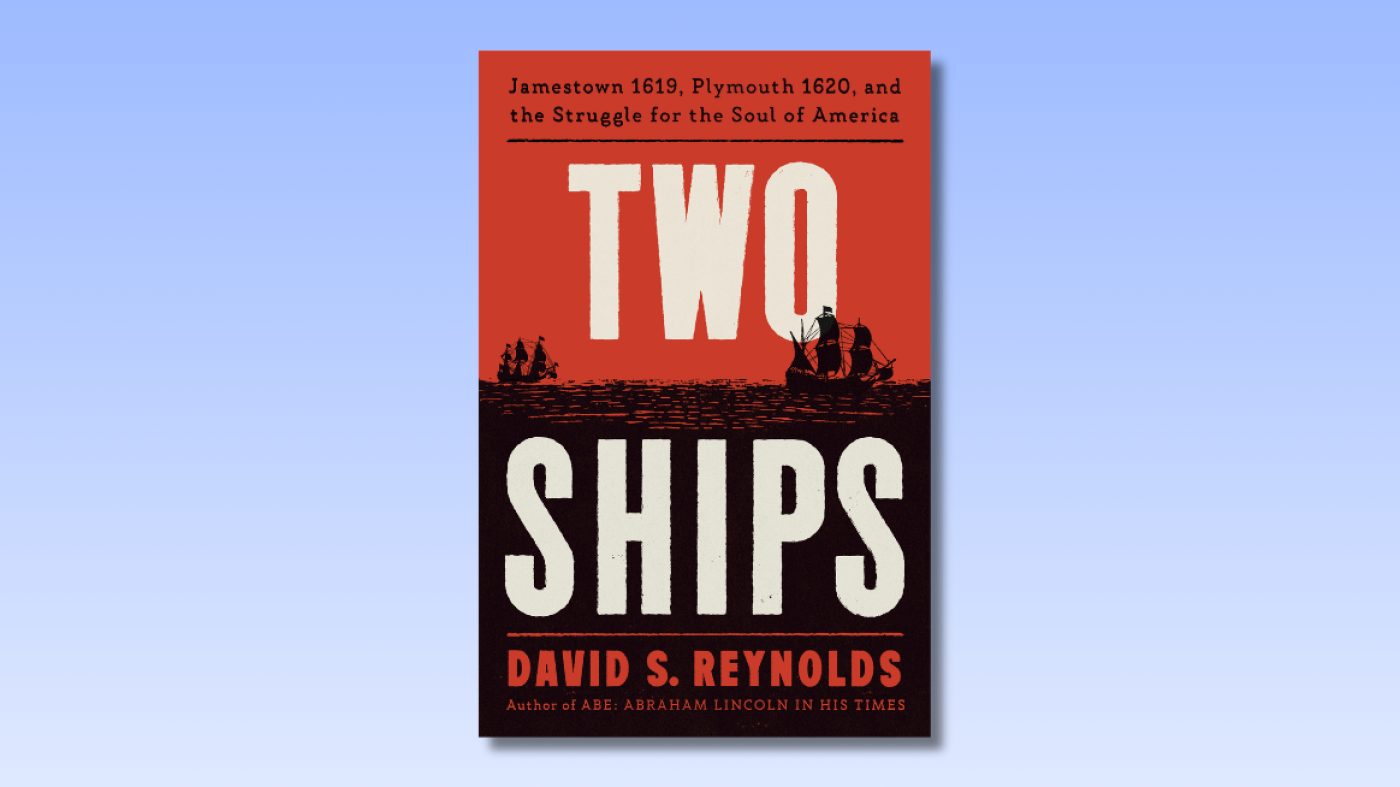
Just in time for a contentious 250th anniversary of the United States of America, historian David S. Reynolds’ latest book, Two Ships, helps us realize that any country that couldn’t agree on its own origin story is destined for divisive times.
Two Ships is about the complicated, conjoined legacy of the landings of the Mayflower, which carried the Pilgrims to Plymouth, Mass., in 1620, and the White Lion, which arrived in Jamestown a year earlier, bringing the first enslaved Africans to Virginia.
As Reynolds demonstrates, it’s not so much the facts of these two voyages, as it is the meanings ascribed to them, that made them such a powerful metaphor for two conflicting visions of American identity.
To simplify, the Mayflower’s passengers were separatist Puritans, dissenters to the reign of the English king, James I. As the United States developed, the Mayflower was credited with carrying the seeds of a radical democracy to the New World, one in which all men (in theory, at least) were equal before God.
In contrast, the European settlers of Jamestown were Royalists, also known as Cavaliers. Loyal to the monarchy, they believed in a strict hierarchy.
But the meaning of the images of the two ships shifted depended on who was invoking them and when. Not surprisingly, the metaphor was deployed most vigorously during the Civil War. In abolitionist speeches and writings, the White Lion or the “Slave-Ship,” as it was commonly called, was condemned for infecting America with the “plague-spot” of slavery.
Reynolds says that Frederick Douglass resorted to the “two ships” metaphor frequently, while Lincoln avoided it, hoping to preserve a unified ship of state. Meanwhile, Southern descendants of Cavaliers invoked the Mayflower to emphasize the intolerance and “cruel, persecuting” character of the Puritans. In a comment that resonates for our own times, Reynolds says:
It didn’t matter to the South that … by the mid-nineteenth century, the North had become a kaleidoscope of religious denominations, …, few of which resembled the faith of the Plymouth colonists. Distortion is intrinsic to cultural memory, especially when amplified by sectional or political bias. For Southerners, the Mayflower had brought Puritanism, which had yielded fanatical movements like abolitionism, now a dire threat to the Union.
In a brief-but-fascinating digression into the unpredictable power of literary fiction, Reynolds observes that the South’s fondness for Nathaniel Hawthorne’s anti-Puritan novel, The Scarlet Letter, and, even more, for the medieval historical romances of Sir Walter Scott, bolstered its nostalgia for a largely-imagined feudal society.

Reynolds quotes the always-quotable Mark Twain, no fan of Scott’s, as saying that Scott “did measureless harm; more real and lasting harm, perhaps, than any other individual that ever wrote …”
Two Ships is a dazzling survey of some three centuries of American history through a close reading of a metaphor. By the 1890s, Reynolds says, the interpretive tide had turned again: “Southern and Northern whites, feeling threatened by people of color and by an array of European immigrants, were retreating to a cocoon of racial solidarity that Mayflower celebrations helped reinforce.”
By the later-20th century, the image of the Mayflower was depoliticized and commercialized into Pilgrim hats and Black Friday sales. The powerful metaphor of the two ships receded into the mist.
Seven years ago, however, the 1619 Project piloted the White Lion — “The Slave-Ship” — back into view and anchored it at the center of debates about slavery’s place in the national story. The 1619 Project has been faulted for its historiography, and it does lie outside of the chronological boundaries of Reynolds’ book; still, it seems too momentous a reappearance of the White Lion not to at least acknowledge in this book.
That criticism noted, I think reading Two Ships would be an excellent way to observe this particular Fourth of July. It’s wise for all of us to have a more informed awareness of how Americans have understood, misunderstood and, often, flattened each other into stereotypes. Or, as Ernest Hemingway, one of the Mayflower Pilgrims’ more cynical descendants, might say in response to that sentiment: “Isn’t it pretty to think so?”



I took a kid’s camera to Paris Fashion Week, because was it ever really that serious? Yes and no. This men’s season happened during one of the hottest weeks in France’s recorded history, which inspired that specific brand of collective hysteria brought on by living through yet another unprecedented moment together — taking over our brains and ruining our plans to wear boots — and a grander reflection on what we were doing there and why. The throngs of teenagers doing back flips into the Canal Saint-Martin and playing soccer in the street set the mood for the week. If the world is ending, you might as well swim in dirty water and have fun doing it, no?
As far as the shows went, there was the coastal stoner energy of Tokyo-based Auralee — brightly colored leathers and furry flip-flops — that reminded me of the low-key elegance of hanging out in Southern California. At the Rick Owens show, Rick-heads made minimal weather-restrictive tweaks to their usual uniforms — platforms, leather, ground-grazing garments — making you appreciate the beauty in that level of ascetic dedication. Louis Vuitton built a literal beach as its runway, complete with sand and a giant wave that felt like a mirage: Is this a heat-induced hallucination or yet another buzzed-about set design under men’s creative director Pharrell Williams? At the Dries Van Noten show, there was an ice-cold beer fridge and popsicles, a chic and inspired detail only rivaled by a collection that was a breath of fresh air during a week where I Googled the symptoms of heat stroke more than once. The Willy Chavarria show was air-conditioned, pumped with Xinú perfume and felt expensive. Sven Marquardt, a Berlin photographer and Berghain’s most famous bouncer, was sitting in front of me, which I took as an incredibly good omen. The painted blue feet and Oakley collab sunglasses at the Kiko Kostadinov show felt auspicious as well.

A look from the Auralee show.
There were conversations floating around about how apocalyptic it felt sitting at a fashion show in over 100-degree Fahrenheit weather, our backs soaked, our minds dizzied, when the industry is responsible for something like 10% of global greenhouse gas emissions. The cognitive dissonance contributed to the thickness in the air that week.
At the Comme des Garçons show, called “If the War Were to End..,” models danced and ran and skipped out onto the runway for the finale, soundtracked by the joyous sound of children singing “You’re So Good to Me” by the Langley Schools Music Project. In that moment, we were happy, we were clapping, we might have even been hopeful. Humans have the capacity to hold a lot — a fan in one hand while attempting not to completely melt in the front row, and a fantasy that there might still be a future where we get to wear those leopard-print Dries shoes we fell in love with on the runway.

The moments before the Comme des Garçons show.

Comme des Garçons show attendees.

Comme des Garçons, head-to-toe.

The Comme des Garçons show.

The Dries Van Noten show.

A chic and inspired detail at the Dries Van Noten show: ice-cold beer.


Scenes from the ERL presentation.


The Kiko Kostadinov show.


Tapping in from Louis Vuitton beach.

Quavo at the Louis Vuitton show.

Scenes from after the Louis Vuitton show.

Scenes from the Louis Vuitton show.

Scenes from the Nahmias x Puma dinner at Gigi Paris.

Scenes from the On X Online Ceramics rave.


At Silencio to see Venezuelan DJ and producer Safety Trance.

The Willy Chavarria show.

Scenes from Willy Chavarria.

The throngs of teenagers doing back flips into the Canal Saint-Martin and playing soccer in the street set the mood for the week.

Taylor Swift and Travis Kelce of the Kansas City Chiefs, pictured at a basketball game in May, announced their engagement in August 2025.
Gregory Shamus/Getty Images
hide caption
toggle caption
Gregory Shamus/Getty Images
NEW YORK — Taylor Swift and Travis Kelce are officially married.
After three years of dating, The pop icon and Super Bowl-winning football player, both 36, tied the knot in New York, according to a statement from Swift’s publicist, Tree Paine.
There were neither bridesmaids nor groomsmen. “Instead, her brother Austin Swift served as Taylor’s Man of Honor and Jason Kelce was Travis’ Best Man. The ceremony joined both families together,” Swift’s publicist said in the statement released Friday evening.
The ceremony was officiated by comedian and a friend of the couple, Adam Sandler, the statement added.
The singer’s rep said that the couple was dressed in Christian Dior Haute Couture.
“The bride and groom’s wedding ceremony looks have been created by Christian Dior Haute Couture. They are designed by Jonathan Anderson, Creative Director of Dior Women’s, Men’s and Haute Couture Collections, in close collaboration with the Bride and Groom,” the statement said. “This is the designer’s first couture wedding dress for a world-renowned celebrity. Their shoes were custom made by Christian Louboutin and the bride wore Cartier jewelry.”
Security around the event was intense, so it remains unclear if the wedding was charming, if a little gauche. But the night before the ceremony the 20,000-person stadium was bathed in a lavender haze.
Details gleaned from a city permit obtained by The Associated Press, showed details of a “special event at MSG” scheduled to begin Friday evening and running overnight Saturday.
As speculation built, fans began gathering in front of the stadium ahead of the expected wedding, despite the couple’s efforts to keep details of the celebration under wraps.
Superfans and sleuths appeared to have their hunches confirmed on Friday, as dozens of black cars dropped off elegantly dressed guests outside of Madison Square Garden in New York City.
Lisa Benham and her daughter, Zara, posed for selfies outside the Garden. They’re visiting from England and both told NPR they’re huge Swifties.
“I just remember always listening to her,” said Zara Benham, age 17. The women said they’ve followed all the ins and outs of Swift’s romance with Travis Kelce, a tight end with the Kansas City chiefs.
“I’m thrilled for her. I love it. I love the whole story,” gushed Lisa Benham, 47, who says she became a fan after her daughter dragged her to a Swift concert. “I’m pleased for them, really pleased for them.”

A woman wearing a white veil stands outside Madison Square Garden in New York City on July 3, 2026. Taylor Swift and Travis Kelce’s official wedding plans are tightly under wraps, but New York is bracing to host the celebrity marriage of the year.
CHARLY TRIBALLEAU/AFP
hide caption
toggle caption
CHARLY TRIBALLEAU/AFP
Swift has a massive global platform, and a tendency to pull back the curtain on her personal life in song lyrics and the occasional documentary. But the shared little about her wedding plans since she and Kelce announced their engagement last August.
“You would think that I had been the type of person who would have obsessed over the idea of a wedding my whole life, but I actually never thought about what I would ever do or what I would want until I met the person,” Swift told the U.K.’s Heart Radio in October, while promoting her last album The Life of a Showgirl.

In the months since, speculation mounted over where and when the wedding would take place. In recent weeks, the theories all pointed in the same direction: New York City’s Madison Square Garden on July Fourth weekend.
Swift loves a good Easter egg, and her fans have been known to crack at least some of them successfully. That appears to have been the case with her wedding, even as some wondered for days whether it was merely a high-profile ruse.

Swift and Kelce celebrate the Kansas City Chiefs’ Super Bowl victory in Feb. 2024.
John Locher/AP
hide caption
toggle caption
John Locher/AP
A recap of their romance
Swift and Kelce began dating in the summer of 2023, during the first year of her record-breaking Eras Tour.
The Kansas City Chiefs tight end admitted on a July 2023 episode of New Heights — the podcast he co-hosts with his brother, retired NFL player Jason Kelce — that he had tried to meet Swift after one of her shows in the area.

“I was a little butt-hurt I didn’t get to hand her one of the [friendship] bracelets I made for her,” Kelce said. “I wanted to give Taylor Swift one with my number on it.”
Swift later told Time she thought that call-out was “metal as hell.”
Within months, she was attending his games — most famously, the 2024 Super Bowl his team went on to win. He was spotted in the crowd — and even onstage — at many of her shows the next year.
Fans got a peek into their chemistry when Swift appeared on New Heights last August to announce her 12th studio album, The Life of a Showgirl (which she said was heavily influenced by their relationship). She said she and Kelce bonded in part over similarities in their careers, in which they both “entertain people for three-plus hours in NFL stadiums.”

Less than two weeks later, Swift announced their engagement on Instagram, with photos of a flower-filled backyard proposal and a massive diamond ring. In an episode of The Graham Norton Show a few months later, Swift deflected questions about her wedding planning but joked about inviting “anyone I’ve ever talked to.”
Sleuths had been eyeing Madison Square Garden
Speculation about a July 3rd wedding at MSG reached new heights this month.
Part of that was through the process of elimination: Swifties descended on Watch Hill, R.I. — where Swift owns a seaside estate — on June 13, but tabloid reports of a ceremony there proved unfounded.
But there also seemed to be a paper trail leading to Manhattan.
New York City Mayor Zohran Mamdani seemed to drop a hint while talking to reporters in June.
“We are used to big events, and we are incredibly excited for this one,” Mamdani said, referring to the World Cup. “We know it coincides with the Knicks Finals run. We know it coincides with July Fourth, America 250, Taylor Swift’s wedding all happening at the same time.”

Forklifts and trucks were spotted outside Madison Square Garden in New York on Tuesday, as speculation about a weekend wedding grew.
Leonardo Munoz/AFP via Getty Images
hide caption
toggle caption
Leonardo Munoz/AFP via Getty Images
Then, The New York Times reported that an event company obtained permits for a gathering of up to 1,000 people at Madison Square Garden on July 3rd (and a smaller event the day before). It also cited unnamed sources with details about plans for street closures in the area, later confirmed by City Hall spokesperson Dora Pekec to Reuters.
CBS News shared video this week of trucks unloading “garden party” themed equipment outside the venue earlier this week. And the venue’s online event calendar is suspiciously empty until July 7.
Mamdani appeared to double down Tuesday, while speaking to reporters about the forthcoming heat wave.
“My recommendation to all New Yorkers is to stay inside and stay cool, and if you happen to be getting married at Madison Square Garden you will be staying inside and staying cool, and I think it’s a good example to set for the city at large,” he said with a smile.
This isn’t the first celebrity wedding celebration to take place at MSG. Sly Stone married actress Kathy Silva there in June 1974. As Stone wrote in his memoir, he was talking to his A&R liaison at Epic Records, Stephen Paley, about wanting to marry Silva, and one of them jokingly suggested he do so before an upcoming show.
“I could do a gig, get paid, and get married at the same time. ‘Go, go, go,’ I told him. He went and went fast,” Stone wrote, adding, “Steve wanted everyone to wear gold to keep the shine high.”
According to a New York Times report at the time, the two married in front of nearly 23,000 people, at a ceremony that turned into a full-fledged Sly and the Family Stone concert.

A closer look at Swift’s engagement ring from the 55th Annual Songwriters Hall of Fame Induction and Awards Gala in New York last month.
Kena Betancur/AFP via Getty Images
hide caption
toggle caption
Kena Betancur/AFP via Getty Images
Why New York, and why now?
Madison Square Garden, which can hold nearly 20,000 people, may seem like a surprising choice for a singer who prizes her privacy.
But Emma Fitzsimmons, one of the New York Times reporters covering the wedding, told NPR last week that it makes sense for privacy and security reasons.
“It’s sort of this locked box where paparazzi can’t get inside,” she said. “There’s not going to be helicopters overhead. She can release photos of the event and her dress, which we’re all very curious to see, on her own terms.”
Swift, who owns a sprawling Tribeca compound, is famously a fan of New York City. She even has a song about it: “Welcome To New York,” on the album 1989, inspired by her relocation to the city.

And she has a well-documented love of Fourth of July. Over the years, many photos have emerged — some on Swift’s own Instagram — of the star celebrating the holiday weekend in Rhode Island with friends and fireworks.
And it’s not lost on Swifties that she met Kelce shortly after the holiday in 2023, which she celebrated with girlfriends and shared photos of on Instagram.
“Happy belated Independence Day from your local neighborhood independent girlies,” she captioned the photo. “See you tonight Kansas Cityyy.”
-

 Los Angeles, Ca10 minutes ago
Motorcyclist struck, killed by driver making U-turn in L.A. neighborhood
-

 Detroit, MI30 minutes ago
GameThread: Detroit Tigers vs. Texas Rangers, 4:05 p.m.
-

 San Francisco, CA40 minutes ago
Why Vogue World Should Definitely Head to San Francisco Next
-

 Dallas, TX45 minutes ago
Mistake avoided? Cowboys FA signing could’ve been drafted… but fate
-

 Miami, FL52 minutes ago
No Room For LB Ronnie Harrison In Miami?
-

 Boston, MA55 minutes ago
Celtics’ Jaylen Brown trade leaves Boston fans, community feeling bankrupt: ‘A huge void’
-

 Denver, CO1 hour ago
Kalshi Promo Code DENVER: Claim $10 Bonus for July 4th World Cup, MLB Trades – Denver Stiffs
-

 Seattle, WA1 hour ago
Experts release new WNBA predictions for Portland Fire vs. Seattle Storm tonight

