Politics
Defense Department to undergo review after over failures during Austin’s hospitalization


The Department of Defense will review the process by which top leaders are notified of the transfer of duties from the secretary of defense following a week in which senior officials, the public and news media were kept in the dark about Lloyd Austin’s hospitalization and work absence.
Jennifer Walsh, the director of Administration and Management, will lead the review “to identify the relevant facts and circumstances during this period and evaluate the processes and procedures through which the Deputy Secretary of Defense was notified that she should carry out the functions and duties of the Secretary of Defense under 10 U.S.C. § 132(b) and Executive Order 13533,” a Defense Department statement said Monday evening.
“The purpose of such review is to better understand the facts surrounding these events and to recommend appropriate processes going forward,” the statement said.
SECRETARY OF DEFENSE LLOYD AUSTIN REMAINS HOSPITALIZED AFTER MYSTERY PROCEDURE; DOD REMAINS MUM ON RELEASE
The Pentagon is facing mounting backlash from reporters on Sunday after failing to disclose Defense Secretary Lloyd Austin was in the hospital. Austin and the Pentagon are facing mounting criticism after key leaders weren’t told of the secretary’s hospitalization last week. (Left: (Photo by Celal Gunes/Anadolu Agency via Getty Images), Right: (Photo by Anna Moneymaker/Getty Images))
The goal of the review is to ensure clarity and transparency when certain authorities are transferred and proper and timely notification to the president, Congress and the public, according to a memo to senior DOD staff by Austin’s Chief of Staff, Kelly Magsamen. The review is to be completed within 30 days.
President Biden and top officials weren’t immediately alerted about the hospitalization of Defense Secretary Lloyd Austin because his chief of staff was out sick, resulting in a breakdown in the notification process, the Pentagon said Monday.
Austin, 70, was admitted to the intensive care unit at the Walter Reed National Military Medical Center on Jan. 1 for severe pain for complications following a recent elective medical procedure,” Pentagon press secretary Maj. Gen. Pat Ryder said last week.
Biden and the National Security Council weren’t told about the hospitalization for a few days and the press and Congress weren’t notified until Friday.
“The best I can tell you is that the secretary’s chief of staff was ill with the flu, which affected the notification timelines,” Ryder said Monday. “We’re we’re going back now and looking at the processes and procedures, as I mentioned, to include both the White House and congressional notifications to ensure that we can improve those processes. You know, the bottom line is we know we can do better and we will do better.”
PENTAGON FACING BACKLASH OVER FAILING TO DISCLOSE SEC. AUSTIN’S ILLNESS: ‘HARMS CREDIBILITY’
The Pentagon building in Arlington, Virginia, on Friday, April 21, 2023. (Photographer: Tom Brenner/Bloomberg via Getty Images)
Magsamen was “unable to make notifications before then” but she informed Deputy Defense Secretary Kathleen Hicks and national security adviser, Jake Sullivan, on Thursday. The National Security Council and Biden weren’t notified of Austin’s hospitalization until Thursday as well.
Ryder acknowledged that he and other public affairs and defense aides were told Jan. 2 that Austin had been hospitalized but did not make it public and did not tell the military service leaders or the National Security Council until days later.
“I want to offer my apologies and my pledge to learn from this experience, and I will do everything I can to meet the standard that you expect from us,” he said.
Hicks, who was on a previously scheduled vacation and not physically in the Pentagon, partially assumed some of Austin’s duties last week, an official told Fox News. She wasn’t told Austin was hospitalized at that time, the Pentagon said.
Austin was taken to the hospital via ambulance on Jan. 1 and he was conscious during the ride, Ryder said Monday.
“The secretary did participate, in a call with the president on New Year’s Day,” Ryder said. “This was, of course, prior to him being admitted to hospital.”
A Jan. 4 strike that killed a a militia leader in Baghdad was pre-approved by Austin and the White House before the secretary was admitted into Walter Reed, Ryder said.
He added that Austin has no plans to resign. No senior Defense Department officials have been asked to resign as well.
Ryder said staff in Austin’s front office will review notification procedures, including whether regulations, rules or laws were broken, and will take steps to improve the notification process. Those staff members, however, are among those who did not disclose the secretary’s hospitalization.
The Pentagon’s failure to disclose Austin’s hospitalization has enraged congressional leaders and the news media responsible for covering the Pentagon.
“I was informed by the assistant to the Secretary of Defense for Public Affairs on Tuesday afternoon that the secretary was in the hospital,” Ryder said. “He didn’t have any additional information to provide, but I recognize that I should have tried to learn more and to press for an earlier public acknowledgment.”
In a statement issued Saturday evening, Austin took responsibility for the delays in notification.
“I am very glad to be on the mend and look forward to returning to the Pentagon soon,” he said. “I also understand the media concerns about transparency and I recognize I could have done a better job ensuring the public was appropriately informed. I commit to doing better. But this is important to say: this was my medical procedure, and I take full responsibility for my decisions about disclosure.”
The Associated Press contributed to this report.

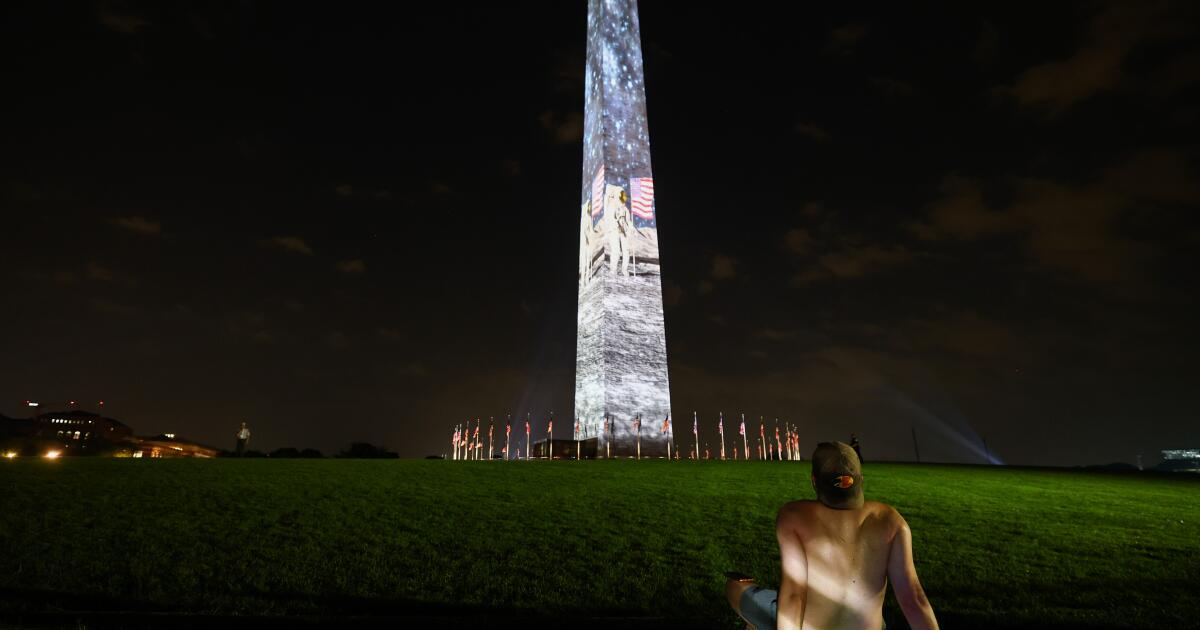
WASHINGTON — Small towns across America had big plans to celebrate the nation’s semiquincentennial this weekend. Local historical societies scheduled town square readings of the Declaration of Independence, hired bands to play patriotic tunes, organized parades and set up themed baking contests.
But many of their most ambitious plans were scrapped after the Trump administration cut $100 million in federal funding for humanities nonprofits and state councils at the start of its term. The decision severely hampered local planning for America’s 250th anniversary, disrupting history projects, museums and educational programs nationwide.
Instead, the Trump administration funneled tens of millions in federal dollars to Event Strategies, the firm behind Trump’s infamous rally at the Ellipse on Jan. 6, 2021, to organize anniversary events throughout the nation’s capital centered on President Trump.
The result, historians say, has become a centralized, more politicized spectacle, marking the national milestone as a celebration of an imperial presidency rather than a revolution from kingly rule.
The spectacular show that Americans will see features Trump at its center, culminating a year of concerted efforts by the president to put his face on passports and currency, national park passes and government buildings.
Members of the Dance4Life studio in Claymont, Del., prepares to march ahead of the Red, White, & Blue To-Do Pomp & Parade on July 2, 2026, in Philadelphia.
(Al Drago / Getty Images)
Yet, beyond the noise of the nation’s capital, historians and teachers, docents and curators, archivists, tour guides and reenactors have sustained the messy, organic discourse of the American story, less funded but no less vocal in their patriotism.
“The way history has been argued since Trump returned to office has been a reminder that governments and political figures have remarkable power to shape a society’s historical memory,” said David Ekbladh, a history professor at Tufts University and author of “Look at the World: The Rise of an American Globalism in the 1930s.”
Trump’s effort to control the anniversary narrative has reminded Ekbladh of one of George Orwell’s most famous quotes: “Who controls the past controls the future. Who controls the present controls the past.”
“The administration’s clear signals that it can and will restrict funding to institutions seems to have muted the way many institutions, like museums and universities, have approached the anniversary,” Ekbladh added. “With this said, Trump’s own direct, personal use of the 250th has been less about articulating a clear view of the nation’s history than using the moment itself to keep attention on him.”
The White House has taken a more active role in the festivities than initially planned, setting up its own Freedom 250 project to supplement America250, a bipartisan congressional effort to celebrate the occasion.
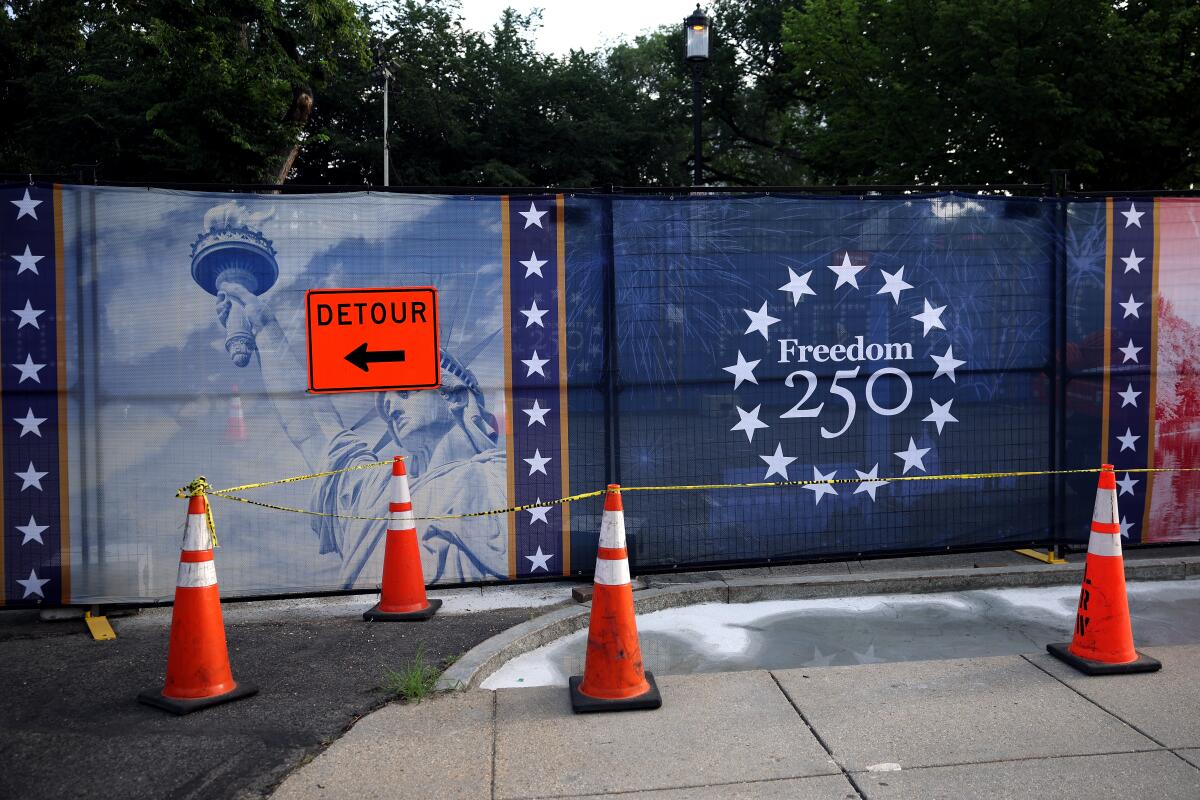
Fencing is seen around the Great American State Fair on the National Mall on Thursday.
(Kevin Dietsch / Getty Images)
The Trump administration has directed funding to events centered on the president’s attendance, primarily around Washington, and partnered with conservative organizations such as PragerU and Hillsdale College to present the country’s founding story through a conservative Christian lens.
Historians are in broad agreement that this year’s celebration has garnered far less attention than the bicentennial, marked in 1976, which generated blanket media coverage and widespread national excitement.
Andrew Rudalevige, a professor of government at Bowdoin College and author of “The New Imperial Presidency,” attributed the lack of enthusiasm this time in part due to a more fragmented media landscape than existed 50 years ago, denying the country a “core curriculum” and a shared story.
“I don’t think it’s a lack of patriotism, so much as a determination that no presidential administration should be able to center itself as the focus of that patriotism,” Rudalevige said.
“There’s a lot to celebrate in the text of the declaration. But that’s not where the focus of the Freedom 250 efforts has been,” Rudalevige said. “It would have been interesting to see what the bipartisan America250 initiative could have come up with if its funding and energies had not been diverted.”
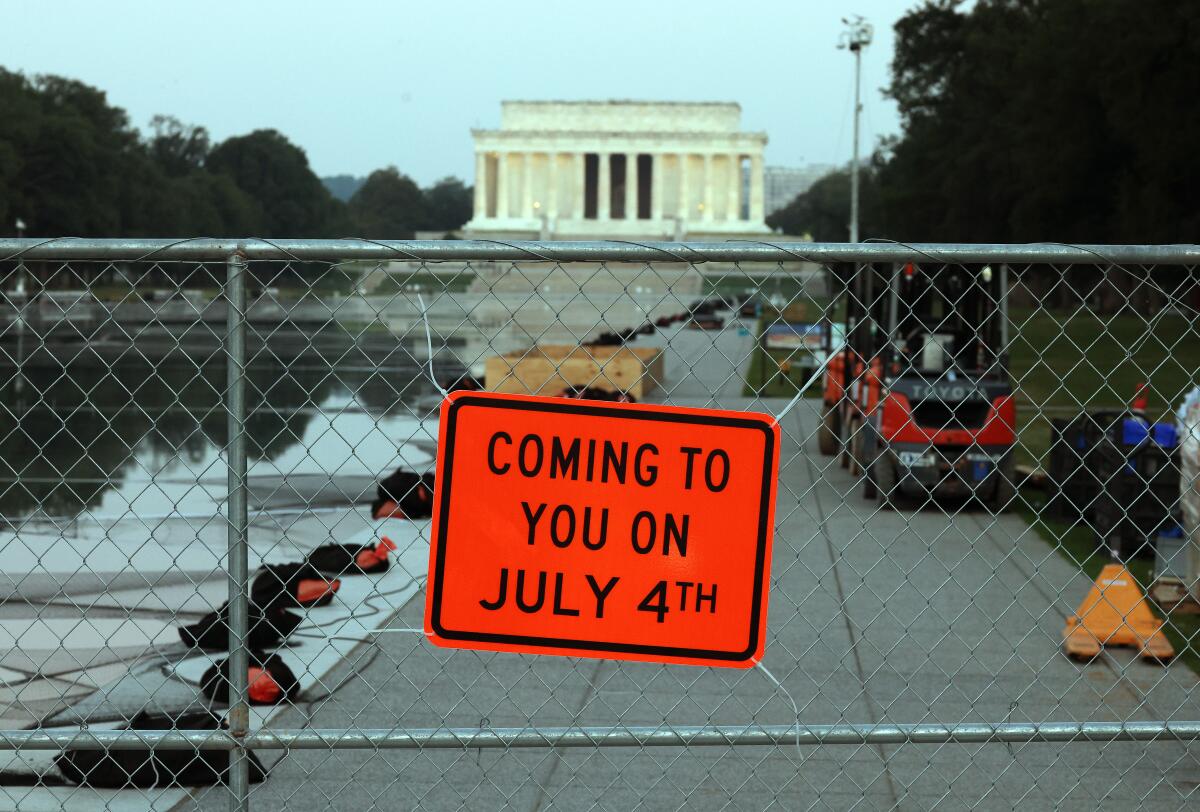
The Lincoln Memorial Reflecting Pool is fenced off in preparation for Fourth of July fireworks.
(Kevin Dietsch / Getty Images)
Trump has scheduled little national travel around the anniversary, visiting North Dakota this week for an event that allowed him to debut a new version of Air Force One, donated by Qatar and outfitted to the president’s tastes. Trump intends to keep the plane after leaving office for his personal use.
The jet will fly over the National Mall alongside the Defense Department’s most impressive equipment on Saturday, before the president delivers a speech in what is forecast to be a blistering heat wave. The evening will end, according to administration officials, with the largest fireworks display in U.S. history.
“The fundamental challenge that we face now is the fight between the historians — people who have been studying the past and who have been thinking about how to tell that story to the public — and government leaders over who gets to control that story,” said Peter Kastor, chair of the history department at Washington University in St. Louis.
“The people who are really on the front lines are museum professionals, the operators of historic sites and schoolteachers,” he said. “They face the responsibility for explaining the past to a general audience on a day-to-day basis, and they are the ones who most often face the backlash from people who want the story to be told differently.”

NEWYou can now listen to Fox News articles!
Lawmakers on Capitol Hill had split reactions to the Supreme Court’s ruling to strike down President Donald Trump’s bid to end birthright citizenship, further allowing children born in the United States to be recognized as U.S. citizens.
“It’s a terrible decision,” Rep. Byron Donalds, R-Fla., told Fox News Digital.
“Regulate folks before they come in — in terms of not coming here just to have a baby and leave,” Rep. Ro Khanna, D-Calif., said.
“In terms of the immigration process coming in, there should be regulation. Not that once you’re born here that we’re going to denaturalize you,” he continued.
REPUBLICAN ACCUSES SCOTUS OF BETRAYING US, PUSHES BILL RESTRICTING BIRTHRIGHT CITIZENSHIP, PREGNANT VISITORS
Rep. Ro Khanna, the U.S. Supreme Court and Rep. Byron Donalds weighed in after the high court rejected President Donald Trump’s bid to end birthright citizenship. (Shannon Finney/NBC via Getty Images; Li Rui/Xinhua via Getty Images; Nathan Posner/Anadolu via Getty Images)
The case, which left many Republicans and Democrats divided, challenged Trump’s executive order to detach birthright citizenship from the 14th Amendment. Most Democrats who Fox News Digital spoke to argued that if the ruling had gone the other way, it would have been considered unconstitutional.
“I think they got it right,” Rep. Christian Menefee, D-Texas said. “The Supreme Court said that the Constitution says what it says. That if anybody even has a question about what the 14th Amendment says, I think it’s a little embarrassing. So I’m glad they got it right.”
TRUMP SUFFERS MAJOR SUPREME COURT DEFEAT AS JUSTICES UPHOLD BIRTHRIGHT CITIZENSHIP
Rep. Christian Menefee (D-TX) speaks onstage during DJ Michael 5000 Watts King’s Day at The Bell Tower on 34th on February 16, 2026 in Houston, Texas. Watts passed away on January 30, 2026 at the age of 52. (Marcus Ingram/Getty Images)
“I believe in the Constitution,” Rep. James Clyburn, D-S.C., said when asked about the ruling.
“The Constitution is the Constitution. If you don’t like the Constitution, you can try to change it,” Rep. Seth Magaziner, D-R.I., said. “But honestly, I think we’ve got much bigger problems as a country than Americans trying to live their lives as birthright citizens.”
The 6-3 decision highlights a significant loss for Trump’s immigration agenda as he has criticized birthright citizenship as a “magnet for illegal immigration.”
ICE SURGES ENFORCEMENT, MAKES 10,000 ARRESTS IN FIVE DAYS AMID SUPREME COURT BIRTHRIGHT CITIZENSHIP DECISION
“I think the president has an obsession with immigrants in this country,” Rep. Sarah Elfreth, D-Md., said. “He’s hell bent on making it as uncomfortable as possible. We’ve seen that time and again with ICE, we’ve seen this with an attack on the 14th Amendment .”
Justice Clarence Thomas, Justice Neil Gorsuch and Justice Samuel Alito were the three to dissent — arguing the 14th Amendment does not guarantee birthright citizenship to all children born to parents who are unlawfully and temporarily in the country. Alito cited that the ruling fails to recognize the rise of “birth tourism,” the concept that foreigners come to America just to give birth, potentially opening the door to national security threats.
CLICK HERE TO DOWNLOAD THE FOX NEWS APP
Rep. Ilhan Omar, D-Minn., and Rep. Maxine Waters, D-Calif., declined to comment on the ruling to Fox News Digital.
“Americans should be happy, because the Constitution means more than one guy’s opinion,” Rep. Bennie Thompson, D-Miss., said.
WASHINGTON — President Trump has spent months waging an unusually aggressive campaign to reshape how states run elections, leveraging federal agencies in ways no previous president has attempted.
He has pushed the Department of Homeland Security to compile a list of citizens in each state to help determine voter eligibility. He is seeking to give the Postal Service a role in deciding who can receive mail ballots. He has threatened to withhold federal funding from states unless they phase out electronic voting machines. And he is pressuring Republican lawmakers to overhaul voting laws, claiming without evidence that elections are being rigged.
The efforts have run into resistance in court and within his own party. They have also left postal workers and local election officials bracing for an election cycle marked by deepening doubts about election integrity, and uncertainty about how the federal government may challenge the post-election results.
“It’s an unprecedented power grab to reshape how our elections work so that he and his allies can maintain and expand power,” said Eric Kashdan, director of federal advocacy at the Campaign Legal Center, a nonpartisan government ethics organization.
The White House defends the effort as fulfilling a campaign promise, and argues the administration is “lawfully enacting the agenda President Trump was elected to enact.”
One of Trump’s defining efforts to assert some federal control over state elections has been his insistence on passing the SAVE America Act, which would require voters to provide proof of citizenship when they register, require Americans to show identification when casting a ballot and require states to send voter data to the Department of Homeland Security.
His relentless push for the measure has prompted him to derail a bipartisan housing bill and threaten to forgo signing any piece of legislation unless the voting measure is approved. He says he considers the matter a “national emergency.” Despite the pressure campaign, Senate Republican leaders maintain there is not enough support to pass the measure.
The political stakes ahead of the midterms have been laid out more bluntly by House Speaker Mike Johnson (R-La.), whose chamber has approved the SAVE America Act. Last month, Johnson warned conservatives gathered at the Faith & Freedom Coalition that if Democrats win back control of the House, they will “go after the president’s family, the Cabinet, his donors, friends,” and supporters.
“I run the protection program,” Johnson said. “I will take care of you.”
Setbacks in court
The administration’s ambitions have hit numerous snags in court in the last month, with judges reaffirming in many cases that the Constitution gives states — not the federal government — primary authority over elections.
In one case, U.S. District Judge Sparkle L. Sooknanan, who was appointed by President Biden, went further.
She said a federal immigration database the Department of Homeland Security was compiling to determine voter eligibility violated privacy laws. She added that the database has resulted in states actively removing U.S. citizens from voter rolls based on inaccurate information.
“All in all, the federal government has knowingly trampled on the privacy rights of American citizens in a manner that threatens the sacred right to vote,” Sooknanan wrote. “This Court cannot stand idly by while that happens.”
James Percival, the general counsel for Homeland Security, said the ruling was the latest example of “how hard the Left will fight to stop us from solving problems they insist do not exist.”
The Supreme Court’s conservative majority this week also dealt a blow to the GOP and upheld state laws that allow for counting mail ballots that are postmarked by election day but arrive late.
The decision left Trump fuming. He said it was a “a little bit surprising” to see the court’s decision, claiming without evidence that the result will inevitably give “people more time to vote illegally.”
Democrats, in turn, saw the ruling as a necessary check on the Trump administration’s efforts.
“While we continue to see unprecedented efforts to interfere with elections from the Trump administration, it is a relief to see federal courts make clear that these attacks on mail and absentee voting are clearly illegal and unconstitutional,” Sen. Alex Padilla (D-Los Angeles) said in a statement after the ruling.
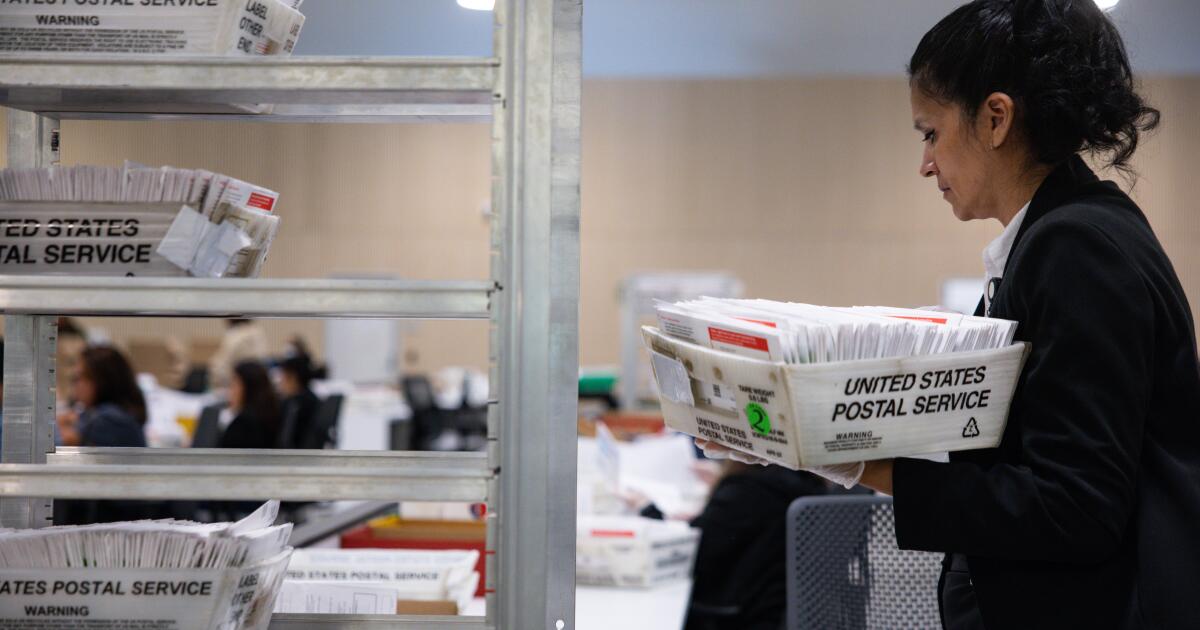
Trump is still eyeing changes to voting by mail. In March, he issued an executive order that seeks to limit who can receive mail ballots. Under the proposed rule, the Postal Service would not deliver mail ballots to states that don’t turn over sensitive voter data to the federal government, Postmaster General David Steiner told a Senate panel last month.
The admission drew immediate condemnation from Democratic lawmakers. They argued the regulation is an illegal attempt to coerce states into handing over their voter rolls.
“Please push back on being a pawn in this authoritarian playbook,” Sen. Elissa Slotkin (D-Mich.) told Steiner. “The Postal Service is one of the most important institutions in our country. Don’t taint it with the obsession of this one man.”
A day after that back-and-forth, U.S. District Court Judge Indira Talwani, who was nominated by President Obama, blocked those plans — at least for now.
“The Constitution does not grant the President any specific powers over elections,” the judge wrote, while adding that the Postal Service does not have the legal authority to determine who can vote by mail and how.
The White House said Wednesday that the administration remains confident the executive order will be in place by the November election.
Taken together, the administration’s efforts are unprecedented, UCLA law professor Rick Hasen said. That’s because the Constitution puts control over elections in the hands of the states and grants Congress the ability to pass laws, he said.
“The president really only has authority through federal statutes that have already been passed,” Hasen said. “It’s not surprising that many courts have struck down or stopped him from doing things to try to interfere with how elections are being run.”
Postal workers waiting for clarity
The legal setback for the Postal Service proposed rule was welcome news to the union representing postal workers.
“We believe that what we’re being asked to do is in violation of the oath that we took,” said Jonathan Smith, the president of the American Postal Workers Union, which represents more than 200,000 postal workers.
Following the ruling, the union called on the agency to abandon the rule, arguing it “will crush mailers’ trust in the Postal Service” and undermine “one of the most important functions the Postal Service and postal workers perform in service of the United States and its remarkable democracy.”
In several states, the union has run ads promoting mail voting as safe and a needed option for Americans. The ads were planned before Trump signed his executive order in March seeking to limit who can receive mail ballots, Smith said.
Now, the ads are taking a different meaning. Smith argued that “sometimes God works in mysterious ways.”
“The ad was then and is now intended as a piece to educate America about how good vote by mail is, how much it has been working out,” Smith said. “It’s an educational piece, not a response to the White House.”
Ahead of the election, Smith said postal workers are waiting for clarity on how their duties may change. But right now, he says, there isn’t much.
Orange County Registrar Bob Page said his office is monitoring any changes to existing federal and state election laws to ensure any changes, if needed, are implemented without disruptions. But he acknowledged the timing crunch could create some hurdles the closer the election gets.
“In many ways, any change to how California voters cast their ballots made between now and election day would create a challenge and may even be disruptive,” Page said.
He said many counties have ordered outgoing and return ballot envelopes for the election to ensure envelopes for more than 23 million California voters are ready to use by the Oct. 5 mailing deadline. Any change to how ballots should be prepared or mailed could present an issue.
“Our office has received calls from voters asking about potential changes to vote-by-mail procedures usually tied to media coverage about proposed changes,” he said. “We inform these voters that our procedures have not changed because the law has not changed and that we will mail their 2026 General Election ballots by Oct. 5.”
L.A. County prepares for possible voting changes
In Los Angeles County, election officials are also in a battle to bring clarity to the process as the administration ushers in a series of proposed changes to the election.
Dean Logan, the head of the Los Angeles County registrar-recorder/county clerk’s office, said his office is fighting to contain a wave of election misinformation, including some that is amplified by the White House.
“It’s not something that we’ve seen happen before, and certainly not at the level we’ve seen,” Logan said.
Rather than respond to every claim, Logan says his office picks its battles, intervening only when a falsehood appears likely to reach a wide audience. Even then, the office tries to avoid engagement with whoever is spreading it.
If the administration imposes a new rule closer to the election, Logan said his office is ready to follow the law.
“It’s really been about finding this balance of staying alert and prepared for the possibility [of change] but also not getting sucked into the political distraction,” he said.
Last month, Trump claimed without evidence that Democrats have cheated to win California’s primary elections, and boasted about federal prosecutors in Los Angeles investigating the matter.
Trump has also continued to claim Democrats are trying to rig or cheat in the upcoming election, remarks that have faced rebukes from members of his own party.
“I think it is ironic that we control the House, Senate, Supreme Court and the White House and we are yelling election fraud. I mean, we won all the damn elections,” Rep. Thomas Massie (R-Ky.) told reporters last month.
At the national level, Senate Democrats have said they plan to send election observers to polling places on behalf of Congress in reaction to Trump’s efforts.
“We are not waiting for chaos to arrive,” Senate Minority Leader Chuck Schumer (D-N.Y.) said last month. “We are preparing now.”
Times staff writer Justine McDaniel contributed to this report from Washington.
-
 Lifestyle6 minutes ago
L.A. Affairs: He wanted L.A. I wanted New York. A panic attack changed everything
-
Politics9 minutes ago
Trump refashions America’s 250th as a celebration of himself
-
 Sports24 minutes ago
How Dodgers’ Max Muncy, vying for his third All-Star selection, continues to evolve
-

 World36 minutes ago
Germany’s Merz defends NATO spending after Trump calls it ‘ridiculous’
-
 News59 minutes ago
Oregon ER doctors win a ‘David and Goliath’ battle against a national company
-

 Videos2 hours ago
Iran gets ready for Khamenei’s funeral • FRANCE 24 English
-

 Los Angeles, Ca2 hours ago
2 arrested after 3 LASD deputies injured during East L.A. World Cup celebration
-

 Detroit, MI3 hours ago
Ex-girlfriend in custody after Taylor man found fatally stabbed, police say

