West
Compton baker laments 'heartbreaking' losses after rioters drive car through front door and loot

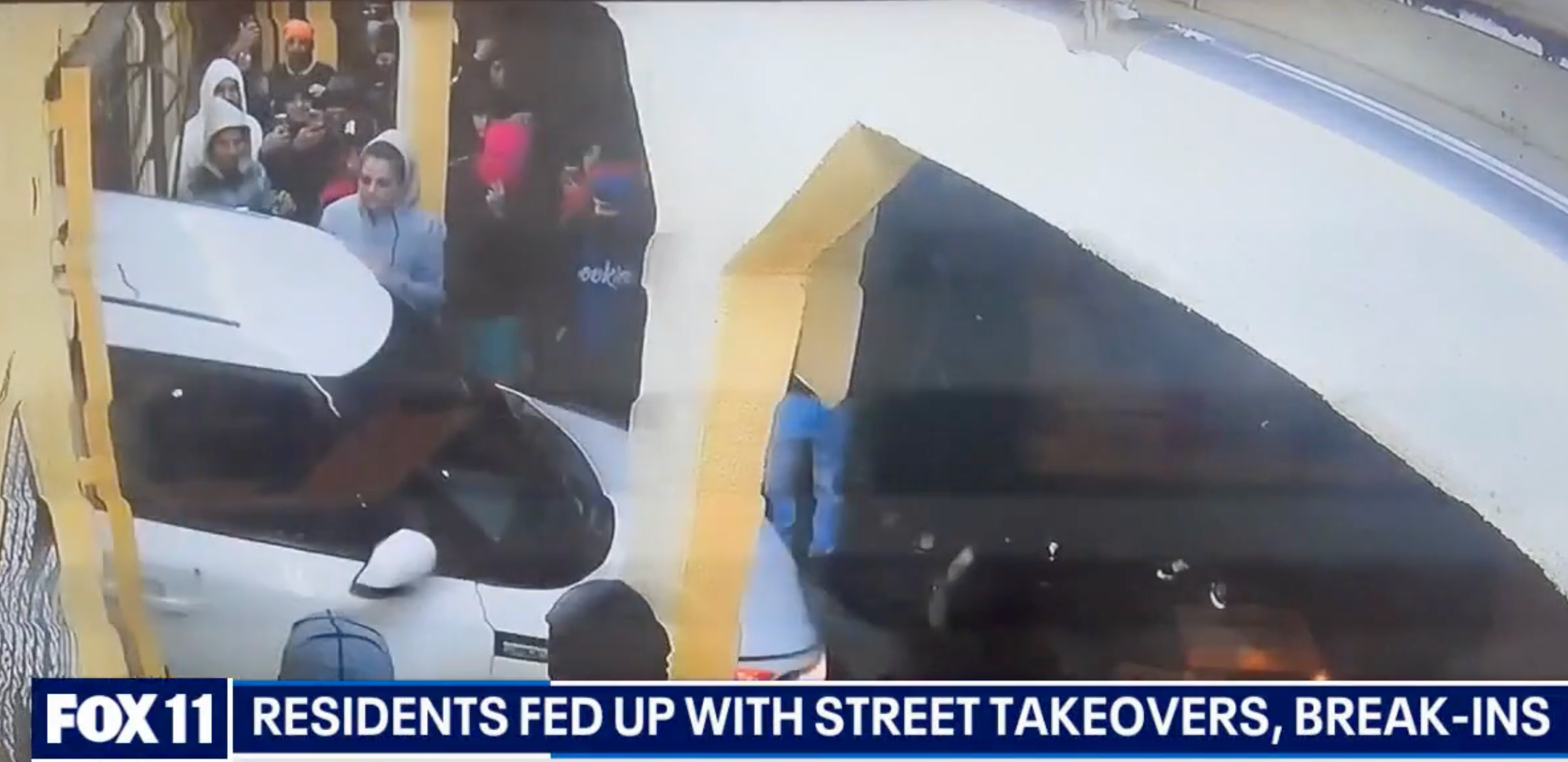
The son of Mexican immigrants who operates a popular Latino bakery in Compton, Calif., spoke out to Fox News on Friday after a mob of looters from an illegal “street takeover” drove a car through the front door and ransacked the business.
Ruben Ramirez Jr. told “America Reports” that the material losses have accumulated so far to $70,000, and that there is even more unimaginable damage to the bakery and to the realities of his family left to pick up the pieces.
A Los Angeles County sheriff’s officer told the New York Post that meat scales, meat, groceries and lottery tickets were among the goods looted in the early Tuesday criminal blitz at Ruben’s Bakery & Mexican Food.
A white Kia could be seen on CCTV repeatedly ramming the front door until it gave way, and let about 100 looters inside to run wild.
LA COUNTY RESIDENTS DEMAND ACTION AFTER CAR SMASHES STORE TO MAKE WAY FOR MOB
A mob used a car to smash open a bakery and loot its goods in Compton, Calif. (Fox 11 screenshot)
“This has never happened to us before. We’ve seen ‘street takeovers’ in the area, but it’s never anything like this,” Ramirez said.
He added that of the dozens of looters, he and his family could not identify a single vandal from the surveillance tapes, but expressed hope Compton and Los Angeles law enforcement will gain better leads.
While Ramirez said he hopes to see arrests made, he told “America Reports” that the more important goal is to see the bakery and eatery reopen to its former glory.
CHICAGO MAYOR-ELECT CONDEMNS ‘TEEN TAKEOVER’ CHAOS, BUT SAYS ‘IT’S NOT CONSTRUCTIVE TO DEMONIZE YOUTH’
“I just want my business back. I want to be able to serve the community how we’ve been doing it for all these years and make everybody happy with our food,” he said.
Another loss caused by the looting, Ramirez said, was that his bakery will not be able to produce substantive quantities of a popular ethnic bread in time for Saturday, which marks Epiphany – or the visit by the Three Kings to a newborn baby Jesus.
“It’s been — it’s going to be a little devastating. We don’t know the effects of how long it’s going to take us to recover completely,” said Ramirez.
CLICK TO GET THE FOX NEWS APP
He added that better community policies are needed to prevent such rampant looting and criminal behavior, saying it is hardworking people who suffer most.
“I had a neighbor in the street takeovers around here who lost his work truck, so now he can’t work,” he said. “He lost his livelihood because of that. So, you know, I hate to say it, but nobody gets punished for anything.”
Read the full article from Here

Alaska
Former Alaska corrections officer sentenced to 150 years in prison for killing wife and teen daughter

A former Alaska corrections officer who pleaded guilty to the 2022 killings of his wife and daughter earlier this year was sentenced this week to 150 years in prison.
Anchorage Superior Court Judge Josie Garton on Tuesday sentenced Jalonni Blackshear to consecutive 75-year sentences for first- and second-degree murder in the 2022 killings of his wife, Raechyl Blackshear, and their 14-year-old daughter, Jayla, according to filings in the case.
The sentence came after Blackshear pleaded guilty to the charges in late January. Blackshear, in a plea agreement affidavit, said that he shot and killed his wife and daughter in their Scenic Foothills neighborhood home on April 4, 2022, amid a police investigation into suspicions that Blackshear had sexually abused his daughter.
The plea agreement called for a 150-year sentence, according to a May 11 sentencing memorandum signed by Assistant District Attorney Rachel Gernat.

Nearly a dozen other charges, including murder, sexual abuse of a minor and incest, were dismissed as part of the plea agreement with prosecutors, according to the memorandum.
Blackshear had a history of abusing and terrorizing his family, Gernat said in the memo. He shot his family members in the head to avoid prosecution on sexual abuse charges after he failed to coerce his daughter to recant statements given to Anchorage police about being sexually assaulted in late March of that year, she wrote.
In his plea agreement affidavit, Blackshear admitted that the murders were unprovoked and that he was likely to face charges for sexually abusing his daughter.
The mother and daughter were last seen on April 3, 2022, after Blackshear convinced his wife to take their daughter to Anchorage police to try to get her to retract her sexual assault allegations, prosecutors said.

Blackshear quit his job and fled Alaska several days later after he was charged with sexually abusing his daughter. Prosecutors said he used the mother and daughter’s phones to impersonate them in an effort to convince others they were alive.
Raechyl and Jayla Blackshear were found dead in the family home days later after Raechyl Blackshear missed a medical appointment, according to police. Tracking data from their phones led to Blackshear’s arrest in New York weeks later, according to prosecutors.
Blackshear was jailed at the Mat-Su Pretrial facility as of Thursday afternoon.

Two men were arrested and two other suspects remain at large after a train burglary in northern Arizona last week, authorities said. On Monday, May 29, local and federal detectives investigating ongoing cargo thefts received a report of a train burglary in progress near Interstate 40 and Meteor Crater, west of Winslow, the Coconino County Sheriff’s Office said.

California lawmakers are again considering A.B. 412, a bill that would require AI developers to identify and disclose copyrighted works used to train generative AI systems.
The problem this year is the same as last year: it’s practically impossible to comply with this law. The bill demands information that often does not exist, and cannot realistically be obtained.
EFF submitted an opposition letter to the California Senate Privacy Committee explaining why we continue to believe A.B. 412 is simply unworkable. To the extent developers do follow this law, it will have the effect of locking in the power of the largest companies in AI.
A Burden That Can’t Be Met
A.B. 412 sounds simple: just have AI developers create and keep a list of all the registered copyrighted works they use in AI training.
That may seem straightforward. In practice, it’s anything but.
There is no machine-readable “list” of copyrighted works at the U.S. Copyright Office. And many copyright holders can get a copyright without even depositing a publicly viewable sample of the work—for example, software companies may register copyright on proprietary code without revealing it to the public.
And on the open internet, copyright information is often incomplete, unavailable, or impossible to verify. One image may be registered with the copyright office, while the next is licensed under a free Creative Commons license (like the images that EFF creates), and the next is public domain. A message forum user might post an original story, photograph, or poem without any indication of ownership or registration status.
The bill effectively asks developers to continuously cross-reference massive batches of online data against a copyright system that simply wasn’t designed to do so. If California passes A.B. 412, its impact will go far beyond the large AI companies we read about in the headlines.
Not Just Big Tech
Supporters often frame this bill as a way to help creative workers have some leverage against Big Tech, but the bill reaches much further than the big AI companies.
Its definition of “developer” extends to anyone who makes a generative AI model available to Californians. That includes indie developers tinkering with an existing model, open-source initiatives, nonprofits, and other non-commercial efforts. Recent amendments added exemptions for universities and government entities, which is important, but that still leaves out a vast swathe of non-commercial tech work that’s done by people without full-time jobs in government or academia.
Large companies will hire compliance teams and lawyers to navigate these requirements. Smaller organizations and independent developers usually can’t. The result will be fewer opportunities for startups and new entrants. Faced with this massive compliance burden, some won’t even try.
Courts Are Already Deciding These Questions
The bill is premised on the idea that copyright owners currently don’t have good remedies if they’re mistreated by AI companies. That simply isn’t true. And the growing wave of federal court filings in this space prove it. Content companies that want to sue tech companies, large or small, have no problem doing so. Those courts are still working through important questions about fair use and transformative use. Some courts have already concluded that many AI training activities qualify as fair use. Others continue to evaluate the issue.
California lawmakers should not rush to impose new state regulation while those questions remain unresolved. This is why copyright is governed at the federal level: both creators and fair users benefit from a single set of nationwide rules.
At this point, the bill remains a solution in search of a problem. Rights holders already have powerful tools to protect their interests under existing federal law. What this bill adds isn’t clarity or transparency, but a costly and essentially impossible compliance burden that will discourage small developers and researchers.
California has been able to support both artistic creativity and tech innovation for decades now. But A.B. 412 does not strike the right balance.
If you are a California resident and interested in speaking out about this bill, you can find and contact your representatives through this website.
-

 Indianapolis, IN7 minutes ago
‘Thrill is gone’: Jason Whitlock says Caitlin Clark fever is over in Indianapolis
-

 Pittsburg, PA10 minutes ago
Pittsburgh promises its largest firework show yet for America’s 250th
-

 Augusta, GA15 minutes ago
Gaines endorses Kendrick in Augusta mayoral runoff
-

 Washington, D.C22 minutes ago
Juvenile injured after gunfire reported in DC’s Michigan Park neighborhood
-

 Cleveland, OH25 minutes ago
Cleveland readies for pre-World Cup soccer match
-

 Austin, TX30 minutes ago
Texas lawmakers discuss rural hospitals
-

 Alabama37 minutes ago
Alabama has one of college football’s toughest schedule stretches in 2026
-

 Alaska40 minutes ago
Former Alaska corrections officer sentenced to 150 years in prison for killing wife and teen daughter

