Colorado
Mild Start to 2024 on Monday


Watch CBS News
Be the first to know
Get browser notifications for breaking news, live events, and exclusive reporting.


The group behind an upcoming rebate program is hoping to get more Coloradans to make the switch to heat pumps for their heating and cooling needs.
Power Ahead Colorado, administered by the Denver Regional Council of Governments, says applications for the new rebates will open this summer. However, people are already taking advantage of incentives.
“I am so ready for the summer,” said Denver homeowner Eric Gehringer, who came home from work as his heat pump was being installed, and he’s pretty excited about it.
“We’re going to be in the house, just chillin’, like, ‘Oh man, is it warm outside? I don’t even know,’” he joked.
Gehringer is upgrading from a swamp cooler and chose a heat pump over a traditional heating and cooling system.
“With the rebates that are happening right now, it just made financial sense as well,” he said.
Several rebates can be stacked for maximum savings, including a state rebate from Xcel Energy.
“The average size of those rebates has been anywhere from $6,000 to $12,000, depending on the size of the heat pump,” said Trevor Seeyle, the president and CEO of Independent Power, a Boulder-based company that installs heat pumps.

Power Ahead Colorado will also be launching a $1,500 rebate program this summer.
“Our typical heat pump installation is probably anywhere from $15,000 to $25,000, and on average, those stacked heat pump rebates are probably about $10,000, and so it’s a significant portion of the installation cost,” Seeyle added.
Heat pumps are also a more energy-efficient option than traditional heating and cooling, and more Coloradans are making the switch.
Independent Power says they install around seven to eight per week.
Heat pumps work by pulling heat from the outside air when it’s cold, and cold from the air when it’s hot outside. The unit then disperses it within the home.
And although heat pump technology has improved to handle sub-zero temperatures in the colder months, there’s also an option to install a furnace along with it.
“That’s the backup that will typically only be running when it’s very, very cold outside,” Seeyle explained.
Heat pumps could be the long-term future of heating and cooling, with people like Gehringer eager to go all in.
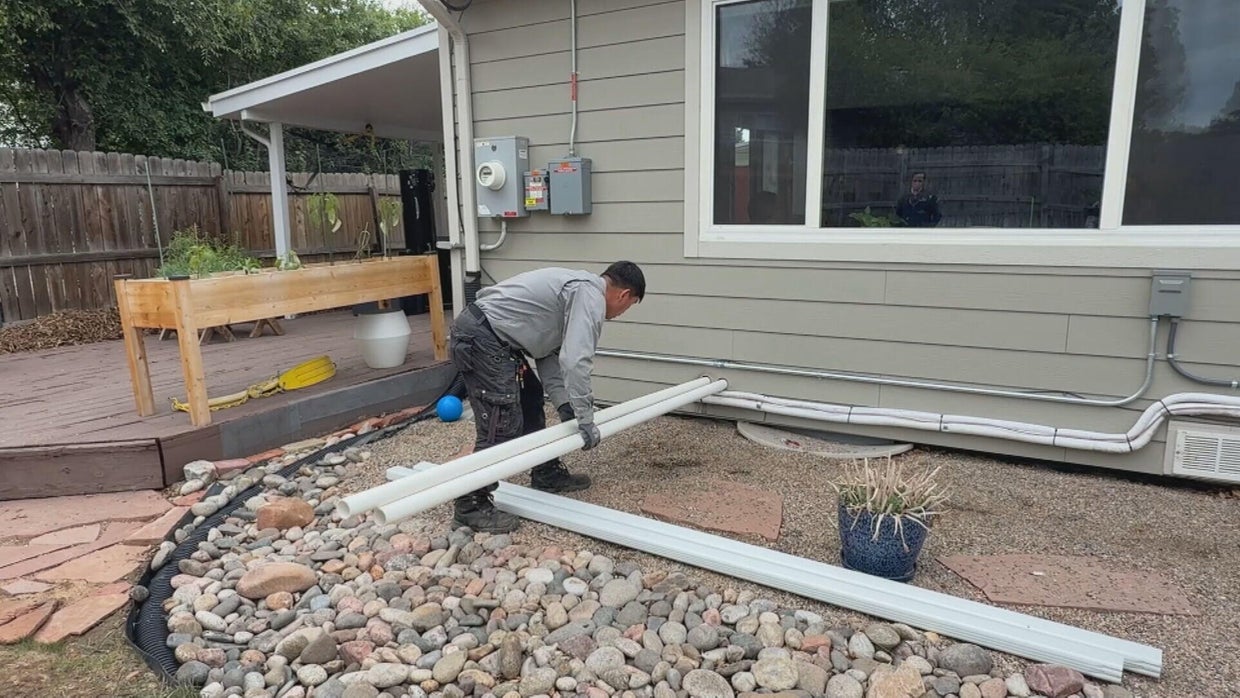
“And seeing that the swamp cooler is gone is fabulous,” Gehringer added.
Colorado
Colorado Supreme Court orders children’s hospital to resume gender-affirming care for minors

DENVER (AP) — The Colorado Supreme Court has ordered Colorado’s largest provider of gender-affirming care for young people to resume medical treatments like puberty blockers and hormone therapy despite threats that providing the care could lead to losing federal funding.
Children’s Hospital Colorado suspended medical treatments for transgender patients under 18 in January after it said the U.S. Department of Health and Human Services opened an investigation into its treatments following a series of clashes between President Donald Trump’s administration and advocates over transgender health care for children.
WATCH: Trump administration seeks to cut off access to transgender health care for U.S. children
The hospital said in a statement that it is reviewing Monday’s court ruling and considering its next steps. It previously said it would continue to provide mental health treatment for minors and also medical treatment for patients aged 18 to 21.
Four transgender girls, ranging from age 10 to 17, sued the hospital, through their parents, alleging that the hospital was violating the state’s antidiscrimination law by refusing to provide them treatment both because of their gender identity and their disability, gender dysphoria. Gender dysphoria is the distress caused when someone’s gender expression doesn’t match their sex assigned at birth.
The girls said they feared not being able to get medication and monitoring to prevent them from undergoing puberty and developing male traits. And they cited mental health fallout, including depression and suicidal ideation.
The court sided with the girls in a 5-2 ruling, finding that the decision to shutter the services for minors violated a state antidiscrimination law. In the majority opinion, Justice William Wood III said, “We conclude that the actual immediate and irreparable harm to petitioners outweighs the speculative harm CHC may face if the federal government further acts against it.”
In a dissent, Justice Brian Boatright said the hospital didn’t make its decision to stop the case because of the gender identity of the patients. Rather, he wrote, “It was a decision driven by the direct threat to the viability of the entire hospital.”
A Kansas judge also sided with transgender minors in a ruling last week.
The Colorado hospital’s TRUE Center, which focuses on gender-affirming care, is one of the largest programs in the country and the only comprehensive care center in the Rocky Mountain region, according to the lawsuit.
Children’s Hospital Colorado said the HHS opened the investigation of the hospital after Health and Human Services Secretary Robert F. Kennedy Jr. issued a declaration that called treatments like puberty blockers, hormone therapy and surgeries unsafe and ineffective for children and adolescents experiencing gender dysphoria, or the distress when someone’s gender expression doesn’t match their sex assigned at birth.
An Oregon-based federal judge ruled in March for Colorado and 20 other states that Kennedy’s declaration went too far.
Mulvihill reported from Haddonfield, New Jersey.
A free press is a cornerstone of a healthy democracy.
Support trusted journalism and civil dialogue.

2026 Colorado Activities Association Boys 4A State Swimming and Diving Championships
- May 8-9, 2026
- Thornton, CO
- SCY (25 yards)
- Results
A year after winning its first- ever state title, Monarch High School stayed on top at the Colorado Activities Association Boys 4A State Swimming and Diving Championships.
Monarch successfully defended its title, earning 355.5 points to outlast runner-up JK Mullen, which came in with 344 points. Glenwood Springs was third at 340.5.
“It was nerve-wracking,” senior Tobin Howe said to the CHSAA site. “We were about halfway through the meet and going into finals we knew if we kept our seed places, we had enough points to win. Mullen was doing really well and I was a bit nervous. I was thinking it might come down to the last event. It almost did, but we pulled through.”
Howe, a Washington University commit, was the leading point-getter for Monarch, claiming individual titles in the 200 IM (personal best 1:51.67) and the 100 breast (55.32).
The other individual standout was Cheyenne Mountain senior Barrett Kerrigan, an Air Force commit. Kerrigan won the 200 free in a personal best time of 1:40.46 and repeated as champion in the 500 free with a time of 4:36.79.
Glenwood Springs won two of the three relays, first claiming the 200 medley in a time of 1:31.78 behind the team of Breck Boyd (22.47), Brian Molloy (25.74), Andrew Molloy (22.79) and Tyson Boyd (20.78).
In the 200 free relay, the Glenwood Springs team of B. Boyd (20.64), Molloy (20.94), Tennyson Sipes (21.96) and T. Boyd (20.64) won in a time of 1:24.18.
The 400 free relay was captured by JK Mullen in 3:07.12 behind the team of Oscar Valdez (47.25), Asher Howe (46.58), Sam Lombardo (48.93) and Thomas Bradac (44.36).
Other individual winners were:
- Bradac, a TCU commit and senior at JK Mullen, won the 50 free in 20.21.
- Evergreen senior Henry Palmquist won the 1-meter diving event with 621.15 points.
- Monarch junior Isaac Skillern captured the 100 fly in a time of 50.11.
- Mountain View senior JJ Phillips, a George Washington commit, won the 100 free in a personal best time of 44.42.
- Breck Boyd, a UC-Santa Barbara commit, won the 100 back in a time of 49.92 after taking 2nd in the event last year.
Team Standings — Top 5
- Monarch, 355.5
- JK Mullen 344
- Glenwood Springs, 340.5
- Littleton, 221.5
- Mountain View, 216
-
 Politics41 seconds ago
Column: Obama’s strong terms curbed Iran. Trump struggles to secure even a weak deal
-
 Science7 minutes ago
Feds declare Eaton fire was a cleanup success. Their testing shows otherwise
-
 Sports13 minutes ago
High school baseball: City Section playoff scores and updated schedule
-

 World25 minutes ago
Merz’s plan of ‘associate membership’ for Ukraine gets mixed reviews
-
 News55 minutes ago
The Girls: “If it was your daughter” : Embedded
-

 Los Angeles, Ca3 hours ago
2 red-tailed hawk nestlings rescued after 63-foot fall in Santa Clarita
-

 Detroit, MI3 hours ago
Former Detroit Mayor Mike Duggan drops out of Michigan governor race
-

 San Francisco, CA3 hours ago
San Francisco Sheriff discusses security at houses of worship, pickpocket arrests

