World
‘Fields were solitary’: Migration raids send chill across rural California


Los Angeles, California — Recent raids carried out by the United States Customs and Border Protection (CBP) in a rural California county have struck fear into immigrant communities as President-elect Donald Trump prepares to return to the White House.
CBP says that the operation in Kern County, which took place over three days in early January, resulted in the detention of 78 people. The United Farm Workers (UFW) union says it believes the number is closer to 200.
“The fields were almost solitary the day after the raids,” a 38-year-old undocumented farmworker named Alejanda, who declined to give her last name, said of the aftermath.
She explained that many workers stayed home out of fear. “This time of year, the orchards are usually full of people, but it felt like I was by myself when I returned to work.”
The raids are being seen by local labourers and organisations like UFW as a shot across the bow from immigration enforcement agencies before Trump’s inauguration on Monday.
His second term as president is expected to ring in a new era of enhanced restrictions and deportation efforts.
While the number of people arrested represents a small fraction of the hundreds of thousands of undocumented workers underpinning California’s agricultural sector, the anxieties caused by such raids extend far beyond those detained.
“On Wednesday [the day after the raids], I stayed home from work. I barely left my house,” said Alejanda, adding that she kept her five-year-old son home from daycare rather than risk driving to drop him off.
“Everyone is talking about what happened. Everyone is afraid, including me. I didn’t actually see any of the agents myself, but you still feel the tension.”
Emboldened agencies
Following a presidential campaign where he routinely depicted undocumented migrants as “criminals” and “animals”, Trump will likely try to fulfill his promise to carry out the “largest deportation programme” in the country’s history on his first day in office.
About 11 million people live in the United States without legal documentation, some of whom have worked in the country for decades, building families and communities.
The January arrests in Kern County appear to be the first large-scale Border Patrol raid in California since Trump’s victory in the November election, which set off speculation about the potential impact of mass deportations on immigrant communities and the economic sectors dependent on their labour.
About 50 percent of California’s agricultural workforce is made up of undocumented immigrants.
In California, undocumented status has been cited as a source of persistent anxiety for workers — as well as a means of leverage for employers, who often pay such labourers lower wages and grant them fewer protections in the fields.
But Alejanda says that workplace raids like the ones that took place in Kern County have not been common in the area.
“I have been here for five years and never experienced anything like this before,” she said, noting that workers were detained while leaving the fields to go home.
CBP said in a statement that the operation, named “Return to Sender”, had targeted undocumented people with criminal backgrounds and connections to criminal organisations.
#WeFeedYou pic.twitter.com/8e6GE9RRkK
— United Farm Workers (@UFWupdates) January 11, 2025
The raids were carried out by agents from the CBP El Centro Sector, located near the border between Mexico and southern California, more than five hours by car from the site of the raids.
“The El Centro Sector takes all border threats seriously,” Chief Patrol Agent Gregory Bovino said in a press release. “Our area of responsibility stretches from the US/Mexico Border, north, as mission and threat dictate, all the way to the Oregon line.”
Antonio De Loera-Brust, a spokesperson for UFW, said that the operation shows that agencies like CBP are likely to become more aggressive as Trump takes office.
He also disputed CBP’s characterisation of the raids as focused on people with criminal records, saying that the operation cast a wide net and profiled people who looked like farmworkers.
Two of those arrested were UFW members, whom the organisation described as fathers who had lived in the area for more than 15 years.
“By operating over 300 miles north of the Mexican border, and apparently conducting this untargeted sweep based on profiling on their own initiative and authority, Border Patrol has shown itself to be clearly emboldened by a national political climate of hostility towards hard-working immigrant communities,” De Loera-Brust told Al Jazeera.
“It’s certainly deeply concerning that this sort of operation could be the new normal under the incoming Trump administration.”



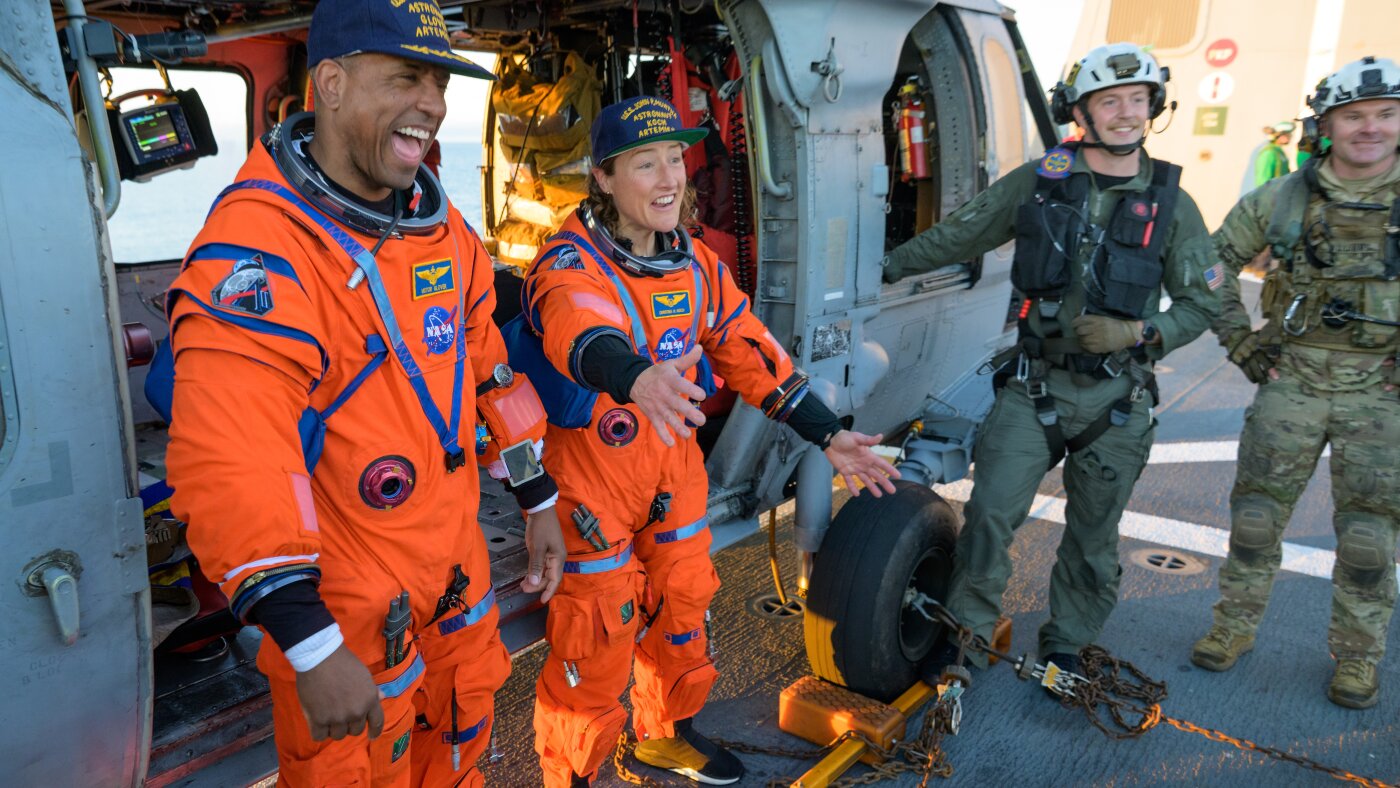
HOUSTON (AP) — Still marveling over their moon mission, the Artemis II astronauts received a thunderous welcome home Saturday from hundreds who took part in NASA’s lunar comeback that set a record for deep space travel.
The crew of four arrived at Ellington Field near NASA’s Johnson Space Center and Mission Control, flying in from San Diego, where they splashed down just offshore the evening before.
After a quick reunion with their spouses and children, commander Reid Wiseman, pilot Victor Glover, Christina Koch and Canada’s Jeremy Hansen took the hangar stage, surrounded by space center workers and other invited guests. They were introduced by NASA Administrator Jared Isaacman, among the first to greet them aboard the recovery ship Friday.
“Ladies and gentlemen, your Artemis II crew,” Isaacman said to a standing ovation.
The jubilant crowd included flight directors and the launch director, Orion capsule and exploration system managers, high-ranking military officers, members of Congress, the space agency’s entire blue-suited astronaut corps and even retired ones, and more.
Their homecoming was poignant: They returned to NASA’s Houston base on the 56th anniversary of the launch of Apollo 13, whose “Houston, we’ve had a problem” refrain turned a near-disaster into triumph.
“This was not easy.” an emotional Wiseman said. “Before you launch, it feels like it’s the greatest dream on Earth. And when you’re out there, you just want to get back to your families and your friends. It’s a special thing to be a human, and it’s a special thing to be on planet Earth.”
Added Glover: “I have not processed what we just did and I’m afraid to start even trying.”
Hansen said the four of them embodied love “and extracting joy out of that” as the four joined together to stand in a row, embracing one another. “When you look up here, you’re not looking at us. We are a mirror reflecting you. And if you like what you see, then just look a little deeper. This is you.”
During Artemis II’s nearly 10-day mission, the astronauts voyaged deeper into space than the moon explorers of decades past and captured views of the lunar far side never witnessed before by human eyes. A total solar eclipse added to the cosmic wonder.
On their record-breaking flyby, the astronauts reached a maximum 252,756 miles (406,771 kilometers) from Earth before hanging a U-turn behind the moon, eclipsing Apollo’s 13 distance record.
The mission also revealed a new side of our planet with an Earthset photo, showing our Blue Marble setting behind the gray, pockmarked moon. The image echoed the famous Earthrise shot from 1968 taken by the world’s first lunar visitors, Apollo 8.
“Honestly, what struck me wasn’t necessarily just Earth, it was all the blackness around it. Earth was just this lifeboat hanging undisturbedly in the universe,” Koch said. “Planet Earth you are a crew.”
Despite the accomplishments, Artemis II astronauts had to contend with a more mundane problem — a malfunctioning space toilet. NASA promised a design fix before longer moon-landing missions.
Wiseman, Glover, Koch and Hansen were the first humans to fly to the moon since Apollo 17 closed out NASA’s first exploration era in 1972. Twenty-four astronauts flew to the moon during Apollo, including 12 moonwalkers.
Apollo 13 commander Jim Lovell — who also flew on Apollo 8 — cheered the Artemis II crew on in a wake-up message recorded before he died last summer.
It was crucial for NASA that Artemis II go well. The space agency is already preparing for next year’s Artemis III, which will see a new crew practice docking its capsule with a lunar lander in orbit around Earth. That will set the stage for the all-important Artemis IV moon landing in 2028, when two astronauts attempt a touchdown near the lunar south pole.
“The long wait is over. After a brief 53-year intermission, the show goes on,” Isaacman said.
___
The Associated Press Health and Science Department receives support from the Howard Hughes Medical Institute’s Department of Science Education and the Robert Wood Johnson Foundation. The AP is solely responsible for all content.
World
Malnourished boy found locked in father’s van for more than a year unable to walk, hadn’t showered since 2024

NEWYou can now listen to Fox News articles!
A malnourished 9-year-old boy was found lying in the fetal position in his father’s utility van in eastern France this week after allegedly being locked in the vehicle two years ago.
The boy, who was unable to walk after sitting for so long, was discovered Monday after a neighbor who heard the “sounds of a child” coming from the van, local prosecutor Nicolas Heitz said Saturday.
Officers in the village of Hagenbach, near the border with Switzerland and Germany, found the boy “lying in a fetal position, naked, covered by a blanket on top of a mound of trash and near excrement” after forcing the van open, Heitz said.
The boy told authorities he hadn’t showered since 2024.
WISCONSIN COUPLE ALLEGEDLY STARVED SIX CHILDREN FOR YEARS, FORCING THEM TO EAT MOLD, BUGS AND DOG FOOD
A 9-year-old boy was rescued after living locked in his father’s utility van since 2024 in Hagenbach, France, on April 11, 2026. (AP Photo)
The boy’s father has been charged with kidnapping. He claimed to police that he had locked his son in the van in November 2024 to “protect” him from his partner who wanted to send him to a psychiatric facility, according to the prosecutor.
But the prosecutor said there was no medical record of the boy having psychiatric problems and he had gotten good grades in school.
When the boy disappeared, his teachers were told he had transferred to another school.
The man’s partner, who denied knowing the boy was locked in the van, has also been charged, including for failure to help a minor in danger.
MICHIGAN WOMAN ARRESTED FOR ALLEGEDLY STARVING, TORTURING DISABLED SISTER-IN-LAW SHE LOCKED IN BASEMENT
The boys’ family and friends told police they believed the boy was in a psychiatric hospital.
A car drives past a road sign at the entrance of Hagenbach, France, where a 9-year-old boy was rescued after living locked in his father’s utility van since 2024, on April 11, 2026. (AP)
The boy’s 12-year-old sister and the 10-year-old daughter of the man’s partner are under the care of social services.
The boy has been taken to the hospital.
CLICK HERE TO DOWNLOAD THE FOX NEWS APP
A 9-year-old boy was rescued after living locked in his father’s utility van since 2024 in Hagenbach, France, on April 11, 2026. (AP)
He told authorities he thought his father had no choice but to lock him in the van and that he’d had “big difficulties” with his father’s partner.
The Associated Press contributed to this report.

Pope Leo XIV on Saturday called on world leaders to reject war as a means of settling their differences, urging a global commitment to peace.
Published On 11 Apr 2026
Artemis II splashdown captures nationwide attention

Boos rain down on Red Wings after missing playoffs for 10th straight season

Aztec Dancers Brave Rain at San Francisco’s Rebranded Farmworkers Day Celebration – San Francisco Today

Heika’s Take: Stars wrap up regular season home slate with stingy shutout win over Rangers | Dallas Stars

Fleet’s sold-out homecoming at TD Garden a resounding victory for women’s sports in Boston

Florida High School Football Rankings: Top 25 teams – Oct. 21

How old is Bo Nix? What to know about Oregon quarterback ahead of 2024 NFL Draft

Cleary's 21 help Le Moyne down Central Connecticut State 69-64 in OT

99th annual Pony Swim held in Virginia

Indiana Members Credit Union announced as new anchor tenant at Bottleworks District
Artemis II splashdown captures nationwide attention

Video: Police Fatally Shoot Man After Stabbings at Grand Central Subway Station

Trump blasts Spanberger ahead of Virginia meetings, says state faces tax base exodus like New York, California

Pope Leo urges world leaders to reject war and negotiate peace

Manhattan DA’s office to investigate Swalwell sexual assault allegation
-

 Atlanta, GA1 week ago
1 teenage girl killed, another injured in shooting at Piedmont Park, police say
-

 Movie Reviews1 week ago
Vaazha 2 first half review: Hashir anchors a lively, chaos-filled teen tale
-

 Georgia5 days ago
Georgia House Special Runoff Election 2026 Live Results
-

 Pennsylvania5 days ago
Parents charged after toddler injured by wolf at Pennsylvania zoo
-

 Arkansas2 days ago
Arkansas TV meteorologist Melinda Mayo retires after nearly four decades on air
-
 Milwaukee, WI6 days ago
Potawatomi Casino Hotel evacuated after fire breaks out in rooftop HVAC system
-

 Indianapolis, IN1 week ago
Fighting Illini begin Final Four preparations in Indianapolis
-

 Technology1 week ago
Anthropic essentially bans OpenClaw from Claude by making subscribers pay extra