World
80 Years After Dachau Concentration Camp Liberation, Witnesses Remember


Lockered Gahs, known unofficially as Bud, was a 20-year-old soldier in the U.S. Army who had been fighting for a year when he and his unit first entered the Dachau concentration camp just outside Munich in 1945.
His unit — the 42nd Infantry Division — had seen harrowing combat since it began fighting in France. But, he said, liberating the concentration camp was altogether different.
“When we opened the gates to Dachau, it was only then have we truly understood what we had been fighting for,” Mr. Gahs, 100 years old, told a crowd that included survivors, families and dignitaries in Dachau on Sunday.
When he and his unit went through the gates, Mr. Gahs encountered prisoners so malnourished, sick and maltreated that they seemed scarcely alive. On the way there, soldiers had found piles of bodies inside train wagons.
On Sunday, Jean Lafaurie, 101, who survived the camp after he was arrested in his village in France, spoke of the sadistic treatment the prisoners had been forced to endure.
Other survivors’ minds were on the present. Mario Candotto, 98, of Italy, who survived the camp but lost four of his brothers and both parents, said: “I hear talk about weapons and nationalism, and the thought occurs to me: Have people learned nothing?”
The 80th anniversary of the end of the Nazi era — and with it anniversaries of the liberations of concentration camps — comes at a pivotal time for Germans.
The last of the survivors, liberators and perpetrators are dying of old age, and with them any living memories of the Holocaust. At the same time, the far right is becoming established. While the Alternative for Germany, or AfD, whose leaders have repeatedly downplayed the Holocaust, was once a fringe party, it is currently the most popular party in Germany, according to some polls.
“We are truly living in a period of upheaval; I feel this at the memorial sites, and at Dachau in particular,” Gabriele Hammermann, the director of the Dachau Concentration Camp Memorial Site, told The New York Times. “It acts as a seismograph.”
The anniversary also comes after a pronounced change in the tone of the relationship between Germany and the United States. While Washington was once instrumental in promoting a culture of accountability and remembrance, President Trump’s administration has made its preference for the AfD very clear.
In January, Vice President JD Vance shocked German leaders when he told a crowd in Munich that they should stop shunning the AfD. Last week, after the AfD was officially labeled an extremist party by Germany’s domestic intelligence unit, Secretary of State Marco Rubio, in a social media post, called the decision by Germany’s intelligence unit “tyranny in disguise,” adding that Germany’s border policies were instead the country’s “extremist” problem.
Antisemitic hate crimes have also increased in Germany. In a country that has long espoused the motto “never again,” many worry that liberal democracy is under threat. In a poll carried out last year, 69 percent of respondents said they thought populism was a threat to democracy.
Even the people who run the concentration camp memorial sites have noted a disquieting uptick in thefts and petty crimes committed on their grounds. In 2019, Nikolai Nerling, a far-right video blogger and provocateur, was convicted of incitement for videos in which he interviewed Dachau visitors and relativized the crimes of the Nazis. Last year thieves stole exhibit items from the camp’s gas chamber.
Established just weeks after Hitler came to power in 1933, the Dachau camp initially held political opponents. It was a model for future camps and was made a formal training site for paramilitary S.S. troops before they were sent to run the new camps that Germany built across Eastern Europe when the war started. More than 40,000 people died in Dachau, which, over the 12 years it was active, held more than 200,000 prisoners.
Built less than 10 miles outside Munich, it also distinguished itself from camps constructed later during the regime, which were located far outside the Reich’s borders. The injustice and atrocities committed within the Dachau camp could not be easily ignored by the general population.
U.S. soldiers of the 42nd and 45th Infantry Divisions who liberated the camp were among the first Americans to witness and document the horrors of the Nazi regime. The scenes they encountered entering the camp 80 years ago changed many men for life. On Sunday it was mostly the families of the liberators who attended the ceremony.
Of the survivors who came to Dachau on Sunday, most were in their 90s and 100s, indicating that this could be the last major anniversary involving people with firsthand memories of the camps. Among the youngest was Leslie Rosenthal, who had traveled from Canada. Born just three months before the liberation, Mr. Rosenthal recently celebrated his 80th birthday.
“With the passage of time, survivors and eyewitnesses are quickly dwindling,” he said, noting that he and the seven babies who were born in Dachau in the final months before liberation would soon become the “last living links to the Holocaust.”




Strikes on gas sites in the Iran war are driving up energy costs, pushing up prices for power, food and more worldwide.
Strikes on gas sites are now part of the US-Israel war with Iran. But its effect will echo far beyond the Gulf, hitting power, food, and prices worldwide. As gas supply shrinks and costs rise, who will feel it most, and how far could the shock spread?
In this episode:
- Justin Dargin (@justindargin), Energy Expert, Middle East Council on Global Affairs
Episode credits:
This episode was produced by Marcos Bartolomé, Tamara Khandaker, Sarí el-Khalili, Chloe K. Li, Tuleen Barakat, Catherine Nouhan and our guest host, Kevin Hirten. It was edited by Sarí el-Khalili. Alex Roldan is our sound designer.
The Take production team is Marcos Bartolomé, Sonia Bhagat, Spencer Cline, Sarí el-Khalili, Tamara Khandaker, Chloe K. Li, Alexandra Locke, Catherine Nouhan, Alex Roldan, and Noor Wazwaz. Our host is Malika Bilal.
Our editorial intern is Tuleen Barakat. Our engagement producers are Adam Abou-Gad and Vienna Maglio. Andrew Greiner is lead of audience engagement. Our video editors are Hisham Abu Salah and Mohannad al-Melhem. Alexandra Locke is The Take’s executive producer.
Connect with us:
@AJEPodcasts on X, Instagram, Facebook, and YouTube
Published On 23 Mar 2026
World
2 people killed in collision between jet and vehicle at New York’s LaGuardia Airport, source says

NEW YORK (AP) — An Air Canada regional jet struck a fire truck on the runway after landing at New York’s LaGuardia Airport late Sunday night, crushing the nose of the plane, according to authorities and photos of the wreckage.
Two people were killed, according to a person familiar with the investigation into the crash. The person spoke to The Associated Press on condition of anonymity because they were not authorized to discuss an active investigation.
Two Port Authority employees who were traveling in the fire truck also were injured, the person said.
There were 72 passengers and four crew members aboard the aircraft, a Jazz Aviation flight operating on behalf of Air Canada, according to a statement from the airline. The flight originated at Montréal-Pierre Elliott Trudeau International Airport, the major airport serving Montreal.
The Port Authority of New York and New Jersey said in a statement that the jet had struck a rescue and firefighting vehicle that was responding to a separate incident at about 11:45 p.m. The airport was closed as of 3 a.m. to facilitate the investigation, officials said.
Photos and videos from the scene showed severe damage to the front of the aircraft, with cables and debris hanging from a mangled cockpit. Nearby, a damaged emergency vehicle lay on its side.
Stairways used to evacuate passengers from aircraft were pushed up to the emergency exits on the jet, a Bombardier CRJ. The impact left the jet with its crumpled nose tilted upward.
In the moments before the crash, an air traffic controller could be heard on a radio transmission giving clearance to a vehicle to cross part of the tarmac, then trying to stop it.
“Stop, Truck 1. Stop,” the transmission says. The controller can then be heard frantically diverting incoming aircraft from landing.
Jazz Aviation issued a statement confirming the accident and noting the passenger and crew list was preliminary and subject to confirmation.
The National Transportation Safety Board said it was investigating the incident.

NEWYou can now listen to Fox News articles!
President Donald Trump spoke with British Prime Minister Keir Starmer on Sunday to discuss escalating tensions in the Middle East, with a focus on the urgent need to reopen the Strait of Hormuz and restore global shipping.
The leaders discussed the current situation in the Middle East, and in particular, the need to reopen the Strait of Hormuz to resume global shipping, Downing Street said in a statement.
STEALTH BOMBERS LANDING AT UK BASES ‘IN DAYS’ AFTER TRUMP PRESSURES STARMER: REPORT
Keir Stamer, UK prime minister, during a news conference providing an update on the situation in the Middle East, at Downing Street in London, UK, on Thursday, March 5, 2026. (Tolga Akmen/EPA/Bloomberg via Getty Images)
“They agreed that reopening the Strait of Hormuz was essential to ensure stability in the global energy market. They agreed to speak again soon.”
The call came amid a rapidly intensifying conflict in the region, with Iran blocking the strategically vital strait since the United States and Israel launched coordinated strikes against Iranian targets on Feb. 28.
The military action triggered swift retaliation from Tehran and has since escalated into a broader regional war as Iran has sent missiles into numerous neighboring countries not directly involved in the initial conflict.
UK NUCLEAR SUBMARINE DEPLOYED TO ARABIAN SEA BEFORE IRAN TARGETS KEY US-UK BASE: REPORTS
President Donald Trump takes questions from reporters during a meeting with Irish Prime Minister Micheál Martin in the Oval Office of the White House, on St. Patrick’s Day, Tuesday, March 17, 2026, in Washington. (AP Photo/Alex Brandon)
On March 21, Trump issued a 48-hour ultimatum to Iran demanding the reopening of the key maritime route, through which approximately 20% of the world’s oil supply passes.
In a post on Truth Social, Trump warned that failure to comply would result in further U.S. action, including potential strikes on Iran’s energy infrastructure.
EU PUSHES FOR END OF IRAN WAR IN A MANNER WHERE ‘EVERYBODY SAVES FACE’
Bulk Carrier, Belray, in the Gulf, near the Strait of Hormuz on March 22, 2026 in northern Ras al Khaimah, United Arab Emirates. (Getty Images/Getty Images)
Sunday’s conversation between Trump and Starmer perhaps reflected a thaw in the tense relationship between the two leaders.
Trump had publicly criticized the U.K. government, stating that Britain “should have acted a lot faster” in allowing the U.S. to use British military bases for strikes targeting Iranian missile sites.
Starmer had also maintained that the use of U.K. bases could only be justified under the principle of “collective self-defense” in the region.
He had initially declined to support the U.S.-Israeli military operation, drawing repeated criticism from the White House.
CLICK HERE TO DOWNLOAD THE FOX NEWS APP
Meanwhile, Trump appeared to apply public pressure, sharing a “Saturday Night Live” clip Sunday mocking the British prime minister’s handling of the crisis.

L.A. Times Concierge: ‘It’s hard to make friends as an adult in L.A. What are some groups I can join?’
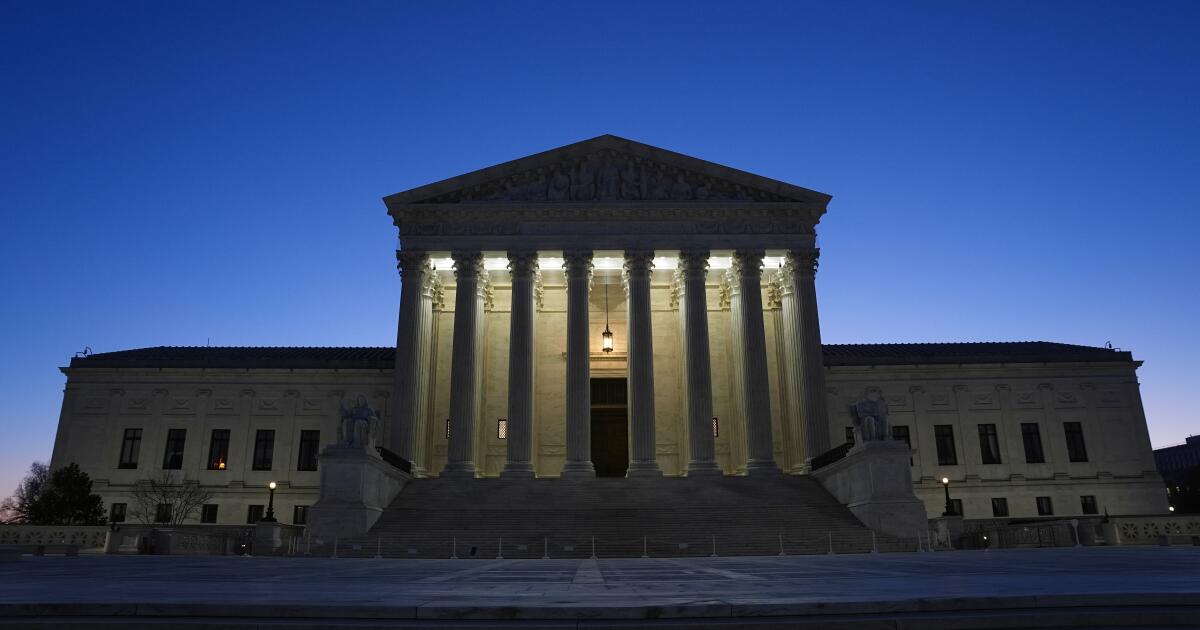
Californians may need to mail ballots early as Supreme Court signals support for new election day deadline

Ohtani. Yamamoto. Sasaki. A 12-story ‘cultural bridge’ between L.A. and Japan to debut in Torrance

How the Iran war is about to hit your wallet

Suspect in slaying of Loyola University student was in the country illegally, officials say

Florida High School Football Rankings: Top 25 teams – Oct. 21

How old is Bo Nix? What to know about Oregon quarterback ahead of 2024 NFL Draft

Cleary's 21 help Le Moyne down Central Connecticut State 69-64 in OT

99th annual Pony Swim held in Virginia

Indiana Members Credit Union announced as new anchor tenant at Bottleworks District
How the Iran war is about to hit your wallet
Suspect in slaying of Loyola University student was in the country illegally, officials say

Video: Plane Collides With Vehicle at LaGuardia Airport

As cattle herds shrink and beef prices rise, investors back AI cow collars

French elections: Paris stays left as far right makes mixed gains
-

 Detroit, MI5 days ago
Drummer Brian Pastoria, longtime Detroit music advocate, dies at 68
-

 Oklahoma1 week ago
Family rallies around Oklahoma father after head-on crash
-

 Georgia1 week ago
How ICE plans for a detention warehouse pushed a Georgia town to fight back | CNN Politics
-
 Science1 week ago
Federal EPA moves to roll back recent limits on ethylene oxide, a carcinogen
-

 Alaska1 week ago
Police looking for man considered ‘armed and dangerous’
-

 Movie Reviews4 days ago
‘Youth’ Twitter review: Ken Karunaas impresses audiences; Suraj Venjaramoodu adds charm; music wins praise | – The Times of India
-
 Science1 week ago
Long COVID leaves thousands of L.A. county residents sick, broke and ignored
-

 Education1 week ago
Video: Turning Point USA Clubs Expand to High Schools Across America