Wyoming
230 Million-Year-Old Fossil From Wyoming Challenges Dinosaur Origin Theories


Though paleontologists have been discussing the origin and spread of dinosaurs for decades, the widely accepted theory was that they emerged in the southern part of the ancient continent of Pangea over 200 million years ago, and only spread northward millions of years later. A new study dramatically changes the conversation.
University of Wisconsin–Madison (UW–Madison) paleontologists announced the discovery of a new dinosaur that challenges the conventional theory about the dinosaurs’ origin and spread. The location and age of the newly-described fossils suggest that dinosaurs prowled the northern regions of Pangea millions of years earlier than previously hypothesized. The findings were detailed in a January 8 study published in the Zoological Journal of the Linnean Society.
“We’re kind of filling in some of this story, and we’re showing that the ideas that we’ve held for so long — ideas that were supported by the fragmented evidence that we had — weren’t quite right,” Dave Lovelace of the University of Wisconsin Geology Museum, who co-led the study, said in a UW–Madison statement. “We now have this piece of evidence that shows dinosaurs were here in the northern hemisphere much earlier than we thought.”
The paleontologists uncovered the theory-defying fossils in present-day Wyoming in 2013. Due to Earth’s shifting tectonic plates, this region was located near the equator over 200 million years ago on Laurasia, the northern half of Pangea (the southern half was called Gondwana). While the remains were fragmented, the paleontologists were able to attribute the fossils to a new dinosaur species they named Ahvaytum bahndooiveche, which was likely an early sauropod relative. Ahvaytum, however, looked very different from the iconic long-necked herbivores.
“It was basically the size of a chicken but with a really long tail,” said Lovelace. “We think of dinosaurs as these giant behemoths, but they didn’t start out that way.” The adult specimen was just over a foot tall (30.5 centimeters) and about three feet long (91.4 cm).
Perhaps most shockingly, however, is the age of the fossil. Lovelace and his colleagues used radioisotopic dating (a method for determining the age of materials by measuring radioactive decay) to determine that the rock layers where they’d found the Ahvaytum fossils—and thus roughly the remains themselves—were about 230 million years old. This makes Ahvaytum the oldest known Laurasian dinosaur, and about equivalent in age to the earliest known Gondwanan dinosaurs, according to the study. Dinosaurs first emerged during the Triassic period, around 230 million years ago. This era, which lasted from about 252 to 201 million years ago, saw the rise of the earliest dinos, before they became dominant in the Jurassic period.
“We have, with these fossils, the oldest equatorial dinosaur in the world — it’s also North America’s oldest dinosaur,” Lovelace added. The fact that the oldest known Laurasian dinosaur is about as old as the earliest known Gondwanan dinosaurs consequently challenges the theory that dinosaurs originated in the south of the ancient continent and only spread north millions of years later.
The site of the discovery is within the ancestral lands of the Eastern Shoshone Tribe. As a result, the researchers partnered with tribal members throughout their work, and included Eastern Shoshone elders and middle school students in choosing the new dinosaur’s name. Ahvaytum bahndooiveche roughly translates to “long ago dinosaur” in the Eastern Shoshone language.
The region also yielded additional finds. The team identified an early dinosaur-like footprint in older rock layers, meaning that dinosaurs or dinosaur-related creatures were calling Laurasia home even before Ahvaytum. The paleontologists also uncovered the fossil of a newly described amphibian, which was also named in the Eastern Shoshone language.
In challenging long-standing theories about how dinosaurs spread across Pangea, the discovery of the chicken-sized Ahvaytum ultimately paints a clearer picture of the creatures that walked the Earth—and where—millions of years before us.



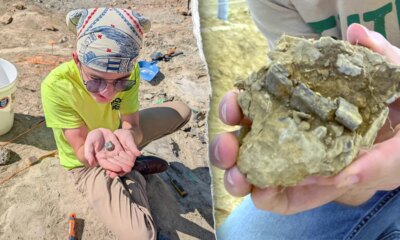


A 6-inch megalodon shark tooth was found by a Wyoming teen during a dive trip off Manasota Key, Florida earlier this week.
Sixteen-year-old Aiden Andrews and his father Brian were on a guided dive with Fossil Junkies, a local fossil-hunting tour company.
Captain John Kreatsoulas told FOX 13 Tampa Bay reporter Kimberly Kuizon that while finding small megalodon teeth isn’t uncommon, finding one that size is quite rare.
Video captured the moments when Aiden and his father celebrated underwater after making the remarkable discovery.
Popularized by Hollywood monster movies, the Carcharocles megalodon was the largest shark to have ever lived, according to the Smithsonian Institution.

Scientists believe the largest megalodon reached up to 60 feet in length and weighed up to 50 tons.
And as Andrews can attest — they possessed teeth the size of a human hand.
According to the Smithsonian, megalodon lived between 23 and 3.6 million years ago across all of Earth’s oceans.
Wyoming
Outdoor Fun Awaits At Local Parks With Izaak Walton League’s Hiking Series From April To September

Hiking can be an activity that you enjoy doing on your own, but sometimes you need a little extra inspiration, and a group hike is exactly what you need. If you’re looking for a group to explore the outdoors with, the Charles E. Piersall chapter of the Izaak Walton League of America hiking group may be what you’re looking for.
The mission of the IWLA:
To engage the community in the conservation, restoration, and promotion of environmental protection, we focus on the sustainable use and enjoyment of our natural resources, including soil, air, woods, waters, and wildlife. This commitment is essential for a sustainable future, and activities like hiking help foster a connection with nature
The group is open to all ages, and even your pup can join in on the fun if they’re on a leash. There is a series of hikes planned beginning on April 1. Nope, this isn’t a prank; it is a real chance to meet other outdoor lovers and take in some of the area’s best hiking trails. The hikes are scheduled on the odd Wednesdays from April to September, weather permitting.
Join us to connect with others who appreciate the beauty of outdoor hiking and environmental advocacy hiking. Remember to bring drinking water, snacks, good walking shoes or boots, and a jacket. A walking stick or hiking poles can also be helpful.
Here are the hikes they have planned for this summer.
April 2026
- Wednesday, April 1, 6 pm, Morad Park to Paradise Valley:
- Wednesday, April 15, 6 pm, Edness K. Wilkins State Park:
- Wednesday, April 29, 6 pm, Tate Pumphouse, Golf Course loop:
May 2026
June 2026
July 2026
- Wednesday, July 1, 6 pm, Muddy Mountain, North Face:
- Wednesday, July 15, 6 pm, Muddy Mountain, Beaver Ponds:
- Wednesday, July 29, 6 pm, Casper Mountain, Biathlon:
August 2026
September 2026
16 Types Of Hikes Explained
7 Trails To Hike In Central Wyoming
There’s no doubt about it, the entire state of Wyoming is covered in amazing hiking trails. If you’re visiting central Wyoming here are 7 trails that you should check out. I’ve organized them from easier to harder, ending with Laramie Peak.

The Platte County Attorney’s Office has nearly doubled the possible penalties for a Wyoming reporter accused of forging exhibits in an environmental case tied to her staunch opposition to a wind farm.
The 10 new counts against April Marie Morganroth, also known as the Wyoming-based reporter Marie Hamilton, allege that she convinced her landlords that she’d been approved for a home loan to buy their property, and grants to upgrade it.
Hamilton was already facing 10 felony charges in a March 9 Wheatland Circuit Court case, as she’s accused of submitting forged documents and lying under oath before the Wyoming Industrial Siting Council.
That’s an environmental permitting panel that granted a permit to a NextEra Resources wind farm, which Hamilton has long opposed. She’s also reported on NextEra’s efforts and the community controversies surrounding those.
Then on Wednesday, Platte County Attorney Douglas Weaver filed 10 more felony charges: five alleging possession of forged writing, and five more alleging forgery.
The former is punishable by up to five years in prison and $5,000 in fines; the latter by up to 10 years in prison and up to $10,000 in fines.
Hamilton faces up to 65 years in prison if convicted of all charges in her March 9 case. The March 25 case would add up to 75 years more to that.
Both cases are ongoing.
Hamilton did not immediately respond to a voicemail request for comment left Thursday afternoon on her cellphone. She bonded out of jail earlier this month. The Platte County Detention Center said Thursday it does “not have her here.”
The Investigative Efforts Of Benjamin Peech
Converse County Sheriff’s Lt. Benjamin Peech investigated both cases at the request of Platte County authorities, court documents say.
When he was investigating evidence that Hamilton submitted forged documents and lied under oath for Industrial Siting Council proceedings, Peech also pursued Hamilton’s claim that she owned property on JJ Road, and that she’d bought it with a U.S. Department of Agriculture loan.
The property, however, is registered under Platte County’s mapping system to a couple surnamed Gillis, says a new affidavit Peech signed March 19, which was filed Wednesday.
Peech spoke with both husband and wife, and they said they had the home on the market to sell it, and Hamilton contacted them in about July of 2025.
Hamilton told the pair that she and her husband wished to buy the property and were pre-qualified for a USDA loan through Neighbor’s Bank, wrote Peech.
But the property didn’t meet the standard of the loan, Hamilton reportedly continued. Still, she’d been approved for a USDA grant to work on the problems with the property and bring it up to the standards to qualify for the loan, she allegedly told the homeowners.
Papers
Hamilton provided the couple and their realtor with letters from USDA showing her loan pre-approval and grant approvals, the affidavit says.
During the lease period that followed, Hamilton was late “often” with rent and didn’t provide the couple with work logs until pressed, Peech wrote.
In early 2026, the lieutenant continued, the homeowners became concerned and asked Hamilton about her progress improving the property.
Hamilton reportedly sent the homeowners two invoices from contractors, showing she’d paid for work to be done. She said the wind had delayed that work, wrote Peech.
The affidavit says the Gillis couple sent Peech the documents Hamilton had reportedly given them, along with supporting emails showing those had come from one of Hamilton’s email addresses.
The Loan approval documents showed the respective logos for USDA Rural Development and Neighbor’s Bank at the top of each page, the lieutenant wrote, adding that the documents assert that Hamilton and her husband had been approved for the loan.
“There was then a list of items that needed to be completed — 14 items — prior to Final Loan Approval,” related Peech in the affidavit.
A signature at the bottom reportedly read, “Sincerely, USDA Rural Development Neighbors Bank Joshua Harris Homebuying Specialist.”
Grant Document
The documents purporting Hamilton had received a grant also showed the USDA Rural Development logo at the top of each page, with the names of Hamilton and her husband, other boilerplate language and a description of a $35,000 home buyer’s grant.
The project was about 65% complete at the time of review, the document adds, according to Peech’s narrative.
Peech describes more documents: a January notice, an invoice bearing the logo and name of “Cowgirl Demolition and Excavation, LLC,” and another invoice bearing the logo and name of “Pete’s Builders Roofing and Restoration.”
Real Estate Agent
Peech spoke with the Gillises’ real estate agent, Kay Pope, and she said she’d tried to verify the USDA grant and pre-approval by calling Susan Allman, who was listed in the documents as the Casper-based USDA agent. Pope left several messages without response, the affidavit says.
Pope spoke with Hamilton’s real estate agent, and he said he’d spoken to Allman, and he gave Pope a phone number.
Cowboy State Daily has identified Hamilton’s real estate agent and tried to contact him for further clarification.
Pope called that number and left messages without response, wrote Peech.
Peech then called a USDA Rural Development office and spoke with a Janice Blare, deputy state director, he wrote.
Peech sent the three USDA letters to Blare and gave her “all of Hamilton’s names and aliases,” he added.
The lieutenant wrote that Blare later told him the USDA investigated the letters and determined no evidence existed to show the USDA had issued them.
No records existed either, of Hamilton “using all her alias permutations” or her husband within either the USDA loan program or grant program, wrote Peech.
The USDA didn’t have an office at the address listed in two of the letters. The address pertains, rather, to a dirt lot. The USDA Rural Development office didn’t have a program titled “Rural Communities Home Buyer Program” as listed on two of the letters.
On Nov. 6, 2025, the date of the first letter purporting Hamilton had been approved for the grant program, all U.S. government offices including USDA were on furlough, noted Peech from his discussion with Blare.
A person named Susan Allman didn’t appear in USDA’s employee records, Blare reportedly added.
The Phone Call
Peech called the cellphone number one of the letters listed for Allman, “and this was disconnected,” he wrote.
The number Hamilton’s real estate agent had given was a voice over internet protocol number that Bandwidth LLC operates but is assigned to Google, added Peech.
Meanwhile, Converse County Investigator Amber Peterson spoke with the construction and roofing companies listed in the documents.
Chad Derenzo of Pete’s Roofing confirmed the logo and name listed on the documents were his company’s own — but said his company hadn’t issued the bid listed in those documents, according to the affidavit.
“Their company had never contracted to do work for Hamilton or at the… JJ Road address,” the document says.
The invoice also bore an address in Torrington, Wyoming, and his company doesn’t have a Torrington office, said Derenzo, reportedly.
Jessica Loge of Cowgirl Demolition and Excavation gave similar statements, saying the documents bore her logo, but her company hadn’t issued the bid or contracted with Hamilton.
Clair McFarland can be reached at clair@cowboystatedaily.com.

Gas prices rose this week in New Mexico. Here’s why

North Dakota medical professionals gather for brain injury education

Math plan would help a generation of Ohio students | Opinion

OU basketball vs South Carolina prediction, our pick for Women’s NCAA Tournament Sweet 16
Oregon Lottery Mega Millions, Pick 4 results for March 27

Florida High School Football Rankings: Top 25 teams – Oct. 21

How old is Bo Nix? What to know about Oregon quarterback ahead of 2024 NFL Draft

Cleary's 21 help Le Moyne down Central Connecticut State 69-64 in OT

99th annual Pony Swim held in Virginia

Indiana Members Credit Union announced as new anchor tenant at Bottleworks District

Dem senators dodge crucial question on illegal alien accused of killing Chicago college student

EU Parliament unblocks key political hurdle in digital euro talks

Man arrested in plot to firebomb Palestinian activist’s home after undercover op

WATCH: Senate hearing goes silent after Angel Father confronts top Dem over daughter’s death

US diplomat Marco Rubio denounces settler violence, tolls in Hormuz strait
-

 Detroit, MI1 week ago
Drummer Brian Pastoria, longtime Detroit music advocate, dies at 68
-

 Movie Reviews1 week ago
‘Youth’ Twitter review: Ken Karunaas impresses audiences; Suraj Venjaramoodu adds charm; music wins praise | – The Times of India
-

 Sports7 days ago
IOC addresses execution of 19-year-old Iranian wrestler Saleh Mohammadi
-

 New Mexico6 days ago
Clovis shooting leaves one dead, four injured
-
 Business1 week ago
Disney’s new CEO says his focus is on storytelling and creativity
-

 Technology6 days ago
YouTube job scam text: How to spot it fast
-

 Tennessee5 days ago
Tennessee Police Investigating Alleged Assault Involving ‘Reacher’ Star Alan Ritchson
-

 Texas1 week ago
How to buy Houston vs. Texas A&M 2026 March Madness tickets