Wyoming
230 Million-Year-Old Fossil From Wyoming Challenges Dinosaur Origin Theories


Though paleontologists have been discussing the origin and spread of dinosaurs for decades, the widely accepted theory was that they emerged in the southern part of the ancient continent of Pangea over 200 million years ago, and only spread northward millions of years later. A new study dramatically changes the conversation.
University of Wisconsin–Madison (UW–Madison) paleontologists announced the discovery of a new dinosaur that challenges the conventional theory about the dinosaurs’ origin and spread. The location and age of the newly-described fossils suggest that dinosaurs prowled the northern regions of Pangea millions of years earlier than previously hypothesized. The findings were detailed in a January 8 study published in the Zoological Journal of the Linnean Society.
“We’re kind of filling in some of this story, and we’re showing that the ideas that we’ve held for so long — ideas that were supported by the fragmented evidence that we had — weren’t quite right,” Dave Lovelace of the University of Wisconsin Geology Museum, who co-led the study, said in a UW–Madison statement. “We now have this piece of evidence that shows dinosaurs were here in the northern hemisphere much earlier than we thought.”
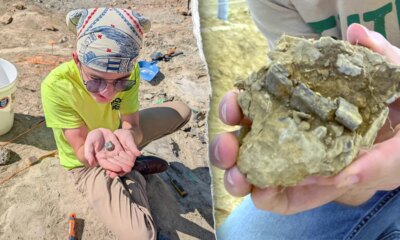
The paleontologists uncovered the theory-defying fossils in present-day Wyoming in 2013. Due to Earth’s shifting tectonic plates, this region was located near the equator over 200 million years ago on Laurasia, the northern half of Pangea (the southern half was called Gondwana). While the remains were fragmented, the paleontologists were able to attribute the fossils to a new dinosaur species they named Ahvaytum bahndooiveche, which was likely an early sauropod relative. Ahvaytum, however, looked very different from the iconic long-necked herbivores.
“It was basically the size of a chicken but with a really long tail,” said Lovelace. “We think of dinosaurs as these giant behemoths, but they didn’t start out that way.” The adult specimen was just over a foot tall (30.5 centimeters) and about three feet long (91.4 cm).
Perhaps most shockingly, however, is the age of the fossil. Lovelace and his colleagues used radioisotopic dating (a method for determining the age of materials by measuring radioactive decay) to determine that the rock layers where they’d found the Ahvaytum fossils—and thus roughly the remains themselves—were about 230 million years old. This makes Ahvaytum the oldest known Laurasian dinosaur, and about equivalent in age to the earliest known Gondwanan dinosaurs, according to the study. Dinosaurs first emerged during the Triassic period, around 230 million years ago. This era, which lasted from about 252 to 201 million years ago, saw the rise of the earliest dinos, before they became dominant in the Jurassic period.
“We have, with these fossils, the oldest equatorial dinosaur in the world — it’s also North America’s oldest dinosaur,” Lovelace added. The fact that the oldest known Laurasian dinosaur is about as old as the earliest known Gondwanan dinosaurs consequently challenges the theory that dinosaurs originated in the south of the ancient continent and only spread north millions of years later.
The site of the discovery is within the ancestral lands of the Eastern Shoshone Tribe. As a result, the researchers partnered with tribal members throughout their work, and included Eastern Shoshone elders and middle school students in choosing the new dinosaur’s name. Ahvaytum bahndooiveche roughly translates to “long ago dinosaur” in the Eastern Shoshone language.
The region also yielded additional finds. The team identified an early dinosaur-like footprint in older rock layers, meaning that dinosaurs or dinosaur-related creatures were calling Laurasia home even before Ahvaytum. The paleontologists also uncovered the fossil of a newly described amphibian, which was also named in the Eastern Shoshone language.
In challenging long-standing theories about how dinosaurs spread across Pangea, the discovery of the chicken-sized Ahvaytum ultimately paints a clearer picture of the creatures that walked the Earth—and where—millions of years before us.





GILLETTE, Wyo. — As the Aug. 18 primary election approaches, County 17 is introducing candidate questionnaires to help voters make informed decisions at the ballot box.
Every candidate in the primary field was sent the same three questions and given a limit of 500 words, which could be distributed among their answers as they saw fit. To ensure a fair and direct line to the community, all responses are published exactly as submitted, without edits or alterations.
Candidates were asked:
- What are the most crucial challenges your constituents are facing?
- If elected, how will you address these challenges?
- What qualities or qualifications do you possess that have prepared you to meet these challenges?
Questionnaires are being published on a rolling basis online through Aug. 11. They will be accessible via the County 17 Election Tracker.
Scott Smith (R), Wyoming state treasurer
What are the most crucial challenges your constituents are facing?
Everywhere I go many Wyoming citizens are concerned that our government is selling out our state lands to the highest bidder for crony capitalism. Some are concerned about Data Centers, Commercial Wind Generators, or nuclear waste storage. The biggest concern is the resources these outfits are taking, secondly, they are concerned about health issues related to living nearby, and lastly they are concerned with cost associated with these projects being passed onto the taxpayer.
If elected, how will you address these challenges?
One of the things that many people don’t know is that the State Treasurer sits on the State Land and Investment Board. (SLIB) The same issues that concern our citizens are the same reasons that I have decided to run for this office. The SLIB has voted to lease state lands to a hydrogen plant in Converse County that would take eight gallons of our valuable water to produce one gallon of hydrogen jet fuel using wind and solar generation to power the plant. These same elected officials have sold off $100 million of our state lands to the federal government. I believe that some things are not for sale. As Treasurer you can count on me to count the cost and listen to the people in the public testimony. If we are going to accept some of these projects the citizens need to have the benefit, like lower utility costs.
What qualities/qualifications do you possess that have prepared you to meet these challenges?
My bachelor’s degree is in Business Administration with an emphasis in management and marketing. I will be a leader in the state treasurer’s office that creates a positive work environment that will allow our investment team to create higher returns on the people’s money that the state invests. I would like to work with the legislature to use these interest earnings to buy down the people’s property taxes to alleviate part of the burden inflation has caused on the average citizen. My day job, I work as a bookkeeper and work with numbers day in and day out and have corrected some inefficiencies to help small businesses become more profitable. I plan to do that within the state office and make those profits available to the legislature to reduce the tax burden for the people. I have also served in the Wyoming House of Representatives for Goshen County and I have served on the Appropriations Committee and I am familiar with the massive state budget.
Related

Scroll down for a list of fireworks restrictions across Wyoming.
I usually don’t buy fireworks for the 4th of July. I go places to watch them. But since this year is the 250th anniversary of our nation, I was going to purchase a small arsenal and have a blast, pardon the pun.
But this has been a very dry year, as happens now and then in the cycles of weather. So I figured I’d wait until things were wet again and just hold my personal celebration a little late.
Many towns across Wyoming have canceled their July 4th fireworks due to the drought. They don’t want you firing off any either.
Based on 2026 reports, several Wyoming towns and counties have canceled or significantly restricted Fourth of July fireworks displays due to high wildfire risks, drought conditions, and Stage 1 fire restrictions.
Canceled/Restricted Public Displays (2026)
- Gillette/Campbell County: The CAM-PLEX fireworks show was postponed, and the county is maintaining a Stage 1 fire restriction due to extreme drought.
- Douglas: The Volunteer Fire Department canceled the 4th of July fireworks show due to fire concerns.
- Newcastle: Fireworks show canceled due to high fire danger, according to a June 27 report.
- Pine Haven: Canceled its Fourth of July fireworks display, according to a June 27 report.
- Riverton: Passed a resolution banning personal fireworks within city limits on July 4, with only a limited, designated area for public displays at the Honeycutt Softball and Saban Baseball Complex.
- Teton County: Fireworks have been historically canceled, and fire officials are urging residents to only attend official, professional displays due to extreme fire danger (confirmed for 2026).
City-Wide Personal Fireworks Bans (2026)
- Cheyenne: Consumer fireworks are prohibited within city limits, despite the county lifting restrictions, with only small novelties allowed.
- Casper: Fireworks are prohibited within city limits and in unincorporated Natrona County.
Key Locations Under Restrictions (2026)
- BLM Land: Fireworks are prohibited on public lands managed by the Bureau of Land Management in Wyoming.
- Weston County: A county-wide ban covers Newcastle and Upton due to high drought conditions.
Even little Chugwater, Wyoming, population 175, has banned fireworks inside its little town limits.
At the State Capital in Cheyenne, however, they will go right ahead with a fireworks display, right over the capital building itself. Dry weather be dammed.
Weird Fireworks Names You’ll Find In Wyoming
Just some of the odd names we found while shopping.
Gallery Credit: Glenn Woods

Media outlets gasped last week at the socialist movement’s success in the New York congressional Democratic primary elections.
That success headed west Tuesday, to Wyoming’s southern neighbor of Colorado.
Democratic socialist Melat Kiros, 29, defeated 15-term incumbent U.S. House Rep. Diana DeGette in Tuesday evening’s primary election.
Colorado Public Radio called the ouster “a stunning blow to the Democratic establishment in Denver and continuing a run of leftist victories in major cities.”
Former Wyoming Gov. Mike Sullivan, a Dvemocrat, told Cowboy State Daily on Tuesday that he wasn’t surprised at the move by Denver voters, but he doubted the proximity of a House socialist – if Kiros wins the general election – will affect Wyoming much.
“We have our own issues, and we’re certainly more sensitive to certain issues than others,” Sullivan said. “And it doesn’t necessarily divide us or make us closer to anybody else.”
Could Deepen ‘Don’t Colorado My Wyoming’ Sentiment
Liz Brimmer, longtime Wyoming politico, agreed in general, but said having a socialist congressional neighbor could galvanize Wyoming even harder into a tendency it already has: spurning anything that looks like Colorado governance.
“I think Wyoming uniformly and strongly feels, you know, ‘Don’t Colorado my Wyoming’,” Brimmer said. “And I think if anything, it deepens that sentiment.”
Brimmer said the ouster speaks of “these times, where there’s no doubt an anti-incumbent strain.” But no one will know all the reasons, nor should presume too much, until the voter data return, she said.
The Republicans saw the anti-incumbent strain surface differently, with newcomers ousting President Donald Trump’s foes in GOP primary elections.
State Rep. Landon Brown, R-Cheyenne, who is finishing off his final legislative term, voiced fascination with the election outcome.
Brown, a self-described political junkie, lives about 14 miles from the Colorado border.
He said the ouster shows Denver is increasingly dictating the rest of Colorado’s fate, and that the state is growing more polarized.
On the Republican gubernatorial primary side, The Associated Press was showing a half-point lead for Victor Marx as of Wednesday.
“He’s just as crazy as a democratic socialist on the left,” said Brown.
As for DeGette’s defeat, it’s not as symptomatic as one would think, he added.
“She was running a ‘Hey, I’m the incumbent and I’ve been here 30 years’ (campaign),” he said.
That hurt her. As did a growing divide on the left over Israel’s approach to its many foes — and Congress’ funding of Israeli war and defense efforts, said Brown.
Israel was also a fulcrum in the May primary loss of libertarian-leaning incumbent Rep. Thomas Massie, of Kentucky. But the Republican voters took the inverse approach on that one, nominating the candidate who supports funding Israeli war efforts.
Jack Speight, the GOP strategist who helped Wyoming Gov. Stan Hathaway to victory in 1966, told Cowboy State Daily Kiros’ win is alarming.
Speight was a Democrat when he graduated from the University of Wyoming law school. But the allure of capitalism and the prevailing logic of his good friends pulled him to the Republican side, he said in another interview last month.
The socialist victories of 2026 are “sad for this country. It may well affect the results of this fall, and nationwide,” he said. He called it a shift of California transplants into the Rockies, and a symptom of a growing entitlement.
Look North
Colorado isn’t the only Wyoming neighbor with socialist momentum.
Sam Forstag, a smoke jumper endorsed by Sen. Bernie Sanders, I-Vermont, and Rep. Alexandria Ocasio Cortez, D-New York, won his primary bid for Montana’s U.S. House District 1 on June 2.
Forstag may be less favored than Kiros going into the general election: No Democrat has won that Montana House district this century.
The New York Times called Forstag’s candidacy a “test for left-leaning politicians” who have been arguing for a populist surge in the blue party.
Clair McFarland can be reached at clair@cowboystatedaily.com.
-
Tennessee1 minute ago
Johnson County marks America’s 250th with Tennessee’s first Charters of Freedom display
-

 Texas6 minutes ago
What to expect on Texas roads this Fourth of July
-

 Utah13 minutes ago
Utah schools still need hundreds of teachers ahead of new school year
-

 Vermont16 minutes ago
Arizona kidnapping suspect indicted while facing separate child sex charges in Vermont
-

 Virginia21 minutes ago
Virginia nonprofit Urban Baby Beginnings to receive $5K grant for Nexstar’s ’30 Days of Giving’
-
 Washington28 minutes ago
Review: Our critic cannot tell a lie: ‘Young Washington’ is the dullest of history lessons
-

 Wisconsin31 minutes ago
Swatting call caused temporary lockdown at Rice Lake, Wisconsin health clinic
-

 West Virginia43 minutes ago
‘We cannot wait’: West Virginia Dems call for special session to address school funding


